
Top 20 Companies in the Global Pet Food Market Driving Industry Growth in 2026
Author:
Intellectual Market Insights Research
Published Date:
13 Jul 2026
Introduction
The global pet food industry has never been more dynamic, more innovative, or more financially significant than it is today. What was once a commoditized market of bulk dry kibble and canned wet food has evolved into a sophisticated, consumer-driven ecosystem encompassing organic nutrition, veterinary-grade therapeutics, fresh refrigerated diets, insect-protein formulas, and AI-personalized feeding plans. At the heart of this transformation is a powerful shift in societal attitudes: across North America, Europe, and increasingly Asia-Pacific, pets are no longer just animals they are beloved family members, and their health and wellness command spending patterns that mirror those of the human nutrition industry.
According to the Intellectual Market Insights Pet Food Market Report (2025–2034), the global pet food market was valued at USD 107.95 billion in 2024 and is expected to reach USD 167.64 billion by 2034, registering a steady compound annual growth rate (CAGR) of 4.5% over the decade-long forecast period. These figures underscore a market that, despite macroeconomic headwinds including inflation, tariff pressures, and raw material volatility, continues to expand on the strength of enduring structural trends.
Several macro forces are converging to fuel this growth. Pet ownership has reached record highs globally, accelerated in part by the COVID-19 pandemic's "pet boom," which saw millions of households adopt cats and dogs as emotional companions during lockdown periods. The American Pet Products Association (APPA) reported that U.S. pet owner expenditures reached $152 billion in 2024, with projections of $157 billion for 2025 numbers that reflect pet care's status as a recession-resilient consumer category.
The humanization of pets arguably the most disruptive cultural force in the market has fundamentally redefined purchasing behavior. Pet owners today scrutinize ingredient labels with the same rigor they apply to their own food, demanding grain-free formulations, clean-label products, organic ingredients, and functional benefits such as probiotic support, joint health, and cognitive enhancement. This has driven a wave of premiumization that has elevated average selling prices and opened high-margin product categories.
Innovation in distribution has been equally transformative. The explosive growth of e-commerce platforms and direct-to-consumer (DTC) subscription models has lowered barriers for emerging brands while empowering established players with richer consumer data, automated replenishment, and broader geographic reach especially in underpenetrated markets across South and Southeast Asia.
From a competitive standpoint, the global pet food market is characterized by moderate-to-high concentration at the top, with leading corporations such as Mars Petcare and Nestlé Purina collectively accounting for approximately 40–55% of global market share, while a long tail of regional players, specialty brands, and disruptive start-ups compete vigorously for the remaining market. The industry is in a constant state of strategic evolution through mergers, acquisitions, R&D investment, and geographic expansion.
This comprehensive article profiles the top 20 companies shaping the global pet food landscape in 2026, provides an in-depth competitive landscape analysis, examines regional dynamics and emerging trends, and offers a forward-looking outlook for the industry through 2034.
Market Overview
|
Parameter |
Details |
|---|---|
|
Market Size (2024) |
USD 107.95 Billion |
|
Market Size (2034) |
USD 167.64 Billion |
|
CAGR (2025–2034) |
4.5% |
|
Base Year |
2024 |
|
Forecast Period |
2025–2034 |
|
By Animal Type |
Dogs, Cats, Fish, Birds, Other Pets |
|
By Product Form |
Dry Food, Wet/Canned Food, Fresh/Refrigerated, Treats & Snacks, Freeze-Dried |
|
By Distribution Channel |
Supermarkets/Hypermarkets, Pet Specialty Stores, Online/E-Commerce, Veterinary Clinics |
|
Leading Segment (Animal Type) |
Dogs |
|
Leading Segment (Form) |
Dry Pet Food |
|
Fastest-Growing Distribution |
Online / E-Commerce |
|
Dominant Region |
North America |
|
Fastest-Growing Region |
Asia-Pacific |
|
Key Market Players |
Mars, Nestlé, Hill's, General Mills, J.M. Smucker, Freshpet |
Key Market Drivers:
- Pet humanization and rising spend on health, wellness, and functional nutrition
- Growing awareness of pet-specific dietary science and veterinary-recommended diets
- Explosive growth of e-commerce and direct-to-consumer subscription models
- Premiumization across grain-free, organic, and clean-label product categories
- Rising pet ownership and disposable incomes in emerging Asia-Pacific and Latin American markets
Key Market Opportunities:
- Expansion of fresh, refrigerated, and minimally processed pet food formats
- Alternative and sustainable proteins (insect, microalgae, cell-cultivated meat)
- AI-driven personalized nutrition and subscription-based feeding platforms
- Untapped growth potential in China, India, Brazil, and Southeast Asia
- Growth of the therapeutic and prescription-diet segment through veterinary channels
Key Market Challenges:
- Raw material price volatility and tariff-driven input cost pressure
- Stringent and evolving regulatory compliance requirements (FDA, EFSA)
- Consolidation risk for smaller regional and specialty manufacturers
- Product safety, recall, and ingredient-transparency scrutiny from consumers
Why the Pet Food Market Is Growing
1. The Humanization of Pets
No single trend has reshaped the pet food industry more profoundly than the humanization of pets. Across developed markets and rapidly urbanizing emerging economies, pet owners increasingly seek the same ingredient transparency, nutritional integrity, and functional health benefits in pet food that they demand for their own diets. This has driven adoption of organic, grain-free, clean-label, and breed- or life-stage-specific formulations categories that command significant price premiums and attract deeply loyal consumer bases.
2. Rising Awareness of Pet Nutrition
Veterinarians, social media influencers, and online health communities have collectively elevated public understanding of pet dietary science. Consumers now seek out formulas targeting specific conditions digestive health, joint support, weight management, allergy mitigation and are willing to invest in premium products that deliver measurable health outcomes. This nutritional consciousness has forced manufacturers to reformulate legacy products and accelerate innovation pipelines.
3. E-Commerce and DTC Expansion
E-commerce penetration in pet food has accelerated dramatically since the COVID-19 pandemic. According to the Pet Food Institute and Packaged Facts, over 30% of U.S. dog owners purchased pet food online in 2024, with subscription models gaining particular traction. Digital-first brands have leveraged this channel to build direct consumer relationships, while legacy brands have invested heavily in omnichannel capabilities. E-commerce also enables penetration of geographically remote or underserved markets.
4. Sustainability and Clean-Label Demand
Environmental consciousness is increasingly shaping purchase decisions, especially among millennial and Gen Z pet owners. Brands that communicate ingredient provenance, use recyclable packaging, and incorporate alternative proteins (insect-based, plant-derived, cellular agriculture) are seeing strong consumer engagement. Mars Petcare's 2025 Global Pet Food Innovation Program which engaged startups in insect proteins (ALT-PRO), microalgae omega-3s (Seaqure Labs), and upcycled potato peels (Terramatter) exemplifies how industry leaders are operationalizing sustainability commitments.
5. Premiumization and Functional Food Trends
The super-premium and functional pet food segments continue to outperform broader market growth. Consumers are investing in products with added vitamins, prebiotics, antioxidants, and condition-specific formulations. Hill's Pet Nutrition's 2025 launch of ActivBiome+ prebiotics across its Science Diet line and prescription diet expansions for brain care and multi-organ support illustrate how functional positioning drives both volume and margin.
6. Emerging Market Expansion
China, India, Brazil, and Southeast Asian markets represent enormous greenfield opportunities. Rising middle classes, increasing urbanization, and shifting lifestyles are creating first-generation pet-owning households that are rapidly transitioning from homemade to commercial pet food. Global brands are aggressively investing in local manufacturing, distribution partnerships, and culturally adapted product development to capture this wave.
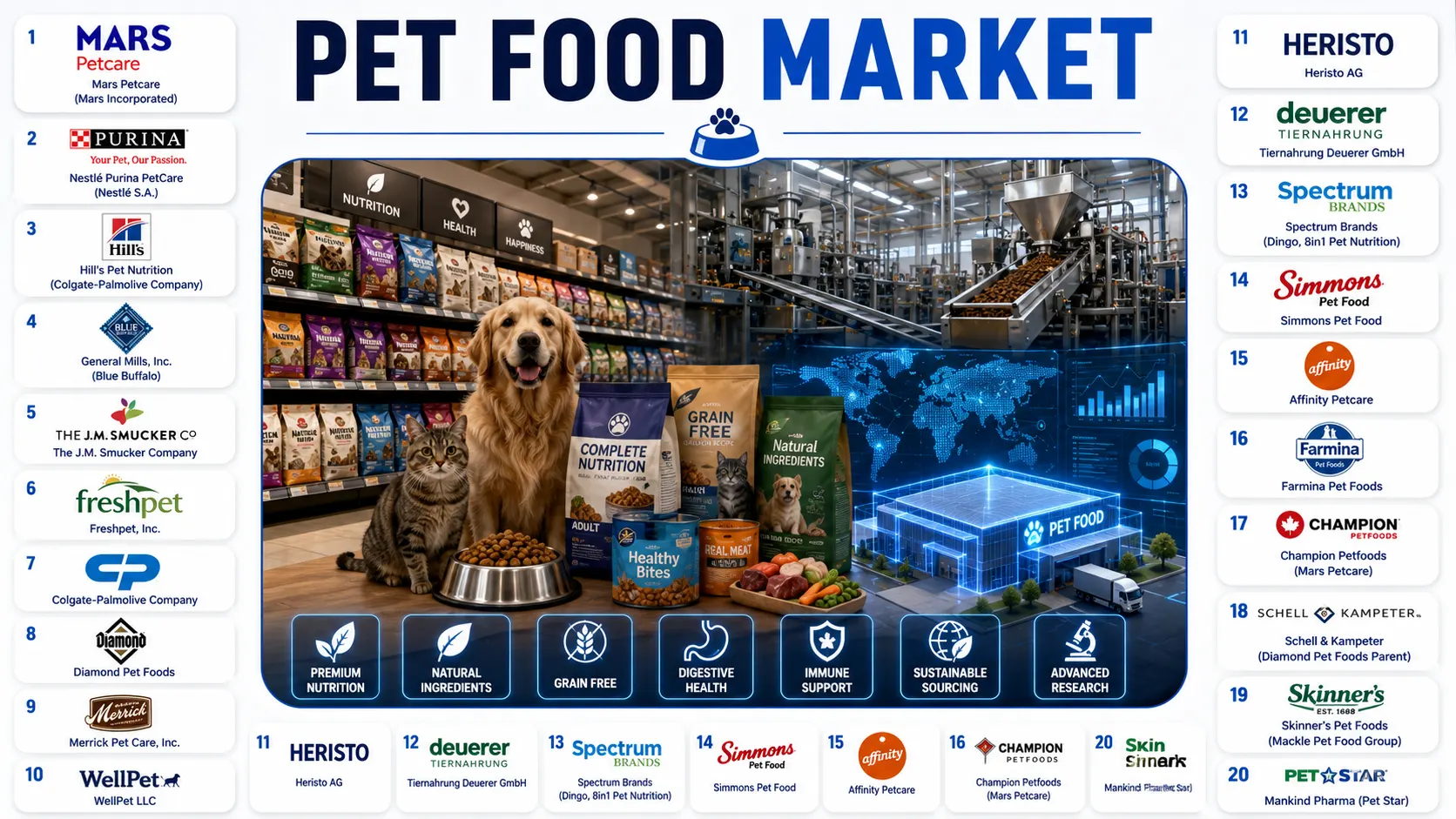
Top 20 Companies in the Global Pet Food Market
- Mars Petcare (Mars Incorporated)
- Nestlé Purina PetCare (Nestlé S.A.)
- Hill's Pet Nutrition (Colgate-Palmolive Company)
- General Mills, Inc. (Blue Buffalo)
- The J.M. Smucker Company
- Freshpet, Inc.
- Colgate-Palmolive Company
- Diamond Pet Foods
- Merrick Pet Care, Inc.
- WellPet LLC (Wellness Pet Company)
- Heristo AG
- Tiernahrung Deuerer GmbH
- Spectrum Brands (Dingo, 8in1 Pet Nutrition)
- Simmons Pet Food
- Affinity Petcare
- Farmina Pet Foods
- Champion Petfoods (Mars Petcare)
- Schell & Kampeter (Diamond Pet Foods Parent)
- Skinner's Pet Foods
- Mankind Pharma (PetStar)
1. Mars Petcare (Mars Incorporated)
|
Category |
Details |
|---|---|
|
Company Name |
Mars Petcare (a division of Mars, Incorporated) |
|
Headquarters |
McLean, Virginia, USA |
|
Founded |
1911 (Mars Incorporated); Pet Food Division established 1935 |
|
Industry Focus |
Pet Nutrition, Pet Care, Veterinary Health Services |
|
Global Presence |
Operations in 100+ countries |
|
Company Overview |
Mars Petcare stands as the world's largest pet nutrition and care company, operating a portfolio of over 50 iconic brands. The division functions within Mars Incorporated one of the world's largest private companies and benefits from exceptional financial resources, global supply chains, and decades of consumer trust. It has pursued an aggressive acquisition strategy, including Champion Petfoods, to expand its premium positioning, and continues to invest in veterinary care through its VCA, Banfield, and BluePearl networks. |
|
Key Products & Services |
Pedigree, Whiskas, Royal Canin, Sheba, Cesar, Temptations, IAMS, Eukanuba, ORIJEN, ACANA; veterinary care services via VCA, Banfield, and BluePearl. |
|
Market Position |
World's largest pet nutrition and care company; co-leader with Nestlé Purina PetCare, collectively holding approximately 40–55% of global market share. |
|
Recent Developments |
Launched its 2025 Global Pet Food Innovation Program with AAK, Bühler, and Givaudan, selecting start-ups in insect protein, microalgae omega-3s, and upcycled ingredients; expanded U.S.-made branding campaign. |
|
Strategic Advantages |
Unparalleled brand portfolio breadth, global manufacturing scale, vertical integration through veterinary networks, and substantial R&D investment across nutrition science. |
2. Nestlé Purina PetCare (Nestlé S.A.)
|
Category |
Details |
|---|---|
|
Company Name |
Nestlé Purina PetCare |
|
Headquarters |
St. Louis, Missouri, USA (Purina); Vevey, Switzerland (Nestlé S.A. parent) |
|
Founded |
1894 (Purina) |
|
Industry Focus |
Pet Nutrition, Pet Food Manufacturing |
|
Global Presence |
Operations in 70+ countries |
|
Company Overview |
The world's second-largest pet food company and Mars Petcare's closest rival. Purina operates 24 manufacturing plants in North America alone and performs 100,000 quality checks daily. Its scientific foundation more than 500 researchers and approximately 2,000 patents underpins evidence-based nutrition and a loyal, premium-spending consumer base built through veterinary and performance-pet community trust. |
|
Key Products & Services |
Purina Pro Plan, Dog Chow, Cat Chow, Friskies, Beneful, Fancy Feast, Felix, ONE, Beyond natural line. |
|
Market Position |
Co-leader of the global pet food market alongside Mars Petcare, collectively accounting for approximately 40–55% of global share. |
|
Recent Developments |
Invested approximately $144 million in a new manufacturing facility in Rayong, Thailand; launched Fancy Feast's "Set for Delight" dinnerware collaboration with Jenna Lyons in 2024. |
|
Strategic Advantages |
Scientific rigor, massive global manufacturing network, deep veterinary relationships, and an iconic multi-brand portfolio spanning all price segments. |
3. Hill's Pet Nutrition (Colgate-Palmolive Company)
|
Category |
Details |
|---|---|
|
Company Name |
Hill's Pet Nutrition, Inc. |
|
Headquarters |
Topeka, Kansas, USA |
|
Founded |
1907 (as Hill Rendering Works); clinical/pet nutrition focus established in the 1940s |
|
Industry Focus |
Science-Based Pet Nutrition, Veterinary Diets |
|
Global Presence |
Available in 86+ countries |
|
Company Overview |
A subsidiary of Colgate-Palmolive, Hill's pioneered the concept of clinical nutrition the idea that pets with diseases could be treated nutritionally after veterinarian Dr. Mark Morris formulated a therapeutic diet for a guide dog with kidney disease. Hill's remains a global leader in veterinary-recommended nutrition and operates the Hill's Food, Shelter & Love shelter-support program. |
|
Key Products & Services |
Science Diet, Prescription Diet, Ideal Balance, targeted formulas including k/d and z/d Hydrolyzed diets. |
|
Market Position |
The No. 1 veterinarian-recommended pet food brand in the U.S., with a leading position in the global therapeutic and prescription-diet segment. |
|
Recent Developments |
2025 launch of ActivBiome+ prebiotics across the Science Diet line; May 2026 precision-fermentation partnership with Bond Pet Foods; June 2026 launch of new Prescription Diet dermatological and GI formulas. |
|
Strategic Advantages |
Deep scientific and veterinary credibility, dominant veterinary-channel distribution, strong R&D pipeline, and the financial backing of parent company Colgate-Palmolive. |
4. General Mills, Inc. (Blue Buffalo)
|
Category |
Details |
|---|---|
|
Company Name |
General Mills, Inc. (Pet segment: Blue Buffalo Pet Products, Inc.) |
|
Headquarters |
Minneapolis, Minnesota, USA (General Mills); Wilton, Connecticut, USA (Blue Buffalo) |
|
Founded |
General Mills: 1866; Blue Buffalo: 2002; acquired by General Mills in 2018 |
|
Industry Focus |
Consumer Packaged Goods, Natural & Premium Pet Food |
|
Global Presence |
Primarily United States, with expanding international distribution |
|
Company Overview |
General Mills completed its $8.0 billion acquisition of Blue Buffalo Pet Products in 2018, establishing itself as the leader in the U.S. Wholesome Natural pet food category. General Mills further expanded its pet segment in 2021 with a $1.2 billion acquisition of Tyson Foods' pet treats business, adding Nudges, Top Chews, and True Chews. |
|
Key Products & Services |
BLUE Life Protection Formula, BLUE Wilderness, BLUE Basics, BLUE Natural Veterinary Diet, Nudges, True Chews, Blue Buffalo Love Made Fresh. |
|
Market Position |
Leading player in the U.S. Wholesome Natural pet food category and among the fastest-growing major pet food companies in the country. |
|
Recent Developments |
Launch of Blue Buffalo Love Made Fresh, entering the refrigerated fresh pet food category to compete directly with Freshpet. |
|
Strategic Advantages |
Strong natural/premium brand positioning, General Mills' global supply chain and retail relationships, and an active pet cancer research program through the Blue Buffalo Foundation. |
5. The J.M. Smucker Company
|
Category |
Details |
|---|---|
|
Company Name |
The J.M. Smucker Company |
|
Headquarters |
Orrville, Ohio, USA |
|
Founded |
1897 (entered pet food category via Big Heart Pet Brands acquisition in 2015) |
|
Industry Focus |
Food & Beverages, Pet Food & Snacks |
|
Global Presence |
Primarily North America |
|
Company Overview |
Smucker entered pet food in 2015 with its $5.8 billion acquisition of Big Heart Pet Brands, later adding Rachael Ray Nutrish through the 2018 Ainsworth Pet Nutrition acquisition. In 2023, Smucker divested several pet brands Nutrish, 9Lives, Kibbles 'n Bits, Nature's Recipe, and Gravy Train to Post Holdings for approximately $1.2 billion, retaining Milk-Bone and Meow Mix as its core focus. |
|
Key Products & Services |
Milk-Bone dog snacks, Meow Mix cat food. |
|
Market Position |
A leading player in U.S. dog snacks and dry cat food; pet has historically been Smucker's most profitable product segment. |
|
Recent Developments |
Milk-Bone biscuit sales grew more than 40% over four years; continued expansion into long-lasting chew and soft-and-chewy treat segments; Meow Mix innovation pipeline targeting renewed category growth. |
|
Strategic Advantages |
Iconic, century-old legacy brands, sharpened post-divestiture portfolio focus, and strong grocery and mass-retail relationships. |
Competitive Landscape
The global pet food market exhibits a semi-consolidated competitive structure, characterized by a handful of multinational corporations commanding significant market share at the top tier, while a diverse ecosystem of regional players, specialist brands, and digital-native disruptors serves the remaining market.
At the apex, Mars Petcare and Nestlé Purina PetCare function as the unchallenged co-leaders, collectively holding approximately 40–55% of global market share depending on the category. In economy dry dog food, Mars alone holds 38.9% share and Nestlé Purina holds 33.2%; in economy wet dog food, Mars dominates with 64.7% share. Their combined brand portfolio breadth, manufacturing scale, and distribution infrastructure create formidable barriers to entry that even well-funded challengers find difficult to overcome.
The next tier comprising Hill's Pet Nutrition, General Mills (Blue Buffalo), J.M. Smucker, and Freshpet competes through differentiation, whether by veterinary channel exclusivity (Hill's), natural brand positioning (Blue Buffalo), value-segment accessibility (Smucker's), or category disruption (Freshpet). A distinct manufacturing-side layer, including Diamond Pet Foods/Schell & Kampeter, Simmons Pet Food, Heristo AG, and Tiernahrung Deuerer, competes through private-label and contract manufacturing scale rather than consumer-facing brand equity.
Key Competitive Trends:
Mergers and Acquisitions: The market has seen significant consolidation activity, including General Mills' $8.0 billion acquisition of Blue Buffalo (2018), Nestlé Purina's acquisition of Merrick Pet Care (2015), Mars Petcare's acquisition of Champion Petfoods (2022), and General Mills' acquisition of the Tyson Foods pet treats business (2021) and Edgard & Cooper. M&A activity is expected to continue as companies seek scale, premium brand access, and geographic expansion.
Partnerships and Collaborations: Technology partnerships, such as Hill's collaboration with precision-fermentation biotech Bond Pet Foods, are enabling legacy players to access new protein science and geographies. Mars Petcare's 2025 Global Pet Food Innovation Program with AAK, Bühler, and Givaudan reflects a broader trend of FMCG giants partnering with ingredient-technology start-ups.
Innovation Strategies: Leading players are investing in AI-enabled personalized nutrition platforms, alternative and sustainable proteins, fresh and refrigerated product lines, and functional/prescription diet development as core innovation priorities.
Regional Analysis
North America
North America is the world's dominant pet food market, accounting for the largest share of global revenue. The U.S. alone reported $152 billion in total pet owner spending in 2024, encompassing food, veterinary care, and ancillary products. High pet ownership rates (approximately 66% of U.S. households own a pet), robust consumer purchasing power, and mature premium and natural food segments underpin North America's leadership. The region is characterized by intense competition between major multinationals, a vibrant start-up ecosystem, and rapidly growing e-commerce penetration.
Europe
Europe is the world's second-largest pet food market, with Germany, the UK, France, Italy, and Spain being the major consumer markets. European consumers are particularly sensitive to ingredient sourcing, sustainability, and animal welfare trends that have driven strong growth in natural, organic, and alternative protein formulations. Regulatory rigor from the European Food Safety Authority (EFSA) shapes product development and labeling standards, maintaining high quality benchmarks that protect consumer confidence. Private-label pet food, led by manufacturers such as Heristo AG and Tiernahrung Deuerer, has a strong presence in European grocery retail.
Asia-Pacific
Asia-Pacific is the fastest-growing regional pet food market, driven by China, India, Japan, South Korea, and Southeast Asian nations. Rising disposable incomes, urbanization, delayed family formation, and the emerging "pet parent" identity among young urban consumers are creating a new generation of premium pet food buyers. China in particular has seen explosive growth in premium and imported pet food, while India where domestic players such as Mankind Pharma's PetStar are emerging represents one of the most significant emerging market opportunities globally. Mars Petcare's establishment of an R&D center in Thailand in April 2024 and Nestlé's manufacturing investment in Rayong, Thailand, signal the strategic importance multinational players assign to the region.
Latin America
Latin America, led by Brazil and Mexico, represents a developing but dynamically expanding market. Brazil is among the world's top five pet populations globally by number of cats and dogs, and Brazilian consumers are increasingly embracing commercial and premium pet food as pet humanization trends gain momentum. Regulatory environments vary significantly across the region, creating both challenges and opportunities for international brands seeking standardized market entry strategies.
Middle East & Africa
The Middle East and Africa remain nascent but increasingly interesting pet food markets. Gulf Cooperation Council (GCC) countries particularly the UAE and Saudi Arabia have seen rising pet ownership among expatriate and younger local populations, driving import-led demand for premium Western pet food brands. African markets remain largely underdeveloped at present but represent long-term optionality as urbanization accelerates and middle-class consumer bases expand.
Emerging Trends Shaping the Pet Food Market
- AI and Personalized Nutrition Companies are leveraging artificial intelligence and consumer data to develop personalized feeding recommendations, customized formulations, and subscription-optimized delivery. Hill's use of AI-driven media optimization has demonstrably improved its advertising return on investment, while digital-first start-ups are building platforms that tailor nutrition plans to individual pet age, breed, activity level, and health status.
- Alternative Proteins Insect protein, single-cell protein, plant-based meat analogues, and cell-cultivated animal protein are transitioning from niche innovation to mainstream consideration. Mars's partnership with insect protein start-up ALT-PRO and microalgae omega-3 specialist Seaqure Labs exemplifies how the industry's largest players are hedging against long-term conventional protein cost and sustainability pressures.
- Fresh and Refrigerated Pet Food Freshpet's success has validated the consumer market for refrigerated, minimally processed pet food. General Mills' launch of Blue Buffalo Love Made Fresh and Champion Petfoods' ORIJEN FRESHPREY reflect the growing conviction that fresh pet food will become a structurally significant category over the next decade.
- Sustainability and Circular Economy Recyclable and compostable packaging, regenerative ingredient sourcing, and carbon footprint disclosure are becoming competitive differentiators. Brands that communicate authentic sustainability credentials are building stronger connections with environmentally conscious millennial and Gen Z pet owners.
- Veterinary and Therapeutic Nutrition Growth The therapeutic and prescription diet segment continues to grow as pet owners increasingly view proactive health management including diet as a cost-effective alternative to veterinary treatment. Hill's Prescription Diet and Royal Canin Veterinary Diet are the dominant players in this high-margin, clinically differentiated segment.
- E-Commerce and Subscription Models Online pet food sales are growing disproportionately versus brick-and-mortar, with subscription and auto-replenishment models delivering predictable revenue and high customer lifetime value. This channel shift is driving investment in digital marketing, data analytics, and logistics optimization across the industry.
Future Outlook (2026–2034)
The global pet food market's trajectory over the next decade is fundamentally positive. The structural drivers pet humanization, premiumization, health consciousness, and demographic shifts toward pet ownership among younger urban consumers globally are durable and unlikely to reverse. The market is projected to grow from USD 107.95 billion in 2024 to USD 167.64 billion by 2034, a gain of nearly USD 60 billion over the decade.
Investment Opportunities: The most compelling investment opportunities lie in premium and super-premium formulations; fresh and refrigerated pet food infrastructure; alternative protein development; digital platforms that enable personalized nutrition; and emerging markets in Asia and Latin America where commercial pet food penetration is still in early stages.
Industry Transformation: Industry transformation will be driven by the convergence of biotechnology, food science, and consumer technology. Cell-cultivated meat, precision fermentation, and AI-driven nutritional optimization will progressively move from pilot programs to commercial scale, fundamentally altering the cost structure and environmental footprint of pet protein production.
Consolidation: Consolidation will continue as well-capitalized multinationals acquire innovative start-ups to access new technologies, consumer relationships, and product categories faster than organic development would allow. The winners of 2034 will be companies that have successfully married the scale advantages of global manufacturing and distribution with the agility and innovation velocity of entrepreneurial brands.
Regulatory Evolution: Regulatory frameworks governing ingredient sourcing, labeling claims, and novel protein approval will become more structured globally over the next decade. Companies that proactively invest in compliance, testing, and quality-assurance infrastructure will be best positioned to navigate the evolving regulatory landscape.
FAQ Section: Global Pet Food Market
Q1: What is the current size of the global pet food market?
The global pet food market was valued at approximately USD 107.95 billion in 2024, according to Intellectual Market Insights' Pet Food Market Report (2025–2034). The market is projected to reach USD 167.64 billion by 2034.
Q2: What is the forecast CAGR for the pet food market?
The global pet food market is projected to grow at a CAGR of 4.5% over the 2025–2034 forecast period.
Q3: Who are the leading companies in the global pet food market?
The top companies include Mars Petcare, Nestlé Purina PetCare, Hill's Pet Nutrition (Colgate-Palmolive), General Mills (Blue Buffalo), The J.M. Smucker Company, Freshpet, Diamond Pet Foods, WellPet LLC, Affinity Petcare, Merrick Pet Care, Heristo AG, Tiernahrung Deuerer, Spectrum Brands, Simmons Pet Food, Farmina Pet Foods, Champion Petfoods, Schell & Kampeter, Skinner's Pet Foods, and Mankind Pharma (PetStar).
Q4: Which company holds the largest market share in the pet food industry?
Mars Petcare and Nestlé Purina PetCare are co-leaders, collectively accounting for approximately 40–55% of global pet food market share. In specific segments, Mars dominates wet dog food with approximately 64.7% share in economy formats.
Q5: Which region dominates the global pet food market?
North America holds the largest regional share of the global pet food market, driven by high pet ownership rates, robust consumer spending, and mature premium and natural food categories.
Q6: Which region is growing the fastest in the pet food market?
Asia-Pacific is the fastest-growing regional market, driven by rising pet ownership in China, India, South Korea, and Southeast Asia, along with increasing disposable incomes and urbanization.
Q7: What are the primary growth drivers for the pet food market?
Key growth drivers include pet humanization trends, increasing awareness of pet nutrition, growth in e-commerce distribution, demand for premium and functional pet food, expanding emerging market pet ownership, and sustainability-driven innovation.
Q8: What are the main challenges facing the pet food industry?
The industry faces raw material price volatility and tariff-driven input cost pressure, stringent and evolving regulatory compliance requirements across markets such as the U.S. (FDA) and Europe (EFSA), ongoing consolidation pressure on smaller regional manufacturers, and heightened consumer scrutiny around ingredient transparency, product safety, and recalls.
Q9: What is the fastest-growing segment in the pet food market by product form?
Fresh and refrigerated pet food is the fastest-growing product-form segment, led by category pioneer Freshpet and followed by newer entrants such as Blue Buffalo Love Made Fresh and Champion Petfoods' ORIJEN FRESHPREY. Freeze-dried and raw formats are also expanding rapidly from a smaller base.
Q10: What segment dominates the pet food market by animal type?
Dogs represent the dominant animal-type segment, reflecting higher per-pet spending, larger serving sizes, and a broader range of premium and functional product offerings compared with cats and other companion animals.
Conclusion
The global pet food market in 2026 is a study in the power of structural consumer trends to sustain long-cycle economic growth. Growing from USD 107.95 billion in 2024 to a projected USD 167.64 billion by 2034 at a CAGR of 4.5%, the market's trajectory reflects the convergence of pet humanization, rising nutritional awareness, and the expansion of premium and functional product categories across both mature and emerging economies.
The companies profiled in this article from the multinational giants of Mars Petcare and Nestlé Purina PetCare to the category disruptors of Freshpet and General Mills' Blue Buffalo; the specialty and natural-food leaders such as Merrick, WellPet, and Farmina; the private-label and contract manufacturing powerhouses of Diamond Pet Foods, Simmons Pet Food, Heristo AG, and Tiernahrung Deuerer; and the emerging market pioneers of Mankind Pharma's PetStar collectively represent the full ecosystem of innovation, investment, and competitive intensity shaping this market in 2026 and beyond.
What unites the leaders is not merely scale, but strategic clarity: an understanding that the pet food consumer of 2026 is not buying calories for an animal, but expressing care, love, and identity through the quality of nutrition they provide to a beloved family member. The companies that honor this truth through innovation, transparency, and authentic brand positioning will be best placed to capture disproportionate value as the market grows toward its USD 167.64 billion destination by 2034.
For investors, industry observers, brand builders, and market researchers, the global pet food market represents one of the most compelling long-term growth stories in the consumer goods sector a market that is both recession-resilient and structurally dynamic, driven by forces that show no signs of abating.