
AI Data Center Market Size, Share & Growth Trends, 2026–2034
Author:
Intellectual Market Insights Research
Published Date:
29 Jul 2026
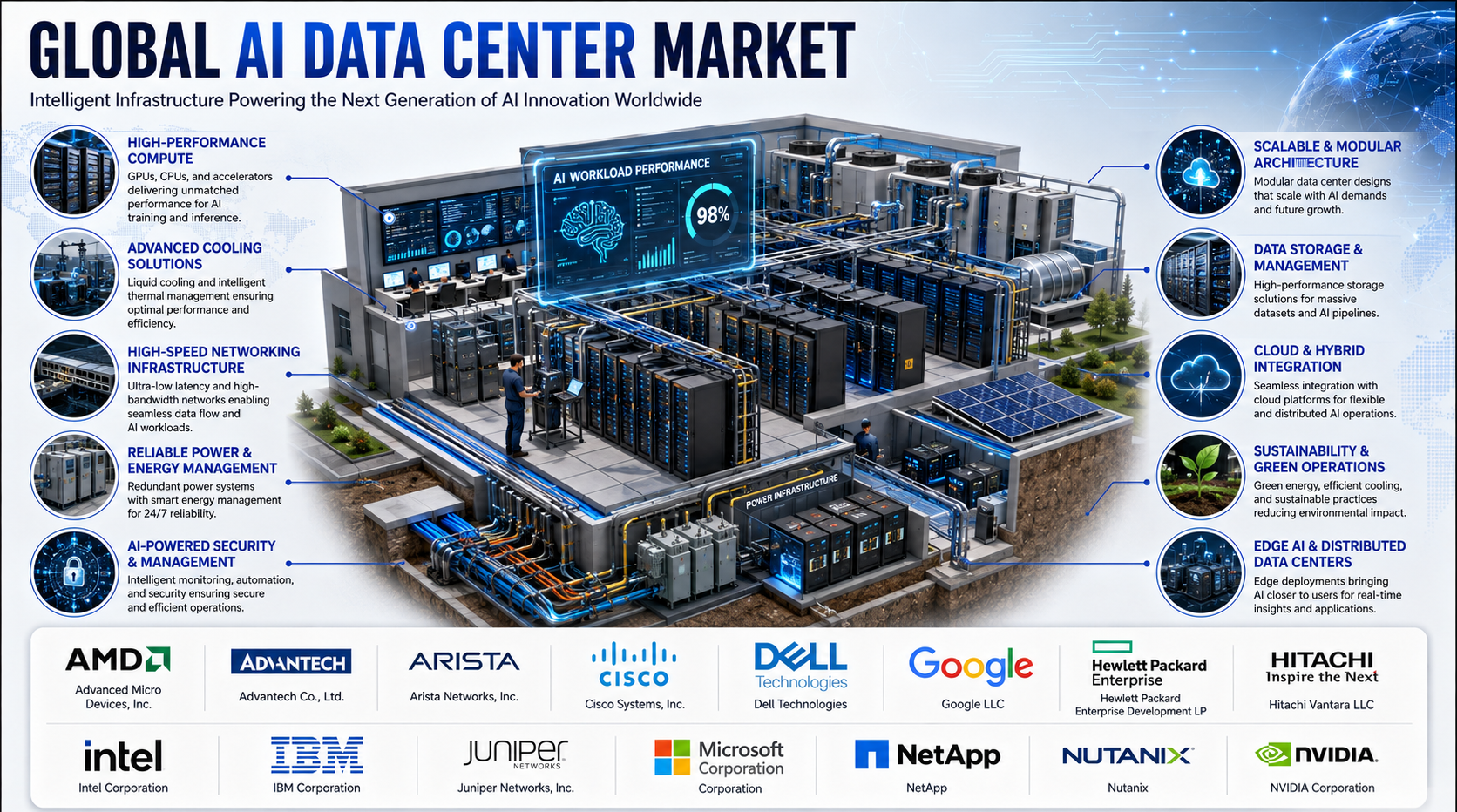
AI Data Center Market Trends, Growth & Forecast to 2034
Introduction
Behind every AI chatbot response, every image generated by a diffusion model, and every real-time recommendation served by an e-commerce platform sits a rapidly expanding layer of physical infrastructure: the AI data center. As enterprises race to train and deploy ever-larger models, the facilities built to house GPUs, AI accelerators, and specialized cooling systems have become one of the most capital-intensive frontiers in global technology infrastructure.
According to the Intellectual Market Insights Research , the global AI data center market was valued at USD 147.3 billion in 2025 and is projected to grow from USD 180.6 billion in 2026 to USD 1,004.3 billion by 2034, at a CAGR of 23.9% from 2026 to 2034. This dramatic growth trajectory underscores how central AI-optimized infrastructure has become to the broader technology economy, as compute demand for training and inference workloads continues to outpace traditional data center build-outs.
At its core, the AI data center market covers infrastructure designed to support artificial intelligence workloads, including high-performance computing, machine learning, deep learning, and generative AI applications.</cite> These facilities rely on advanced GPUs, TPUs, and AI accelerators paired with purpose-built cooling and power management systems capable of handling far higher energy densities than conventional data centers.
The industry's growth is being driven by a convergence of technological and commercial forces. First, the explosive expansion of generative AI and large language models is pushing hyperscalers to continuously expand GPU-dense capacity to support both model training and always-on inference workloads. Second, enterprises across healthcare, finance, automotive, and telecommunications are embedding AI into core operations, creating sustained demand for AI-ready compute. Third, the rise of edge computing and AI-as-a-Service models is reshaping how organizations access AI infrastructure, extending demand beyond hyperscale campuses into distributed, latency-sensitive deployments.
At the same time, the market faces real friction: AI workloads are extraordinarily power-intensive, and grid capacity in many regions is not expanding fast enough to keep pace, creating delays tied to transmission upgrades and high-voltage connection availability. Ongoing semiconductor supply constraints and data privacy concerns in regulated industries add further complexity. Even so, the long-term trajectory remains strongly positive, anchored by sustained enterprise AI adoption and continuing infrastructure investment from both hyperscalers and specialized AI-cloud providers.
This article profiles the leading companies shaping the global AI Data Center Market in 2026, examines segmentation and regional dynamics, and looks ahead at the trends set to define the industry through 2034.
Market Overview
|
Parameter |
Details |
|---|---|
|
Market Size (2025) |
USD 147.3 Billion |
|
Market Estimate (2026) |
USD 180.6 Billion |
|
Market Forecast (2034) |
USD 1,004.3 Billion |
|
CAGR (2026–2034) |
23.9% |
|
Forecast Period |
2026–2034 |
|
Historical Data |
2021–2025 |
|
By Component |
Hardware, Software, Services |
|
By Data Center Type |
Hyperscale, Enterprise, Colocation, Edge, Modular & Portable |
|
By Deployment |
On-Premises, Cloud-Based, Hybrid |
|
By AI Application |
AI Model Training, AI Model Inference, Big Data Analytics, Computer Vision, NLP, Autonomous Systems & Robotics, Cybersecurity & Fraud Detection |
|
By Industry Vertical |
IT & Telecom, BFSI, Healthcare, Retail & E-commerce, Manufacturing, Government & Defense, Energy & Utilities, Media & Entertainment, Automotive, Others |
|
Key Regions |
North America, Europe, Asia Pacific, Latin America, MEA |
|
Dominant Region |
North America |
|
Fastest Growing Region |
Asia Pacific |
Key Market Drivers:
- Explosive growth of generative AI and large language models driving demand for high-performance compute infrastructure
- Continuous, always-on inference demand as enterprises integrate AI into everyday workflows such as customer support, coding, and analytics
- Aggressive hyperscale capacity expansion by leading cloud providers
- Rising enterprise AI adoption across BFSI, healthcare, retail, and manufacturing
- Growing convergence of AI with 5G and IoT enabling new autonomous and smart-city use cases
Key Market Opportunities:
- Development of energy-efficient, sustainable data center infrastructure through liquid cooling and renewable energy integration
- Expansion of edge AI for autonomous drones, robotics, and IoT applications
- Untapped growth potential in Asia-Pacific, Latin America, and Africa as digitalization accelerates
- Advances in quantum computing and neuromorphic chips that could reshape long-term infrastructure design
- Strategic partnerships between governments, technology firms, and energy providers to accelerate build-out
Key Market Challenges:
- Power availability and grid constraints, as GPU-dense AI workloads push facilities toward multi-hundred-megawatt to gigawatt-level capacity needs
- High energy consumption and associated environmental and sustainability concerns
- Ongoing semiconductor supply constraints affecting GPU and AI chip availability
- Data privacy and security concerns limiting cloud-based AI adoption in regulated industries
Why the AI Data Center Market Is Growing
The rapid expansion of the AI data center market reflects a convergence of technological necessity, enterprise adoption, and infrastructure investment.
1. The Generative AI and LLM Compute Race
Training foundation models requires massive distributed GPU clusters running in parallel, and models are frequently fine-tuned and updated, keeping infrastructure utilization consistently high. Beyond training, inference workloads from AI-powered chatbots, copilots, and analytics tools now demand continuous, low-latency compute at scale.
2. Hyperscaler Capacity Expansion
Major cloud providers are rapidly building out AI-optimized capacity featuring GPU-dense architectures, advanced networking, and high-efficiency cooling to keep pace with sustained AI workload growth across their customer bases.
3. Enterprise AI Adoption Across Verticals
Industries including BFSI, healthcare, retail, and manufacturing are embedding AI into core operations from fraud detection to predictive maintenance, creating steady demand for AI-ready infrastructure beyond the technology sector itself.
4. Edge Computing and Real-Time AI
Applications in autonomous vehicles, robotics, and smart manufacturing require localized, low-latency processing, driving expansion of edge data centers that bring compute closer to where data is generated.
5. AI-as-a-Service and Hybrid Cloud Models
Cloud-based AI service delivery is lowering the barrier for enterprises to access advanced AI capabilities without operating their own infrastructure, while hybrid deployments are gaining ground among regulated industries balancing compliance with scalability.
6. Strategic Infrastructure Partnerships
Technology, energy, and telecom companies are increasingly forming alliances to secure power supply, semiconductor capacity, and next-generation cooling technology needed to sustain AI infrastructure build-out at scale.
Leading Companies in the Global AI Data Center Market
- Advanced Micro Devices, Inc.
- Advantech Co., Ltd.
- Arista Networks, Inc.
- Cisco Systems, Inc.
- Dell Technologies
- Google LLC
- Hewlett Packard Enterprise Development LP
- Hitachi Vantara LLC
- Intel Corporation
- IBM Corporation
- Juniper Networks, Inc.
- Microsoft Corporation
- NetApp
- Nutanix
- NVIDIA Corporation
1. NVIDIA Corporation (United States)
|
Category |
Details |
|---|---|
|
Industry Focus |
AI Accelerators, GPUs, Data Center Computing Platforms |
|
Global Presence |
Operations across North America, Europe, Asia-Pacific |
|
Company Overview |
NVIDIA supplies the GPU and AI accelerator hardware underpinning the majority of hyperscale AI training and inference infrastructure worldwide, alongside networking and software platforms for AI data centers. |
|
Market Position |
A dominant enabling-technology vendor across essentially all major AI infrastructure builds. |
|
Recent Developments |
Announced strategic collaborations spanning telecom AI infrastructure, gigawatt-scale power architectures, and sovereign AI data center initiatives across multiple regions. |
|
Strategic Advantages |
Deep vertical integration across chips, networking, and AI software; strong ecosystem lock-in among hyperscalers and enterprise customers. |
2. Microsoft Corporation (United States)
|
Category |
Details |
|---|---|
|
Industry Focus |
Hyperscale Cloud Computing, AI Infrastructure |
|
Global Presence |
Global hyperscale data center footprint across all major regions |
|
Company Overview |
Microsoft operates one of the largest hyperscale cloud platforms, rapidly expanding AI-optimized capacity to support Azure AI services, enterprise AI adoption, and generative AI workloads. |
|
Market Position |
A leading hyperscaler with deep enterprise relationships and integrated AI service offerings. |
|
Strategic Advantages |
Vast installed base, strong enterprise trust, and vertically integrated cloud-to-AI software stack. |
3. Google LLC (United States)
|
Category |
Details |
|---|---|
|
Industry Focus |
Hyperscale Cloud Computing, AI Infrastructure |
|
Global Presence |
Global hyperscale and cloud data center operations |
|
Company Overview |
Google Cloud is expanding large-scale AI data center campuses in partnership with energy providers to support generative AI and enterprise digital transformation. |
|
Market Position |
A top-tier hyperscaler with strong positioning in AI-optimized cloud infrastructure. |
|
Strategic Advantages |
Deep AI research integration, global infrastructure scale, and expanding clean-energy partnerships supporting sustainable data center growth. |
4. Advanced Micro Devices, Inc. (United States)
|
Category |
Details |
|---|---|
|
Industry Focus |
AI Accelerators, CPUs, Data Center Compute |
|
Global Presence |
Operations across North America, Europe, and Asia-Pacific |
|
Company Overview |
AMD supplies CPU and AI accelerator hardware for data center and AI infrastructure builds, positioning itself as a key alternative compute provider alongside NVIDIA. |
|
Market Position |
A major hardware vendor within the AI data center hardware segment. |
|
Strategic Advantages |
Broad compute portfolio spanning CPUs and accelerators, and growing partnerships across hyperscale and enterprise infrastructure providers. |
5. Hewlett Packard Enterprise Development LP (United States)
|
Category |
Details |
|---|---|
|
Industry Focus |
Enterprise IT Infrastructure, AI-Ready Servers |
|
Global Presence |
Global enterprise and data center infrastructure operations |
|
Company Overview |
HPE provides AI-optimized servers, networking, and infrastructure solutions for enterprise and colocation data center operators building out AI capacity. |
|
Market Position |
A leading enterprise infrastructure vendor supporting on-premises and hybrid AI deployments. |
|
Strategic Advantages |
Strong enterprise relationships, broad infrastructure portfolio, and positioning across both hyperscale-adjacent and enterprise AI infrastructure segments. |
Competitive Landscape
The AI data center market is moderately to highly concentrated, dominated by a small group of hyperscale cloud providers, GPU platform leaders, and large colocation operators, alongside a growing ecosystem of infrastructure specialists and regional players supporting rapid capacity expansion.</cite> Market leadership is held by hyperscalers operating vertically integrated stacks spanning compute, storage, networking, and AI software.
Key Competitive Trends:
Mature Players (Microsoft, Amazon Web Services, Google, Meta, Oracle, Equinix, Digital Realty, HPE, Vertiv, Schneider Electric): Building hyperscale AI "factory" campuses optimized for GPU-dense training and inference, investing heavily in liquid and direct-to-chip cooling, and expanding modular and edge AI facilities closer to end users. Their scale brings strong recurring revenue and brand trust, but also extremely capital-intensive infrastructure commitments, rising energy costs, and long construction timelines tied to GPU and transformer supply chains.
Emerging Players (CoreWeave, Crusoe, Lambda, Voltage Park, Applied Digital, Switch): Focused on AI-native GPU cloud infrastructure, partnering with renewable and stranded-energy providers to lower operating costs, and building sovereign AI infrastructure partnerships with governments. These players move faster and offer more customizable solutions but face weaker balance sheets, heavy dependence on GPU supply, and smaller global footprints compared with hyperscalers.
Regional Analysis
North America
North America held a 37.5% revenue share of the global AI data center market in 2025,</cite> supported by strong hyperscaler investment, a mature cloud computing ecosystem, and rapid AI adoption across finance, healthcare, and autonomous vehicles. Government initiatives around domestic semiconductor manufacturing further reinforce the region's leadership, even as energy consumption and data privacy scrutiny remain ongoing concerns.
Europe
Europe's AI data center market is shaped strongly by AI governance frameworks encouraging ethical and secure deployments, with Germany, the Netherlands, and Ireland attracting significant investment due to favorable regulation and strong connectivity. Sustainability remains a top priority as operators adopt green energy and advanced cooling to meet regional carbon-neutrality goals, even as high energy costs and land constraints pose challenges.
Asia Pacific
Asia Pacific is expected to register the fastest growth, fueled by digitalization, expanding cloud services, and government-led AI initiatives across China, India, and Japan,</cite> with Singapore, Hong Kong, and Sydney emerging as key regional hubs. Uneven infrastructure development and power shortages in some markets remain notable hurdles.
Latin America
Latin America's AI data center market is in an earlier stage of development but is attracting large-scale hyperscale investment, including major campus buildouts in Brazil supported by dedicated power infrastructure partnerships.
Middle East & Africa
The Middle East and Africa region is emerging as a strategic AI infrastructure frontier, with growing government interest in sovereign AI initiatives, though regional growth will depend heavily on power availability, permitting environments, and fiber connectivity maturity.
Emerging Trends Shaping the AI Data Center Market
- Liquid and Direct-to-Chip Cooling Adoption — As AI accelerators become more power-dense, operators are rapidly shifting from air cooling toward liquid and direct-to-chip cooling architectures to manage heat dissipation.
- Power Infrastructure Partnerships — Data center operators are increasingly partnering directly with energy providers and utilities to secure dedicated, reliable power for gigawatt-scale AI campuses.
- Edge AI Expansion — Growth in autonomous systems, robotics, and IoT is driving decentralized AI processing closer to end users to reduce latency and bandwidth strain.
- Sovereign AI Infrastructure — Governments in multiple regions are backing domestic AI data center development to support national digital infrastructure and reduce reliance on foreign compute capacity.
- Modular and Portable Data Center Designs — Modular construction approaches are gaining traction as operators look to deploy AI capacity faster and more flexibly across new geographies.
Future Outlook (2026–2034)
The global AI Data Center Market is positioned for sustained, rapid growth through 2034, underpinned by durable structural demand for AI compute.
Growth Projections: The market is expected to grow from USD 180.6 billion in 2026 to USD 1,004.3 billion by 2034, at a CAGR of 23.9%,with Asia Pacific likely to be the fastest-growing region even as North America retains its position as the largest market.
Investment Opportunities: The most compelling opportunities lie in energy-efficient cooling and power infrastructure, edge AI expansion for latency-sensitive applications, and infrastructure build-out in high-growth emerging markets.
Industry Transformation: As GPU-dense workloads become the norm, the industry is expected to see continued convergence between AI infrastructure providers, energy companies, and semiconductor manufacturers to solve the power-availability bottleneck.
Regulatory Evolution: AI governance and data sovereignty regulations are expected to shape regional infrastructure strategies further, particularly across Europe and parts of Asia Pacific.
FAQ Section: AI Data Center Market
Q1: What is the current size of the global AI Data Center Market?
global AI data center market was valued at USD 147.3 billion in 2025 and is estimated at USD 180.6 billion for 2026.
Q2: Who are the leading companies in the AI Data Center Market?
Key players include Advanced Micro Devices, Advantech, Arista Networks, Cisco Systems, Dell Technologies, Google, Hewlett Packard Enterprise, Hitachi Vantara, Intel, IBM, Juniper Networks, Microsoft, NetApp, Nutanix, and NVIDIA.
Q3: Which region dominates the AI Data Center Market?
North America dominated the market with a 37.5% share in 2025, driven by strong tech-giant investment, a mature cloud ecosystem, and rapid AI adoption, while Asia Pacific is expected to be the fastest-growing region.
Q4: What is the projected CAGR of the AI Data Center Market?
The market is forecast to grow at a CAGR of 23.9% from 2026 to 2034.
Q5: Which component segment leads the market?
The hardware segment led with a 53.7% revenue share in 2025, while services is the fastest-growing component.
Q6: Which data center type dominates the market?
Hyperscale data centers held the largest revenue share in 2025, while edge data centers are the fastest-growing type.
Q7: What are the main applications of AI data centers?
Key applications include AI model training, AI model inference, big data analytics, computer vision processing, natural language processing, autonomous systems and robotics, and cybersecurity and fraud detection.
Conclusion
The global AI Data Center Market reflects one of the most capital-intensive infrastructure build-outs in modern technology history, growing from an estimated USD 180.6 billion in 2026 to a projected USD 1,004.3 billion by 2034 at a CAGR of 23.9%. The market's trajectory is shaped by the explosive growth of generative AI and large language models, aggressive hyperscale capacity expansion, and mounting pressure to solve the power and cooling challenges that come with GPU-dense computing.
The companies profiled in this article from hyperscale leaders like Microsoft and Google, to hardware enablers like NVIDIA and AMD, to enterprise infrastructure providers like HPE collectively illustrate a market balancing explosive demand growth against real physical constraints in energy, supply chains, and construction timelines.
For investors, infrastructure operators, and enterprise decision-makers, understanding the interplay between AI compute demand, regional power availability, and the shifting balance between hyperscale and edge deployment models will be key to identifying where the greatest opportunity lies through 2034.