
The 6 Best IT Asset Lifecycle Management Solutions for Modern Enterprises
Author:
Workwize
Published Date:
28 Sep 2026
The 6 Best IT Asset Lifecycle Management Solutions for Modern Enterprises
Most IT leaders don't need convincing that asset tracking is a problem. What actually trips teams up is choosing the wrong IT Asset Lifecycle Management platform for their setup, then patching around its shortcomings for years. Keeping tabs on hardware across scattered teams, staying compliant with software licenses, and pushing clean asset data into ITSM and procurement systems are hard problems in their own right. This guide walks through six of the strongest platforms on the market, comparing what they do well, where they fit, and who should use them.
Why IT Asset Lifecycle Management Matters
Handling assets through spreadsheets and stitched-together tools can seem workable, right up until it isn't.
The moment a device drops off the radar in a remote office, or a software license overage slips past unnoticed, the price tag arrives quickly. A well-chosen platform keeps your utilization figures honest, your license compliance clean, and your time-to-provision short enough that new hires aren't left waiting on gear for weeks.
The teams that sail through audits aren't the ones with the flashiest demo — they're the ones that picked software matching their actual stack.
Comparison of the Top 6 IT Asset Lifecycle Management Platforms
Note: All data below is drawn from review platforms and the official websites of each vendor.
|
Company Name |
Years Operating |
Headquartered In |
|
Workwize |
Est. 2020 |
Amsterdam, Netherlands |
|
Firstbase |
Est. 2019 |
Aberdeen, Scotland and New York |
|
Device42 |
Est. 2010 |
West Haven, Connecticut |
|
Certero |
Est. 2007 |
Undisclosed |
|
Snipe-IT |
13+ years |
San Diego, CA, USA |
|
Anunta |
Est. 2012 |
Mumbai, Maharashtra, India |
Workwize – Best for Global IT Asset Lifecycle Management
What Does Workwize Do?
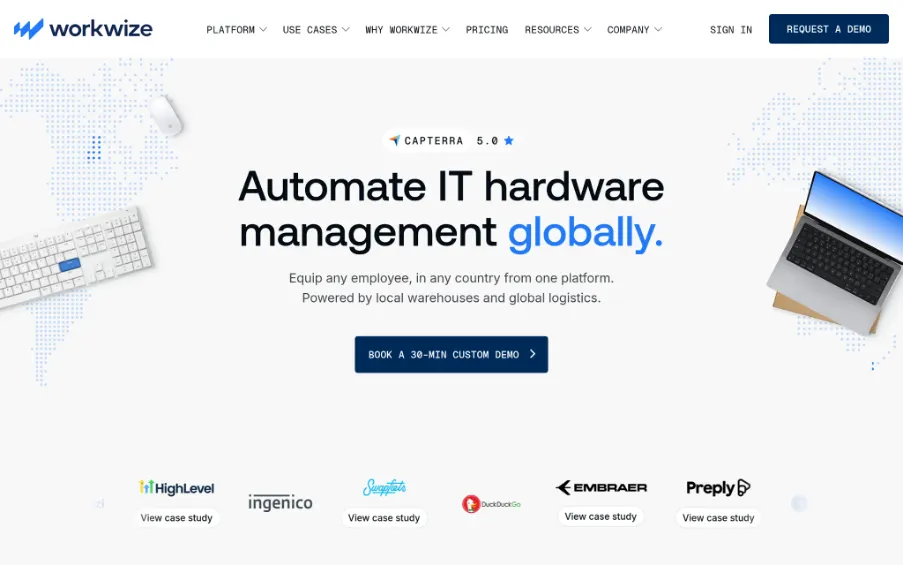
Workwize takes the entire hardware journey off IT's plate for globally spread-out teams, covering sourcing, deployment, tracking, retrieval, and disposal across 120 countries. The platform plugs straight into HRIS, MDM, and identity systems, meaning onboarding and offboarding kick off on their own without anyone chasing tickets between departments. Backed by regional warehouses and its own logistics network, Workwize gets devices to employees in 2 to 7 days across most markets. Customers report reclaiming more than 80,000 hours a year, with device recovery rates climbing as high as 98% (a serious number when thousands of assets are scattered worldwide).
Why Does Workwize Stand Out?
Workwize closes a gap that has quietly frustrated enterprise IT for years: no single system handles physical logistics, compliance workflows, and automation together. For teams juggling hardware across borders, that kind of joined-up coverage is hard to piece together with add-on tools.
Summary of Real User Reviews:
Customers repeatedly praise Workwize for reliable international logistics and the hours saved once automation replaces manual back-and-forth. HRIS integration is often flagged as the piece that shifted operations the most, and international recovery performance keeps coming up as a genuine competitive edge.
Firstbase – Best for International IT Asset Operations
What Does Firstbase Do?
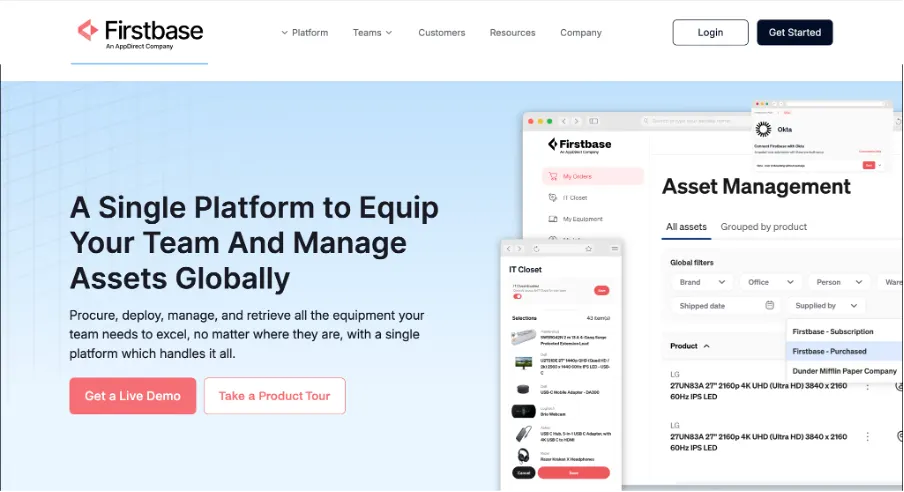
Firstbase bundles procurement, provisioning, inventory management, mobile device management, and asset recovery into one system built for globally distributed enterprises. The company operates in 150+ countries (with some capabilities extending to 190+), offering zero-touch deployment, end-to-end audit records from purchase to retirement, and device retrieval rates above 97%. Names on their customer roster include Spotify, Cloudflare, and UiPath, and their investor list — Andreessen Horowitz and Kleiner Perkins — isn't exactly bargain-tier, which typically says something about a product's standing. Firstbase was acquired by AppDirect, bringing added distribution muscle to the platform.
Why Does Firstbase Stand Out?
Firstbase tackles the logistics and compliance headaches IT teams run into once they expand into markets where their existing tools have little to no presence. Pre-stocked, pre-configured inventory takes the coordination pain out of international rollouts.
Summary of Real User Reviews:
Enterprise customers point to fast deployment in new regions as a real strength, especially for organizations that scaled remote workforces in a hurry. Reviewers from fast-growing tech companies call out the completeness of the audit trail as a compliance highlight, while noting the platform delivers the most value when used for full lifecycle management rather than one-off needs.
Device42 – Best for Hybrid Infrastructure Discovery and Mapping
What Does Device42 Do?
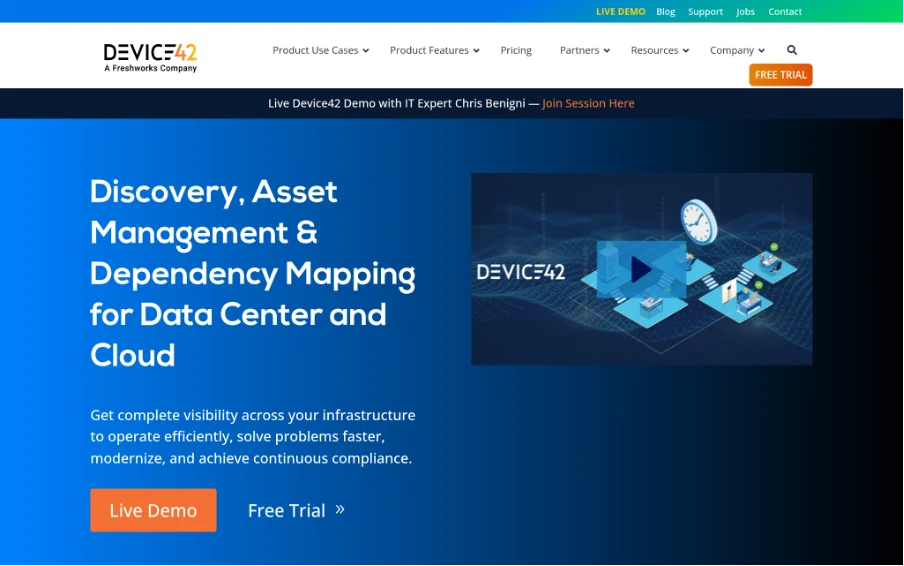
Device42 handles IT infrastructure discovery and asset management for hybrid environments, spanning aging on-premise gear all the way to modern cloud containers. Their agentless discovery model lets organizations chart the whole infrastructure, including how applications depend on each other, without rolling out agents across thousands of endpoints. Deployed in more than 70 countries, the platform feeds a near real-time CMDB and includes built-in AI for natural language searches. Customers say outages get resolved 10 times faster on average, with a reported 4.8x return on investment (numbers that make procurement teams pay attention). Freshworks picked up Device42 for $230M in May 2024.
Why Does Device42 Stand Out?
Device42 solves the infrastructure blind-spot problem, the kind that shows up mid-outage when nobody knows what depends on what. Combined with over 30 integrations, including ServiceNow and Ansible, its agentless discovery gives IT a continuously accurate view of the environment without hand-cataloging anything.
Summary of Real User Reviews:
Reviewers routinely highlight dependency mapping as the standout capability during cloud migrations and data center consolidations. Teams in complex hybrid environments turn to Device42 when other tools see only fragments of the picture, and the Freshworks acquisition is widely read as a good sign for continued product investment.
Certero – Best for Consolidated Management of Hardware, Software, SaaS, and Cloud Assets
What Does Certero Do?
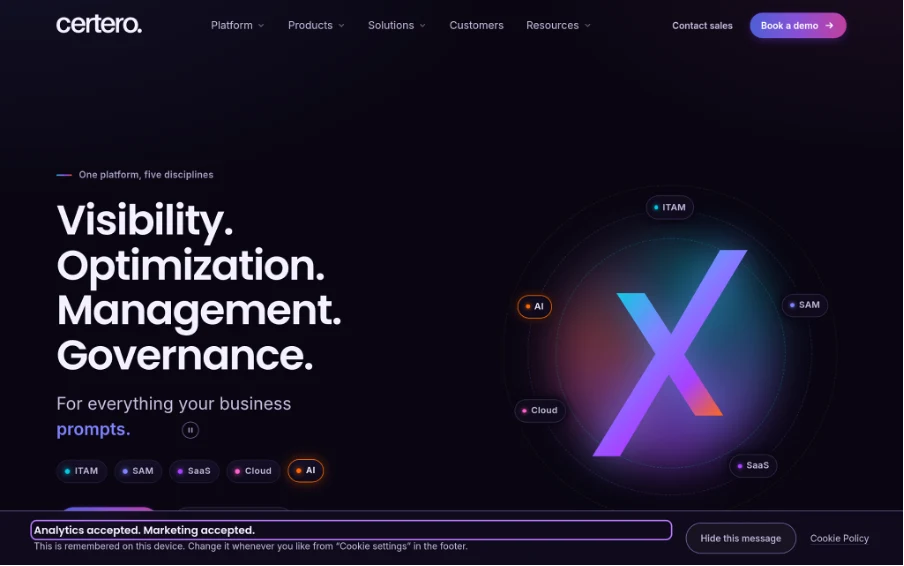
Certero is a privately held enterprise software company founded in 2007, offering IT asset management, software asset management, SaaS management, cloud management, and AI management inside a single platform called CerteroX. Unlike rivals that stitch together acquired products, Certero built the whole thing organically, so the shared data model across all five asset classes actually functions as intended. Reporting runs through their Command Centre, a discovery engine that uses ten distinct methods gathers data, and compliance-as-code keeps governance automated. ISO 27001:2022, Cyber Essentials Plus, and FinOps Certified Platform status all reflect a serious compliance posture (the sort of thing enterprise procurement checklists demand).
Why Does Certero Stand Out?
Certero addresses the vendor fragmentation issue that plagues enterprise asset management, where separate tools for software, SaaS, and hardware create data gaps that make accurate reporting nearly impossible. Being the only vendor to earn Customers' Choice status in the 2024 Gartner Peer Insights Voice of the Customer for SAM Tools is the sort of third-party endorsement that carries real weight during evaluations.
Summary of Real User Reviews:
A recurring theme in Certero's feedback is customers pointing to the unified data model as the reason they stay, not just why they signed. Regulated-industry teams, including NHS organizations and regional health systems, single out governance and compliance features as particularly well-built. Companies that need every asset class managed in one place, without separate integration work, tend to find this platform sticky.
Snipe-IT – Best for Open Source Enterprise Asset Tracking
What Does Snipe-IT Do?
Snipe-IT is a free, open source IT asset management system from Grokability, Inc. that swaps out spreadsheet mayhem for a structured, automated tracking environment. Deployments come in either self-hosted or cloud-hosted flavors, and the platform supports barcode scanning, REST API connections, and user-level asset assignment. With 13 years of operational history behind it and over 21.7 million assets tracked across 10.4 million users, Snipe-IT has earned its reputation as a mature, no-frills tool. Its freemium model keeps it accessible, and the open source foundation means no vendor lock-in (always practical for enterprise procurement).
Why Does Snipe-IT Stand Out?
Snipe-IT is a natural fit for organizations that need a reliable, security-minded asset tracking foundation without locking into an expensive proprietary suite from day one. Its 330-plus contributors and 12 data centers, along with a 99.99% uptime guarantee, give enterprise teams infrastructure confidence that open source tools don't always deliver.
Summary of Real User Reviews:
The common thread in user feedback is how much teams appreciate Snipe-IT's straightforward setup versus heavier enterprise platforms. Reviewers regularly flag REST API flexibility as the standout for custom integrations, though some note that advanced reporting still involves manual work. It's a platform that wins loyalty through dependability rather than showmanship.
Anunta – Best for Desktop-as-a-Service and Managed Endpoint Delivery
What Does Anunta Do?
Anunta is an enterprise software company centered on digital workspace delivery, spanning desktop-as-a-service (DaaS), managed endpoint services, and desktop management in cloud environments. Founded in 2012 and headquartered in Mumbai, they've migrated more than 1 million remote desktop users across private, public, and hybrid cloud setups. Their in-house platforms — DesktopReady, CloudOptimal, and EuVantage — handle VDI migration, modern desktop management, and cloud spend analysis. Four consecutive appearances in the Gartner Magic Quadrant for DaaS confirm they're firmly established in the space, not simply claiming to be.
Why Does Anunta Stand Out?
Anunta answers the challenge of managing endpoint environments at scale when the physical device isn't the primary workload carrier anymore, shifting the focus to virtual desktop lifecycle management. For enterprises running hybrid workforce models, that focus on the workspace layer, rather than just the hardware, reflects a grounded read on where IT complexity actually lives today.
Summary of Real User Reviews:
Customers point to Anunta's migration experience as the sharpest differentiator, particularly for large VDI transitions where getting it wrong is expensive. Feedback highlights strong technical depth from their delivery teams, though a few reviewers note that their proprietary platform ecosystem does require real upfront investment to set up.
Research Methodology and Selection Process
Choosing the right IT Asset Lifecycle Management platform involves more than ticking boxes on a feature list. The research behind this guide pulled data from a range of public sources, then applied one consistent evaluation framework across all six platforms.
Initial Data Collection
The longlist was assembled from software directories, review aggregators, industry analyst coverage, and vendor comparison sites. Each entry was checked against public documentation, including company profiles, product pages, and customer case studies. Platforms without enough public evidence of enterprise deployment were dropped before any scoring began.
Shortlisting Phase
Unverified or lightly documented options were cut early. The remaining candidates went through a review pattern analysis, examining consistency in how customers described outcomes rather than raw satisfaction scores. Platforms with thin or overly promotional review profiles didn't move forward. Only those with meaningful review volume and real operational context stayed on the list.
Verification of Claims
Each vendor's stated capabilities were tested against actual user reports. Wherever a vendor claimed an outcome (faster provisioning, higher retrieval rates, license savings), that claim was checked against review language, case study data, and third-party analyst commentary. Claims that lived only in vendor marketing without backup were noted and weighted accordingly.
Authority and Industry Contribution Layer
Recognition signals were part of the picture too. This included analyst placements, awards from recognized bodies, mentions in enterprise IT publications, and evidence of original research or product contributions. Platforms that showed up consistently across authoritative sources scored higher on confidence than those relying purely on self-reported metrics.
IT Asset Lifecycle Management-Specific Evidence
Every platform was checked for direct evidence of work in IT asset lifecycle management. This meant dedicated service pages on hardware and software asset management, verified reviews from IT asset managers and procurement leaders, and case studies showing real lifecycle outcomes such as cost avoidance, audit readiness improvement, or device recovery performance. Generalist tools without clear lifecycle depth didn't make the final six.
Bottom Line
Managing the full IT asset lifecycle across a distributed organization is genuinely difficult, and the right platform makes a measurable difference in how well teams handle it. Workwize leads for global hardware automation, Firstbase for international asset operations, Device42 for infrastructure discovery, and Certero for consolidated software and SaaS governance. Each platform tackles a distinct problem, so the right pick depends on where your operational gaps run deepest. As enterprises grow more distributed, the demand for lifecycle automation and audit readiness will keep climbing.