
Global Cable Conduit Systems Market Outlook 2025-2035 Growth Drivers, Emerging Trends, and Future Opportunities
Author:
Intellectual Market Insights Research
Published Date:
23 Jun 2026
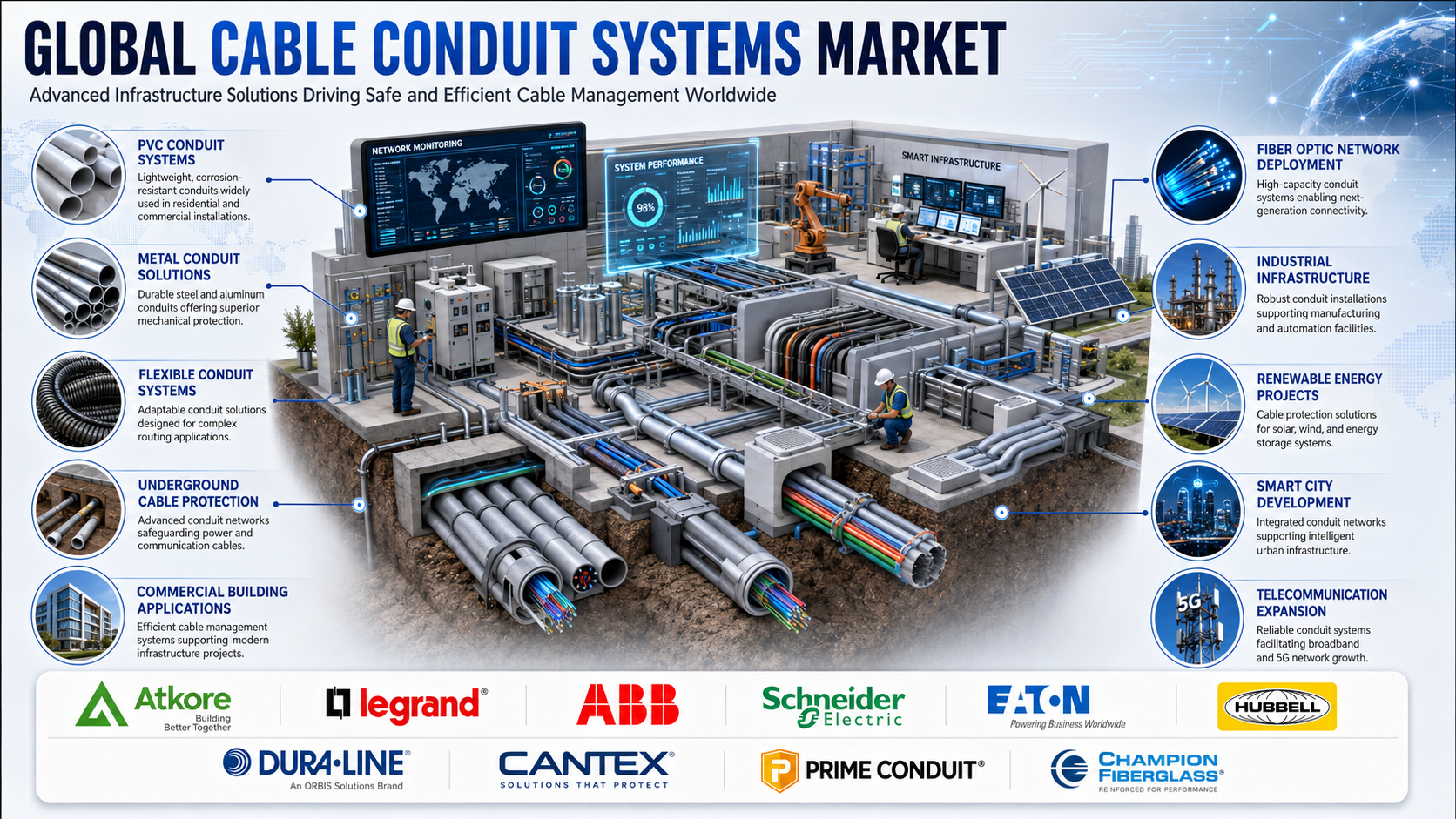
Top 10 Manufacturers in the Global Cable Conduit Systems Market Driving Industry Growth in 2025
The global infrastructure landscape is undergoing a sweeping transformation, and quietly running through the walls, floors, and ceilings of every building, data center, factory, and energy installation sits one of the most indispensable components of the modern built environment the cable conduit system. Tubes and raceways of steel, aluminum, PVC, and fiber-reinforced composite that protect the electrical and data wiring that powers the digital economy.
The global cable conduit systems market was valued at USD 8.2 billion in 2025 and is projected to reach USD 12.7 billion by 2034, expanding at a compound annual growth rate (CAGR) of 4.84% over the forecast period, according to a new report by Intellectual Market Insights Research. These figures reflect a steady, durable expansion story not the explosive hypergrowth of semiconductors or warehouse robotics, but the reliable, infrastructure-driven demand that comes from building and electrifying the world.
So what exactly is a cable conduit system? At its core, a cable conduit is a protective tube, channel, or raceway used to route, organize, and shield electrical wiring and data cables in commercial, industrial, residential, and infrastructure environments. Conduit systems range from rigid galvanized steel conduits protecting high-voltage power cables in industrial plants, to flexible liquid-tight conduits navigating tight corners in commercial construction, to non-metallic PVC conduits buried underground carrying fiber-optic cables for telecommunications networks.
Several powerful forces are propelling this market forward in 2025 and beyond. First, the global surge in data center construction driven by the AI computing boom, cloud expansion, and the explosive growth of digital services is creating unprecedented demand for high-density cable management and protection solutions, as modern hyperscale facilities house millions of meters of power and data cabling that requires organized, code-compliant protection.
Second, the global transition to renewable energy is dramatically reshaping conduit demand. Solar farms, wind installations, and battery storage facilities require vast quantities of conduit to protect high-voltage cables across large outdoor environments, often in harsh weather and corrosive conditions that demand specialized materials.
Third, a global infrastructure modernization wave spanning the U.S. Infrastructure Investment and Jobs Act, the European Green Deal, India's Smart Cities Mission, and similar programs across Asia-Pacific is funding large-scale upgrades to electrical grids, transportation networks, healthcare facilities, and public buildings, all of which generate direct demand for cable conduit systems.
Finally, the continued growth of electric vehicle charging infrastructure, Industry 4.0 manufacturing automation, and smart building technology is adding new, sustained demand streams for conduit systems in environments that are more wiring-intensive than their predecessors.
Understanding which manufacturers lead this dynamic, steadily growing market is critical for construction procurement teams, electrical contractors, infrastructure investors, and supply chain managers. This article provides an overview of the top manufacturers in the global cable conduit systems market, covering their strategies, market positions, key products, and competitive advantages, alongside a regional and competitive landscape review.
Market Overview
|
Parameter |
Details |
|---|---|
|
Market Size (2025) |
USD 8.2 Billion |
|
Projected Market Size (2034) |
USD 12.7 Billion |
|
CAGR (2025–2034) |
4.84% |
|
Base Year |
2025 |
|
Forecast Period |
2025–2034 |
|
Leading Product Segment |
Rigid Cable Conduit Systems |
|
Fastest-Growing Product Segment |
Flexible Cable Conduit Systems |
|
Leading Application Segment |
Construction |
|
Fastest-Growing Application |
Energy (Renewable Energy Infrastructure) |
|
Dominant Region (Revenue Share) |
Asia-Pacific (~39%) |
|
Fastest-Growing Region |
North America |
|
Key Growth Drivers |
Data center construction, renewable energy expansion, infrastructure modernization, EV charging rollout, smart building adoption |
|
Key Challenges |
Raw material price volatility, supply chain complexity, labor shortages in installation trades |
|
Key Opportunities |
Fire-resistant and corrosion-resistant materials, smart/integrated conduit systems, data center and 5G infrastructure |
Why the Cable Conduit Systems Market is Growing
1. The Data Center and AI Infrastructure Build-Out
The explosive growth of artificial intelligence, cloud computing, and digital services is driving an unprecedented wave of data center construction worldwide. Hyperscale facilities house millions of meters of power and data cabling requiring organized, high-density cable management and protection. Modern data centers demand conduit systems capable of handling high power densities, stringent fire resistance requirements, and complex routing architectures creating a fast-growing, premium-specification demand stream for cable conduit manufacturers.
2. Renewable Energy Infrastructure Expansion
The global transition to solar, wind, and battery storage energy systems is reshaping conduit demand across the energy sector. Large-scale renewable installations require extensive conduit systems to protect high-voltage cables across wide outdoor areas, often in harsh environmental conditions requiring corrosion-resistant, UV-stable, and weatherproof materials. Government renewable energy targets across the U.S., Europe, India, and Asia-Pacific are translating into sustained, long-term conduit demand from the energy sector.
3. Global Infrastructure Modernization Programs
Governments worldwide are deploying substantial public investment in infrastructure upgrades from electrical grid modernization and rail electrification to healthcare facility expansion and smart city development. The U.S. Infrastructure Investment and Jobs Act, the European Chips Act, India's Smart Cities Mission, and similar initiatives across Asia-Pacific are generating direct, sustained demand for cable conduit systems across public infrastructure projects.
4. Electric Vehicle Charging Infrastructure Rollout
The accelerating deployment of EV charging infrastructure across highways, commercial properties, residential developments, and urban public spaces is creating growing demand for conduit systems to protect the high-power wiring serving charging installations. As EV adoption scales globally, charging infrastructure represents a durable, multi-decade demand stream for conduit manufacturers.
5. Industry 4.0 and Smart Factory Automation
The transition to smart manufacturing, robotics, and IoT sensor networks in industrial facilities dramatically increases the density and complexity of electrical and data wiring, requiring more extensive and often specialized conduit systems capable of withstanding harsh industrial environments including vibration, heat, moisture, and corrosive substances.
6. Safety Regulations and Compliance Standards
Increasingly stringent electrical safety codes including the U.S. National Electrical Code (NEC), the international IEC 61386 standard, and various national building regulations are mandating the use of code-compliant conduit systems across a growing range of applications, supporting sustained baseline demand and encouraging product innovation in fire resistance, environmental protection, and material performance.
Top 10 Manufacturers in the Global Cable Conduit Systems Market
- Atkore International
- ABB Ltd.
- Legrand SA
- Schneider Electric SE
- Hubbell Incorporated
- Eaton Corporation
- Dura-Line Holdings
- HellermannTyton
- Aliaxis Group
- Champion Fiberglass
1. Atkore International
Headquarters: Harvey, Illinois, USA | Founded: 2010 (spun off from Tyco International; heritage dating to 1959) | Industry Focus: Electrical Raceway Products, Mechanical Products and Solutions | Global Presence: Manufacturing and distribution operations across North America, Australia, and the UK
Company Overview: Atkore International is the leading cable conduit systems manufacturer in North America and one of the largest globally. The company produces a comprehensive range of electrical raceway products including steel, aluminum, and PVC conduit — alongside cable trays, fittings, and support systems serving commercial construction, data centers, industrial facilities, and infrastructure projects.
Key Products and Services: Atkore's portfolio includes rigid metal conduit (RMC), electrical metallic tubing (EMT), intermediate metal conduit (IMC), rigid PVC conduit, and high-density polyethylene conduit for underground applications, sold under brands including Allied Tube & Conduit, AFC Cable Systems, and Calbond.
Market Position: Atkore commands the largest share of the North American cable conduit market, with an estimated 16%+ market share in PVC conduit and dominant positions across multiple product categories driven by its extensive distributor network and broad UL-listed product portfolio.
Recent Developments: Expanded high-density polyethylene conduit offerings for hyperscale data center applications, continued investment in manufacturing capacity, and ongoing product portfolio development targeting renewable energy and EV charging infrastructure demand.
Strategic Advantages: Unmatched North American distribution reach, a broad multi-material product portfolio, strong relationships with electrical distributors and contractors, and extensive UL certifications covering a wide range of applications.
2. ABB Ltd.
Headquarters: Zurich, Switzerland | Founded: 1988 (merger of ASEA and BBC; heritage dating to 1883) | Industry Focus: Electrification, Automation, Industrial Robotics | Global Presence: Operations in more than 100 countries
Company Overview: ABB is one of the world's largest electrification and automation technology companies, with a significant presence in the cable conduit and cable management systems market through its Thomas & Betts subsidiary and Adaptaflex brand. ABB serves industrial, commercial, infrastructure, and utility customers globally with a comprehensive range of electrical installation products.
Key Products and Services: ABB's cable conduit portfolio includes flexible metallic conduit through its Adaptaflex brand (acquired 2023), rigid and flexible conduit fittings through Thomas & Betts, and cable management systems for industrial and hazardous-area applications.
Market Position: ABB holds the leading cable conduit market position in Europe and maintains a strong global presence, benefiting from its integration of conduit and cable management products within its broader electrification and automation platform.
Recent Developments: Acquired Adaptaflex in 2023 to enhance its industrial robotics protection tubing range, expanded manufacturing in Bengaluru India to serve Asia-Pacific markets, and continued investment in smart electrical installation products.
Strategic Advantages: Global manufacturing scale, a highly trusted brand in industrial and utility markets, integration of conduit products within a broader electrification platform, and strong relationships with electrical engineering and construction firms worldwide.
3. Legrand SA
Headquarters: Limoges, France | Founded: 1865 | Industry Focus: Electrical and Digital Building Infrastructure | Global Presence: Operations in more than 90 countries, with products sold in 180 countries
Company Overview: Legrand is a global specialist in electrical and digital building infrastructure, producing a broad range of cable management, wiring accessories, and conduit systems for residential, commercial, and industrial buildings. The company serves electricians, contractors, installers, and building developers across virtually every global market.
Key Products and Services: Legrand's cable management portfolio spans cable trays, trunking systems, conduit systems, and prefabricated cable-in-conduit solutions, complemented by its broader wiring accessories and digital building infrastructure products. Its acquisition of AFC Cable Systems (2024) bolstered its U.S. prefabricated conduit offerings.
Market Position: Legrand holds the leading cable conduit position in Latin America and a strong second position across Europe, with a highly diversified geographic revenue base reducing exposure to regional construction cycles.
Recent Developments: Acquired AFC Cable Systems in January 2024 to strengthen U.S. prefabricated cable-in-conduit solutions, continued expansion across emerging markets, and ongoing development of smart building-integrated cable management products.
Strategic Advantages: Exceptional geographic diversification, a long-established brand trusted by electrical contractors across global markets, and a broad product portfolio spanning from basic conduit through to fully integrated smart building infrastructure.
4. Schneider Electric SE
Headquarters: | Founded: | Industry Focus: | Global Presence:
Company Overview:
Key Products and Services:
Market Position:
Recent Developments:
Strategic Advantages:
Competitive Landscape
5. Hubbell Incorporated
Headquarters: | Founded: | Industry Focus: | Global Presence:
Company Overview:
Key Products and Services:
Market Position:
Recent Developments:
Strategic Advantages:
Competitive Landscape
The global cable conduit systems market exhibits a moderately consolidated competitive structure, with a small number of large diversified electrical product manufacturers Atkore, ABB, Legrand, Schneider Electric, and Eaton holding the largest revenue positions, alongside a broader field of specialized manufacturers and regional players.
The competitive landscape is shaped by several key dynamics:
Product Material Specialization: Competitors differentiate across rigid metallic (steel, aluminum), flexible metallic (galvanized steel, stainless steel), rigid non-metallic (PVC, HDPE), flexible non-metallic (corrugated polymer), and fiberglass reinforced plastic conduit each with distinct performance characteristics, installation requirements, and target application profiles.
Distribution Channel Control: Cable conduit systems are sold primarily through electrical distributors and contractors rather than directly to end users. Companies with the broadest distributor relationships and most comprehensive product catalogs particularly Atkore and Hubbell in North America command significant competitive advantages in channel access.
Acquisitive Consolidation: The market is consolidating through strategic acquisitions, as large electrical infrastructure groups absorb specialized conduit manufacturers to broaden their product portfolios. Schneider Electric's acquisition of Electri-Flex, Eaton's acquisition of Champion Fiberglass, and ABB's acquisition of Adaptaflex (all 2023–2024) illustrate this trend clearly.
Compliance and Certification: Code compliance is a critical purchase criterion products must meet applicable national electrical codes, fire ratings, and material standards. Companies with the broadest range of certified products across multiple standards (UL, NEC, IEC 61386) have a structural advantage in specification and procurement.
Regional Manufacturing Advantages: Asian manufacturers, particularly in China, benefit from cost-competitive production of standard PVC and metal conduit, creating pricing pressure in commodity segments while established Western manufacturers differentiate in premium, specialty, and certified-product categories.
Regional Analysis
North America
North America holds a leading revenue position in the global cable conduit market, driven by the strictest electrical safety codes (National Electrical Code), heavy data center construction activity, federal infrastructure investment programs, and the ongoing EV charging infrastructure rollout. The U.S. market is dominated by Atkore, Hubbell, Legrand, Schneider Electric, and Eaton, which collectively account for approximately 65% of North American market share. Infrastructure modernization spending and the data center construction boom are expected to sustain above-average growth through the forecast period.
Europe
Europe represents the second-largest cable conduit market, supported by stringent IEC 61386 electrical safety standards, robust commercial construction and renovation activity, green building initiatives under the European Green Deal, and a strong industrial manufacturing base requiring specialized conduit solutions. ABB, Legrand, and Schneider Electric hold dominant European market positions, with ABB particularly strong in industrial applications and Legrand well established in commercial construction.
Asia-Pacific
Asia-Pacific dominates the global cable conduit market with approximately 39% revenue share, driven by rapid urbanization, extensive new infrastructure construction, strong industrial manufacturing activity, and substantial government investment across China, Japan, South Korea, and India. The region is also the fastest-growing major market, with above-average growth driven by India's electrification and smart city programs and Southeast Asia's expanding manufacturing base.
Latin America
Latin America represents a growing cable conduit market, with Legrand holding the strongest regional brand position, supported by expanding construction activity, telecommunications infrastructure investment, and gradual electrification of remote areas across Brazil, Mexico, and the broader region.
Middle East & Africa
Smart city development projects, telecommunications infrastructure expansion, renewable energy investments, and large-scale commercial construction particularly across the Gulf Cooperation Council countries are supporting growing cable conduit demand across the Middle East. Africa represents a longer-term growth opportunity tied to broader electrification and infrastructure development.
Emerging Trends in the Cable Conduit Systems Market
1. Fire-Resistant and Specialty Materials Innovation: Growing regulatory requirements and heightened fire safety awareness are accelerating demand for fire-resistant conduit materials, including halogen-free, intumescent-coated, and ceramic fiber conduit systems in high-risk commercial and industrial applications.
2. Smart and Integrated Conduit Systems: Early-stage development of conduit systems with embedded RFID tags, sensors, and monitoring capabilities is emerging, enabling real-time asset tracking and condition monitoring within building and industrial electrical infrastructure.
3. Sustainable and Recycled-Content Materials: Growing demand for LEED-compliant and environmentally sustainable construction is driving manufacturer investment in bio-based PVC, recycled-content conduit systems, and low-carbon manufacturing processes.
4. Flexible Conduit Growth Outpacing Rigid: Flexible conduit systems are growing faster than rigid alternatives, favored for their ease of installation in complex commercial construction environments, industrial retrofit projects, and EV charging infrastructure.
5. Data Center Specification Evolution: Hyperscale data center projects are driving demand for high-density cable management solutions combining conduit, cable tray, and structured cable management in integrated systems capable of handling extreme power and data wiring densities.
6. 3D-Printed Custom Conduit Bends: Early-stage adoption of on-site 3D printing for custom conduit bends and fittings is emerging in specialized construction and industrial projects, potentially reducing installation labor costs and lead times for complex routing requirements.
Future Outlook (2026–2034)
The global cable conduit systems market's trajectory toward USD 12.7 billion by 2034 reflects the steady, infrastructure-driven nature of its underlying demand. The 4.84% CAGR through 2034 is supported by durable long-term drivers data center construction, renewable energy deployment, infrastructure modernization programs, and the gradual electrification of transportation and industry that are unlikely to experience sharp cyclical reversals.
Key investment themes include the continued premiumization of conduit materials toward fire-resistant, corrosion-resistant, and environmentally sustainable products, growth in telecommunications and fiber-optic conduit driven by ongoing broadband network expansion, the emergence of smart and sensor-integrated conduit systems for digital building and industrial IoT applications, and continued consolidation as large electrical infrastructure conglomerates absorb specialized conduit manufacturers.
For investors, the cable conduit market offers stable, infrastructure-backed exposure with growth meaningfully above global GDP, supported by non-discretionary safety compliance spending and long-term structural tailwinds from electrification and digital infrastructure build-out. Leading manufacturers Atkore, ABB, Legrand, and Eaton are likely to continue capturing significant share through their distribution reach, product certification breadth, and ongoing acquisition activity.
Frequently Asked Questions (FAQ)
1. What is the current size of the global cable conduit systems market? The global cable conduit systems market was valued at USD 8.2 billion in 2025. According to Intellectual Market Insights Research, it is projected to grow at a CAGR of 4.84%, reaching USD 12.7 billion by 2034. Note that estimates vary across research providers depending on market scope and methodology.
2. Who are the top manufacturers in the global cable conduit systems market? Leading manufacturers include Atkore International, ABB Ltd., Legrand SA, Schneider Electric, Hubbell Incorporated, Eaton Corporation, Dura-Line Holdings, HellermannTyton, Aliaxis Group, and Champion Fiberglass (now part of Eaton).
3. Which region dominates the cable conduit systems market? Asia-Pacific holds the largest revenue share at approximately 39%, driven by rapid urbanization and infrastructure construction across China, Japan, South Korea, and India. North America is among the fastest-growing regions, supported by infrastructure modernization and data center construction.
4. What is the forecast CAGR for the cable conduit systems market? According to Intellectual Market Insights Research, the market is projected to grow at a CAGR of 4.84% from 2025 to 2034. Note that estimates across other research providers vary, generally ranging from roughly 5% to 10% depending on market scope and methodology.
5. What are the primary types of cable conduit systems? Key product types include rigid metal conduit (RMC), electrical metallic tubing (EMT), intermediate metal conduit (IMC), rigid PVC conduit, flexible metallic conduit, flexible non-metallic conduit, high-density polyethylene (HDPE) conduit, and fiberglass reinforced plastic (FRP) conduit.
6. What are the primary applications of cable conduit systems? Major applications include commercial construction, industrial facilities, IT and telecommunications infrastructure, energy and utilities, healthcare buildings, data centers, and transportation infrastructure.
7. What is driving growth in the cable conduit systems market? Key growth drivers include data center construction, renewable energy expansion, global infrastructure modernization programs, EV charging infrastructure rollout, Industry 4.0 automation, and increasingly stringent electrical safety codes.
8. What challenges does the cable conduit systems market face? Key challenges include raw material price volatility (steel, copper, PVC resins), supply chain complexity, skilled labor shortages in electrical installation trades, and pricing pressure from low-cost Asian manufacturers in commodity product segments.
9. What safety standards apply to cable conduit systems? Key standards include the U.S. National Electrical Code (NEC) and UL certifications in North America, IEC 61386 internationally, and various national building and electrical safety regulations across major markets.
10. What investment opportunities exist in the cable conduit systems market? Opportunities include specialty conduit for data centers and renewable energy, smart and sensor-integrated conduit systems, fire-resistant and sustainable material development, telecommunications HDPE conduit for fiber network expansion, and strategic consolidation acquisitions.
11. Why is the flexible conduit segment growing faster than rigid conduit? Flexible conduit systems offer ease of installation in complex environments, suitability for retrofit and renovation projects, and adaptability for EV charging and industrial automation applications driving above-average growth versus traditional rigid metallic conduit.
12. How is the data center boom affecting the cable conduit market? Hyperscale data center construction is creating strong demand for high-density cable management and protection solutions capable of handling extreme electrical and data wiring densities, including conduit systems with enhanced fire resistance, thermal management, and organization capabilities.
Conclusion
The global cable conduit systems market represents one of the most dependable growth stories in the broader electrical infrastructure landscape steady, non-discretionary, and underpinned by some of the most durable structural drivers in the modern economy. With a projected market size of USD 12.7 billion by 2034 and a CAGR of 4.84% (per Intellectual Market Insights Research), the sector offers reliable, infrastructure-backed growth supported by data center construction, renewable energy expansion, global electrification, and infrastructure modernization.
The top manufacturers in the cable conduit market led by Atkore, ABB, Legrand, and Schneider Electric are not merely competing on conduit dimensions and material specifications. They are competing on distribution reach, product certification breadth, integration within broader electrical infrastructure platforms, and the ability to deliver specialized solutions for the evolving demands of data centers, renewable energy installations, and smart buildings. Manufacturers that successfully combine broad distribution, code-compliant product portfolios, and specialty capabilities for high-growth application segments will be best positioned to capture the market's long-term expansion through 2034 and beyond.