
Global Closed Blood Sampling System Market: Top Companies and Trends 2025–2034
Author:
Intellectual Market Insights Research
Published Date:
12 Sep 2026
Introduction
Every time a critically ill patient in an ICU needs repeated blood draws, clinicians face a quiet but persistent tension: drawing enough blood to run essential lab tests while avoiding the cumulative blood loss and infection risk that comes from disconnecting IV lines over and over. Closed blood sampling systems solve this by letting clinicians draw blood samples directly from an existing IV or arterial line without opening the system to air, reducing blood loss, contamination risk, and needlestick exposure for both patients and healthcare workers.
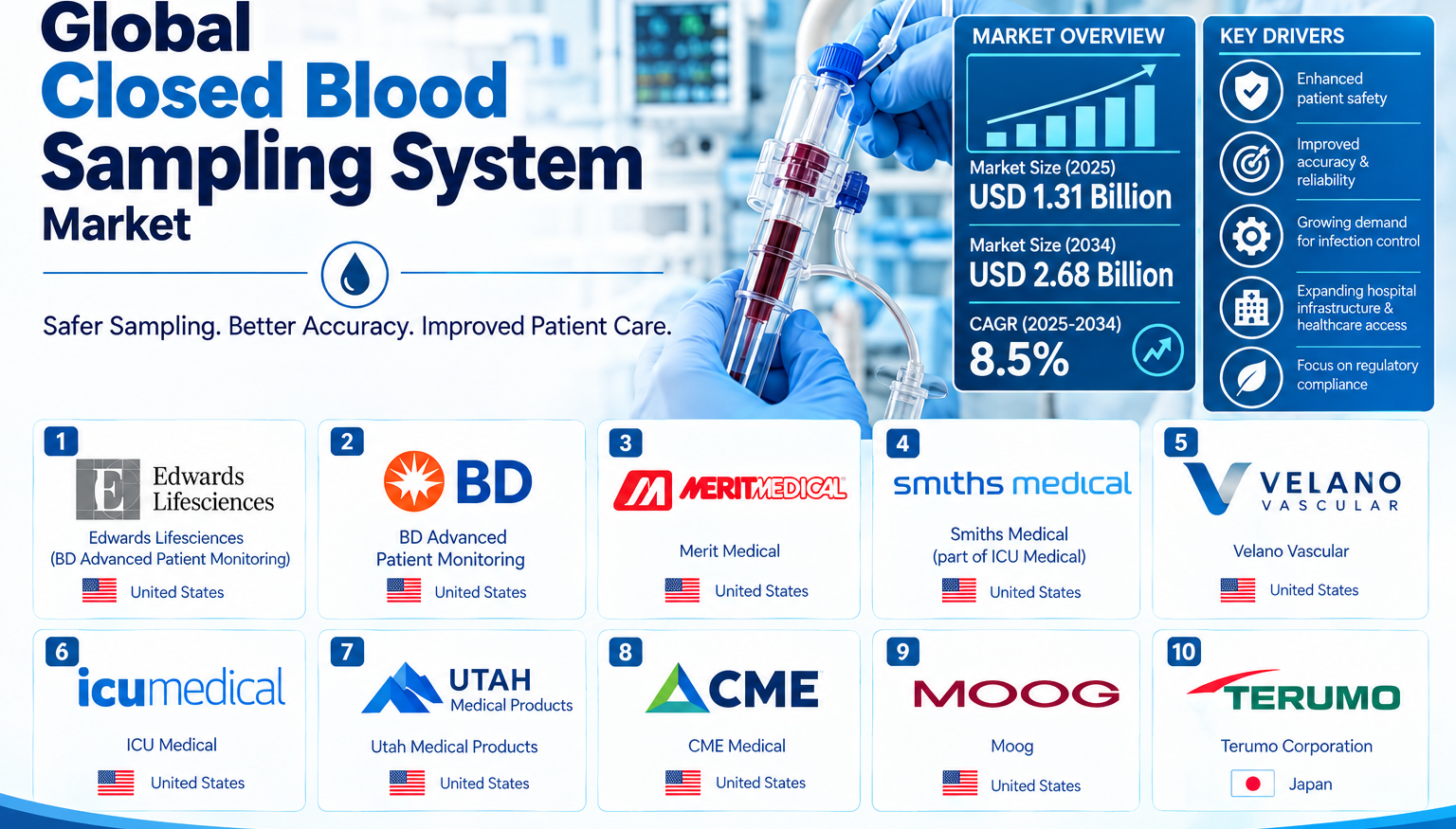
The global closed blood sampling system market was valued at approximately USD 1.31 billion in 2025 and is projected to reach USD 2.68 billion by 2034, expanding at a compound annual growth rate (CAGR) of 8.5% over the forecast period. This growth reflects rising demand for safer blood collection practices in intensive care and surgical settings, growing awareness of hospital-acquired infection risks, and continued innovation in needle-free vascular access technology.
The competitive landscape blends established critical care monitoring companies with specialist vascular access innovators and diversified medical device manufacturers that have built closed sampling technology into broader interventional and cardiovascular portfolios. Because closed blood sampling systems must integrate seamlessly with existing IV and arterial line infrastructure while meeting rigorous infection-control and patient-safety standards, the market rewards companies that combine deep clinical validation with strong hospital distribution relationships.
Understanding which companies lead this focused but growing niche of critical care technology is essential for hospital procurement teams and infection-control programs. This article provides a research-based analysis of the top companies in the global closed blood sampling system market, their positioning, flagship offerings, and the competitive forces shaping the landscape.
Market Overview
|
Parameter |
Details |
|---|---|
|
Market Size (2025) |
USD 1.31 Billion |
|
Projected Market Size (2034) |
USD 2.68 Billion |
|
CAGR (2025–2034) |
8.5% |
|
Base Year |
2023/2024 |
|
Historic Period |
2018–2023 |
|
Forecast Period |
2025–2034 |
|
Leading Region |
North America |
|
Fastest-Growing Region |
Asia-Pacific, led by Japan and China |
|
Key Growth Drivers |
Rising ICU patient volumes, growing infection-control focus, innovation in needle-free vascular access |
|
Key Challenges |
Integration complexity with existing IV infrastructure, cost sensitivity in price-constrained healthcare systems |
|
Key Opportunities |
Needle-free blood draw technology, expansion into ambulatory and outpatient settings, growth in emerging market hospital infrastructure |
Why the Closed Blood Sampling System Market Is Growing
1. Rising ICU and Critical Care Patient Volumes
Critically ill patients frequently require repeated blood sampling for lab monitoring, and closed systems allow clinicians to reinfuse rather than discard the clearing volume of blood, reducing iatrogenic blood loss and the risk of hospital-acquired anemia in intensive care settings.
2. Growing Focus on Infection Control and Patient Safety
Closed blood sampling systems reduce the number of times a line is opened to the outside environment, lowering the risk of catheter-related bloodstream infections and supporting broader hospital infection-control initiatives.
3. Innovation in Needle-Free Vascular Access
New needle-free blood collection technologies that draw samples through existing peripheral IV catheters are reducing the number of separate needle sticks patients endure, improving both patient experience and practitioner safety.
4. Reduced Healthcare Worker Needlestick Exposure
Closed systems minimize direct blood exposure during sampling procedures, addressing occupational safety concerns for nurses and phlebotomists and supporting compliance with needlestick prevention regulations.
5. Expansion of Hemodynamic and Continuous Monitoring
Closed blood sampling systems are frequently used alongside arterial pressure monitoring and hemodynamic monitoring platforms in ICU settings, and continued growth in advanced patient monitoring adoption is supporting parallel demand for compatible closed sampling technology.
6. Growing Healthcare Infrastructure in Emerging Markets
Expanding hospital and ICU capacity across Asia-Pacific and other developing regions is creating new demand for advanced blood sampling technology as healthcare systems modernize critical care practices.
Top Companies in the Global Closed Blood Sampling System Market
- Edwards Lifesciences / BD Advanced Patient Monitoring
- Merit Medical
- Smiths Medical (part of ICU Medical)
- Velano Vascular
- ICU Medical
- Utah Medical Products
1. BD Advanced Patient Monitoring (formerly Edwards Lifesciences Critical Care)
|
Category |
Details |
|---|---|
|
Company Name |
BD Advanced Patient Monitoring (division of Becton, Dickinson and Company); formerly Edwards Lifesciences' Critical Care product group |
|
Headquarters |
Irvine, California, United States (parent BD headquartered in Franklin Lakes, New Jersey) |
|
Founded |
Critical Care business built over decades within Edwards Lifesciences; acquired by BD in 2024 |
|
Employees |
Part of BD's approximately 70,000–74,000 global workforce |
|
Revenue |
Acquired by BD for USD 4.2 Billion in an all-cash transaction completed in September 2024 |
|
Company Overview |
This business is the maker of the VAMP closed blood sampling systems, which use an in-line reservoir to let clinicians reinfuse rather than discard the clearing volume of blood during sampling, historically developed as part of Edwards Lifesciences' Critical Care monitoring portfolio before being sold to BD. |
|
Key Products |
VAMP Closed Blood Sampling Systems, often used alongside TruWave disposable pressure transducers and Acumen hemodynamic monitoring sensors. |
|
Market Position |
A leading name in closed blood sampling technology, now integrated into BD's broader Advanced Patient Monitoring portfolio alongside the BD Alaris Infusion System, creating opportunities for combined closed-loop hemodynamic monitoring and IV therapy solutions. |
|
Recent Developments |
Completed its transition from Edwards Lifesciences to BD in September 2024, with the renamed BD Advanced Patient Monitoring business now positioned to integrate with BD's infusion and monitoring platforms for future closed-loop care innovations. |
|
Strategic Advantages |
Deep clinical heritage in hemodynamic monitoring and closed blood sampling technology, now backed by BD's global distribution scale and integration with the market-leading Alaris infusion platform. |
2. Merit Medical Systems
|
Category |
Details |
|---|---|
|
Company Name |
Merit Medical Systems, Inc. |
|
Headquarters |
South Jordan, Utah, United States |
|
Founded |
1987 |
|
Employees |
Approx. 7,400–7,500 |
|
Revenue |
Approx. USD 1.5–1.6 Billion (FY2025) |
|
Company Overview |
Merit Medical is a leading manufacturer and marketer of proprietary disposable medical devices used in interventional and diagnostic procedures, with a Cardiovascular segment spanning cardiology, radiology, and critical care products including vascular access and blood sampling accessories. |
|
Key Products |
A broad line of interventional cardiology and radiology disposables, including catheters, embolotherapy devices, and critical care access products used alongside blood sampling procedures. |
|
Market Position |
One of the largest independent manufacturers of proprietary disposable medical devices, with a diversified Cardiovascular and Endoscopy product portfolio and continued strategic acquisitions expanding its interventional device reach. |
|
Recent Developments |
Named Martha Aronson as President and CEO in October 2025 and completed the acquisition of PENTAX Medical's relevant assets, continuing its pattern of strategic bolt-on acquisitions to expand its device portfolio. |
|
Strategic Advantages |
Deep in-house manufacturing capabilities supporting quality control across its device portfolio, a diversified interventional product line beyond blood sampling, and a track record of more than 20 strategic acquisitions expanding its market reach. |
3. ICU Medical (including Smiths Medical)
|
Category |
Details |
|---|---|
|
Company Name |
ICU Medical, Inc. |
|
Headquarters |
San Clemente, California, United States |
|
Founded |
1984 |
|
Employees |
Approx. 9,100–14,000 |
|
Revenue |
Approx. USD 2.2–2.3 Billion |
|
Company Overview |
ICU Medical is a medical technology company focused on infusion therapy, vascular access, and vital care, having significantly broadened its vascular access and blood sampling accessory portfolio through its 2022 acquisition of Smiths Medical. |
|
Key Products |
Needle-free IV connectors, closed system transfer devices, and vascular access products used in conjunction with blood sampling procedures across hospital and critical care settings. |
|
Market Position |
A comprehensive provider of clinically essential vascular access and critical care products, competing alongside larger rivals in both infusion systems and vascular access technology following its major acquisitions. |
|
Recent Developments |
Continued integrating Smiths Medical's vascular access and blood sampling accessory lines following the 2022 acquisition, while advancing broader IV Performance Platform innovations across its device portfolio. |
|
Strategic Advantages |
A broadened vascular access and critical care product line strengthened through the Hospira Infusion Systems and Smiths Medical acquisitions, and deep expertise spanning oncology, vascular access, and critical care applications. |
4. Velano Vascular
|
Category |
Details |
|---|---|
|
Company Name |
Velano Vascular, Inc. |
|
Headquarters |
San Francisco, California, United States |
|
Founded |
2012 |
|
Employees |
Small specialized team (venture-backed, approximately a few dozen employees) |
|
Revenue |
Privately held; has raised more than USD 37 million in venture and strategic financing to date |
|
Company Overview |
Velano Vascular is a specialist vascular access technology company focused on transforming inpatient blood draws through its FDA-cleared PIVO needle-free blood collection device, which attaches to an existing peripheral IV catheter to collect venous blood samples without a separate needle stick. |
|
Key Products |
PIVO (Push-In, Twist-Off) needle-free blood collection device, designed to reduce patient pain, bruising, and repeat needle sticks during hospitalization. |
|
Market Position |
A pioneering needle-free blood draw innovator with strategic backing from healthcare industry veterans including former leadership at BD and Baxter International, and established partnerships with major health systems including Intermountain Healthcare, Sutter Health, and Northwestern Medicine. |
|
Recent Developments |
Continued expanding its intellectual property portfolio, having filed nearly 50 patents related to catheters, blood tests, and medical equipment, while deepening partnerships with hospital systems seeking to reduce needle stick exposure. |
|
Strategic Advantages |
A differentiated needle-free approach to blood collection backed by notable healthcare industry investors, strong hospital system relationships, and industry recognition including a Frost & Sullivan Product Leadership Award. |
5. Utah Medical Products
|
Category |
Details |
|---|---|
|
Company Name |
Utah Medical Products, Inc. |
|
Headquarters |
Midvale, Utah, United States |
|
Founded |
1978 |
|
Employees |
Several hundred across its global operations, including its Irish subsidiary Utah Medical Products Ireland |
|
Revenue |
Mid-tier medical device manufacturer with an established niche in obstetrics, gynecology, and critical care disposables |
|
Company Overview |
Utah Medical Products designs, manufactures, and markets a range of disposable medical devices, including specialty catheters, pressure monitoring accessories, and blood sampling components used in neonatal, obstetric, and critical care applications. |
|
Key Products |
Blood pressure monitoring transducers and related disposable accessories used in conjunction with closed blood sampling procedures in hospital critical care settings. |
|
Market Position |
A niche, long-established manufacturer with deep expertise in specialty disposables for critical care and women's health applications, competing on product reliability and focused clinical specialization. |
|
Recent Developments |
Continues to focus on incremental product line expansion within its established niche categories, leveraging decades of manufacturing experience in specialty medical disposables. |
|
Strategic Advantages |
Decades of focused manufacturing experience in specialty critical care and obstetric disposables, a lean and profitable operating model, and an established reputation for product reliability in niche clinical categories. |
Competitive Landscape
The global closed blood sampling system market is led by a mix of large medical technology companies with broad critical care portfolios, including BD (through its newly acquired Advanced Patient Monitoring business) and ICU Medical, alongside specialist vascular access innovators like Velano Vascular and established mid-tier manufacturers like Merit Medical and Utah Medical Products.
Integration with Broader Monitoring Platforms as an Advantage: BD's 2024 acquisition of Edwards Lifesciences' Critical Care business, including the VAMP closed blood sampling system, illustrates how integrating blood sampling technology with broader hemodynamic monitoring and infusion platforms creates opportunities for combined, closed-loop patient care solutions.
Consolidation Through Acquisition: Much like the broader infusion and vascular access space, this market has seen significant consolidation, with ICU Medical's acquisitions of Hospira Infusion Systems and Smiths Medical, and BD's acquisition of Edwards' Critical Care business, concentrating blood sampling and related vascular access technology among fewer, larger players.
Innovation-Driven Differentiation from Smaller Players: Specialist innovators like Velano Vascular compete not on scale but on differentiated, needle-free technology that addresses specific clinical pain points around repeat needle sticks, backed by strategic investment from healthcare industry veterans.
Niche Specialization as a Viable Strategy: Smaller, established manufacturers like Utah Medical Products demonstrate that focused, deep expertise in specific clinical categories can sustain a durable competitive position even without the scale of larger diversified medical device companies.
Emerging Trends in the Closed Blood Sampling System Market
1. Consolidation of Critical Care Portfolios: Large medical technology companies continue to acquire specialized blood sampling and monitoring businesses, as seen in BD's acquisition of Edwards Lifesciences' Critical Care group, to build more comprehensive, integrated critical care offerings.
2. Growth of Needle-Free Blood Collection Technology: Innovations like Velano Vascular's PIVO device are expanding the market beyond traditional arterial line-based closed sampling systems into needle-free peripheral IV-based blood collection.
3. Integration with Hemodynamic Monitoring Platforms: Closed blood sampling systems are increasingly designed to work seamlessly alongside pressure transducers and advanced hemodynamic monitoring sensors, creating more comprehensive critical care monitoring ecosystems.
4. Focus on Reducing Hospital-Acquired Anemia: Growing clinical awareness of iatrogenic blood loss from repeated sampling is driving continued adoption of closed systems that allow blood reinfusion, particularly in ICU settings with critically ill patients.
5. Expansion into Broader Care Settings: While closed blood sampling has traditionally been concentrated in ICU and surgical settings, growing interest in extending safer blood collection technology into general hospital wards and outpatient settings is expanding the addressable market.
Future Outlook (2025–2034)
The global closed blood sampling system market's trajectory toward USD 2.68 billion by 2034 reflects steady, focused growth in a market driven by patient safety, infection control, and healthcare worker protection priorities. The 8.5% CAGR forecast through 2034 assumes continued growth in ICU and critical care patient volumes, ongoing innovation in needle-free vascular access technology, and deepening integration between blood sampling and broader hemodynamic monitoring platforms.
Key investment themes include continued consolidation of blood sampling technology into larger critical care and monitoring portfolios, growth in needle-free blood collection innovation, and expansion of closed sampling technology into new care settings beyond traditional ICU environments. Leading companies including BD's Advanced Patient Monitoring business, ICU Medical, Merit Medical, and innovative specialists like Velano Vascular are likely to shape the market's evolution by combining clinical validation, distribution scale, and continued technology innovation.
Frequently Asked Questions (FAQ)
1. What is the current size of the global closed blood sampling system market?
The global closed blood sampling system market was valued at approximately USD 1.31 billion in 2025 and is projected to reach USD 2.68 billion by 2034, growing at a CAGR of 8.5%.
2. Who are the top companies in the closed blood sampling system market?
Leading companies include Edwards Lifesciences (whose Critical Care business, including its VAMP closed blood sampling system, is now part of BD Advanced Patient Monitoring), Merit Medical, Smiths Medical (part of ICU Medical), Velano Vascular, ICU Medical, and Utah Medical Products.
3. What is the forecast CAGR for the closed blood sampling system market?
The market is forecast to grow at a CAGR of 8.5% from 2025 to 2034.
4. What are the main growth drivers for this market?
Key drivers include rising ICU and critical care patient volumes, growing focus on infection control and patient safety, and continued innovation in needle-free vascular access technology.
5. What happened to Edwards Lifesciences' closed blood sampling business?
Edwards Lifesciences sold its entire Critical Care product group, including its VAMP closed blood sampling systems, to BD (Becton, Dickinson and Company) in an all-cash transaction valued at USD 4.2 billion, completed in September 2024 and renamed BD Advanced Patient Monitoring.
6. What is needle-free blood collection technology?
Needle-free blood collection devices, such as Velano Vascular's PIVO, attach to an existing peripheral IV catheter to draw a venous blood sample without requiring a separate needle stick, reducing patient pain and improving practitioner safety compared to traditional venipuncture.
7. Which end-use setting drives the most demand for closed blood sampling systems?
Hospitals and surgical clinics represent the largest end-use segment, given the concentration of critical care and ICU patients who require frequent blood monitoring, while diagnostic centers represent a smaller but growing segment of demand.
Conclusion
The global closed blood sampling system market sits at the intersection of patient safety, infection control, and critical care monitoring, addressing a specific but persistent clinical challenge in how hospitals safely collect blood from vulnerable patients. With a projected size of USD 2.68 billion by 2034 at a 8.5% CAGR, the sector offers strong growth potential for companies that can combine clinical validation with integration into broader monitoring and infusion ecosystems.
BD's 2024 acquisition of Edwards Lifesciences' Critical Care business signals how larger medical technology companies are consolidating blood sampling technology into comprehensive critical care portfolios, while specialist innovators like Velano Vascular continue pushing the boundaries of needle-free blood collection, and established players like Merit Medical and Utah Medical Products maintain durable niche positions. The companies that successfully integrate closed blood sampling with broader hemodynamic monitoring and reduce hospital-acquired blood loss will define market leadership through 2034 and beyond.