
Companies in the Global Energy Drinks Market Top Leading Companies Blog
Author:
Intellectual Market Insights Research
Published Date:
12 Oct 2026
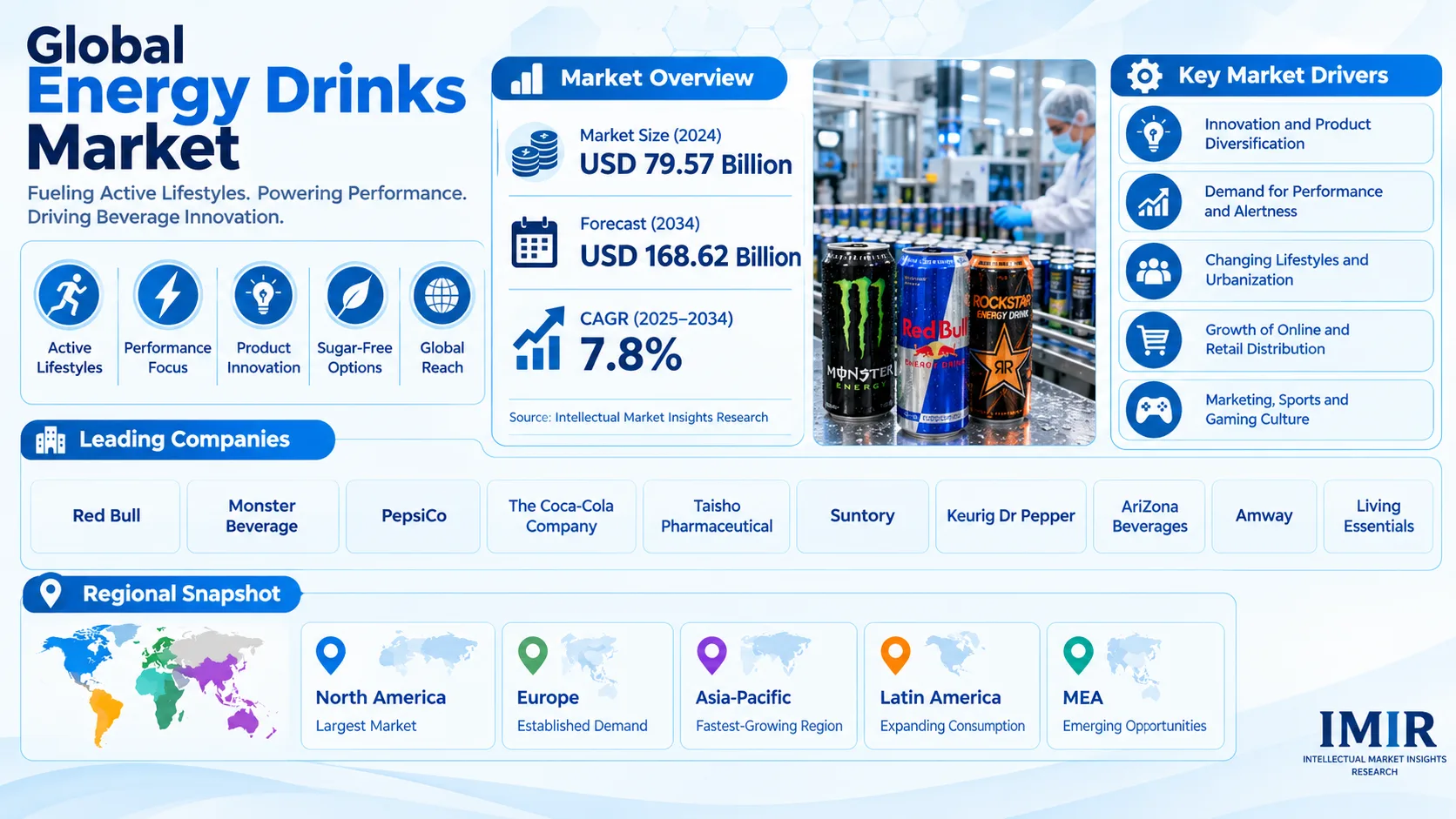
Global Energy Drink Market: Size, Leading Companies, Trends and Outlook (2025–2034)
Market Overview and Forecast: According to IMIR, the global energy drink market was valued at about USD 79.57 billion in 2024 and is projected to reach USD 168.62 billion by 2034, growing at a CAGR of 7.8% over 2025–2034.
Energy drinks are beverages that combine caffeine with ingredients such as taurine, B-vitamins, amino acids, ginseng and sugar or sweeteners, and are sold to help consumers stay alert and active. They come as canned drinks, bottles and small "energy shots."
Once a niche for athletes and night-shift workers, energy drinks are now a mainstream category in convenience stores, supermarkets and vending channels. The category has changed quickly in recent years: zero-sugar and "better-for-you" brands have taken share, women and Gen Z buyers have become major consumers, and big beverage companies have bought or invested in fast-growing brands.
This blog covers the size of the market, what is driving growth, the companies named by IMIR, recent changes in ownership, and the outlook to 2034.
Why the Energy Drink Market Is Growing
1. Demand for convenient energy and focus. Busy lifestyles, long work hours, gaming and fitness routines keep driving everyday consumption.
2. Zero-sugar and functional formulas. Zero-sugar versions are among the biggest growth drivers. Red Bull Zero, widely released in January 2025, grew nearly 200% in the US in the year to March 2026, and Monster's Ultra and Zero Sugar lines were among its biggest gainers.
3. New consumer groups. Brands such as Alani Nu and Celsius target women and wellness-oriented buyers with flavour, design and "fitness" positioning, and sales have nearly doubled for the leading newer brands.
4. Strong international growth. Monster's sales outside the US rose 34.6% in Q2 2026, about 46% of its total, and Celsius is expanding into the Nordics, Iberia and the UK.
5. Distribution power. Partnerships with PepsiCo and Coca-Cola bottlers give brands access to large retail and convenience networks. Alani Nu's move into PepsiCo's distribution system in 2026 is a recent example.
6. Marketing and sponsorship. Sports, music, gaming and social-media marketing build brand loyalty. Monster's Q2 2026 operating expenses increased mainly because of higher social, digital and media spend.
7. Premiumisation and variety. More flavours, sizes, multipacks and functional claims (focus, hydration, vitamins) support higher price points.
Companies Associated with the Energy Drink Market
| Company | HQ | Main Energy Brands | Latest Verifiable Point |
|---|---|---|---|
| Red Bull GmbH | Fuschl am See, Austria | Red Bull | 2025 net sales EUR 12.2B (+8.6%); about 14B cans |
| Monster Beverage | Corona, USA | Monster, Reign, NOS, Bang | Q2 2026 net sales USD 2.54B (+20.2%) |
| PepsiCo | Purchase, USA | Mountain Dew energy; distributes Celsius, Alani Nu | About 11% Celsius stake (reported) |
| The Coca-Cola Company | Atlanta, USA | Distributes Monster | Strategic Monster shareholder |
| Keurig Dr Pepper | Burlington / Frisco, USA | Ghost (majority) | JDE Peet's acquired Apr 2026; split planned |
| Suntory Holdings | Osaka, Japan | V Energy, Lucozade Energy | Revenue not disclosed |
| Taisho Pharmaceutical | Tokyo, Japan | Lipovitan D | Revenue not disclosed |
| Amway | Ada, USA | XS | Revenue not disclosed |
| AriZona Beverages | Woodbury, USA | AriZona energy range | Private; not disclosed |
| Living Essentials | Farmington Hills, USA | 5-hour Energy | Private; not disclosed |
| Celsius Holdings (other) | Boca Raton, USA | Celsius, Alani Nu, Rockstar | Q2 2026 revenue USD 817.9M |
Competitive Landscape
- Highly concentrated. In the US, the top five companies make up over 90% of energy drink sales. Monster has the largest dollar share, Red Bull is second, and Celsius has grown fastest.
- Distribution is a competitive weapon. Monster relies on Coca-Cola's bottlers, Celsius and Alani Nu on PepsiCo, and Red Bull on its own and partner distributors. Changes in distribution deals can quickly move sales and profit, as Celsius's termination fees showed.
- Growth is shifting between brands. In the year to March 2026, Alani Nu nearly doubled, Red Bull Zero grew nearly 200%, Celsius's namesake brand grew about 9%, while Bang fell over 4% and Rockstar fell 7%. In Q2 2026, Celsius brand revenue fell 11.7% as the company cut SKUs.
- M&A speculation. Analysts have discussed possible buyers for Celsius (for example PepsiCo, Coca-Cola or Monster), though no deal has been reported and antitrust concerns would apply.
- Regulatory pressure. The EU probe into Red Bull and ongoing debate on caffeine labelling and sales to minors could affect competition.
- Asian and regional brands. Taisho (Lipovitan), Osotspa (M-150), Suntory (V) and others hold strong positions in Asia-Pacific.
Regional Analysis
IMIR's regional percentages are placeholders, so this section is qualitative. IMIR describes Asia-Pacific as the fastest-growing region, with a CAGR above 9%.
North America is the largest and most competitive market. US retail data shows double-digit growth, with the convenience store channel central to sales and fierce competition in zero-sugar and women-focused brands.
Europe is a large market led by Red Bull and Monster, with growth in sugar-free products and new entrants such as Celsius. Regulation, including sugar taxes, age limits on sales to minors and the EU probe into Red Bull, shapes the market.
Asia-Pacific is the fastest-growing region. Japan, Thailand, China, India and Southeast Asia have long traditions of energy tonics and drinks (Lipovitan, M-150, V), and rising incomes and urban populations add growth.
Latin America. Brazil and Mexico are growing markets with strong demand for value-priced energy drinks and expansion by global brands.
Middle East & Africa. Gulf states and South Africa are growing, with demand from young populations, though some countries restrict sales or set caffeine limits.
Emerging Trends
- Zero-sugar everything. The strongest gains come from zero-sugar launches by Red Bull, Monster and Celsius.
- Female and wellness-focused positioning. Alani Nu and similar brands use flavour, design and "clean" claims to attract new buyers.
- Functional ingredients. Added vitamins, electrolytes, nootropics, natural caffeine and "clean label" formulas are becoming common.
- Portfolio reshuffling. Large beverage companies buy, invest in or distribute fast-growing brands (Monster-Bang, Celsius-Alani Nu and Rockstar, KDP-Ghost).
- International expansion. Brands are pushing into Europe, Asia-Pacific and Latin America, where per-capita consumption is lower than in the US.
- Multipacks and value formats. Larger cans and multipacks respond to price-sensitive shoppers and are the focus of the EU's Red Bull probe.
- Direct-to-consumer and e-commerce. Online sales and subscriptions are growing, especially for niche and functional brands.
- Health scrutiny. Regulators and researchers continue to examine caffeine and sugar levels, particularly for teenagers.
Future Outlook (2025–2034)
IMIR's forecast covers 2025–2034: from about USD 79.57 billion in 2024 to USD 168.62 billion in 2034, at a 7.8% CAGR.
- 2025–2027. Growth is led by zero-sugar launches, new-consumer brands and international expansion. Distribution deals and possible acquisitions reshape competition.
- 2028–2030. Asia-Pacific, Latin America and the Middle East & Africa add volume as per-capita consumption rises. Functional and "better-for-you" products grow share.
- 2031–2034. The market matures in North America, while emerging markets and new formats (shots, powders, hydration blends) continue to expand.
Risks: health and regulatory scrutiny, input-cost inflation (aluminium, sweeteners, caffeine), shifts in distribution agreements, brand fads, and antitrust limits on consolidation.
Opportunities: sugar-free and functional formulas, emerging markets, women and Gen Z buyers, private-label and value ranges, and partnerships with sports and gaming.
FAQ
Q1. How big is the global energy drink market?
IMIR values it at about USD 79.57 billion in 2024, rising to USD 168.62 billion by 2034.
Q2. What is the expected growth rate?
A CAGR of 7.8% from 2025 to 2034, per IMIR.
Q3. Who are the leading companies?
Red Bull, Monster Beverage, PepsiCo, The Coca-Cola Company, Keurig Dr Pepper, Suntory, Taisho, Amway, AriZona Beverages and Living Essentials are named by IMIR. Celsius Holdings is also a major player.
Q4. Which region will grow fastest?
IMIR points to Asia-Pacific (CAGR above 9%). North America is the largest market.
Q5. What are the main product segments?
Energy drinks and energy shots, in organic and conventional types, sold in cans, bottles and other packaging, through on-trade and off-trade channels.
Q6. What is driving growth?
Convenience, zero-sugar innovation, new consumer groups, international expansion and strong distribution partnerships.
Q7. Has the ownership of any key brands changed recently?
Yes. Monster bought Bang (2023), Celsius bought Alani Nu (2025) and now owns Rockstar, and Keurig Dr Pepper acquired JDE Peet's in 2026 and holds a majority of Ghost.
Q8. What are the main risks?
Health regulation, ingredient and packaging costs, distribution changes and intense brand competition.
Q9. Is the US market still growing?
Yes. Retail data shows about 14% growth in US energy drink sales for the year to March 2026.
Conclusion
The energy drink market is large, concentrated and still growing quickly. IMIR projects it will expand from about USD 79.57 billion in 2024 to USD 168.62 billion by 2034, a CAGR of 7.8%, as zero-sugar products, new consumer segments and emerging markets add volume. Recent results back that picture: Monster's Q2 2026 net sales rose 20.2%, Red Bull posted record 2025 sales of EUR 12.2 billion, and US category sales grew nearly 14%.
For brands, the winners will combine strong distribution, zero-sugar and functional innovation, and international reach. For investors and partners, the main watch points are consolidation, regulation and the shifting balance between established leaders and fast-growing challengers.