The Global Data Fabric Market: Trends, Growth Drivers, and What Comes Next
Author:
Intellectual Market Insights Research
Published Date:
14 Jul 2026
The Global Data Fabric Market: A Complete Guide to Trends, Drivers, and What Comes Next
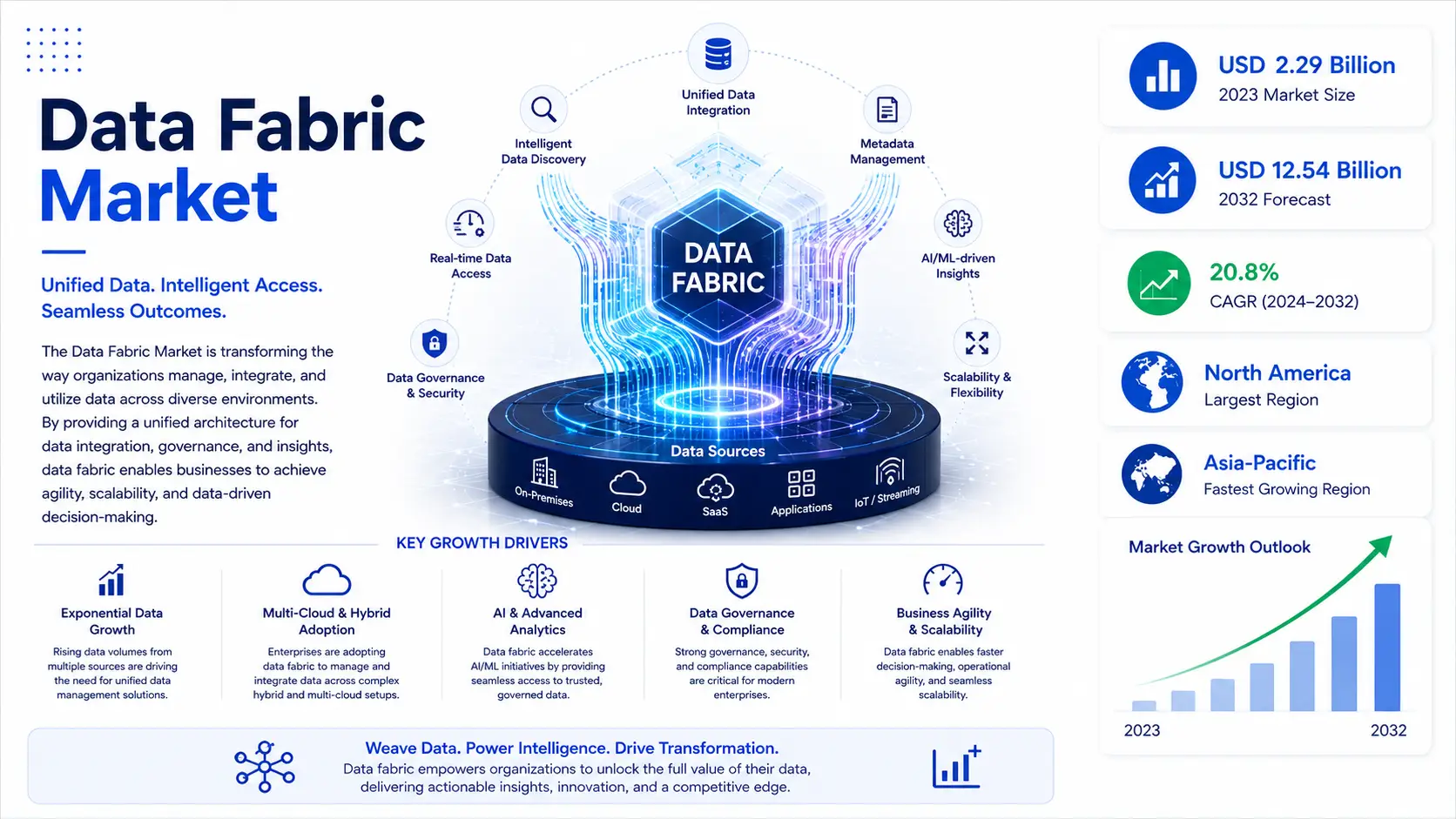
The data fabric market refers to the software, platforms, and services that help organizations connect, govern, and deliver data across cloud, on-premises, and hybrid systems through a metadata-driven architecture rather than manual, point-to-point integration. Multiple independent research firms currently size the global market in the low single-digit billions of dollars, with most projecting it to grow several times over by the early 2030s as enterprises scale AI, real-time analytics, and multi-cloud operations. Leading vendors include IBM, Informatica, SAP, Oracle, Denodo, Microsoft, and Qlik (which now owns Talend).
Market Overview
Every enterprise today sits on top of a sprawling, uneven landscape of data. Customer records live in a CRM. Transaction data sits in a data warehouse. Product telemetry streams from IoT sensors. Financial data is locked inside an ERP system. Marketing data lives in a dozen SaaS tools. For most of the last two decades, the default answer to "how do we make sense of all this?" was to physically move everything into one place — a data warehouse, then a data lake, then a lakehouse — and hope integration teams could keep up with the pace of change.
That approach is straining under its own weight. Data volumes have grown faster than integration teams can be hired. Cloud adoption has multiplied the number of systems that need to talk to each other. And the arrival of enterprise AI has raised the bar further still: machine learning models and AI agents need trustworthy, well-governed, up-to-date data on demand, not a nightly batch job that ran twelve hours ago.
The data fabric market has emerged directly out of this tension. Rather than forcing every dataset into a single physical location, a data fabric creates an intelligent, metadata-driven layer that connects data wherever it resides — in place, where possible — and automates much of the discovery, integration, and governance work that used to require armies of engineers writing custom pipelines. Gartner, which popularized the term as a formal architectural concept, describes it as a way to help organizations manage growing, distributed data assets by leveraging metadata to automate and improve data management tasks</cite>.
For business leaders, the appeal is less about the underlying plumbing and more about outcomes: faster access to trustworthy data, lower integration costs, stronger governance, and a foundation that can actually support enterprise AI at scale. This guide walks through what the data fabric market is, how the technology works, who the major players are, and where the market is realistically headed — grounded in publicly available research and industry reporting rather than speculation.
Quick Facts Table
|
Metric |
Detail |
|---|---|
|
Market concept origin |
Popularized by Gartner as a data management and integration design pattern |
|
Core mechanism |
Active metadata, automation, and a unified access layer across distributed data sources |
|
Market size estimates (2024–2025) |
Independent analyst estimates range from roughly USD 2.4–3.2 billion, depending on scope and methodology |
|
Projected market size (2030–2035) |
Estimates from various research firms range from roughly USD 8 billion to over USD 13 billion, depending on the forecast horizon and methodology |
|
Typical CAGR cited |
Estimates across firms commonly fall in the 15%–26% range for various forecast windows — figures vary significantly by research provider |
|
Largest reported end-use segment |
Banking, Financial Services, and Insurance (BFSI), per multiple market research firms |
|
Region with largest reported share |
North America, per multiple market research firms |
|
Fastest-growing region (commonly cited) |
Asia-Pacific |
|
Competing/complementary architecture |
Data mesh (domain-oriented, decentralized ownership model) |
|
Notable 2026 vendor consolidation |
Talend is now part of Qlik, following Qlik's earlier acquisition of Talend |
Note: Because "data fabric market" is defined differently across research houses (some include only software, others bundle in services, adjacent data governance, or data integration tooling), size and growth figures vary meaningfully between reports. Readers evaluating vendors or investment decisions should treat any single figure as directional rather than definitive, and consult primary source reports for methodology.
Key Takeaways
- A data fabric is an architectural approach, not a single product — no vendor currently delivers every capability out of the box.
- It relies on active metadata: metadata that is continuously analyzed and acted on, rather than passively logged and forgotten.
- The market spans software platforms (data virtualization, cataloging, integration, governance) and professional services.
- BFSI, healthcare, retail, and manufacturing are consistently cited as leading adopter industries.
- North America currently holds the largest reported regional share; Asia-Pacific is frequently cited as the fastest-growing region.
- Data fabric and data mesh are often discussed as rivals but are increasingly implemented together in practice.
- AI and agentic systems are becoming a primary growth driver, since trustworthy, well-governed data is a prerequisite for reliable AI outputs.
- The competitive landscape includes long-established enterprise software vendors (IBM, SAP, Oracle, Informatica) alongside specialists in virtualization (Denodo), cataloging (Atlan, Alation, Collibra), and cloud-native platforms (Microsoft Fabric, Databricks).
What Is a Data Fabric?
A data fabric is a data management architecture designed to connect, integrate, and deliver data from dispersed sources without requiring every dataset to be physically consolidated first. Gartner describes it as a distributed, decentralized data analytics and management framework, or data integration layer design pattern
In practical terms, a data fabric sits above an organization's existing databases, data warehouses, data lakes, applications, and cloud platforms. It continuously scans these systems, collects metadata about what data exists, how it's used, who touches it, and how it relates to other data, and uses that metadata to automate tasks that used to be manual: discovering relevant datasets, mapping relationships between them, enforcing governance rules, and delivering the right data to the right consumer — human or machine — in the right format.
A useful mental model: think of a data fabric less as a warehouse and more as an air-traffic-control system for enterprise data. It doesn't necessarily move every plane (dataset) to one airport (central repository). Instead, it knows where every plane is, what it's carrying, who's authorized to access it, and how to route requests efficiently and safely.
It's worth being precise about the boundaries of the concept. As multiple research firms note, data fabric is an emerging data management design that uses metadata to automate data management tasks and eliminate manual data integration but it is not a mature, fully standardized technology, and no single vendor currently delivers every data fabric component. Most real-world implementations are composed of several tools working together — a catalog, a virtualization layer, a governance suite, and orchestration tooling — rather than one monolithic product.
Why Is It Important?
Three structural pressures explain why data fabric adoption has accelerated:
1. Data has outgrown centralization. Multi-cloud strategies, SaaS sprawl, edge computing, and IoT have made it increasingly impractical — and expensive — to physically move all enterprise data into one warehouse before anyone can use it.
2. Talent hasn't kept pace with demand. Skilled data engineers remain scarce relative to the volume of integration work enterprises need done. Automating discovery, mapping, and quality checks reduces dependency on manual pipeline-building.
3. AI has raised the stakes on data trust. Machine learning models and AI agents are only as reliable as the data feeding them. A data fabric's governance and lineage capabilities give organizations a way to know where data came from, whether it's current, and whether it's safe to use in an automated decision — something that's increasingly a compliance requirement as well as a technical one.
For business leaders specifically, data fabric adoption is generally framed around three outcomes: faster time-to-insight, lower total cost of data integration over time, and reduced risk from inconsistent or ungoverned data feeding into regulatory reporting, customer-facing systems, or AI models.
How It Works
A data fabric is best understood as a layered, ongoing process rather than a one-time setup. While implementations vary by vendor, the typical operating sequence looks like this:
- Connect to source systems. The fabric establishes connections to databases, data warehouses, lakes, SaaS applications, APIs, and streaming sources across the enterprise — without necessarily replicating all the underlying data.
- Harvest metadata. Technical metadata (schemas, formats), operational metadata (usage patterns, freshness), business metadata (definitions, ownership), and social metadata (who uses what, and how) are collected continuously.
- Build and enrich a knowledge graph. The fabric analyzes relationships between datasets — which tables relate to which customers, which fields mean the same thing across systems — often using AI/ML to detect these connections automatically.
- Convert passive metadata into active metadata. This is the defining step: instead of metadata simply being logged and stored, the system actively uses it to trigger recommendations, alerts, or automated actions — for example, flagging a duplicate customer record or automatically applying a masking policy to a newly discovered sensitive field.
- Apply governance and semantics. Business definitions, access policies, and compliance rules are layered on so that "revenue," "active customer," or "churn" mean the same thing no matter which team or system is asking.
- Deliver data to consumers. Through APIs, virtualized queries, or curated data products, the fabric serves data to BI dashboards, applications, data scientists, and — increasingly — AI agents, ideally without each consumer needing to know where the underlying data physically lives.
- Monitor, learn, and refine. The system observes how data is actually used and continuously improves recommendations, catalog quality, and automation rules over time.
Core Components
|
Component |
Function |
|---|---|
|
Augmented data catalog |
Uses AI/ML to automatically discover, tag, and classify data assets across source systems |
|
Data virtualization / federation layer |
Allows queries to run across multiple source systems without physically moving or duplicating data |
|
Active metadata management |
Continuously analyzes metadata and converts it into automated actions and recommendations |
|
Semantic layer |
Standardizes business definitions and terminology so data means the same thing across the organization |
|
Data integration and orchestration |
Manages how data moves, transforms, and synchronizes between systems where physical movement is still required |
|
Data governance and security |
Enforces access controls, privacy rules, and regulatory compliance consistently across all connected sources |
|
Data quality and observability |
Monitors freshness, accuracy, and completeness, and flags anomalies before they reach downstream users |
|
Knowledge graph |
Maps relationships between datasets, business terms, and usage patterns to support discovery and recommendations |
|
APIs and delivery layer |
Exposes governed data to applications, analytics tools, and AI systems in consumable formats |
No two vendor implementations combine these components identically — this is part of why buyers are advised to scope their needs (governance-first vs. platform-consolidation, for instance) before evaluating tools.
Types of Data Fabric Architecture
Industry analysis generally groups data fabric implementations into three broad architectural approaches:
Virtualization-first fabrics query data where it lives, using a logical access layer rather than physically relocating it. This approach, associated most closely with data virtualization vendors, typically offers faster initial deployment because it avoids large-scale data movement projects, though query performance depends on the speed of underlying source systems.
Integration-led fabrics build on traditional ETL/ELT pipelines, adding governance, cataloging, and automation on top of established data movement processes. This suits organizations with mature integration practices that want to modernize incrementally rather than replace their approach.
Platform-centric fabrics consolidate storage, compute, transformation, and analytics into a single unified environment, often tied to a specific cloud ecosystem. These platforms trade some vendor flexibility for a more seamless, "single pane of glass" experience.
Most enterprises, in practice, end up with a hybrid of these approaches — a base platform supplemented by specialist tools for cataloging, virtualization, or governance where the primary platform falls short.
Market Drivers
Explosive, fragmented data growth. The sheer volume and variety of enterprise data — structured, unstructured, streaming, and semi-structured — has outpaced what manual integration processes can handle, pushing organizations toward automated approaches.
Multi-cloud and hybrid cloud adoption. As enterprises spread workloads across multiple cloud providers alongside on-premises systems, the need for a unifying access and governance layer becomes less optional and more foundational.
Enterprise AI and machine learning initiatives. AI systems require consistent, trustworthy, well-labeled data at scale. Data fabric's metadata and governance capabilities are increasingly framed as prerequisite infrastructure for reliable AI deployment, including agentic AI use cases that need governed, real-time access to enterprise data.
Regulatory and compliance pressure. Rules such as GDPR, sector-specific financial regulations, and data residency requirements push organizations to invest in consistent governance, lineage tracking, and access control across all their data — something a fragmented integration landscape struggles to deliver.
Real-time and operational analytics demand. Batch processing is no longer sufficient for use cases like fraud detection, dynamic pricing, or supply chain response. Data fabrics that support real-time or near-real-time data delivery address this gap directly.
Cost pressure on data engineering. Automating discovery, mapping, and integration tasks reduces the ongoing engineering burden of maintaining brittle, custom-built pipelines — a meaningful consideration as organizations look to control the cost of data operations.
IoT and edge computing expansion. As more data is generated outside the traditional data center — in factories, vehicles, and connected devices — architectures that can incorporate distributed, edge-generated data without requiring full centralization become more valuable.
Opportunities
AI-ready data infrastructure. Organizations building internal AI and agentic systems have a clear, measurable reason to invest in governed, discoverable, real-time data — positioning data fabric as foundational rather than optional infrastructure.
Mid-market expansion. As vendors introduce more modular, lower-friction offerings, adoption is extending beyond large enterprises into mid-sized organizations that previously found full-scale data fabric deployments cost-prohibitive.
Vertical-specific fabrics. Purpose-built data fabric capabilities for regulated industries — healthcare interoperability, financial services compliance — represent a growing niche within the broader market.
Convergence with data mesh. Rather than being purely competitive, many organizations are blending centralized data fabric governance with decentralized data mesh ownership models, creating opportunities for vendors who support both patterns.
Managed and consulting services. Given the skills gap, systems integrators and managed service providers have room to grow their role in designing, deploying, and operating data fabric environments on behalf of enterprises that lack in-house expertise.
Leading Companies
IBM
- Headquarters: Armonk, New York, United States
- Main offerings: IBM Cloud Pak for Data, Watson Knowledge Catalog, watsonx.data
- Strategic strengths: Long-established data integration, quality, master data management, and governance portfolio, expanded through acquisitions including Databand for data pipeline observability in 2022, and Manta for data lineage and StepZen for GraphQL support in 2023
- Publicly known focus areas: Hybrid and multi-cloud data governance, AI-infused data management for regulated industries such as banking and healthcare
Informatica
- Headquarters: Redwood City, California, United States
- Main offerings: Intelligent Data Management Cloud (IDMC), including cataloging, integration, governance, and master data management
- Strategic strengths: A semantic layer-centered reference architecture connecting governance, catalog, orchestration, and AI/ML integrations, supported by its Claire AI service that continuously analyzes new data to populate the semantic layer automatically
- Publicly known focus areas: Knowledge graphs, process automation, and enterprise-scale data democratization
SAP
- Headquarters: Walldorf, Germany
- Main offerings: SAP Datasphere, Business Technology Platform (BTP) data integration capabilities
- Strategic strengths: Deep native integration with SAP's ERP and business applications ecosystem, with semantic modeling designed to preserve business context during integration
- Publicly known focus areas: Enterprises with a strong existing SAP footprint that need to extend governance and integration to non-SAP data sources
Oracle
- Headquarters: Austin, Texas, United States
- Main offerings: Oracle Cloud Infrastructure Data Integration and related database and analytics tooling
- Strategic strengths: Deep database engineering expertise and tight integration with Oracle's broader cloud infrastructure and application stack
- Publicly known focus areas: Automated schema mapping, machine learning-driven data quality management, and integration across hybrid Oracle environments
Denodo
- Headquarters: Palo Alto, California, United States
- Main offerings: Denodo Platform, a logical data management and virtualization solution
- Strategic strengths: Recognized as a leading pure-play data virtualization vendor, emphasizing fast time-to-value through querying data in place rather than physically relocating it; a member of the Open Semantic Interchange initiative for vendor-neutral business semantics
- Publicly known focus areas: Hybrid and multi-cloud federated query performance, AI-ready and business-ready data delivery
Microsoft
- Headquarters: Redmond, Washington, United States
- Main offerings: Microsoft Fabric, a unified SaaS analytics platform spanning data engineering, warehousing, real-time intelligence, and Power BI, built around the OneLake centralized data lake
- Strategic strengths: Deep integration across the Microsoft ecosystem, particularly for organizations already using Azure, Power BI, and Microsoft 365
- Publicly known focus areas: Consumption-based analytics platform consolidation for Azure-centric enterprises
Qlik (including Talend)
- Headquarters: King of Prussia, Pennsylvania, United States
- Main offerings: Qlik Cloud analytics, combined with Talend's data integration and governance capabilities following their consolidation
- Strategic strengths: Combines traditional ETL-based integration strength with analytics and, more recently, decentralized data capabilities
- Publicly known focus areas: Comprehensive data management and governance for organizations seeking an integration-led approach
TIBCO Software
- Headquarters: Palo Alto, California, United States
- Main offerings: TIBCO Data Virtualization and broader integration and analytics tooling
- Strategic strengths: Established presence in real-time data integration and event-driven architectures
- Publicly known focus areas: Hybrid data access layers for large, complex enterprise environments
Note: Company details above reflect publicly available product and positioning information. Market share and revenue figures attributed to individual vendors vary across third-party research reports and are not independently verified here; readers seeking precise competitive share data should consult primary analyst reports directly.
Market Segmentation
Research firms typically segment the data fabric market along the following dimensions:
- By component: Software (solutions) and services — with the solutions segment generally reported as holding the larger revenue share, while services are frequently cited as the faster-growing segment as organizations seek implementation and consulting support.
- By deployment mode: On-premises, cloud, and hybrid — with cloud and hybrid deployment models generally gaining share over purely on-premises approaches.
- By organization size: large enterprises versus small and medium-sized businesses, with large enterprises currently representing the bulk of spending.
- By business application: Common categories include customer experience management, fraud detection and security management, governance/risk/compliance (GRC), and business process management.
- By industry vertical: BFSI, healthcare and life sciences, retail and e-commerce, manufacturing, IT and telecom, government, and others.
- By region: North America, Europe, Asia-Pacific, Latin America, and Middle East & Africa.
Regional Analysis
North America
Consistently reported as the largest regional market, reflecting early cloud adoption, a dense concentration of data-intensive BFSI, healthcare, and technology companies, and a mature vendor ecosystem headquartered largely in the United States.
Europe
Growth in the region is closely tied to regulatory drivers — GDPR compliance, data sovereignty requirements, and sector-specific rules in financial services and healthcare — which push organizations toward stronger governance and lineage capabilities as a baseline requirement rather than a differentiator.
Asia-Pacific
Frequently cited by research firms as the fastest-growing region, driven by rapid digital transformation, expanding cloud infrastructure investment, and rising IT spending among enterprises in markets such as China, India, Japan, and Southeast Asia looking to modernize legacy data environments.
Latin America
A smaller but growing market, with adoption concentrated among larger enterprises and financial institutions in economies such as Brazil and Mexico, often paired with broader cloud migration initiatives.
Middle East & Africa
Growth here is linked to government-led digital transformation programs and expanding investment in cloud and data infrastructure, particularly in Gulf Cooperation Council countries, though the region generally represents a smaller share of global spend than other regions.
Frequently Asked Questions
1. What is a data fabric in simple terms? A data fabric is a technology architecture that connects and manages an organization's data across different systems using automated, metadata-driven processes, rather than requiring all the data to be physically consolidated first.
2. Is data fabric a specific product or a broader concept? It's an architectural concept and design pattern, not a single product. Most organizations implement a data fabric using a combination of tools from one or more vendors.
3. How is data fabric different from a data warehouse? A data warehouse is a physical repository where data is consolidated and structured for analysis. A data fabric is a broader architectural layer that can connect to a data warehouse as one of many sources, without requiring everything to live there.
4. How is data fabric different from data mesh? Data fabric emphasizes centralized, automated, metadata-driven governance across the enterprise. Data mesh emphasizes decentralized ownership, where individual business domains manage their own data as products. Many organizations combine elements of both.
5. Who invented the term "data fabric"? The term has been used by multiple vendors and analysts over the years, but Gartner is widely credited with formalizing it as a structured architectural concept and design pattern.
6. What industries use data fabric the most? Banking, financial services, and insurance (BFSI) is consistently cited as the leading adopter industry, followed by healthcare, retail, and manufacturing.
7. How big is the global data fabric market? Estimates vary by research firm, generally placing the market in the low single-digit billions of dollars currently, with most projecting substantial growth by the early 2030s. See the Quick Facts table above for a range of cited figures.
8. What are the main components of a data fabric? Common components include an augmented data catalog, data virtualization or federation layer, active metadata management, a semantic layer, integration and orchestration tooling, governance and security controls, and data quality monitoring.
9. Does implementing a data fabric require replacing existing systems? No. A key appeal of the approach is that it can connect to and augment existing data warehouses, lakes, and applications rather than requiring a full replacement.
10. What is "active metadata"? Active metadata is metadata that a system continuously analyzes and acts on — triggering alerts, recommendations, or automated actions — as opposed to passive metadata, which is simply logged and stored without further use.
Conclusion
The data fabric market sits at the intersection of two forces that aren't going away anytime soon: the relentless growth and fragmentation of enterprise data, and the rising demand for trustworthy, governed data to power both human decision-making and AI systems. While the technology remains genuinely early-stage — no single vendor yet delivers a complete solution, and the market's size estimates vary considerably across research firms — the underlying direction is consistent across independent sources: organizations are investing more, not less, in architectures that connect and govern data without forcing full physical consolidation.
For business leaders, technology teams, and investors evaluating this space, the practical takeaway is to focus less on market-size headlines and more on architectural fit: which combination of cataloging, virtualization, integration, and governance capabilities actually solves your organization's specific data fragmentation problem. For readers who want a deeper, structured breakdown of market sizing, segmentation, and competitive positioning, IMIR's full Data Fabric Market Size and Share Analysis report provides a more granular, data-driven view to support that evaluation.