
Depression Treatment Devices Market Size, Share & Growth Forecast 2026-2035
Author:
Intellectual Market Insights Research
Published Date:
13 Jun 2026
Depression Treatment Devices Market Size, Share & Growth Forecast 2026-2035
Introduction
Mental health is one of the defining healthcare challenges of the 21st century — and depression sits at its center. The World Health Organization estimates that more than 280 million people worldwide live with depression, making it one of the leading causes of disability globally. As pharmaceutical approaches show their limits — particularly for treatment-resistant patients — a rapidly expanding market for depression treatment devices is filling the gap.
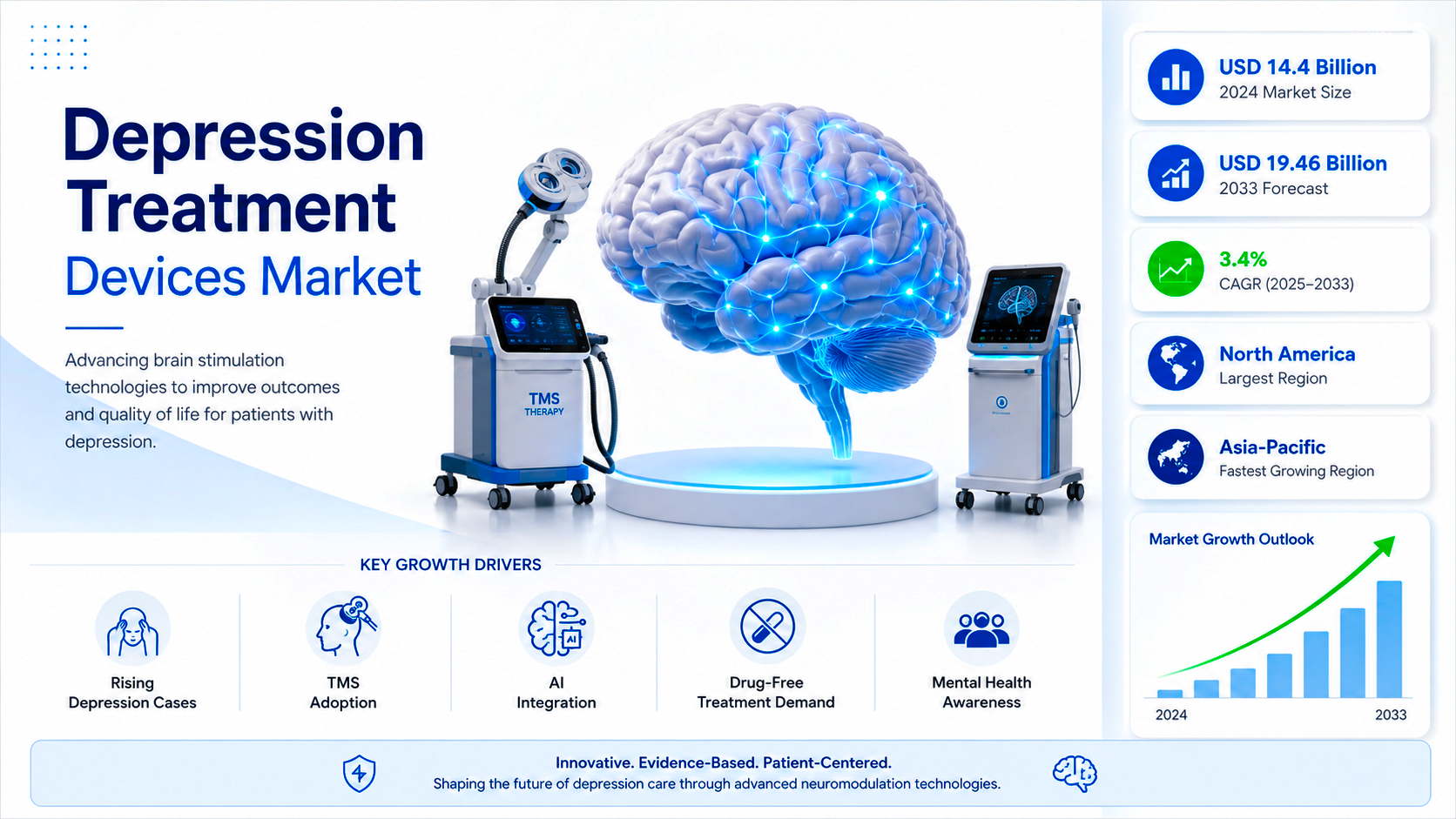
This is not a niche or emerging category. The global depression treatment devices market was valued at approximately $14.4 billion in 2024 and is on a clear growth trajectory through the next decade. Whether you are an investor evaluating opportunities, a healthcare provider tracking clinical technology, or an industry strategist mapping the competitive landscape, understanding this market is increasingly critical.
This in-depth analysis covers market size, CAGR, segment dynamics, regional performance, competitive positioning, and the technology trends reshaping how the world treats depression — without relying solely on a pill.
What Is the Depression Treatment Devices Market?
At its core, the depression treatment devices market refers to the global industry that develops, manufactures, and commercializes medical devices specifically designed to alleviate, manage, or treat depressive disorders — including major depressive disorder (MDD), treatment-resistant depression (TRD), and bipolar depression.
These devices generally fall into two broad categories: non-invasive and invasive neuromodulation systems.
Non-invasive options include transcranial magnetic stimulation (TMS), cranial electrotherapy stimulation (CES), and light therapy devices. These are administered in outpatient or even home settings with minimal side effects and no surgery required. Invasive solutions — such as deep brain stimulation (DBS) and vagus nerve stimulation (VNS) — involve surgically implanted electrodes or pulse generators and are typically reserved for the most severe, drug-resistant cases.
What unites this market is a common premise: depression has a neurological dimension that can be addressed by modulating brain activity through electrical, magnetic, or ultrasound energy — rather than (or in addition to) pharmacology.
Key Takeaways
- 2024 Market Value: ~$14.4 billion; projected to reach $19.46 billion by 2033 at a 3.4% CAGR
- Dominant Segment: Stimulation therapies (particularly TMS) lead the market
- Largest Region: North America (>50% global share), driven by reimbursement and manufacturer presence
- Fastest-Growing Region: Asia-Pacific, fueled by healthcare infrastructure growth and rising awareness
- Key Players: Neuronetics (NeuroStar), BrainsWay, MagVenture, Medtronic, Boston Scientific, Abbott, Fisher Wallace
- Drug-Free Segment CAGR: ~8.7% through 2035 (IndexBox)
- Emerging Platforms: Mental health devices/platforms projected to reach $41.23B by 2035 at 24% CAGR
Market Snapshot
|
Metric |
Data |
|
2024 Market Value |
~$14.4 billion |
|
2025 Market Value |
~$14.89 billion |
|
2033 Projected Value |
$19.46 billion |
|
CAGR (2025-2033) |
3.4% |
|
Forecast Period |
2025-2033 |
|
Largest Region |
North America |
|
Fastest-Growing Region |
Asia-Pacific |
|
Dominant Segment |
Stimulation Therapies (TMS) |
|
Key Companies |
Neuronetics, BrainsWay, Medtronic, Boston Scientific, Abbott, MagVenture, Fisher Wallace |
Why Is the Depression Treatment Devices Market Growing So Fast?
Several structural forces are converging to drive sustained, multi-year growth in this market.
1. An Unprecedented Disease Burden
Depression affects roughly 3.8% of the global population — with rates climbing to 5.7% among adults aged 60 and older. Post-pandemic, incidence rates surged significantly. The WHO reported that the COVID-19 outbreak disrupted critical mental health services in 93% of countries worldwide, simultaneously deepening the unmet treatment need. This translates directly into expanded patient populations for depression devices.
2. The Limits of Pharmacotherapy
First-line antidepressants — SSRIs and SNRIs — fail to produce adequate remission in approximately 30-40% of patients. Up to 20% meet the clinical definition of treatment-resistant depression. This substantial non-responder population represents a structural, captive market for device-based alternatives. When a patient cannot get better with a pill, a device becomes the next clinical step.
3. Rising Preference for Drug-Free Alternatives
Consumer attitudes are shifting. Awareness of medication side effects — weight gain, sexual dysfunction, emotional blunting — is pushing patients and clinicians toward non-pharmacological options. Insurance and payer networks are responding: Medicare now covers TMS therapy for medication-resistant depression in the US, a reimbursement shift that dramatically improves market access.
4. Technology Maturation and Innovation
Early TMS systems were bulky, slow, and limited in targeting precision. Today's devices — including deep TMS (dTMS) systems from BrainsWay — can reach deeper brain structures, complete treatment sessions in under 20 minutes, and are increasingly integrating AI for personalized stimulation protocols. These innovations are improving clinical outcomes and expanding the appropriate patient base.
5. Regulatory Momentum
The US FDA has been progressively expanding cleared indications for TMS. Neuronetics' NeuroStar received FDA clearance for anxious depression — a significant extension of the market beyond pure MDD. As device indications broaden, the addressable market grows correspondingly.
Latest Industry Trends
Artificial Intelligence Integration
AI is beginning to transform how depression devices are programmed, monitored, and personalized. Machine learning algorithms can analyze patient EEG data, clinical history, and biomarker profiles to optimize stimulation parameters in real time. Closed-loop neurostimulation systems — which adjust their output based on ongoing brain signal feedback — represent the frontier of this integration. Companies are investing heavily in AI-driven psychiatry platforms that pair hardware devices with software intelligence layers.
Accelerated TMS Protocols
Standard TMS therapy involves daily sessions over 4-6 weeks. Accelerated TMS (aTMS) protocols compress this timeline to as few as 5 days — with some clinical trials demonstrating remission within a single week. Stanford University's SAINT (Stanford Accelerated Intelligent Neuromodulation Therapy) protocol has demonstrated particularly striking results in treatment-resistant depression, sparking significant clinical and commercial interest. Shorter treatment timelines dramatically improve patient adherence and expand the feasibility of TMS in broader clinical settings.
Wearable and Home-Use Devices
A compelling trend is the miniaturization of depression devices for personal use outside clinical settings. Companies are developing transcranial direct current stimulation (tDCS) and CES wearables that patients can apply at home. Fisher Wallace's cranial stimulator is already prescribed for home use. This shift toward decentralized care has the potential to massively expand market reach — particularly in underserved or rural areas where in-clinic psychiatric care is scarce.
Digital Therapeutics Convergence
The boundary between depression devices and digital therapeutics is blurring. AI-powered mental health platforms are increasingly being positioned alongside or in conjunction with device-based treatments. Emerging mental health device platforms represent one of the fastest-growing adjacent segments, projected to grow at a 24% CAGR from 2025 to 2035, reaching $41.23 billion by 2035.
Expanded Indications for Existing Platforms
Deep brain stimulation, originally FDA-approved for Parkinson's disease and essential tremor, is being actively researched for treatment-resistant depression. Clinical studies are exploring DBS targets including the subcallosal cingulate cortex and the nucleus accumbens. Positive trial data in this area could dramatically reshape the depression device market landscape.
Insurance and Reimbursement Expansion
Coverage expansion is a market accelerator. TMS coverage has now been established by Medicare and many commercial insurers in the US. As clinical evidence mounts for newer modalities — including VNS and certain DBS applications — reimbursement expansion is expected to follow, broadening patient access and pulling more revenue through the system.
Market Drivers
- Rising Global Depression Prevalence: With 280+ million people living with depression, the patient pipeline is deep and widening.
- Growing Mental Health Awareness: Social destigmatization is pushing more patients to seek active treatment.
- Reimbursement Policy Improvements: Medicare's TMS coverage decision was a watershed moment; further expansions anticipated.
- Technological Advancement: Shorter sessions, improved targeting, AI-personalized protocols improving adoption.
- Clinical Unmet Need in TRD: Treatment-resistant depression creates enduring structural demand for device-based therapies.
- Healthcare Infrastructure Expansion: Rapid build-out of psychiatric care infrastructure across Asia-Pacific and the Middle East opens new markets.
Market Restraints
- High Cost of Devices and Treatment: A full TMS course can cost $6,000-$12,000 in the US; DBS surgery runs well into six figures.
- Limited Awareness: Many psychiatrists still default to pharmacotherapy; awareness gaps slow market penetration.
- Regulatory Complexity: Gaining clearance across FDA, CE Mark, and NMPA jurisdictions is time-consuming and expensive.
- Shortage of Trained Clinicians: Operating TMS and DBS systems requires trained personnel, creating bottlenecks.
- Device Maintenance Costs: Implantable devices require battery replacements and technical maintenance, adding long-term burden.
Market Opportunities
- Home-Use Device Expansion: Prescription-at-home neuromodulation represents a multi-billion-dollar uncaptured opportunity.
- Emerging Market Penetration: Asia-Pacific, Latin America, and the Middle East offer double-digit growth potential.
- AI-Enabled Precision Psychiatry: Biomarker-guided stimulation with AI software subscriptions creates durable competitive moats.
- Adolescent Depression Market: Surging teen depression rates and expanding FDA clearance to younger populations offer significant upside.
- Digital Health Ecosystem Partnerships: Device companies embedding into telehealth platforms and hospital systems can improve patient funneling.
Segment Analysis
By Therapy Type
Stimulation Therapies dominate the depression treatment devices market and are expected to maintain their lead through 2033.
- Transcranial Magnetic Stimulation (TMS): The TMS market alone was valued at ~$1.375 billion in 2025 and is projected to reach $2.65 billion by 2033 at roughly 8.5% CAGR. TMS accounts for approximately 19% of total neuromodulation segment demand.
- Electroconvulsive Therapy (ECT): ECT remains the most effective acute treatment for severe depression and continues to evolve with refined pulse technology. It contributes approximately 14% of treatment volume within the stimulation segment.
- Deep Brain Stimulation (DBS): Currently more prevalent in Parkinson's and essential tremor, the overall DBS market was valued at $1.4-$2.1 billion in 2024, with 8.5-11.6% CAGR projected.
- Vagus Nerve Stimulation (VNS): FDA-cleared for TRD; LivaNova is the dominant player in this niche.
- Cranial Electrotherapy Stimulation (CES): A smaller but growing segment driven by home-use demand.
By End User
- Hospitals: Represent the largest end-user segment, accounting for over 51% of the DBS market and a dominant share of ECT utilization.
- Specialty Psychiatric Clinics: The fastest-growing end-user segment, particularly for TMS outpatient administration.
- Ambulatory Care / Home Use: An emerging and high-growth category, driven by wearable CES devices and home-prescribed TMS systems.
Regional Analysis
North America
North America dominates the global depression treatment devices market, holding well over 50% of total market share. This leadership rests on multiple structural pillars: the highest concentration of major device manufacturers, Medicare and commercial insurance reimbursement for TMS, a sophisticated regulatory and clinical trial infrastructure, and high rates of diagnosed depression coupled with active treatment-seeking behavior.
Over 27% of psychiatric clinics in the US have adopted TMS for depression management. NeuroStar (Neuronetics) and BrainsWay have built substantial installed bases in outpatient psychiatric centers. The FDA's progressive clearance of new TMS indications continues to expand the addressable market.
Europe
Europe holds a significant secondary market share, with key contributors including Germany, the United Kingdom, France, and the Netherlands. CE Mark pathways have enabled broad device access. The UK's NHS is piloting TMS programs for treatment-resistant depression, representing a potentially large-scale reimbursement expansion.
Asia-Pacific
Asia-Pacific is the fastest-growing regional market and represents the single most significant long-term opportunity for depression device manufacturers. Rising mental health awareness, rapid healthcare infrastructure expansion, growing middle-class access to psychiatric care, and a massive underlying disease burden are collectively driving accelerating demand.
China, Japan, South Korea, and Australia are the primary markets. China's NMPA has been approving neuromodulation devices at an increased pace. India represents a transformative long-term opportunity given its enormous population.
Latin America
Brazil and Mexico lead the Latin American market. Private healthcare systems and medical tourism dynamics are enabling TMS adoption in premium psychiatric centers. Market growth is constrained by cost barriers and reimbursement gaps but accelerating from a low base.
Middle East & Africa
The Middle East is an emerging market, driven by healthcare modernization investments in the GCC countries. Saudi Arabia, UAE, and Qatar are investing in mental health infrastructure as part of Vision 2030-type national development agendas. Africa remains least developed, constrained by infrastructure and cost, with South Africa as the primary beachhead.
Competitive Landscape
The global depression treatment devices market features a mix of pure-play neuromodulation companies, large diversified medtech giants, and a growing roster of innovative startups. Competition is concentrated around TMS — where three to four companies have established meaningful market positions — with more fragmented competition in DBS, VNS, and CES.
Top Companies in the Depression Treatment Devices Market
Neuronetics (NeuroStar)
Neuronetics is the leading US pure-play TMS company. Its NeuroStar Advanced Therapy system was one of the first TMS devices cleared by the FDA for MDD and has since received clearance for anxious depression. NeuroStar has been installed in thousands of psychiatric clinics across the US and has accumulated one of the largest TMS outcomes datasets in the industry.
BrainsWay
BrainsWay, an Israeli company, developed deep TMS (dTMS) using proprietary H-Coils that can stimulate deeper and broader brain regions than standard TMS coils. The company's system is FDA-cleared for MDD and OCD and is in clinical development for additional indications, with a strong global installed base.
MagVenture A/S
A Danish company and global technology leader in TMS hardware. MagVenture serves both clinical and research markets with a wide product portfolio for depression treatment and neurological research, competing on technological precision and equipment durability.
Medtronic
Medtronic is the global leader in DBS for movement disorders and is increasingly active in DBS research for psychiatric conditions including TRD. Its Percept PC neurostimulator featuring BrainSense technology represents a next-generation capability that positions the company for eventual psychiatric DBS indications.
Boston Scientific
Boston Scientific is a major DBS player competing directly with Medtronic. Its Vercise DBS platform features directional stimulation technology for more precise targeting. The company is expanding its DBS research into depression applications.
Abbott Laboratories
Abbott's Infinity DBS system, with directional leads and advanced programming, is a third significant player in the DBS space. Abbott also has broader investments in neuromodulation and may expand into psychiatric applications as the market develops.
Fisher Wallace Laboratories
Fisher Wallace makes a FDA-cleared cranial stimulator — a wearable CES device — designed for home prescription use in depression, anxiety, and insomnia. It occupies a distinct niche: affordable, non-clinic-based neuromodulation for milder presentations.
LivaNova
LivaNova holds FDA approval for vagus nerve stimulation (VNS) for TRD via its Symmetry Surgi-System. VNS is a surgically implanted device occupying a specific niche for severe chronic depression where other treatments have failed.
Recent Industry Developments (2024-2026)
2024
- Neuronetics received FDA clearance for NeuroStar Advanced Therapy for anxious depression — the first TMS indication specifically targeting comorbid anxiety symptoms in MDD patients.
- BrainsWay announced expansion of its dTMS platform research into PTSD and additional psychiatric indications.
- Medicare finalized expanded coverage guidance for TMS in additional outpatient settings.
2025
- Medtronic's BrainSense technology demonstrated real-time biomarker tracking capability in early TRD studies, positioning the company for a psychiatric DBS indication submission.
- The emerging mental health devices and platforms segment surpassed $4.85 billion in value as AI-powered digital therapeutics gained clinical validation.
- Stanford's SAINT protocol attracted further clinical replication studies, accelerating interest in accelerated TMS products.
2026
- The drug-free depression treatment market entered a period of structural transformation, with 8.7% CAGR forecast through 2035 (IndexBox).
- AI-integrated closed-loop neurostimulation systems entered early clinical trials at multiple academic medical centers.
- Asia-Pacific installed base for TMS grew significantly, driven by Chinese and Japanese market expansion.
Investment Analysis
Venture Capital
Mental health technology — including devices — has attracted growing venture capital interest. The post-pandemic mental health crisis accelerated investor urgency, with increasing deal flow in the mental health device and digital therapeutics space since 2020.
Government Funding
The US National Institutes of Health (NIH) has funded substantial research into neuromodulation for depression. DARPA has invested in next-generation closed-loop brain stimulation for military PTSD and TRD applications. In Europe, Horizon Europe funding supports mental health research including device-based approaches.
Strategic M&A
The depression device sector has seen consolidation as large medtech players acquire innovative neuromodulation startups. Medtronic, Boston Scientific, and Abbott have all made strategic acquisitions to bolster neurostimulation capabilities. Further consolidation is expected as the market matures.
Defense and VA Spending
The US Department of Veterans Affairs (VA) has been an early and significant adopter of TMS and CES devices for treating depression and PTSD among veterans — a clinical population with high TRD rates. VA procurement represents a meaningful and stable revenue stream for device companies.
Future Outlook (2026-2035)
The depression treatment devices market is entering a decade of accelerating sophistication. Several developments are likely to define the 2026-2035 period:
- Closed-Loop Neuromodulation: AI-driven, biomarker-responsive neurostimulation will progressively replace fixed-protocol systems, improving clinical outcomes and differentiating premium products.
- Home Use Expansion: Regulatory approvals for home TMS and CES devices will broaden the patient population beyond those able to access specialty psychiatric clinics.
- DBS for Psychiatry: As clinical trial data matures and FDA submissions are made, DBS for TRD could become commercially meaningful by 2030-2032.
- Asia-Pacific Becomes the Growth Engine: By 2030-2032, Asia-Pacific may rival or surpass Europe in market size.
- Combination Approaches: The clinical paradigm will increasingly be device + drug + digital — combined treatment protocols leveraging neurostimulation, pharmacotherapy, and AI-powered monitoring.
- Drug-Free Treatment Index: The drug-free depression treatment market is forecast to reach an index of approximately 225 by 2035 (2025=100), more than doubling from its 2025 base.
Frequently Asked Questions
Q1. What is the depression treatment devices market?
The depression treatment devices market encompasses medical devices including TMS, ECT, DBS, VNS, and CES systems used to treat major depressive disorder and related conditions. It serves as an alternative or complement to pharmaceutical approaches.
Q2. How big is the depression treatment devices market?
The market was valued at approximately $14.4 billion in 2024 and is projected to grow to $19.46 billion by 2033, at a CAGR of 3.4%.
Q3. Which region dominates the market?
North America dominates, holding over 50% of global market share, driven by favorable reimbursement, a high disease burden, and the presence of major manufacturers.
Q4. Which region is growing fastest?
Asia-Pacific is the fastest-growing region, fueled by rising mental health awareness, healthcare infrastructure expansion, and a large untreated patient population.
Q5. What is TMS and how is it used for depression?
Transcranial Magnetic Stimulation (TMS) uses focused electromagnetic pulses to stimulate specific brain regions associated with mood regulation. It is FDA-cleared for MDD and anxious depression, administered in outpatient settings over several weeks.
Q6. What are the main types of depression treatment devices?
The main categories are: Transcranial Magnetic Stimulation (TMS), Electroconvulsive Therapy (ECT), Deep Brain Stimulation (DBS), Vagus Nerve Stimulation (VNS), Cranial Electrotherapy Stimulation (CES), and light therapy devices.
Q7. Who are the leading companies in this market?
Key players include Neuronetics (NeuroStar), BrainsWay, MagVenture, Medtronic, Boston Scientific, Abbott, LivaNova, Fisher Wallace, and Electromedical Products International.
Q8. Is TMS covered by insurance?
In the United States, Medicare covers TMS for medication-resistant depression. Many commercial insurers also provide coverage, though criteria vary. Reimbursement expansion is a significant growth driver.
Q9. What is treatment-resistant depression (TRD)?
TRD is depression that fails to respond to two or more antidepressant treatments. Approximately 20-30% of depression patients have TRD, creating a large, captive patient population for device-based alternatives.
Q10. What is deep TMS (dTMS) and how does it differ?
Deep TMS, developed by BrainsWay, uses proprietary H-Coil technology to stimulate deeper and broader brain regions than standard TMS coils. It is FDA-cleared for MDD and OCD.
Q11. What is the fastest-growing segment?
Stimulation therapies, particularly TMS, are the dominant and fast-growing segment. The broader emerging mental health devices and platforms market grows even faster, at approximately 24% CAGR through 2035.
Q12. What are the key barriers to growth?
High device and treatment costs, limited insurance coverage in many markets, shortage of trained psychiatric clinicians, and patient/provider awareness gaps are the primary barriers.
Q13. Are there home-use depression devices?
Yes. CES devices such as the Fisher Wallace Stimulator and Alpha-Stim are prescribed for home use. Emerging portable TMS devices may also expand home administration in coming years.
Q14. How is AI being used in depression treatment devices?
AI is applied to optimize stimulation parameters based on patient biomarkers, enable closed-loop devices that adjust in real time to brain signals, predict treatment response, and integrate with digital therapeutics platforms.
Q15. What is the forecast through 2035?
The core market reaches $19.46 billion by 2033. The drug-free depression treatment market expands at approximately 8.7% CAGR through 2035. Emerging mental health device platforms are forecast to reach $41.23 billion by 2035.
Conclusion
The depression treatment devices market stands at a meaningful inflection point. A massive, growing global disease burden — amplified by the pandemic's mental health legacy — is colliding with the demonstrated limits of pharmacotherapy to create enduring, structural demand for device-based alternatives.
The numbers are compelling: a $14.4 billion market in 2024 projected to reach $19.46 billion by 2033, with high-growth adjacent segments expanding far faster. But the qualitative story may be even more powerful — the integration of AI, the shift to home use, the emergence of closed-loop systems, and the progressive expansion of reimbursement coverage suggest a market that is still in relatively early stages of its growth arc.
For industry participants, the imperative is clear: innovate on outcomes, demonstrate cost-effectiveness to payers, expand geographic reach into underserved markets, and build the data infrastructure to power next-generation AI-integrated devices.
For investors, this market offers exposure to one of healthcare's most urgent unmet needs with a diversified set of modalities — from non-invasive outpatient TMS to the longer-duration DBS opportunity — spread across a rich competitive landscape.
The world is coming to grips with its mental health crisis. The depression treatment devices market will play a central role in responding to it.


