
Electronic Shelf Label (ESL) Market Size, Share & Growth Forecast 2025–2034: Trends, Drivers, and Key Players
Author:
Intellectual Market Insights Research
Published Date:
07 Aug 2026
Introduction
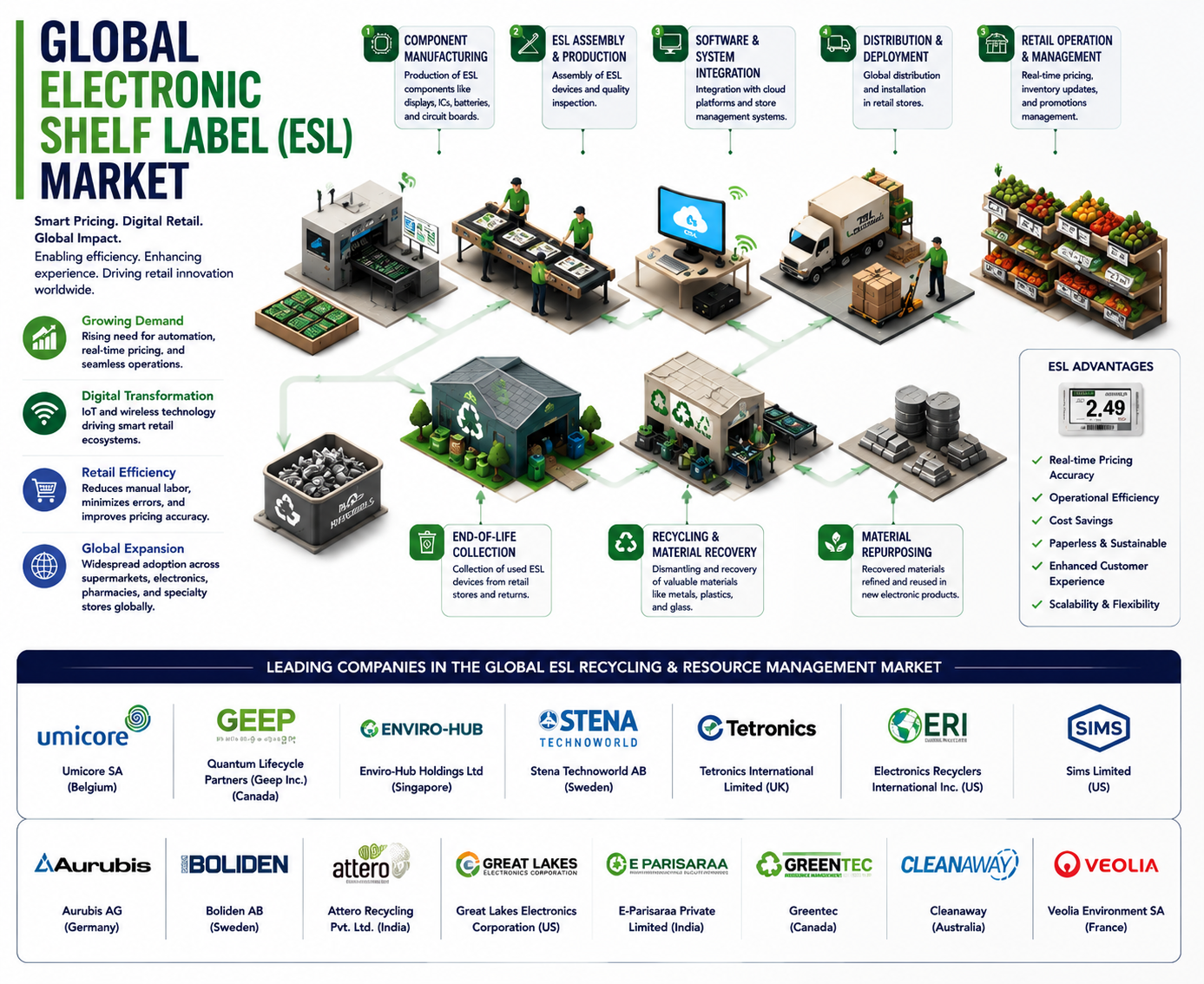
Electronic shelf labels have quietly replaced one of retail's most mundane fixtures, the paper price tag, with a wireless, remotely updatable display, and in doing so have become a foundational piece of infrastructure for the modern store. By pairing low-power e-paper or LCD screens with wireless communication modules, ESL systems let retailers change prices, run promotions, and sync inventory information across thousands of shelf edges in seconds, eliminating manual price-tag swaps and reducing the pricing errors that erode margin and customer trust.
According to a new report from Intellectual Market Insights Research, the global electronic shelf label market was valued at approximately USD 2.1 billion in 2025 and is projected to reach USD 7.2 billion by 2034, growing at a compound annual growth rate (CAGR) of 12.6% between 2025 and 2034. That is more than a threefold increase in under a decade, reflecting how quickly grocery chains, hypermarkets, and specialty retailers are digitizing the shelf edge as part of broader store automation and omnichannel pricing strategies.
In this article, we break down what's driving this growth, the challenges holding the market back, where the biggest opportunities lie, how the market is segmented, which regions are leading adoption, and who the major players are. Whether you're a retail technology buyer, a systems integrator, an investor, or simply curious about where in-store digitization is headed, this guide will give you a clear, structured view of the electronic shelf label market landscape through 2034.
Market Overview
What Is an Electronic Shelf Label?
An electronic shelf label is a small digital display, most commonly built on low-power e-paper (E Ink) or segmented LCD technology, mounted on a retail shelf edge in place of a printed paper tag. Each label connects to a central store server through a wireless communication protocol and receives price, promotion, and product-information updates in real time, removing the need for store staff to manually reprint and swap tags whenever prices change.
ESL systems can be grouped into a few core building blocks: the display itself (segmented e-paper being the dominant format thanks to its readability and multi-year battery life, alongside LCD variants for simpler, lower-cost deployments), the communication module that keeps labels synchronized with store systems (commonly radio frequency, NFC, Wi-Fi, or Bluetooth Low Energy), and the software platform that manages pricing rules, promotions, and integration with point-of-sale and inventory systems. Because e-paper displays retain an image without continuous power draw, most modern ESL tags run for years on a single coin-cell battery, which has been central to making large-scale rollouts economically viable.
Current Market Landscape
The ESL space today sits squarely at the intersection of retail automation, e-paper display manufacturing, and IoT connectivity. What began as a niche deployment among a handful of large European grocery chains has expanded into mainstream adoption across hypermarkets, supermarkets, convenience stores, and specialty retail formats worldwide. Display and component manufacturers have steadily driven down per-unit costs while extending battery life, which has widened the addressable customer base from flagship stores of large retail groups to mid-size regional chains that previously found ESL deployments cost-prohibitive.
Industry Background
Electronic shelf labels emerged in the late 1990s and early 2000s as an answer to the labor cost and pricing-accuracy problems created by manual paper tagging in large-format stores. Early deployments relied on simple segmented LCD displays and proprietary radio protocols, and adoption was largely confined to a small number of technology-forward European retailers. Over the past decade, the maturation of low-power e-paper display technology, falling wireless-module costs, and growing retailer pressure to support real-time and dynamic pricing have pushed ESLs from a discretionary upgrade into a near-standard fixture for large-format grocery and hypermarket rollouts, setting the stage for the market's expansion into specialty retail, pharmacy, and consumer electronics store formats.
Key Market Trends
- Shift toward AI-driven and dynamic pricing: Retailers are increasingly linking ESL systems to AI-based pricing engines that adjust prices in near real time based on demand, inventory levels, and competitor pricing, moving ESLs from a labor-saving tool toward a active merchandising and revenue-management platform.
- Deeper integration with inventory and omnichannel systems: ESL platforms are being tied more closely to backend inventory management and e-commerce systems, allowing shelf displays to reflect stock availability and support click-and-collect and omnichannel pricing consistency.
- Growth of segmented and full-graphic e-paper displays: Display manufacturers continue to push e-paper resolution and color capability higher, enabling ESLs to show promotional graphics, QR codes, and nutritional or sourcing information alongside price.
- Expansion of wireless communication standards: The market is seeing continued movement toward more robust, lower-power wireless protocols such as Bluetooth Low Energy and proprietary sub-GHz radio systems, improving synchronization speed and reliability across large store footprints.
- Broader adoption beyond grocery: Beyond hypermarkets and supermarkets, specialty retail, pharmacy, consumer electronics, and DIY store formats are increasingly piloting and rolling out ESL systems, broadening the technology's addressable market beyond its traditional grocery core.
Market Growth Drivers
Rising Labor Costs and Retail Automation Pressure: Escalating store-labor costs and chronic staffing shortages continue to push retailers toward automation solutions that reduce manual, repetitive tasks, with price-tag changes among the most time-consuming, making ESL adoption a direct labor-cost lever.
Growing Demand for Real-Time and Dynamic Pricing: As e-commerce competitors adjust prices continuously, brick-and-mortar retailers are turning to ESL systems to match pricing speed and consistency across channels, particularly for perishable and promotion-heavy categories.
Declining Hardware Costs and Longer Battery Life: Continued improvement in e-paper display manufacturing and low-power wireless components has lowered the total cost of ownership for ESL deployments, expanding the pool of mid-size and regional retailers that can justify a rollout.
Expansion of Omnichannel Retail Strategies: Retailers investing in unified pricing and inventory visibility across physical and digital channels increasingly view ESLs as a foundational piece of infrastructure that keeps in-store pricing synchronized with online storefronts.
Sustainability and Paper-Reduction Initiatives: Corporate sustainability commitments and regulatory pressure to reduce paper waste are giving retailers an additional incentive to replace printed price tags with reusable digital displays.
Market Challenges
High Upfront Deployment Costs: Despite falling per-unit prices, outfitting a large-format store with thousands of ESL tags, gateways, and supporting software still requires significant upfront capital, which can be a barrier for smaller and budget-constrained retailers.
Integration with Legacy Store Systems: Many retailers operate on older point-of-sale and inventory management infrastructure, and integrating modern ESL platforms with these legacy systems can slow deployment timelines and add implementation cost.
Wireless Interference and Synchronization Reliability: As store networks grow denser with connected devices, ensuring reliable, low-latency synchronization across thousands of shelf-edge labels without signal interference remains a technical challenge for large-format rollouts.
Battery Replacement and Maintenance at Scale: While individual ESL batteries can last years, managing replacement schedules across a large store fleet, or across a multi-store chain, adds an ongoing maintenance burden that retailers must plan for.
Data Security and Network Vulnerability: As ESL systems become more deeply networked with pricing and inventory platforms, they also become a potential attack surface, requiring retailers to invest in securing wireless infrastructure against tampering or unauthorized price manipulation.
Market Opportunities
Untapped Mid-Size and Emerging Market Retailers: Falling hardware costs are opening ESL adoption to regional grocery chains and retailers in Asia-Pacific, Latin America, and the Middle East that previously could not justify the investment, representing a large runway for volume growth.
Expansion Beyond Grocery and Hypermarkets: While grocery and hypermarket formats remain the largest adopters, growing interest from pharmacy, consumer electronics, DIY, and fashion retail represents meaningful white-space opportunity for ESL vendors.
AI and Dynamic Pricing Platforms: As retailers look to compete with e-commerce pricing agility, there is room for ESL vendors to capture greater value by bundling AI-driven pricing and analytics software with hardware, rather than competing purely on display cost.
Color and Full-Graphic E-Paper Displays: Continued advancement in higher-resolution, color e-paper technology offers a path toward ESLs that double as in-store marketing and promotional media, a significant opportunity for vendors able to differentiate on display quality.
Consolidation and Strategic Partnerships: As the market matures, there is ongoing opportunity for strategic partnerships between display manufacturers, wireless connectivity providers, and retail software platforms serving the ESL ecosystem.
Market Segmentation
By Product
- LCD ESL
- Segmented E-Paper ESL
- Full-Graphic E-Paper ESL
By Component
- Display
- Battery
- Communication Module / Processor
- Others
By Communication Technology
- Radio Frequency (RF)
- Near Field Communication (NFC)
- Wi-Fi
- Bluetooth Low Energy (BLE)
By Store Type
- Hypermarkets
- Supermarkets
- Specialty Stores
- Others
Segmented e-paper displays represent the largest and fastest-growing product segment given their combination of low power consumption, strong readability, and multi-year battery life, which has made them the default choice for large-format grocery rollouts. On the store-type side, hypermarkets and supermarkets are expected to remain the largest volume driver given the sheer scale of shelf-edge coverage required per store, while specialty retail formats are emerging as a faster-growing niche as ESL costs continue to fall.
Regional Analysis
Europe: Europe holds the largest revenue share of the global ESL market, underpinned by early and sustained adoption among major European grocery chains, strong retail-automation investment, and a dense concentration of leading ESL and e-paper display manufacturers headquartered in the region.
North America: North America represents a fast-growing market, supported by large-format retailers and big-box chains investing heavily in digital transformation, omnichannel pricing consistency, and AI-driven retail analytics integration with ESL platforms.
Asia-Pacific: Asia-Pacific is expected to be the fastest-growing region over the forecast period, driven by rapid retail modernization, government-backed smart-retail initiatives, and the presence of key ESL component and display manufacturers in countries like China, Japan, and South Korea.
Latin America: Latin America remains a smaller but developing market, with growth concentrated among larger regional retail groups in Brazil and Mexico as retail modernization investment expands.
Middle East & Africa: The Middle East & Africa region is an emerging opportunity area, with adoption led by large retail groups in Saudi Arabia and the UAE investing in store modernization, alongside gradual uptake in South Africa.
Competitive Landscape
The global electronic shelf label market features a mix of established e-paper display manufacturers and specialized ESL system providers. Key players identified in the market include:
- VusionGroup (SES-imagotag)
- Pricer AB
- Hanshow Technology Co., Ltd.
- SoluM Co., Ltd.
- Displaydata Ltd.
- E Ink Holdings Inc.
- Samsung Electro-Mechanics Co., Ltd.
- Panasonic Holdings Corporation
- DIGI International
- Altierre Corporation
Competition in this space centers on extending battery life, improving display resolution and color capability, reducing per-tag hardware cost, and building software platforms that tie pricing, inventory, and promotional data together. Display specialists such as E Ink benefit from deep intellectual property in e-paper manufacturing, while system integrators like VusionGroup, Pricer, and Hanshow compete on end-to-end platform breadth, retailer relationships, and large-scale rollout experience. As the market matures, continued consolidation, partnerships between display manufacturers and retail software providers, and new product launches targeting AI-driven dynamic pricing are expected to shape the competitive landscape through 2034.
1. VusionGroup (SES-imagotag)
|
Category |
Details |
|---|---|
|
Company Name |
VusionGroup SA (formerly SES-imagotag) |
|
Headquarters |
Paris, France |
|
Industry Focus |
Electronic Shelf Labels, Retail IoT, and Digital Store Technology |
|
Global Presence |
Operations across more than 60 countries, serving large grocery and specialty retail chains worldwide |
|
Company Overview |
VusionGroup is widely regarded as the pioneer and long-standing global leader in electronic shelf labels, having driven early adoption among major European grocery chains before expanding into North America, Asia-Pacific, and beyond. The company has broadened its offering from standalone ESL hardware into a full retail IoT platform spanning pricing, inventory sensing, and in-store analytics. |
|
Key Products & Services |
Segmented and full-graphic e-paper ESL displays; VUSION Cloud retail IoT and pricing management platform; integrated in-store sensing and inventory-visibility solutions. |
|
Market Position |
A market share leader in electronic shelf labels globally, with an installed base spanning thousands of retail locations and deep relationships with major European and North American grocery groups. |
|
Recent Developments |
Continues to expand its VUSION Cloud platform and AI-driven dynamic pricing capabilities, deepening integration between shelf-edge hardware and retailer pricing and inventory systems. |
|
Strategic Advantages |
First-mover scale advantage, the industry's broadest installed base, a full-stack hardware-plus-software platform, and long-standing relationships with tier-one European and North American retailers. |
2. Pricer AB
|
Category |
Details |
|---|---|
|
Company Name |
Pricer AB |
|
Headquarters |
Stockholm, Sweden |
|
Industry Focus |
Electronic Shelf Labels and In-Store Digital Solutions |
|
Global Presence |
Operations across Europe, North America, and Asia-Pacific, serving grocery and specialty retail customers |
|
Company Overview |
Pricer is a long-established Nordic ESL provider known for its focus on retail execution accuracy, combining shelf-edge hardware with software designed to reduce pricing errors and improve store operational efficiency. |
|
Key Products & Services |
Segmented e-paper ESL displays; Pricer software platform for price and promotion management; store-execution and compliance tools for large-format retailers. |
|
Market Position |
A well-established mid-to-large scale ESL vendor with a strong base among European grocery retailers and a growing footprint in North America. |
|
Recent Developments |
Continues to expand its retail software capabilities alongside core ESL hardware, targeting deeper integration with retailer pricing and promotional workflows. |
|
Strategic Advantages |
Deep grocery-retail domain expertise, a reputation for pricing-accuracy-focused software, and long-standing customer relationships across the Nordic and broader European market. |
3. Hanshow Technology Co., Ltd.
|
Category |
Details |
|---|---|
|
Company Name |
Hanshow Technology Co., Ltd. |
|
Headquarters |
Shanghai, China |
|
Industry Focus |
Electronic Shelf Labels and Smart Retail Solutions |
|
Global Presence |
Operations across Asia-Pacific, Europe, and North America, with a growing global retailer customer base |
|
Company Overview |
Hanshow is one of the fastest-growing global ESL providers, leveraging China's manufacturing scale to compete aggressively on cost while expanding its software and smart-retail platform capabilities internationally. |
|
Key Products & Services |
Segmented and full-graphic e-paper ESL displays; smart retail software platform covering pricing, inventory, and in-store analytics; wireless communication and gateway infrastructure. |
|
Market Position |
A rapidly growing global ESL vendor, competing on manufacturing scale and cost efficiency while building out an increasingly broad international retailer customer base. |
|
Recent Developments |
Continues to expand internationally, targeting large-format grocery and specialty retail rollouts across Europe and North America alongside its established Asia-Pacific base. |
|
Strategic Advantages |
Strong manufacturing cost efficiency, deep integration with China's electronics supply chain, and an expanding global sales and support footprint. |
4. E Ink Holdings Inc.
|
Category |
Details |
|---|---|
|
Company Name |
E Ink Holdings Inc. |
|
Headquarters |
Hsinchu, Taiwan |
|
Industry Focus |
Electrophoretic (E-Paper) Display Technology |
|
Global Presence |
Global manufacturing and licensing operations serving e-reader, ESL, and broader e-paper display markets |
|
Company Overview |
E Ink is the dominant supplier of electrophoretic display technology that underpins the majority of e-paper electronic shelf labels worldwide, supplying display components and licensing core e-paper intellectual property to ESL system vendors. |
|
Key Products & Services |
Electrophoretic (e-paper) display modules for ESL applications; color and full-graphic e-paper display technology; core electrophoretic display intellectual property licensing. |
|
Market Position |
The foundational display-technology supplier to the broader ESL industry, with its e-paper components embedded across the product lines of most major ESL system vendors. |
|
Recent Developments |
Continues to advance color and higher-resolution e-paper display capability, supporting ESL vendors' push toward full-graphic and promotional-media-capable shelf labels. |
|
Strategic Advantages |
Deep, foundational intellectual property in electrophoretic display technology, a central supplier position across nearly the entire ESL vendor ecosystem, and continued innovation in color and resolution capability. |
5. SoluM Co., Ltd.
|
Category |
Details |
|---|---|
|
Company Name |
SoluM Co., Ltd. |
|
Headquarters |
Seoul, South Korea |
|
Industry Focus |
Electronic Shelf Labels, Power Electronics, and Retail IoT |
|
Global Presence |
Operations across Asia-Pacific, Europe, and North America, with a growing retail and grocery customer base |
|
Company Overview |
SoluM, a Samsung Electro-Mechanics affiliate, has built a significant global ESL business leveraging its electronics manufacturing heritage, positioning itself as a scaled competitor to established European ESL vendors. |
|
Key Products & Services |
Segmented and full-graphic e-paper ESL displays; retail IoT and store-management software platform; wireless communication modules and gateway infrastructure. |
|
Market Position |
A fast-growing global ESL vendor leveraging component-manufacturing scale to compete on cost and reliability across grocery and specialty retail customers worldwide. |
|
Recent Developments |
Continues to expand its retail software and analytics capabilities, aiming to broaden its offering beyond hardware into integrated retail IoT solutions. |
|
Strategic Advantages |
Strong electronics manufacturing scale and supply chain integration, growing international retailer relationships, and continued investment in retail software capability. |
Future Outlook
The electronic shelf label market is on a clear upward trajectory, with the forecasted CAGR of 12.6% through 2034 reflecting sustained demand across grocery, hypermarket, and increasingly specialty retail formats. Growth is expected to be increasingly driven by AI-enabled dynamic pricing and deeper integration with omnichannel and inventory-management platforms, as retailers look to match the pricing agility of e-commerce competitors.
Looking ahead, expect continued declines in per-unit hardware cost, wider adoption of color and full-graphic e-paper displays, deeper integration of ESL systems with in-store analytics and AI pricing engines, and expanding adoption among mid-size and regional retailers as deployment economics continue to improve. Consolidation among display manufacturers and system vendors, along with closer partnerships between ESL providers and retail software platforms, are also likely as the industry continues to scale through 2034.
Frequently Asked Questions (FAQ)
Q1: How big is the electronic shelf label market currently? The global electronic shelf label market was valued at approximately USD 2.1 billion in 2025.
Q2: How fast is the electronic shelf label market expected to grow? The market is projected to grow at a CAGR of 12.6% from 2025 to 2034, reaching an estimated USD 7.2 billion by 2034.
Q3: What is the difference between LCD and e-paper electronic shelf labels? LCD electronic shelf labels use liquid-crystal display technology and typically require more frequent battery replacement, while segmented and full-graphic e-paper labels retain an image without continuous power draw, offering multi-year battery life and better readability in varied lighting.
Q4: What are the main components of an electronic shelf label system? Key components include the display itself, the battery, the wireless communication module or processor, and supporting infrastructure such as gateways and store-management software.
Q5: Which region leads the electronic shelf label market? Europe currently holds the largest market share, supported by early and sustained retailer adoption, while Asia-Pacific is expected to see the fastest growth over the forecast period.
Q6: Who are the major companies in the electronic shelf label market? Leading players include VusionGroup (SES-imagotag), Pricer AB, Hanshow Technology, SoluM, Displaydata, E Ink Holdings, Samsung Electro-Mechanics, Panasonic Holdings, DIGI International, and Altierre Corporation.
Q7: What are the biggest challenges facing the electronic shelf label market? High upfront deployment costs, integration with legacy store systems, wireless synchronization reliability at scale, ongoing battery maintenance, and data security across networked shelf-edge devices are among the primary challenges.
Q8: What store types use electronic shelf labels? The main adopters are hypermarkets and supermarkets, followed by a growing base of specialty retail stores across pharmacy, consumer electronics, and other formats.
Q9: Is electronic shelf label adoption mainly limited to large grocery chains? ESL adoption has deep roots in large-format European grocery chains but is increasingly spreading to mid-size regional retailers and specialty formats as hardware costs continue to fall.
Q10: What opportunities exist in the electronic shelf label market going forward? Opportunities include expansion into mid-size and emerging-market retailers, growth in color and full-graphic e-paper displays, deeper integration of AI-driven dynamic pricing software, and continued consolidation among display manufacturers and system vendors.
Conclusion
Electronic shelf labels have evolved from a niche efficiency upgrade for a handful of European grocery chains into a foundational piece of retail infrastructure worldwide, and the numbers reflect that shift. With the market projected to grow from USD 2.1 billion in 2025 to USD 7.2 billion by 2034, the opportunity spans e-paper display manufacturers, ESL system integrators, and retail software providers alike. While upfront deployment cost, legacy-system integration, and wireless reliability at scale remain real challenges, the underlying demand drivers, namely labor-cost pressure, real-time pricing needs, and omnichannel retail strategy, show no signs of slowing. For stakeholders across the value chain, understanding regional dynamics, segmentation trends, and the competitive landscape will be key to capturing this growth.