
Gas Detection Equipment Top Companies
Author:
Intellectual Market Insights Research
Published Date:
04 Aug 2026
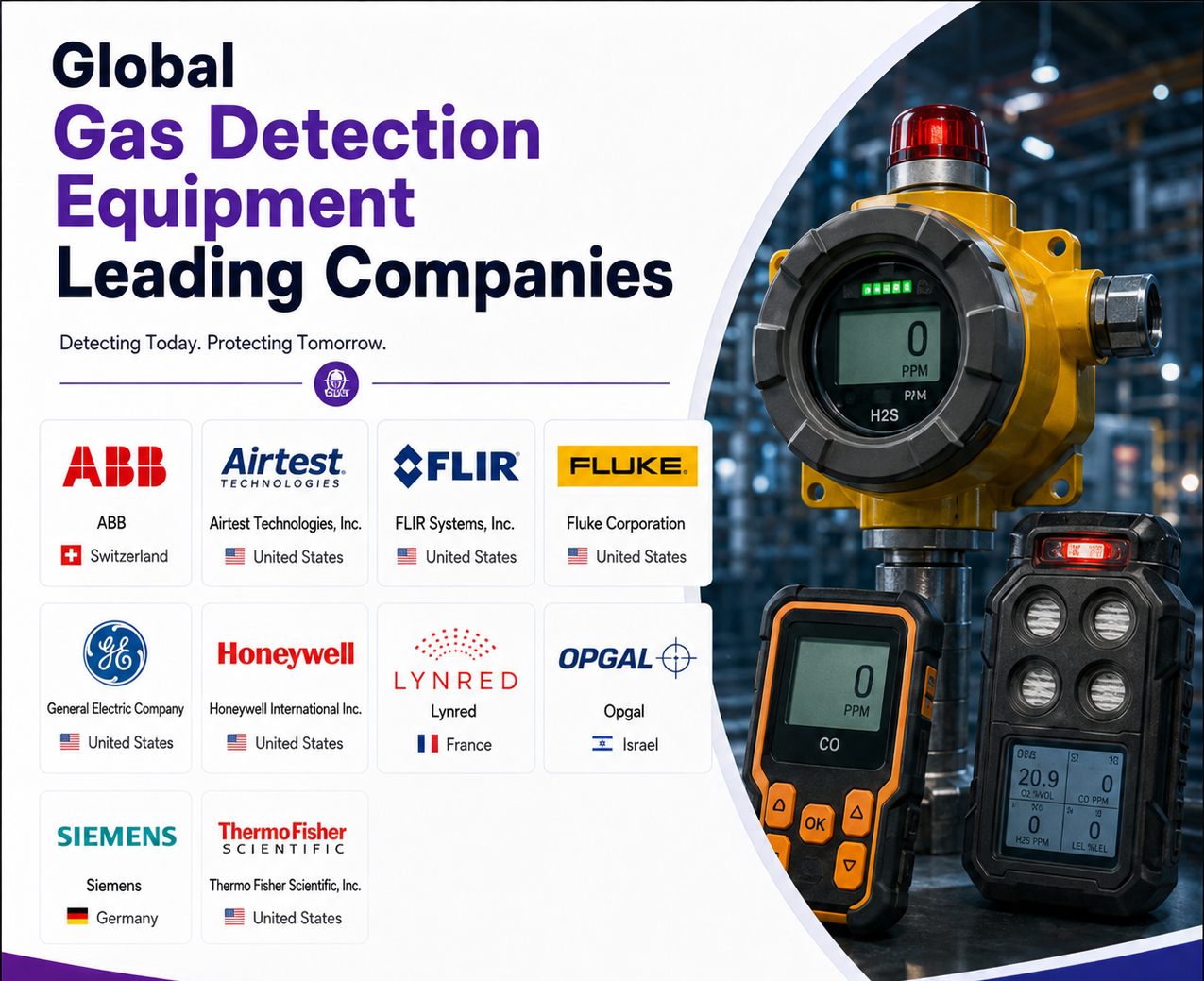
Top 10 Companies in the Gas Detection Equipment Market Driving Industry Growth in 2026
Introduction
Gas detection equipment sits at the core of industrial safety, environmental compliance, and worker protection across the world's most hazard-prone sectors from oil & gas platforms and chemical plants to hospitals, mines, and building automation systems. These fixed and portable devices continuously monitor for toxic, combustible, and oxygen-deficient atmospheres, triggering alarms before a leak becomes a fire, explosion, or health emergency.
Download brochure link: https://www.intellectualmarketinsights.com/report/gas-detection-equipment-market-size-and-trends/imi-001067
The global gas detection equipment market was valued at approximately USD 5.18 billion in 2025 and is projected to reach USD 8.17 billion by 2034, expanding at a compound annual growth rate (CAGR) of 5.7% over the forecast period, according to Intellectual Market Insights Research. This growth trajectory reflects tightening workplace safety regulations, rapid adoption of wireless and connected sensor networks, and continued industrial expansion across petrochemical, manufacturing, and utility sectors.
The market's appeal lies in its regulatory necessity: fixed detectors are increasingly mandated in hazardous industrial zones, while portable detectors give field technicians and first responders real-time protection in variable environments. Vendors compete less on the core sensing principle largely standardized around electrochemical, infrared, catalytic, semiconductor, and photoionization technologies and more on accuracy, connectivity, calibration cost, and integration with plant-wide safety systems.
Understanding which companies lead this technically demanding, safety-critical market is essential for industrial safety officers, EHS investors, and procurement teams. This article provides a research-based analysis of the top companies in the global gas detection equipment market, their positioning, flagship products, and the regional and technological forces shaping the competitive landscape.
Market Overview
|
Parameter |
Details |
|---|---|
|
Market Size (2025) |
USD 5.18 Billion |
|
Projected Market Size (2034) |
USD 8.17 Billion |
|
CAGR (2025–2034) |
5.7% |
|
Base Year |
2025 |
|
Forecast Period |
2025–2034 |
|
Leading Region |
North America |
|
Fastest-Growing Region |
Asia-Pacific (led by Japan and China) |
|
Key Growth Drivers |
Stricter workplace safety mandates, industrial automation, growing adoption of wireless/portable detectors, AI-enabled monitoring |
|
Key Challenges |
High calibration and maintenance costs, technological complexity of multi-gas systems, price sensitivity among SMEs |
|
Key Opportunities |
IoT-enabled fixed detection networks, hydrogen infrastructure monitoring, emerging-market industrialization |
Why the Gas Detection Equipment Market Is Growing
1. Tightening Workplace Safety Regulations
Governments and industrial safety bodies worldwide are enforcing stricter permissible exposure limits and mandatory gas monitoring in confined spaces, refineries, and chemical facilities, pushing operators to upgrade legacy detection infrastructure.
2. Rising Adoption of Portable and Wireless Detectors
Field technicians increasingly rely on portable, Bluetooth- and cloud-connected detectors that transmit live readings to centralized safety platforms, improving response times during leak events and enabling remote fleet monitoring.
3. Industrial Automation and Plant Digitization
Integration of gas detection networks with broader plant automation and SCADA systems is accelerating as facility operators pursue predictive, data-driven safety programs rather than reactive maintenance.
4. Expansion of the Petrochemical and Oil & Gas Sector
Continued investment in refineries, pipelines, and LNG infrastructure particularly across Asia-Pacific and the Middle East is a persistent driver of fixed and portable gas detector deployment.
5. Growth in Building Automation and Domestic Applications
Rising demand for carbon monoxide and combustible gas detectors in commercial and residential building automation systems is broadening the market beyond traditional heavy-industry end users.
6. Technological Advancement in Sensor Design
Innovation in infrared, laser-based, and photoionization detection (PID) technologies is improving accuracy and reducing false alarms, encouraging replacement of older catalytic and semiconductor-based units.
Top 10 Companies in the Gas Detection Equipment Market
- ABB Ltd. Fixed & portable gas detection systems
- Honeywell International Inc. BW Technologies, Sensepoint, Searchpoint
- Siemens AG SITRANS, Calomat gas analyzers
- Thermo Fisher Scientific, Inc. Gas monitoring & analysis instruments
- General Electric Company GE Gas Detection portfolio
- Fluke Corporation Combustible gas detectors & leak testers
- FLIR Systems, Inc. Optical gas imaging cameras
- Airtest Technologies, Inc. Fixed gas detection systems
- Lynred Infrared sensor components for gas imaging
- Opgal Optical gas leak detection cameras
1. ABB Ltd.
|
Category |
Details |
|---|---|
|
Company Name |
ABB Ltd. |
|
Headquarters |
Zurich, Switzerland |
|
Founded |
1988 (merger of ASEA and BBC, tracing roots to the 1880s) |
|
Employees |
100,000+ |
|
Revenue (2024) |
Approx. USD 32.2 Billion (group-wide) |
|
Company Overview |
ABB is a diversified global technology group with a strong process automation and instrumentation division that includes fixed and portable gas detection and analyzer systems for hazardous industrial environments. |
|
Key Products |
Fixed point gas detectors, gas analyzers, flame and gas safety systems integrated with ABB's broader process control platforms. |
|
Market Position |
A top-tier supplier to oil & gas, chemical, and power-generation customers seeking integrated safety-and-automation solutions. |
|
Recent Developments |
Continued investment in digital, IoT-enabled safety instrumentation and expansion of its process automation software ecosystem. |
|
Strategic Advantages |
Global engineering footprint, deep integration with plant-wide automation systems, and long-standing relationships with major industrial operators. |
2. Honeywell International Inc.
|
Category |
Details |
|---|---|
|
Company Name |
Honeywell International Inc. |
|
Headquarters |
Charlotte, North Carolina, USA |
|
Founded |
1906 |
|
Employees |
95,000+ |
|
Revenue (2024) |
Approx. USD 38.5 Billion (group-wide) |
|
Company Overview |
Honeywell is one of the world's largest suppliers of gas detection technology, offering both fixed and portable systems under brands including BW Technologies, Sensepoint, and Searchpoint. |
|
Key Products |
BW Solo and BW Ultra portable detectors, Sensepoint XCD/XRL fixed detectors, Searchpoint Optima flame-resistant open-path detectors. |
|
Market Position |
Widely regarded as a category leader across both fixed and portable segments, with strong penetration in oil & gas, mining, and industrial safety. |
|
Recent Developments |
Continued rollout of connected, cloud-linked portable detectors and expansion of predictive-maintenance safety software. |
|
Strategic Advantages |
Broad product breadth across sensing technologies, strong global distribution, and deep integration with Honeywell's industrial software platforms. |
3. Siemens AG
|
Category |
Details |
|---|---|
|
Company Name |
Siemens AG |
|
Headquarters |
Munich, Germany |
|
Founded |
1847 |
|
Employees |
320,000+ (group-wide) |
|
Revenue (2024) |
Approx. USD 79 Billion (group-wide) |
|
Company Overview |
Siemens supplies gas analyzers and detection systems through its process industries and drives division, serving chemical, power, and manufacturing customers. |
|
Key Products |
SITRANS gas analyzers, Calomat and Oxymat continuous gas analyzers, process safety instrumentation. |
|
Market Position |
A leading supplier of process gas analysis equipment, particularly for continuous industrial monitoring applications. |
|
Recent Developments |
Ongoing integration of gas analysis instrumentation with Siemens' digital industries software suite. |
|
Strategic Advantages |
Strong industrial automation ecosystem, global engineering and service network, and deep process-industry expertise. |
4. Thermo Fisher Scientific, Inc.
|
Category |
Details |
|---|---|
|
Company Name |
Thermo Fisher Scientific, Inc. |
|
Headquarters |
Waltham, Massachusetts, USA |
|
Founded |
1956 (as Thermo Electron; renamed following 2006 merger with Fisher Scientific) |
|
Employees |
125,000+ |
|
Revenue (2024) |
Approx. USD 42.9 Billion (group-wide) |
|
Company Overview |
Thermo Fisher supplies gas monitoring and analysis instruments used in environmental, industrial hygiene, and process-safety applications. |
|
Key Products |
Portable and fixed multi-gas monitors, ambient air quality gas analyzers, environmental monitoring instrumentation. |
|
Market Position |
A strong player in environmental and industrial-hygiene-focused gas monitoring, complementing its broader scientific instruments portfolio. |
|
Recent Developments |
Continued expansion of its environmental and industrial safety instrumentation lines alongside its core life-sciences business. |
|
Strategic Advantages |
Extensive analytical-instrumentation expertise, strong laboratory and environmental-services customer base, and global service infrastructure. |
5. General Electric Company
|
Category |
Details |
|---|---|
|
Company Name |
General Electric Company |
|
Headquarters |
Boston, Massachusetts, USA |
|
Founded |
1892 |
|
Employees |
75,000+ (group-wide, post spin-offs) |
|
Revenue (2024) |
Approx. USD 76 Billion (group-wide, including GE Aerospace and Vernova) |
|
Company Overview |
GE's measurement and sensing legacy businesses supply fixed and portable gas detection equipment used across oil & gas, power generation, and industrial safety applications. |
|
Key Products |
Fixed and portable gas detectors, flame detectors, and gas analysis instrumentation historically marketed under GE Measurement & Control. |
|
Market Position |
An established legacy supplier with strong brand recognition in industrial gas detection, particularly in North America and the Middle East. |
|
Recent Developments |
Continued servicing and incremental innovation of its installed base of industrial safety instrumentation following corporate restructuring. |
|
Strategic Advantages |
Long operating history, strong installed base in oil & gas and power markets, and established distributor relationships. |
Competitive Landscape
The global gas detection equipment market is moderately consolidated, with Honeywell, ABB, and Siemens commanding significant combined share across fixed and portable segments, while Thermo Fisher, GE, Fluke, FLIR, Airtest, Lynred, and Opgal compete for the remaining volume through technology differentiation and niche application focus.
Technology-Led Differentiation: Unlike commodity industrial equipment categories, competition centers heavily on sensor accuracy, response time, and connectivity rather than price alone, allowing leading players to sustain premium pricing on advanced multi-gas and optical-imaging systems.
Regulation as a Growth Catalyst: Expanding workplace safety mandates and confined-space monitoring requirements have pushed operators toward continuous, networked fixed detection, creating a growing premium segment for connected safety infrastructure.
Niche Technology Specialists: Beyond the diversified conglomerates, specialists such as FLIR Systems, Lynred, and Opgal maintain strong positions in optical gas imaging (OGI), a fast-growing sub-segment used for methane leak detection and emissions compliance.
Diversification as Risk Management: Leading groups including Honeywell, Siemens, and ABB have embedded gas detection within broader industrial automation and safety software ecosystems, reducing reliance on hardware sales alone and improving customer retention through service contracts.
Regional Analysis
North America
North America holds the highest share of the gas detection equipment market by revenue, supported by stringent OSHA and EPA-driven safety regulations and extensive refinery and pipeline infrastructure across the U.S. and Canada.
Europe
Germany, the U.K., and France show steady demand driven by chemical-sector safety compliance and growing adoption of optical gas imaging for methane emissions monitoring under tightening EU environmental rules.
Asia-Pacific
Japan and China are expected to register the fastest growth, driven by the presence of key gas detection equipment manufacturers, rapid industrialization, and expanding petrochemical and manufacturing capacity across the region.
Latin America & Middle East and Africa
Growing oil & gas investment in Brazil, Saudi Arabia, and the UAE is gradually expanding demand for fixed and portable gas detection systems, though adoption remains behind North America and Europe.
International Markets
The United States, Germany, Japan, China, and the Gulf states represent the largest national markets, driven by dense concentrations of oil & gas, chemical, and manufacturing facilities. Honeywell, ABB, and Siemens maintain the most developed global distribution and service networks among gas detection equipment manufacturers, supported by direct sales, safety-equipment distributors, and long-term service contracts with large industrial clients.
Emerging Trends in the Gas Detection Equipment Market
1. AI-Enabled Predictive Analytics: Manufacturers are embedding machine-learning-based analytics into detection networks to predict sensor drift, optimize calibration schedules, and flag anomalous readings before they escalate.
2. Wireless and Cloud-Connected Monitoring: Bluetooth- and cellular-connected portable and fixed detectors are increasingly standard, enabling centralized, real-time visibility across distributed industrial sites.
3. Optical Gas Imaging (OGI) Growth: Rising methane-emissions compliance requirements are accelerating adoption of infrared optical gas imaging cameras for non-contact leak detection across oil & gas operations.
4. Multi-Gas and Miniaturized Sensors: Demand is shifting toward compact, multi-gas portable units that reduce the number of devices field technicians must carry while improving detection coverage.
5. Hydrogen Infrastructure Monitoring: The expansion of hydrogen production, storage, and refueling infrastructure is creating a new application segment for specialized hydrogen leak detection equipment.
Future Outlook (2025–2034)
The gas detection equipment market's trajectory toward USD 8.17 billion by 2034 reflects a durable combination of regulatory tightening, industrial automation, and technological advancement set against a backdrop of rising safety expectations across hazardous industries. The 5.7% CAGR forecast through 2034 assumes continued adoption of connected, AI-enabled detection systems alongside steady volume growth in emerging industrial markets.
Key investment themes include the scaling of wireless and cloud-connected detection networks, continued growth in optical gas imaging for emissions compliance, and diversification by leading conglomerates into broader industrial safety software ecosystems. Leading companies Honeywell, ABB, and Siemens are likely to retain leadership, while specialists with strong technology footholds, such as FLIR Systems and Thermo Fisher, will continue to compete for incremental share.
Frequently Asked Questions (FAQ)
1. What is the current size of the global gas detection equipment market?
The global gas detection equipment market was valued at approximately USD 5.18 billion in 2025 and is projected to reach USD 8.17 billion by 2034, growing at a CAGR of 5.7%.
2. Who are the top companies in the gas detection equipment market?
Leading companies include ABB, Honeywell International, Siemens, Thermo Fisher Scientific, General Electric Company, Fluke Corporation, FLIR Systems, Airtest Technologies, Lynred, and Opgal.
3. Which region dominates the gas detection equipment market?
North America holds the largest market share, supported by stringent workplace safety regulations, while Asia-Pacific particularly Japan and China is the fastest-growing region.
4. What is the forecast CAGR for the gas detection equipment market?
The market is forecast to grow at a CAGR of 5.7% from 2025 to 2034.
5. What are the main growth drivers for this market?
Key drivers include stricter workplace safety regulations, growing adoption of wireless and portable detectors, industrial automation, and expansion of the petrochemical and oil & gas sectors.
6. What challenges does the gas detection equipment industry face?
The industry faces high calibration and maintenance costs, the technological complexity of multi-gas systems, and price sensitivity among small and mid-sized industrial buyers.
7. What are the main product and technology segments in this market?
By product type, the market is segmented into fixed and portable gas detectors. By technology, it spans semiconductor, infrared (IR), laser-based detection, catalytic, photoionization detector (PID), and other sensing methods.
Conclusion
The global gas detection equipment market sits at the intersection of industrial safety necessity and rapid sensing-technology innovation. With a projected size of USD 8.17 billion by 2034 at a 5.7% CAGR, the sector continues to offer substantial growth as industries worldwide prioritize hazard detection, regulatory compliance, and connected safety infrastructure.
Companies led by Honeywell, ABB, and Siemens are not just defending market share they are actively expanding into connected, AI-enabled detection networks and adjacent industrial safety software to deepen customer relationships and manage evolving compliance requirements. The manufacturers that successfully balance sensing accuracy, connectivity, and total cost of ownership will define market leadership through 2034 and beyond.