Global Activated Carbon Fiber Market Top Leading Companies
Author:
Intellectual Market Insights Research
Published Date:
03 Sep 2026
Top Companies in the World Offering Activated Carbon Fiber
Activated carbon fiber (ACF) is a carbonaceous material with a huge surface area and micro-porous structure, produced by carbonizing and activating organic precursors such as polyacrylonitrile, pitch, and phenolic resin. Compared with conventional activated carbon, ACF offers higher adsorption efficiency, faster adsorption rates, and easier regeneration, making it the material of choice across air and water purification, chemical processing, pharmaceuticals, food and beverage, and healthcare applications.
The global activated carbon fiber market was valued at USD 436.36 million in 2025 and is projected to reach USD 639.35 million by 2034, growing at a compound annual growth rate (CAGR) of 4.43% from 2025 to 2034. Growth is being driven by rising demand for air and water purification amid tightening environmental legislation, growing adoption in chemical processing, pharmaceuticals, and food and beverage industries, expanding use in healthcare applications such as protective clothing and wound dressings, and growing interest in sustainability and circular-economy solutions given ACF's regenerative, reusable nature.
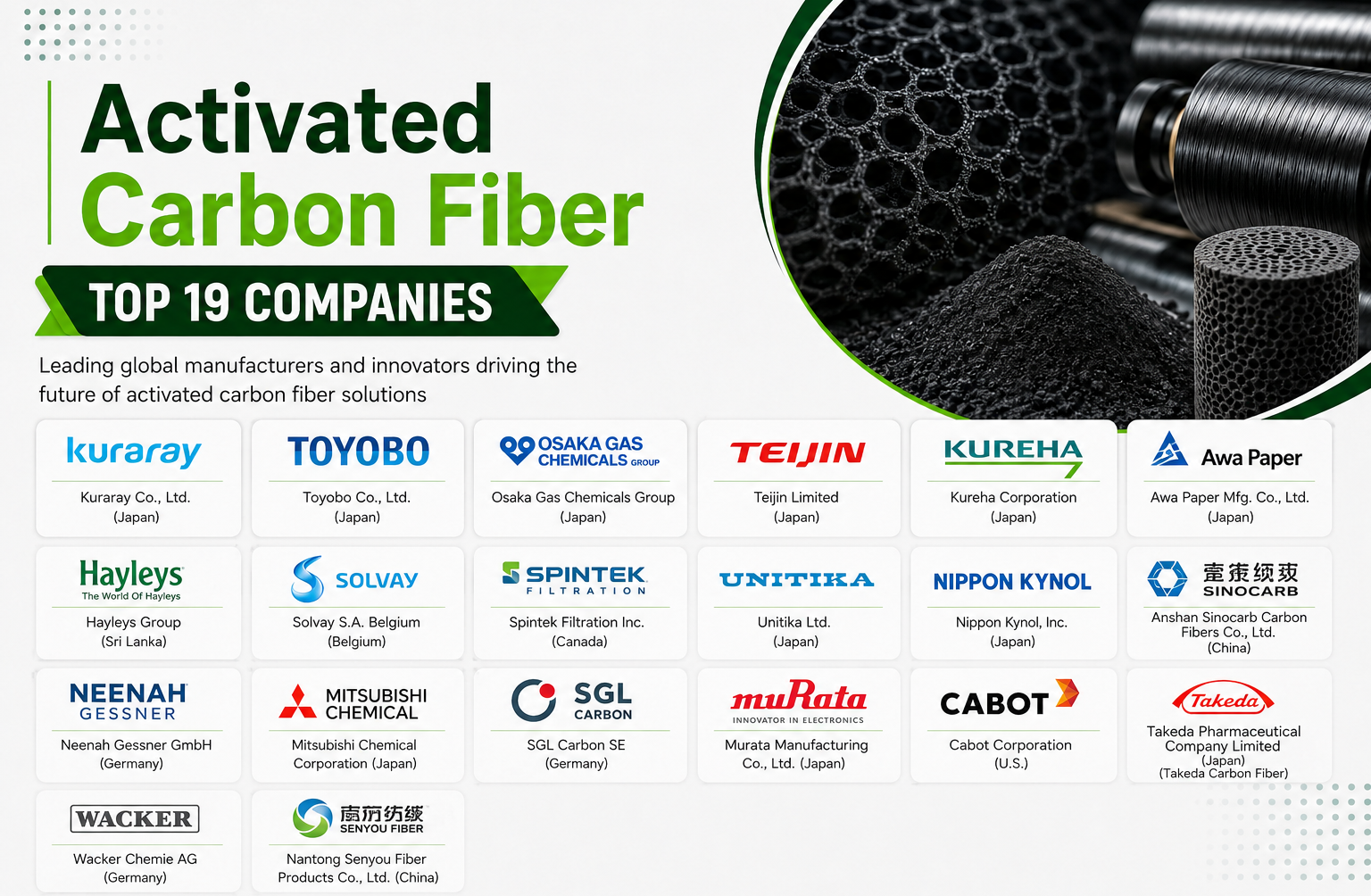
The competitive landscape is anchored by Japanese specialty chemical and materials companies including Kuraray, Toyobo, and Teijin, alongside global chemical and carbon-materials leaders such as SGL Carbon and Cabot Corporation, and a broad base of specialized regional manufacturers. This article provides a research-based analysis of the top companies shaping the global activated carbon fiber market, their positioning, flagship offerings, and the regional and technological forces driving the industry forward.
Market Overview
|
Parameter |
Details |
|---|---|
|
Market Size (2025) |
USD 436.36 Million |
|
Projected Market Size (2034) |
USD 639.35 Million |
|
CAGR (2025–2034) |
4.43% |
|
Base Year |
2024 |
|
Historic Year |
2019–2023 |
|
Forecast Period |
2025–2034 |
|
Leading & Fastest-Growing Region |
Asia-Pacific |
|
Key Segments (by Application) |
Air Purification, Wastewater Treatment, Chemical Separation & Catalysis, Protective Clothing, Others |
|
Key Segments (by Material) |
Synthetic, Natural |
|
Fastest-Growing Application |
Chemical Separation & Catalysis (~8% CAGR) |
Why the Activated Carbon Fiber Market Is Growing
1. Rising Demand for Air and Water Purification
Rapid industrialization and urbanization have pushed air and water pollution to critical levels, and governments worldwide are enacting stringent pollution-control regulations, driving demand for ACF's high adsorption capacity across industrial air filters, gas masks, air purifiers, and water treatment systems.
2. Growth Across Chemical Processing, Pharmaceuticals, and Food & Beverage
ACF is used for gas and liquid purification and catalyst support in chemical processing, purification of APIs and solvent recovery in pharmaceuticals, and decolorization, deodorization, and impurity removal in food and beverage production to meet stringent quality standards.
3. Expanding Healthcare Applications
ACF's ability to adsorb hazardous gases, bacteria, and viruses is driving adoption in medical devices, protective clothing, and wound dressings, including activated carbon fiber face masks and respirators for airborne pathogen protection and ACF-based dressings that promote faster healing.
4. Advances in Technology and Material Science
Ongoing R&D to enhance ACF's surface area, mechanical strength, and hybrid composite properties is opening new application areas and fueling broader industry adoption.
5. Sustainability and Circular Economy Momentum
ACF can be regenerated and reused multiple times without substantial performance degradation, making it an economically viable, environmentally friendly solution that appeals to industries seeking to reduce their ecological footprint.
6. Rapid Growth in Chemical Separation & Catalysis
This segment is projected to grow at roughly 8% CAGR, driven by rising demand for advanced, eco-friendly separation solutions from pharmaceutical industries, chemical separation processes, and water treatment, supported by ACF's large surface area, high porosity, and chemical stability.
Market Opportunities & Restraints
A key opportunity lies in innovation in regenerative and reusable ACF products: advances in structural integrity and fiber surface properties, along with microwave and thermal regeneration techniques, are extending ACF's usable lifespan at lower energy cost, while hybrid materials combining ACF with other functional components are broadening its application range. On the restraint side, economic fluctuations affecting industrial investment remain the primary headwind, as companies take a more conservative capital-spending approach during periods of instability, delaying adoption of ACF-based solutions, while volatile raw material, labor, and energy costs, alongside global trade policy and currency uncertainty, further constrain new investment in chemical processing, automotive, and manufacturing end markets.
Top 10 Companies in the Activated Carbon Fiber Market
- Kuraray Co., Ltd.
- Toyobo Co., Ltd.
- Teijin Limited
- Osaka Gas Chemicals Group
- Unitika Ltd.
- SGL Carbon SE
- Cabot Corporation
- Kureha Corporation
- Mitsubishi Chemical Corporation
- Solvay S.A.
1. Kuraray Co., Ltd.
|
Category |
Details |
|---|---|
|
Company Name |
Kuraray Co., Ltd. |
|
Headquarters |
Chiyoda-ku, Tokyo, Japan |
|
Founded |
1926 |
|
Employees |
Approx. 11,900–13,400 |
|
Revenue |
Approx. USD 5.4 Billion (total company revenue across Vinyl Acetate, Isoprene, Functional Materials, Fibers, and Trading segments) |
|
Company Overview |
Kuraray is a global specialty chemical leader operating in 31 countries, offering activated carbon and activated carbon fiber products alongside resins, fibers, and high-performance materials. |
|
Key Products |
Activated carbon and activated carbon fiber products serving air and water purification, chemical processing, and specialty industrial applications, alongside Calgon Carbon reactivated-carbon services. |
|
Market Position |
One of the world's leading suppliers of activated carbon fiber, with integrated global manufacturing presence across Asia-Pacific, North America, and Europe. |
|
Recent Developments |
Highlighted growth priorities for its activated carbon business including drinking-water PFAS removal at a June 2026 management briefing; its Calgon Carbon subsidiary announced a nearly USD 100 million reactivation-capacity expansion in Columbus, Ohio (February 2026). |
|
Strategic Advantages |
Proprietary activation technology, integrated global manufacturing and reactivation infrastructure through Calgon Carbon, and a diversified specialty chemicals base supporting sustained R&D investment. |
2. Toyobo Co., Ltd.
|
Category |
Details |
|---|---|
|
Company Name |
Toyobo Co., Ltd. |
|
Headquarters |
Osaka, Japan |
|
Founded |
1882 |
|
Employees |
Approx. 10,500 (consolidated) |
|
Revenue |
Approx. USD 3.4 Billion+ (total company revenue across Films and Functional Polymers, Mobility, Lifestyle and Environment, Life Science, and Real Estate segments) |
|
Company Overview |
Toyobo designs, manufactures, and distributes activated carbon fiber-based air filter products through its Films and Functional Polymers segment, serving air purification, dust removal, and deodorization needs. |
|
Key Products |
Activated carbon fiber-equipped air filter products for industrial and consumer air-purification applications. |
|
Market Position |
A major global activated carbon fiber player with a wide presence across Asia-Pacific, North America, Europe, Latin America, and the Middle East & Africa. |
|
Recent Developments |
Continues expanding its activated carbon fiber air-filter product lines as part of its broader Films and Functional Polymers segment strategy targeting global purification markets. |
|
Strategic Advantages |
Over a century of Japanese functional-materials manufacturing heritage, a diversified global regional footprint, and integration of ACF into a broader air-filtration product portfolio. |
3. Teijin Limited
|
Category |
Details |
|---|---|
|
Company Name |
Teijin Limited |
|
Headquarters |
Tokyo and Osaka, Japan |
|
Founded |
1918 (as Japan's first rayon producer) |
|
Employees |
Approx. 20,000 (across roughly 150–170 group companies) |
|
Revenue (FY2025) |
Approx. JPY 1,005.5 Billion (~USD 6.8 Billion) |
|
Company Overview |
Teijin is a global technology group spanning high-performance fibers (aramid, carbon), advanced composites, healthcare, films, and textiles, with carbon and activated-carbon-adjacent fiber technology developed through its Material segment. |
|
Key Products |
High-performance carbon and aramid fiber products through its Teijin Carbon and Toho Tenax brands, alongside composite materials serving aerospace, automotive, and industrial applications. |
|
Market Position |
A leading global materials group with deep carbon fiber manufacturing scale, strengthened significantly since acquiring a majority stake in Toho Tenax in 2000. |
|
Recent Developments |
Continues expanding its Material segment's high-performance fiber and composite capabilities, with production facilities across Japan, Germany, and the United States supporting global carbon fiber demand. |
|
Strategic Advantages |
Century-long fiber and materials manufacturing heritage, globally distributed production (Japan, Germany, U.S.), and deep integration between fiber science R&D and industrial-scale carbon fiber manufacturing. |
4. SGL Carbon SE
|
Category |
Details |
|---|---|
|
Company Name |
SGL Carbon SE |
|
Headquarters |
Wiesbaden, Germany |
|
Founded |
1992 |
|
Employees |
Approx. 3,800 |
|
Revenue |
Approx. EUR 850.2 Million (~USD 920 Million, 2025) |
|
Company Overview |
SGL Carbon is one of the world's leading manufacturers of carbon-based products, operating 29 production sites globally, with graphite specialties and carbon fibers and composites forming core business lines relevant to activated carbon fiber applications. |
|
Key Products |
Graphite specialties, carbon fibers, and composite materials serving industrial, chemical processing, and specialty adsorption applications. |
|
Market Position |
A leading European carbon-materials manufacturer with a global production footprint spanning 17 sites in Europe and 8 in other regions. |
|
Recent Developments |
Continues to operate as a leading global carbon-materials producer, maintaining an extensive international manufacturing network across Europe and beyond. |
|
Strategic Advantages |
Deep carbon and graphite materials science expertise, an extensive global production network, and strength across both graphite specialty and carbon fiber composite product lines. |
5. Cabot Corporation
|
Category |
Details |
|---|---|
|
Company Name |
Cabot Corporation |
|
Headquarters |
Boston, Massachusetts, USA |
|
Founded |
1882 |
|
Employees |
Approx. 4,500 |
|
Revenue |
Approx. USD 3.2 Billion |
|
Company Overview |
Cabot is an American specialty chemicals and performance materials company whose product portfolio includes activated carbon, following its 2012 acquisition of Norit NV, the largest producer of activated carbon at the time, for USD 1.1 billion. |
|
Key Products |
Activated carbon and related adsorbent products, alongside aerogel, elastomer composites, silicas, and other specialty performance materials. |
|
Market Position |
A leading North American activated carbon and specialty materials supplier, serving purification and industrial adsorption markets globally. |
|
Recent Developments |
Continues to leverage its Norit-derived activated carbon manufacturing base to serve global purification and industrial adsorption markets. |
|
Strategic Advantages |
Scale acquired through the Norit acquisition, a diversified specialty chemicals portfolio, and established North American and global distribution for activated carbon and adsorbent products. |
Competitive Landscape
The global activated carbon fiber market brings together a broad and diverse set of competitors. Japanese specialty materials leaders Kuraray, Toyobo, Teijin, Osaka Gas Chemicals, and Unitika hold particularly strong positions, built on proprietary activation and fiber-science technology developed over decades. Global carbon and specialty chemicals majors SGL Carbon, Cabot Corporation, Mitsubishi Chemical, and Solvay bring broader carbon-materials manufacturing scale and diversified specialty chemicals portfolios to the market. A large base of specialized and regional manufacturers, including Kureha Corporation, Awa Paper Mfg., Hayleys Group, Spintek Filtration, Nippon Kynol, Anshan Sinocarb Carbon Fibers, Neenah Gessner, Murata Manufacturing, Wacker Chemie, and Nantong Senyou Fiber Products, compete on application-specific engineering, regional manufacturing cost advantages, and niche product specialization across the fragmented global supply base.
Regional Analysis
Asia-Pacific
Asia-Pacific leads the activated carbon fiber market and is expected to remain the fastest-growing region, supported by a strong industrial base in China, Japan, and South Korea, tightening environmental regulations driving ACF adoption for air and water purification, easy availability of raw materials, and a large concentration of ACF manufacturing companies. Rising urbanization, industrialization, and a growing middle-class population are further increasing demand for effective purification solutions across the region.
North America
North America represents a high-profile ACF market shaped by strict enforcement of environmental regulations and rising demand for advanced purification technologies, though growth remains relatively modest compared to Asia-Pacific.
Europe
Europe similarly features strong environmental regulatory enforcement and demand for advanced purification technologies, supporting steady, if moderate, market growth relative to the Asia-Pacific region.
Latin America & Middle East and Africa
Latin America and the Middle East & Africa remain emerging ACF markets, projected to grow further as environmental awareness and industrial activity expand across these regions.
Emerging Trends in the Activated Carbon Fiber Market
1. Regenerative and Reusable ACF Innovation: Advances in fiber structural integrity and surface properties, combined with microwave and thermal regeneration techniques, are extending ACF's usable lifespan while lowering energy consumption and environmental impact.
2. Hybrid and Composite ACF Materials: Development of hybrid materials combining ACF with other functional components is broadening the range of pollutants and industrial requirements that ACF-based solutions can address.
3. Growth in Chemical Separation & Catalysis: This application segment is projected to grow at roughly 8% CAGR, outpacing the broader market as pharmaceutical, chemical separation, and water treatment industries adopt ACF for its large surface area, porosity, and chemical stability.
4. Natural Fiber-Based ACF Development: Growing interest in eco-friendly, natural fiber-derived ACF, including experimental sources with high porosity and graphite-like crystalline structures, reflects rising demand for sustainable, environmentally preferable adsorption materials.
5. Healthcare and Protective Textile Applications: Expanding use of ACF in face masks, respirators, and wound dressings is driven by its ability to adsorb hazardous gases, bacteria, and viruses while maintaining sterile, protective environments.
Future Outlook (2025–2034)
The global activated carbon fiber market's trajectory toward USD 639.35 million by 2034 reflects sustained demand growth across purification, chemical processing, and healthcare applications. The 4.43% CAGR forecast through 2034 assumes continued tightening of environmental regulations, growing circular-economy adoption given ACF's regenerative properties, and expanding chemical separation and catalysis demand, projected to grow at nearly double the overall market rate.
Key investment themes include continued innovation in regenerative and reusable ACF products, development of hybrid materials that broaden ACF's application range, and growing natural fiber-based ACF development aligned with sustainability priorities. Japanese specialty materials leaders Kuraray, Toyobo, and Teijin are likely to retain strong positions built on proprietary activation technology, while global carbon-materials majors SGL Carbon and Cabot Corporation continue leveraging their diversified manufacturing scale, and a broad base of specialized regional manufacturers compete on application-specific engineering across the fragmented global market.
Frequently Asked Questions (FAQ)
1. What is the current size of the global activated carbon fiber market?
The global activated carbon fiber market was valued at USD 436.36 million in 2025 and is projected to reach USD 639.35 million by 2034, growing at a CAGR of 4.43%.
2. Who are the top companies in the activated carbon fiber market?
Leading companies include Kuraray Co., Ltd., Toyobo Co., Ltd., Teijin Limited, Osaka Gas Chemicals Group, Unitika Ltd., SGL Carbon SE, Cabot Corporation, Kureha Corporation, Mitsubishi Chemical Corporation, and Solvay S.A.
3. Which region dominates the activated carbon fiber market?
Asia-Pacific dominates the market and is also expected to be the fastest-growing region, driven by a strong industrial base in China, Japan, and South Korea and tightening environmental regulations.
4. What is the forecast CAGR for the activated carbon fiber market?
The market is forecast to grow at a CAGR of 4.43% from 2025 to 2034.
5. What are the main growth drivers for this market?
Key drivers include rising demand for air and water purification amid tightening environmental legislation, growth across chemical processing, pharmaceuticals, and food and beverage industries, expanding healthcare applications, and growing interest in sustainable, regenerative ACF solutions.
6. Which application segment is growing fastest?
The Chemical Separation & Catalysis segment is projected to grow at approximately 8% CAGR, outpacing the overall market due to rising demand from pharmaceutical and chemical separation industries.
7. What raw materials are used to produce activated carbon fiber?
Activated carbon fiber is produced from organic precursors including polyacrylonitrile, pitch, and phenolic resin (synthetic materials), as well as emerging natural fiber sources that are carbonized and activated to develop high adsorption capacity.
Conclusion
The global activated carbon fiber market sits at the intersection of tightening environmental regulation and rising demand for high-performance, regenerative purification materials. With a projected size of USD 639.35 million by 2034 at a 4.43% CAGR, the market offers steady, sustainability-driven growth across air and water purification, chemical processing, and healthcare applications.
Kuraray, Toyobo, and Teijin continue to lead on the strength of decades of Japanese fiber-science and activation technology, while SGL Carbon and Cabot Corporation bring global carbon-materials manufacturing scale, and a broad base of specialized regional manufacturers compete on application-specific engineering. As regenerative ACF innovation, hybrid materials, and natural fiber development reshape the industry, the companies that combine deep activation expertise with sustainable, circular-economy positioning will define market leadership through 2034 and beyond.