
Global Electrophotographic Printing Market Top Companies, Trends, and Future Outlook
Author:
Intellectual Market Insights Research
Published Date:
12 Sep 2026
Introduction
Electrophotographic printing, also known as laser printing or xerography, is a digital printing technology that uses electrostatic charges to transfer toner onto a substrate, producing sharp, durable, high-quality output. The process works by creating an image on a photosensitive drum or belt using a laser or LED light source, which attracts electrically charged toner particles to the exposed areas; the toner is then transferred to paper or another substrate and fused using heat and pressure to create a permanent print.
The global electrophotographic printing market spans office printing, commercial and production printing, packaging, and publishing applications, competing alongside inkjet and offset printing technologies for a share of the broader digital and commercial printing industry. This article provides a research-based analysis of the global electrophotographic printing market, the companies shaping it, and the regional and technological forces driving its growth toward the mid-2030s.
Market Overview
Market size estimates for electrophotographic printing vary meaningfully across research providers depending on scope and segment definitions, but most independent sources point to a market in the low-to-mid single-digit billions of dollars, growing at a moderate mid-single-digit CAGR:
| Parameter | Details |
|---|---|
| Market Size (2024) | Approx. USD 3.4–3.6 Billion (per most independent research estimates) |
| Projected Market Size (2032–2033) | Approx. USD 5.0–5.4 Billion |
| CAGR (2025–2033) | Approx. 4.9%–5.6% (estimates vary by source and scope) |
| Leading Region | North America (largest share); Asia-Pacific (fastest growth) |
| Key Segments (by Component) | Toners, Drums, Fusers, Transfer Belts, Others |
| Key Segments (by Type) | Monochrome Printing, Color Printing |
| Key Segments (by Application) | Commercial Printing, Office Printing, Packaging, Publishing, Advertising |
Why the Electrophotographic Printing Market Is Growing
Rising Demand for High-Volume, High-Precision Printing
Electrophotographic printing's ability to deliver sharp, consistent, and smudge-resistant output at high speed continues to make it the preferred technology for businesses with high-volume printing needs, including commercial print shops and corporate document centers.
Growth of the Packaging Industry
Rising e-commerce activity and demand for customized, branded packaging is driving adoption of electrophotographic printing for short-run and variable-data packaging applications, a segment expected to grow faster than the overall market.
Demand for Variable Data and Personalized Printing
Businesses increasingly rely on high-speed electrophotographic printers to produce personalized marketing materials and variable-data documents, capabilities well suited to toner-based digital printing technology.
Advancements in Toner and Imaging Technology
Continuous innovation in toner formulations, digital control systems, and laser and LED imaging units is improving print reliability, color accuracy, and overall system efficiency, supporting continued adoption over competing print technologies.
Sustained Office and Institutional Printing Demand
Despite the broader shift toward digital and paperless workflows, offices, educational institutions, and government agencies continue to require reliable, high-quality printing infrastructure, sustaining steady baseline demand for electrophotographic printing systems.
Managed Print Services Growth
Growing adoption of managed print services, which bundle printer hardware, consumables, and workflow management into subscription-style offerings, is helping printer manufacturers maintain steady recurring revenue streams tied to electrophotographic printing hardware.
Market Opportunities & Restraints
A key opportunity lies in packaging and short-run digital printing: as e-commerce growth drives demand for smaller, more frequent, and more customized packaging runs, electrophotographic printing technology is well positioned to capture share from traditional offset printing methods that are less economical for short runs, while continued advances in toner and imaging technology open the door to higher-margin specialty and industrial printing applications. On the restraint side, structural decline in traditional office printing volumes remains the primary headwind, as digitization and paperless workflows continue to erode baseline office printing demand, forcing manufacturers to pursue growth in adjacent segments such as packaging, commercial production printing, and managed print services to offset the secular decline in traditional print volumes.
Companies Associated with the Electrophotographic Printing Market (Details in Bullet)
Canon Inc.
- Headquarters: Tokyo, Japan
- Founded: 1937
- Employees: Approx. 184,000+ (group-wide)
- Revenue: Multi-billion dollar diversified imaging and optics conglomerate
- Overview: A global leader in electrophotographic printing and imaging technology, offering office and production printing systems through its Canon Production Printing subsidiary alongside its broader imaging, optics, and medical systems businesses.
HP Inc.
- Headquarters: Palo Alto, California, USA
- Founded: 2015 (spun off from Hewlett-Packard)
- Employees: Approx. 55,000
- Revenue: Approx. USD 55.29 Billion (2025)
- Overview: A leading global printer and personal computing company offering laser and LaserJet electrophotographic printers alongside its broader PC, 3D printing, and managed print services businesses.
Fujifilm Business Innovation (formerly Fuji Xerox)
- Headquarters: Tokyo, Japan
- Founded: 1962 (as Fuji Xerox)
- Employees: Tens of thousands across Asia-Pacific operations
- Revenue: Reported as part of Fujifilm Holdings
- Overview: A major electrophotographic printing and document technology provider across Asia-Pacific, operating independently from Xerox Corporation since 2021 following Fujifilm's full acquisition of the joint venture.
Xerox Holdings Corporation
- Headquarters: Norwalk, Connecticut, USA
- Founded: 1906
- Employees: Approx. 16,800 (2024)
- Revenue: Approx. USD 6.22 Billion (2024)
- Overview: The pioneer of the photocopier and electrophotographic printing industry, offering office printers, production printing systems, and document services to customers in more than 160 countries.
Eastman Kodak Company
- Headquarters: Rochester, New York, USA
- Founded: 1888
- Employees: Several thousand
- Revenue: Approx. USD 1.06 Billion (2025)
- Overview: A commercial print and advanced materials manufacturer with a long history in imaging technology, continuing to focus on commercial printing solutions and specialty chemicals following its broader corporate restructuring.
Konica Minolta, Inc.
- Headquarters: Marunouchi, Chiyoda, Tokyo, Japan
- Founded: 2003 (merger of Konica and Minolta)
- Employees: Approx. 34,000+
- Revenue: Multi-billion dollar diversified imaging technology company
- Overview: A leading manufacturer of business and industrial imaging products, including electrophotographic printers and multi-function printers (MFPs), holding a leading position in color digital printers and A3 color MFPs globally, with a 2024 strategic partnership with Fujifilm for supply chain coordination.
Ricoh Company, Ltd.
- Headquarters: Tokyo, Japan
- Founded: 1936
- Employees: Approx. 72,000–76,000
- Revenue: Approx. USD 17.3–17.4 Billion
- Overview: A major Japanese electronics and imaging company manufacturing office automation equipment, electrophotographic printers, and photocopiers, competing globally alongside Canon, HP, and Xerox in the production printing and managed print services markets.
MGI Digital Graphic Technology
- Headquarters: Champs-sur-Marne, France
- Founded: 1982
- Employees: Several hundred
- Revenue: Not publicly disclosed
- Overview: A specialized French manufacturer of digital printing and finishing equipment, focused on enhancing electrophotographic and digital print output through embellishment and finishing technologies for commercial printers.
Xeikon
- Headquarters: Lier, Belgium
- Founded: 1988
- Employees: Several hundred
- Revenue: Not publicly disclosed
- Overview: A specialist manufacturer of digital label and packaging presses using dry toner electrophotographic printing technology, focused on the label, packaging, and specialty print markets.
Jadason Enterprises
- Headquarters: Singapore
- Founded: Not publicly disclosed in detail
- Employees: Not publicly disclosed
- Revenue: Not publicly disclosed
- Overview: A Singapore-based supplier of printing and imaging technology components serving the broader Asia-Pacific electrophotographic and digital printing supply chain.
Competitive Landscape
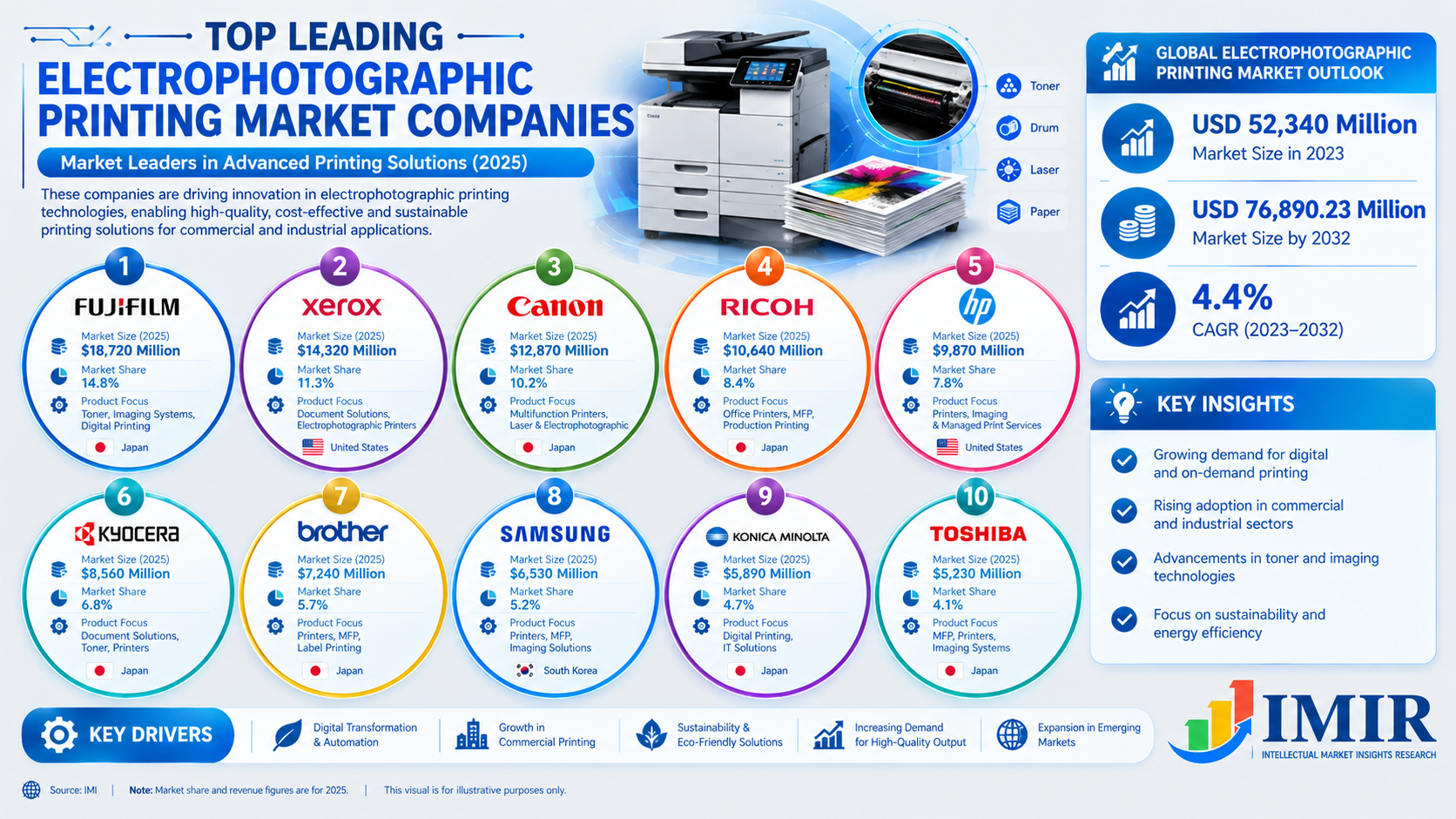
The global electrophotographic printing market brings together a small group of large, diversified Japanese and American imaging technology conglomerates alongside specialized niche manufacturers. Global imaging majors Canon, HP, Xerox, Konica Minolta, and Ricoh hold particularly strong positions, built on decades of laser and toner-based printing technology development, extensive global service and distribution networks, and diversified product portfolios spanning office, production, and managed print services. Regional and specialty players including Fujifilm Business Innovation (which now operates independently of Xerox in Asia-Pacific following the 2021 dissolution of the Fuji Xerox joint venture), Eastman Kodak, MGI Digital Graphic Technology, Xeikon, and Jadason Enterprises compete through deep application-specific focus, particularly in packaging, label printing, and finishing technology, and regional market strength.
Regional Analysis
North America
North America remains the largest electrophotographic printing market, supported by extensive commercial printing infrastructure, strong managed print services adoption, and the presence of major manufacturers such as HP, Xerox, and Eastman Kodak.
Europe
Europe represents a significant electrophotographic printing market, anchored by specialty manufacturers such as MGI Digital Graphic Technology and Xeikon, alongside strong commercial printing and packaging industry demand across Germany, France, and the UK.
Asia-Pacific
Asia-Pacific is expected to register the fastest growth, driven by the presence of major manufacturers such as Canon, Konica Minolta, Ricoh, and Fujifilm Business Innovation in Japan, alongside rising commercial printing and packaging demand across China and India.
Latin America & Middle East and Africa
Latin America and the Middle East & Africa represent emerging growth markets for electrophotographic printing, with demand tied to expanding commercial printing infrastructure and growing packaging and labeling industry investment.
Emerging Trends in the Electrophotographic Printing Market
1. Growth of Digital Packaging and Label Printing: Rising e-commerce activity is driving demand for short-run, customized packaging and labels, a segment where electrophotographic and digital printing technologies hold a cost advantage over traditional offset printing for smaller print runs.
2. Expansion of Managed Print Services: Printer manufacturers are increasingly bundling hardware, consumables, and workflow management into subscription-based managed print service offerings, exemplified by Ricoh's 2025 CloudStream platform launch and Konica Minolta's Workplace Hub initiative.
3. Consolidation and Restructuring Among Legacy Imaging Companies: The 2021 dissolution of the Fuji Xerox joint venture, resulting in Fujifilm Business Innovation operating independently in Asia-Pacific, illustrates the ongoing restructuring occurring among legacy imaging and printing companies as they adapt to declining traditional print volumes.
4. Sustainability and Environmental Positioning: Manufacturers are increasingly emphasizing environmental sustainability in their printing technology offerings, with companies such as Konica Minolta highlighting strong sustainability scores and environmental reporting as competitive differentiators.
5. Shift Toward Production and Commercial Printing: As traditional office printing volumes decline due to digitization, manufacturers are increasingly focusing growth investment on production printing, commercial digital printing, and packaging applications rather than general office printing hardware.
Future Outlook (2025–2034)
The global electrophotographic printing market's trajectory toward the mid-single-digit billions by the early-to-mid 2030s reflects a maturing industry balancing structural decline in traditional office printing against growth in packaging, commercial production printing, and managed print services. Estimates of the forecast CAGR range from approximately 4.9% to 6.5% depending on the source and market scope, but the underlying trend across independent research is consistent: moderate, steady growth driven by packaging and commercial printing demand rather than traditional office printing volumes.
Key investment themes for 2025–2034 include continued growth in packaging and short-run digital printing applications, expansion of managed print services as a recurring revenue model, and ongoing restructuring among legacy imaging companies as they reposition away from declining office print volumes toward higher-growth commercial and production printing segments. As e-commerce-driven packaging demand, toner technology innovation, and managed print services continue to reshape the industry, the companies that combine deep imaging technology expertise with diversification into packaging and commercial printing will be best positioned to capture growth through the 2030s.
Frequently Asked Questions (FAQ)
1. What is the current size of the global electrophotographic printing market?
Independent market research estimates place the global electrophotographic printing market at approximately USD 3.4–3.6 billion in 2024, with projections to reach approximately USD 5.0–5.4 billion by 2032–2033, though estimates vary meaningfully by source and market scope.
2. Who are the top companies in the electrophotographic printing market?
Leading companies include Canon Inc., HP Inc., Fujifilm Business Innovation (formerly Fuji Xerox), Xerox Holdings Corporation, Eastman Kodak Company, Konica Minolta, Inc., Ricoh Company, Ltd., MGI Digital Graphic Technology, Xeikon, and Jadason Enterprises.
3. Which region dominates the electrophotographic printing market?
North America remains the largest electrophotographic printing market, while Asia-Pacific is expected to register the fastest growth due to the presence of key manufacturers in Japan and rising demand in China and India.
4. What is the forecast CAGR for the electrophotographic printing market?
Independent research estimates range from approximately 4.9% to 6.5% CAGR through the early-to-mid 2030s, depending on the source and market scope used.
5. What are the main growth drivers for this market?
Key drivers include rising demand for high-volume, high-precision printing, growth of the packaging industry, demand for variable data and personalized printing, advancements in toner and imaging technology, and continued managed print services growth.
6. What components make up an electrophotographic printing system?
The market is segmented by component into toners, drums, fusers, transfer belts, and other imaging and consumable components essential to the electrophotographic printing process.
7. What applications does electrophotographic printing serve?
Electrophotographic printing serves commercial printing, office printing, packaging, publishing, and advertising applications, competing alongside inkjet and offset printing technologies across the broader printing industry.
Conclusion
The global electrophotographic printing market sits at the intersection of structural decline in traditional office printing and emerging growth opportunities in packaging, commercial production printing, and managed print services. With most independent estimates pointing to steady, moderate growth into the low-to-mid single-digit billions of dollars through the early-to-mid 2030s, the market offers a mixed but resilient growth profile.
Canon, HP, Xerox, Konica Minolta, and Ricoh continue to lead on the strength of decades of imaging technology expertise and global service networks, while Fujifilm Business Innovation, Eastman Kodak, MGI Digital Graphic Technology, and Xeikon compete through regional strength and specialty application focus in packaging and label printing. As packaging-driven digital printing growth, managed print services expansion, and industry restructuring continue to reshape the sector, the companies that successfully diversify beyond declining office print volumes will define market leadership through the 2030s and beyond.


