
Global Energy Storage Market Leading Companies
Author:
Intellectual Market Insights Research
Published Date:
09 Sep 2026
Introduction
Energy storage has become one of the most critical technologies underpinning the global transition to renewable, decentralized, and resilient power systems. By capturing surplus electricity during periods of high generation and releasing it when demand peaks or renewable output dips, energy storage systems address the fundamental challenge of intermittency in solar and wind power while improving grid reliability, reducing reliance on fossil-fuel peaker plants, and enabling everything from utility-scale grid balancing to residential backup power and electric vehicle charging.
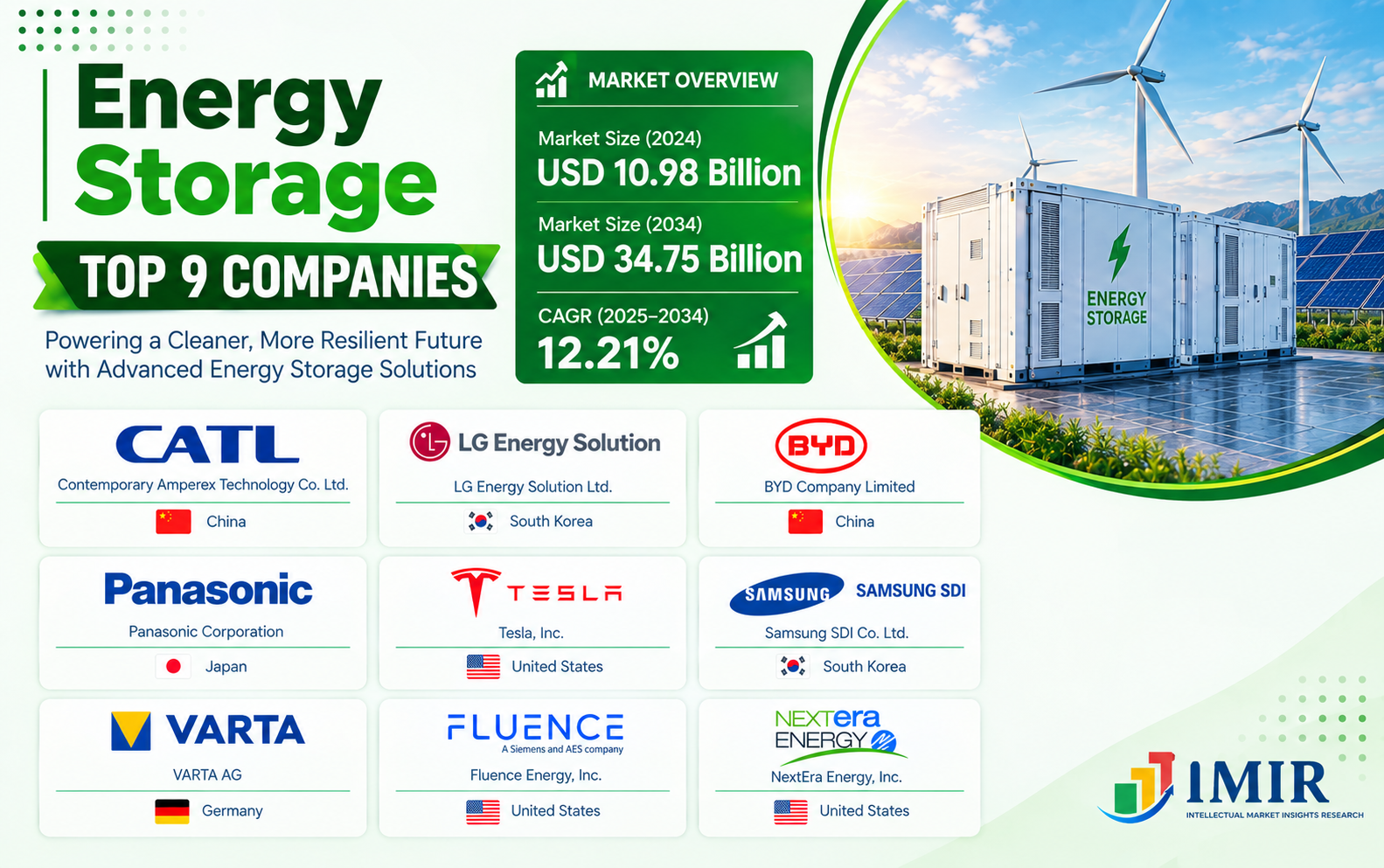
The Energy Storage Market size was valued at around USD 10.98 billion in 2024 and is expected to reach a value of USD 34.75 billion by 2034, at a CAGR of 12.21% over the forecast period (2025–2034).
The global energy storage market spans a wide range of technologies, including lithium-ion, lead-acid, flow, sodium-based, and solid-state battery storage; mechanical storage such as pumped hydro, flywheels, and compressed air energy storage (CAES); thermal energy storage using molten salts and phase-change materials; and hydrogen energy storage via fuel cells and power-to-gas systems. This article provides a research-based analysis of the global energy storage market, the companies shaping it, and the regional and technological forces driving its growth toward 2034.
Market Overview
|
Parameter |
Details |
|---|---|
|
Market Size (2024) |
USD 10.98 Billion |
|
Projected Market Size (2034) |
USD 34.75 Billion |
|
CAGR (2025–2034) |
12.21% |
|
Base Year |
2024 |
|
Historic Year |
2020–2023 |
|
Forecast Period |
2025–2034 |
|
Leading Region |
North America (largest installed capacity); Asia-Pacific (fastest-growing) |
|
Key Segments (by Technology) |
Battery Storage, Mechanical Storage, Thermal Energy Storage, Hydrogen Energy Storage |
|
Key Segments (by Application) |
Grid-Scale Storage, Renewable Energy Storage, Backup & Emergency Power, Microgrid & Off-Grid Storage, EV Storage |
|
Key Segments (by End-User) |
Utility Sector, Residential Sector, Commercial & Industrial Sector, Transportation Sector |
Why the Energy Storage Market Is Growing
Managing the Intermittency of Solar and Wind Power
Solar panels generate electricity only during daylight hours, while wind turbine output varies with wind speed. Energy storage technologies such as lithium-ion batteries, pumped hydro, and hydrogen storage capture excess generation during peak output and release it during periods of high demand or low renewable generation, forming the backbone of a reliable transition to renewable energy.
Enhancing Grid Reliability and Efficiency
Conventional grids face growing uncertainty as renewable penetration rises. Energy storage technologies offset these irregularities by storing excess power during off-peak periods and releasing it during peak demand, preventing blackouts, improving power quality, and reducing stress on grid infrastructure while lowering dependence on fossil-fuel backup generation.
Rising Power Supply-Demand Disparities
Power outages caused by storms, equipment failures, and fire accidents continue to expose gaps between power supply and demand. Energy storage helps eliminate energy poverty and allows utilities to capture excess generation during low-demand periods rather than losing it, directly improving firm profitability and system resilience.
Rapid Industrialization and Renewable Capacity Growth
Rapid industrialization in developing economies such as India, China, and Brazil is driving strong growth in the power generation sector, which in turn is expected to boost demand for energy storage systems capable of balancing new generation capacity with variable demand patterns.
Declining Fossil Fuel Reserves
Anticipated shortages in coal, oil, and uranium supply are expected to boost demand for energy storage systems as a hedge against future fossil-fuel scarcity and price volatility, encouraging a broader pivot toward storage-backed renewable generation.
Long-Duration Storage Innovation
Advances in hydrogen and thermal energy storage are enabling longer-duration solutions that complement short-duration battery storage, allowing excess renewable electricity to be converted into hydrogen or stored as heat for release during extended low-generation periods.
Market Opportunities & Restraints
A key opportunity lies in large-scale renewable integration investment: as solar and wind adoption accelerates, governments, private investors, and utilities are funding utility-scale battery storage, pumped hydro, and emerging hydrogen storage projects to guarantee reliable renewable integration, drive down technology costs, and meet climate targets, while hydrogen and thermal storage are emerging as first-rate solutions for long-duration power needs that batteries alone cannot economically address. On the restraint side, environmental risks from improper battery disposal and high installation costs remain the primary headwinds: used batteries contain toxic substances such as lithium, cobalt, and lead that can contaminate soil and water if not properly recycled, while the high capital cost of storage technologies continues to constrain deployment, particularly in price-sensitive and emerging markets, even as pumped hydro and hydrogen fuel cells compete with batteries for long-duration storage use cases.
Companies Associated with the Energy Storage Market
- Contemporary Amperex Technology Co. Limited (CATL)
- BYD Co. Ltd.
- GS Yuasa Corporation
- Clarios
- UniEnergy Technologies, LLC
Contemporary Amperex Technology Co. Limited (CATL)
|
Category |
Details |
|---|---|
|
Headquarters |
Ningde, Fujian Province, China |
|
Founded |
2011 |
|
Employees |
Approx. 100,000+ (including roughly 23,000 engineers and scientists) |
|
Revenue (2025) |
RMB 423.7 Billion (approx. USD 61.4 Billion), up 17% year-over-year |
|
Overview |
CATL is the world's largest lithium-ion battery manufacturer, holding the top global power battery market share for nine consecutive years and leading global energy storage systems (ESS) shipments for five consecutive years. |
|
Recent Developments |
Sold 121 GWh of energy storage batteries in 2025, up 29% year-over-year, and expanded global production capacity to 772 GWh with 321 GWh under construction. |
BYD Co. Ltd.
|
Category |
Details |
|---|---|
|
Headquarters |
Shenzhen, Guangdong Province, China |
|
Founded |
1995 |
|
Employees |
290,000+ |
|
Revenue |
Approx. USD 80+ Billion (includes EVs and energy storage) |
|
Overview |
BYD is a vertically integrated Chinese conglomerate and a global leader in lithium iron phosphate (LFP) battery technology, supplying storage systems for both electric mobility and grid-scale applications. |
|
Recent Developments |
Continues expanding its LFP-based Blade Battery platform into grid-scale battery energy storage deployments outside China, building on its position as one of the top global EV and ESS battery suppliers. |
GS Yuasa Corporation
|
Category |
Details |
|---|---|
|
Headquarters |
Kyoto, Japan |
|
Founded |
2004 (through the merger of Japan Storage Battery Co. and Yuasa Corporation; predecessor companies trace to 1917–1918) |
|
Employees |
Approx. 12,500–15,800 |
|
Revenue |
Approx. USD 3.9 Billion |
|
Overview |
GS Yuasa develops lead-acid and lithium-ion batteries for automotive, motorcycle, industrial, aerospace, and defense applications, drawing on more than a century of Japanese battery manufacturing heritage. |
|
Recent Developments |
Supplied space-grade batteries supporting JAXA's HTV-X1 mission and continues developing automotive lithium-ion batteries adopted by major automakers including Toyota. |
Clarios
|
Category |
Details |
|---|---|
|
Headquarters |
Glendale, Wisconsin, USA |
|
Founded |
1885 (heritage business); operating as Clarios since 2019 |
|
Employees |
Over 10,000 (estimates vary significantly across global operations) |
|
Revenue |
Approx. USD 10.6 Billion |
|
Overview |
Clarios is a leading global provider of automotive, AGM, and low-voltage battery technologies, supplying advanced lead-acid and next-generation battery chemistries for automotive, commercial, and industrial applications. |
|
Recent Developments |
Continues expanding its global footprint across North America, Europe, Asia, and South America, supplying advanced energy storage solutions across a wide range of vehicle platforms. |
UniEnergy Technologies, LLC
|
Category |
Details |
|---|---|
|
Headquarters |
Mukilteo, Washington, USA |
|
Founded |
2012 |
|
Employees |
Approx. 5–52 (varied by source over the company's operating history) |
|
Revenue |
Approx. USD 11 Million (last reported estimate) |
|
Overview |
UniEnergy Technologies was a U.S. vanadium redox flow battery manufacturer producing megawatt-scale, long-duration energy storage systems for utility, commercial, and industrial customers using a proprietary mixed-acid vanadium electrolyte licensed from Pacific Northwest National Laboratory. |
|
Recent Developments |
The company partnered with Chemours and ENGIE on flow battery deployments and operated a European sales subsidiary, Vanadis Power, but has since ceased operations, illustrating the commercialization challenges facing specialty non-lithium storage technologies. |
Competitive Landscape
The global energy storage market brings together a diverse mix of competitors spanning multiple storage chemistries and technology categories. Lithium-ion battery giants CATL and BYD dominate the market through massive manufacturing scale, vertically integrated supply chains, and continuous chemistry innovation, particularly in lithium iron phosphate (LFP) formulations favored for stationary storage. Established industrial and automotive battery manufacturers GS Yuasa and Clarios bring deep expertise in lead-acid and hybrid battery technologies, serving automotive, industrial, aerospace, and defense end-markets that demand long-established reliability. Specialty and emerging-technology innovators such as UniEnergy Technologies represent the flow-battery and long-duration storage segment, though the company's closure highlights the difficulty smaller specialty manufacturers face scaling against lithium-ion incumbents. Beyond these five, the broader competitive field includes pumped hydro operators, thermal storage developers, and hydrogen storage technology providers competing across the fragmented global storage landscape.
Regional Analysis
North America
North America holds the largest installed energy storage capacity globally, supported by strong federal and state-level policy backing, particularly in California and Texas, where grid-scale lithium-ion battery storage investment continues to expand. Canada is advancing pumped hydro storage projects to support clean energy integration, while rising EV adoption continues to fuel demand for battery storage technologies.
Europe
Europe is one of the fastest-growing regions, led by Germany, the UK, and France, where the EU Green Deal and carbon-neutrality targets are driving investment in renewable energy storage, hydrogen storage, and battery recycling technologies. Norway and Spain are expanding pumped hydro storage capacity, while the Netherlands and Denmark are focusing on hydrogen fuel cells to store excess wind power.
Asia-Pacific
Asia-Pacific, led by China, India, Japan, and South Korea, is the fastest-developing energy storage market, driven by rising energy demand, supportive government programs, and rapid solar and wind capacity growth. China's dominance in lithium-ion battery manufacturing is driving massive gigafactory and grid-scale storage investment, India is rapidly adopting solar-plus-storage for rural electrification, and Japan and South Korea continue advancing hydrogen-fueled storage and solid-state battery technologies.
Latin America
Brazil, Chile, and Mexico are commissioning solar and wind power storage facilities to improve grid feasibility. Chile is leading regional thermal energy storage planning for concentrated solar power (CSP) plants, while Mexico is exploring microgrid storage systems to expand rural electricity access.
Middle East & Africa
The Middle East is investing in hydrogen and thermal storage to support large-scale solar power initiatives, including Saudi Arabia's NEOM hydrogen project, while Africa, endowed with abundant solar resources, is turning to microgrids and off-grid battery storage to expand rural energy access.
Emerging Trends in the Energy Storage Market
Long-Duration Storage via Hydrogen and Thermal Technologies: Hydrogen energy storage and thermal storage using molten salts and phase-change materials are emerging as first-rate solutions for long-duration power needs, complementing shorter-duration battery storage and reconciling the intermittency of solar and wind generation.
Growth of Sodium-Based and Solid-State Batteries: Sodium-sulphur and sodium-ion batteries are emerging as potential lower-cost replacements for lithium-ion chemistries, while solid-state battery technology continues to advance toward commercialization with promises of higher safety and efficiency.
Expansion of Grid-Scale and Utility Investment: Grid-scale energy storage remains the leading application segment, with pumped hydro, lithium-ion batteries, and compressed air energy storage (CAES) all playing central roles in preventing power fluctuations and managing peak loads.
Vehicle-to-Grid (V2G) Integration: Electric vehicle storage is increasingly enabling vehicle-to-grid technology, where EVs feed stored power back into the grid during periods of high demand, blurring the line between transportation and stationary storage applications.
Battery Recycling and Second-Life Applications: Growing focus on sustainable recycling technology and second-life battery applications is helping the industry address environmental risks associated with battery disposal while recovering valuable materials such as lithium and cobalt.
Consolidation Risk Among Specialty Storage Technologies: The closure of specialty manufacturers such as UniEnergy Technologies highlights the ongoing consolidation pressure facing non-lithium storage technologies as they compete against the scale advantages of established lithium-ion incumbents like CATL and BYD.
Future Outlook (2025–2034)
The global energy storage market's trajectory toward USD 34.75 billion by 2034 reflects sustained demand growth driven by renewable integration, grid modernization, and the ongoing search for cost-effective long-duration storage solutions. The 12.21% CAGR forecast through 2034 assumes continued lithium-ion cost declines, expanding hydrogen and thermal storage deployment for long-duration applications, and growing utility-scale investment across both developed and emerging markets.
Key investment themes include continued scale-up of lithium-ion manufacturing capacity by CATL and BYD, the ongoing evolution of automotive and industrial battery technology at GS Yuasa and Clarios, and the broader industry's search for viable long-duration and non-lithium storage alternatives following the commercialization struggles faced by specialty players like UniEnergy Technologies. As grid-scale, renewable-storage, and EV-storage applications continue to expand across every major region, the companies that combine manufacturing scale with technology diversification will be best positioned to capture the next decade of global energy storage growth.
Frequently Asked Questions (FAQ)
1. What is the current size of the global energy storage market?
The global energy storage market was valued at USD 10.98 billion in 2024 and is expected to reach USD 34.75 billion by 2034, growing at a CAGR of 12.21% from 2025 to 2034.
2. Who are the top companies in the energy storage market?
Leading companies include Contemporary Amperex Technology Co. Limited (CATL), BYD Co. Ltd., GS Yuasa Corporation, Clarios, and UniEnergy Technologies, LLC.
3. Which region dominates the energy storage market?
North America currently holds the largest installed capacity, supported by strong policy backing and technological innovation, while Asia-Pacific is expected to register the fastest growth, led by China, India, Japan, and South Korea.
4. What is the forecast CAGR for the energy storage market?
The market is forecast to grow at a CAGR of 12.21% from 2025 to 2034.
5. What are the main growth drivers for this market?
Key drivers include the need to manage intermittent solar and wind power, enhance grid reliability, address power supply-demand disparities, and support rapid industrialization and renewable capacity growth in developing economies.
6. What are the key technology segments in the energy storage market?
The market is segmented by technology into battery storage (lithium-ion, lead-acid, flow, sodium-based, and solid-state batteries), mechanical storage (pumped hydro, flywheel, and compressed air energy storage), thermal energy storage (molten salt and phase-change materials), and hydrogen energy storage (fuel cells and power-to-gas systems).
7. What are the primary applications of energy storage systems?
Energy storage systems are used for grid-scale storage, renewable energy storage, backup and emergency power, microgrid and off-grid storage, and electric vehicle (EV) storage, including emerging vehicle-to-grid (V2G) applications.
Conclusion
The global energy storage market sits at the intersection of accelerating renewable energy adoption and the urgent need for reliable, cost-effective ways to balance electricity supply and demand. With a projected size of USD 34.75 billion by 2034 at a 12.21% CAGR, the market offers steady, technology-diverse growth spanning battery, mechanical, thermal, and hydrogen storage solutions.
CATL and BYD continue to lead on the strength of massive lithium-ion manufacturing scale, GS Yuasa and Clarios bring deep expertise in industrial and automotive battery chemistries, while the trajectory of specialty innovators like UniEnergy Technologies illustrates both the promise and the commercialization risk facing non-lithium storage technologies. As grid modernization, long-duration storage innovation, and electric vehicle integration continue to reshape the industry, the companies that combine manufacturing scale with technological diversification will define market leadership through 2034 and beyond.