
Global Industrial Automation Market Top Companies
Author:
Intellectual Market Insights Research
Published Date:
15 Sep 2026
Introduction
Industrial automation refers to the use of control systems, software, and technology to operate industrial equipment and processes with minimal human intervention, replacing manual operations with programmable logic controllers (PLCs), distributed control systems (DCS), sensors, drives, and supervisory control and data acquisition (SCADA) systems. As manufacturers worldwide face mounting pressure to improve productivity, reduce operating costs, and maintain consistent product quality, industrial automation has become an essential enabler of competitiveness across process and discrete manufacturing industries.
The global industrial automation market spans a range of product categories, including SCADA, PLC, DCS, drives, and sensors, deployed across process industries such as oil and gas, chemicals, and power generation, as well as discrete manufacturing industries such as automotive, electronics, and machinery production. This article provides a research-based analysis of the global industrial automation market, the companies shaping it, and the regional and technological forces driving its growth toward 2034.
Market Overview
| Parameter | Details |
|---|---|
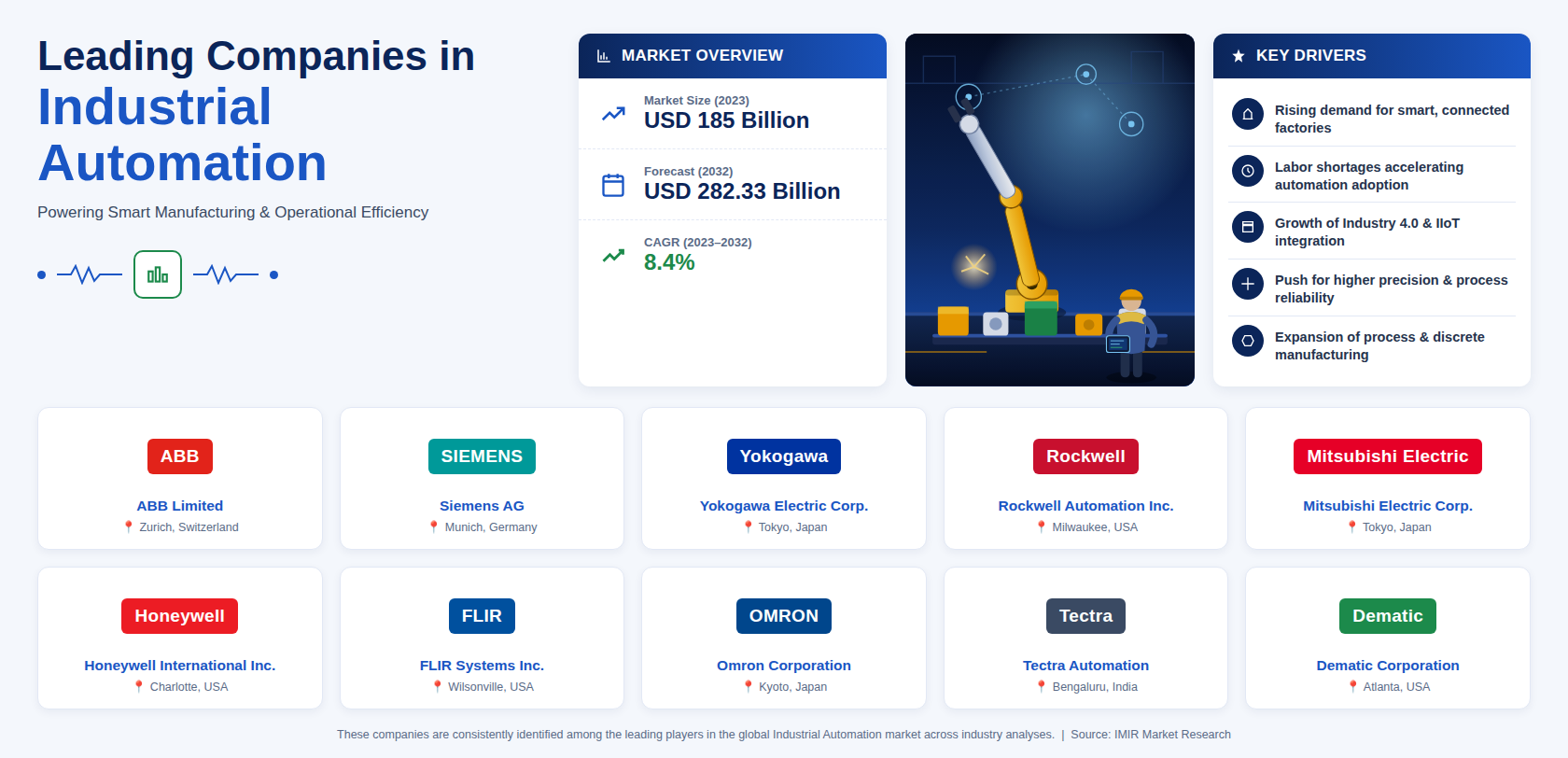
| Market Size (2023) | USD 185 Billion |
| Projected Market Size (2032) | USD 282.33 Billion |
| CAGR (2023–2032) | 8.4% |
| Base Year | 2023 |
| Historic Year | 2019–2022 |
| Forecast Period | 2024–2032 |
| Leading Region | North America (highest revenue share); Asia-Pacific (significant growth) |
| Key Segments (by Product) | SCADA, PLC, DCS, Drives, Sensors |
| Key Segments (by End-User) | Process Industry, Discrete Industry |
Why the Industrial Automation Market Is Growing
1. Rising Adoption of Industry 4.0 and Smart Manufacturing
Manufacturers worldwide are increasingly adopting Industry 4.0 principles, integrating connected sensors, real-time data analytics, and intelligent control systems to improve operational visibility and enable predictive, data-driven decision-making across production facilities.
2. Growing Demand for Operational Efficiency and Cost Reduction
Rising labor costs and competitive pressure are pushing manufacturers to automate repetitive and labor-intensive processes, improving throughput, consistency, and overall equipment effectiveness while reducing dependency on manual labor.
3. Increasing Focus on Workplace Safety
Industrial automation reduces the need for human workers to perform hazardous tasks in dangerous environments such as chemical processing, mining, and heavy manufacturing, driving adoption of automated control and monitoring systems to improve workplace safety outcomes.
4. Expansion of Process Industries in Emerging Markets
Rapid industrialization and growing investment in oil and gas, chemicals, power generation, and water treatment infrastructure across emerging economies in Asia-Pacific and the Middle East continue to drive demand for distributed control systems and SCADA infrastructure.
5. Growth in Robotics and Discrete Automation
Rising automotive and electronics manufacturing activity is driving increased adoption of programmable logic controllers, drives, and sensors to support robotic assembly lines and high-precision discrete manufacturing processes.
6. Advancements in AI-Driven Industrial Control Systems
Continued integration of artificial intelligence and machine learning into industrial control platforms is enabling predictive maintenance, adaptive process optimization, and more sophisticated automated decision-making across process and discrete manufacturing applications.
Market Opportunities & Restraints
A key opportunity lies in AI-driven predictive maintenance and smart factory integration: as manufacturers seek to minimize unplanned downtime and optimize asset utilization, automation providers have significant opportunity to develop advanced analytics and AI-enabled control platforms that predict equipment failures before they occur, positioning early movers to capture premium value in the fast-growing smart manufacturing segment. On the restraint side, high implementation costs and integration complexity remain the primary headwind, as deploying comprehensive automation systems requires substantial upfront capital investment in hardware, software, and workforce training, while integrating new automation technology with legacy industrial infrastructure can be technically complex and costly, particularly for small and medium-sized manufacturers.
Companies Associated with the Industrial Automation Market (Details in Bullet)
-
ABB Ltd — Headquarters: Zurich, Switzerland | Founded: 1988 | Employees: Approx. 112,000 | Revenue: Approx. USD 33.2 Billion (2025) | A global technology leader in electrification and automation, offering process automation, robotics, and industrial control systems, with a 2025 divestment of its Robotics division to SoftBank Group as the company sharpens its focus on electrification and automation.
-
Siemens AG — Headquarters: Munich, Germany | Founded: 1847 | Employees: Approx. 320,000+ (group-wide) | Revenue: Approx. EUR 78.91 Billion (2025) | A global conglomerate offering industrial automation systems, industrial software, and drive technology, serving process and discrete manufacturing industries worldwide through its Digital Industries business.
-
Yokogawa Electric Corporation — Headquarters: Tokyo, Japan | Founded: 1915 | Employees: Approx. 18,000+ | Revenue: Approx. USD 4.5 Billion+ | A Japanese leader in industrial automation and control systems, specializing in distributed control systems (DCS), field instruments, and process analyzers for the energy, oil and gas, and chemical industries.
-
Rockwell Automation, Inc. — Headquarters: Milwaukee, Wisconsin, USA | Founded: 1903 | Employees: Approx. 26,000–27,000 | Revenue: Approx. USD 8.34 Billion (2025) | The largest company in the world dedicated exclusively to industrial automation, offering PLCs, drives, and digital transformation technologies under its Allen-Bradley and FactoryTalk brands.
-
Mitsubishi Electric Corporation — Headquarters: Tokyo, Japan | Founded: 1921 | Employees: Approx. 140,000+ (group-wide) | Revenue: Multi-billion dollar diversified electronics conglomerate | A major Japanese electronics company offering programmable controllers, drives, and industrial automation systems, having reorganized its mobility and digital innovation businesses into separate subsidiaries in 2025.
-
Honeywell International Inc. — Headquarters: Charlotte, North Carolina, USA | Founded: 1906 | Employees: Approx. 101,000 | Revenue: Approx. USD 37.4 Billion (2025) | A diversified American conglomerate operating in building automation, industrial automation, and energy and sustainability solutions, offering process control and automation systems for process manufacturing industries.
-
Teledyne FLIR (formerly FLIR Systems Inc.) — Headquarters: Wilsonville, Oregon, USA | Founded: 1978 | Employees: Approx. 4,000+ | Revenue: Part of Teledyne Technologies (USD 6.12 Billion total company revenue, 2025) | A specialist in thermal imaging and infrared sensing technology used in industrial monitoring and automation applications, having become a subsidiary of Teledyne Technologies since January 2021.
-
Omron Corporation — Headquarters: Kyoto, Japan | Founded: 1933 | Employees: Approx. 28,000+ | Revenue: Multi-billion dollar diversified automation and electronics company | A Japanese electronics company manufacturing automation components, equipment, and systems, competing directly with Rockwell Automation and Mitsubishi Electric in the industrial control and sensing market.
-
Tectra Automation — Headquarters: Not publicly disclosed in detail | Founded: Not publicly disclosed | Employees: Not publicly disclosed | Revenue: Not publicly disclosed | An industrial automation solutions provider offering control system integration and automation equipment for manufacturing customers.
-
Dematic Corporation — Headquarters: Atlanta, Georgia, USA (part of KION Group) | Founded: 1819 (predecessor origins); operating as Dematic since 2003 | Employees: Approx. 10,000+ | Revenue: Part of KION Group's multi-billion dollar revenue | A global supplier of intelligent logistics and material handling automation solutions, including warehouse automation and supply chain technology, operating as a subsidiary of KION Group.
-
ACE-Hellas S.A. — Headquarters: Greece | Founded: Not publicly disclosed in detail | Employees: Not publicly disclosed | Revenue: Not publicly disclosed | A Greek industrial automation and control systems integration company serving regional manufacturing and process industry customers.
-
Saudi Controls Ltd — Headquarters: Saudi Arabia | Founded: Not publicly disclosed in detail | Employees: Not publicly disclosed | Revenue: Not publicly disclosed | A regional industrial control and automation systems provider serving the Middle East's oil and gas, petrochemical, and manufacturing industries.
Competitive Landscape
The global industrial automation market brings together a small group of large, diversified multinational conglomerates alongside specialized regional automation providers. Global automation majors ABB, Siemens, Rockwell Automation, Honeywell, Yokogawa, Mitsubishi Electric, and Omron hold particularly strong positions, built on decades of control systems engineering expertise, extensive global service networks, and broad product portfolios spanning PLCs, DCS, drives, and sensors across both process and discrete manufacturing industries. The competitive landscape continues to evolve through strategic corporate restructuring, exemplified by ABB's 2025 divestment of its Robotics division to SoftBank Group and Teledyne Technologies' 2021 acquisition of FLIR Systems, both illustrating how large industrial technology companies are reshaping their portfolios to sharpen strategic focus. Regional and specialty providers including Tectra Automation, Dematic Corporation, ACE-Hellas S.A., and Saudi Controls Ltd compete through localized system integration expertise, warehouse and logistics automation specialization, and regional market relationships across Europe, the Middle East, and North America.
Regional Analysis
North America
North America accounted for the highest market share in terms of revenue in the industrial automation market, expected to expand at a strong CAGR during the forecast period, attributable to the growing adoption of industrial automation and the presence of major automation technology providers such as Rockwell Automation and Honeywell.
Europe
Europe represents a significant industrial automation market, anchored by major manufacturers such as ABB and Siemens, alongside strong process and discrete manufacturing industry demand across Germany, Switzerland, and the broader European Union.
Asia-Pacific
The APAC market is expected to witness significant growth, driven by the presence of key industrial automation companies in economies such as Japan and China, including Yokogawa, Mitsubishi Electric, and Omron, alongside rapid industrialization and manufacturing capacity expansion across the region.
Latin America & Middle East and Africa
Latin America and the Middle East & Africa represent emerging growth markets for industrial automation, with demand tied to expanding oil and gas, petrochemical, and manufacturing infrastructure investment, supported by regional providers such as Saudi Controls Ltd.
Emerging Trends in the Industrial Automation Market
1. Corporate Restructuring and Portfolio Realignment: Major industry restructuring, exemplified by ABB's 2025 divestment of its Robotics division to SoftBank Group, reflects an industry-wide trend of large automation conglomerates sharpening their strategic focus on core electrification and process automation businesses.
2. Growth of AI-Enabled Predictive Maintenance: Increasing integration of artificial intelligence and machine learning into industrial control systems is enabling predictive maintenance capabilities that reduce unplanned downtime and optimize asset utilization across process and discrete manufacturing facilities.
3. Expansion of Warehouse and Logistics Automation: Growing e-commerce activity is driving demand for intelligent logistics and material handling automation solutions, exemplified by Dematic's warehouse automation technology under KION Group.
4. Consolidation Through Strategic Acquisitions: Continued acquisition activity, such as Teledyne Technologies' 2021 purchase of FLIR Systems, illustrates ongoing consolidation as larger industrial technology companies seek to add specialized sensing and imaging capabilities to their automation portfolios.
5. Rising Demand for Cybersecurity in Industrial Control Systems: As industrial automation systems become increasingly connected and data-driven, growing investment in industrial cybersecurity is becoming essential to protect critical infrastructure and manufacturing operations from cyber threats.
6. Growth of Cloud-Based and Edge Computing Automation Platforms: Manufacturers are increasingly adopting cloud-based and edge computing architectures for industrial automation systems, enabling real-time data processing, remote monitoring, and more flexible, scalable control system deployment.
Future Outlook (2025–2034)
The global industrial automation market's trajectory toward USD 282.33 billion by 2032 reflects sustained demand growth driven by Industry 4.0 adoption, rising labor costs, and continued industrialization across emerging markets. The 8.4% CAGR forecast through 2032 assumes continued smart manufacturing investment, expanding AI-driven predictive maintenance adoption, and sustained process industry infrastructure development across Asia-Pacific, the Middle East, and Latin America.
Key investment themes for 2025–2034 include continued portfolio realignment by global automation majors such as ABB, Siemens, and Honeywell, growing AI and cloud-based automation platform investment, and sustained consolidation activity as larger industrial technology companies acquire specialized sensing, imaging, and logistics automation capabilities. As smart manufacturing, cybersecurity, and AI-enabled predictive maintenance continue to reshape the industry, the companies that combine deep control systems engineering expertise with digital and AI innovation will be best positioned to capture growth through 2034.
Frequently Asked Questions (FAQ)
1. What is the current size of the global industrial automation market?
The global industrial automation market was valued at USD 185 billion in 2023 and is projected to reach USD 282.33 billion by 2032, growing at a CAGR of 8.4% from 2023 to 2032.
2. Who are the top companies in the industrial automation market?
Leading companies include ABB Ltd, Siemens AG, Yokogawa Electric Corporation, Rockwell Automation, Inc., Mitsubishi Electric Corporation, Honeywell International Inc., Teledyne FLIR (formerly FLIR Systems Inc.), Omron Corporation, Tectra Automation, Dematic Corporation, ACE-Hellas S.A., and Saudi Controls Ltd.
3. Which region dominates the industrial automation market?
North America accounted for the highest market share in terms of revenue in the industrial automation market, while the APAC region is expected to witness significant growth due to the presence of key companies in economies such as Japan and China.
4. What is the forecast CAGR for the industrial automation market?
The market is forecast to grow at a CAGR of 8.4% from 2023 to 2032.
5. What are the main growth drivers for this market?
Key drivers include rising adoption of Industry 4.0 and smart manufacturing, growing demand for operational efficiency and cost reduction, increasing focus on workplace safety, expansion of process industries in emerging markets, and growth in robotics and discrete automation.
6. What products make up the industrial automation market?
The market is segmented by product into SCADA (supervisory control and data acquisition), PLC (programmable logic controllers), DCS (distributed control systems), drives, and sensors.
7. What end-user industries does industrial automation serve?
Industrial automation serves both process industries, such as oil and gas, chemicals, and power generation, and discrete industries, such as automotive, electronics, and machinery manufacturing.
Conclusion
The global industrial automation market sits at the intersection of rising manufacturing productivity demands and the ongoing shift toward smart, connected, and AI-enabled industrial control systems. With a projected size of USD 282.33 billion by 2032 at an 8.4% CAGR, the market offers strong, technology-driven growth across process and discrete manufacturing segments worldwide.
ABB, Siemens, Rockwell Automation, and Honeywell continue to lead on the strength of decades of control systems engineering expertise and global service networks, while corporate restructuring activity, exemplified by ABB's divestment of its Robotics division and Teledyne's acquisition of FLIR Systems, continues to reshape the competitive landscape. As AI-driven predictive maintenance, cybersecurity, and cloud-based automation platforms continue to advance globally, the companies that combine deep engineering expertise with digital innovation will define market leadership through 2034 and beyond.