
Global Leaders in In Vitro Diagnostics (IVD) Market Gdowth
Author:
Intellectual Market Insights Research
Published Date:
06 Oct 2026
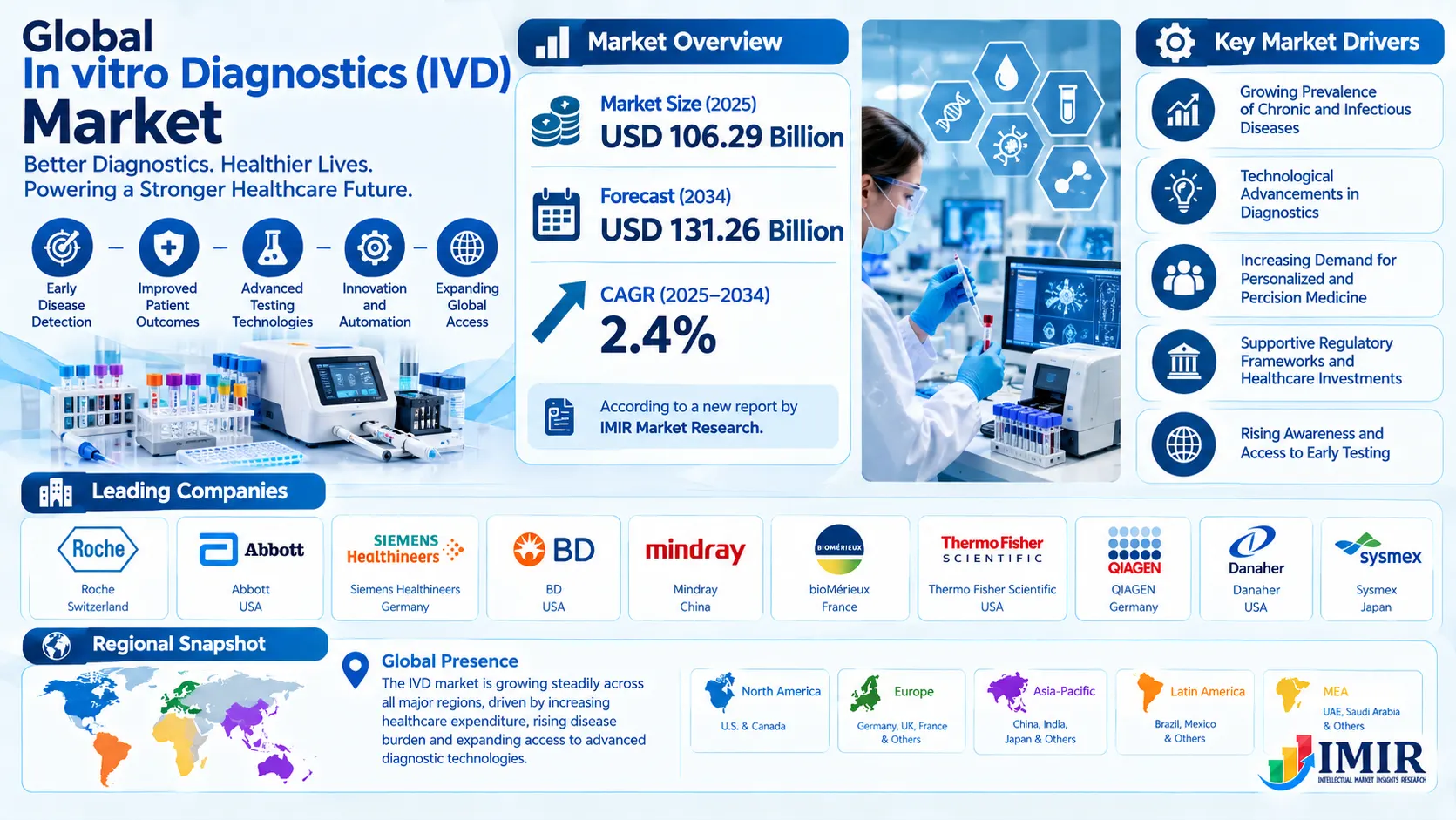
Global In Vitro Diagnostics (IVD) Market: Top Companies, Trends, and Future Outlook
Introduction
In vitro diagnostics (IVD) encompass the tests, reagents, instruments, and systems used to analyze human samples, including blood, urine, tissue, and saliva, outside the body to detect diseases, monitor health conditions, and guide treatment decisions. Spanning clinical chemistry, immunoassays, molecular diagnostics, hematology, microbiology, and point-of-care testing, IVD technology underpins an estimated 70% of clinical decisions made by physicians worldwide, despite typically accounting for only a small fraction of overall healthcare spending.
The global IVD market spans reagents, instruments, software, and services, deployed across clinical laboratories, hospitals, point-of-care settings, and home testing environments for infectious disease, oncology, cardiology, diabetes, and other diagnostic applications. This article provides a research-based analysis of the global IVD market, the companies shaping it, and the technological forces driving its growth toward 2034.
Market Overview
Global In Vitro Diagnostics (IVD) Market size was valued at USD 106.29 Billion in 2025 and is projected to reach USD 131.26 Billion by 2034, growing at a CAGR of 2.4% from 2025 to 2034, according to a new report by IMIR Market Research.
| Parameter | Details |
|---|---|
| Market Size (2025) | USD 106.29 Billion |
| Projected Market Size (2034) | USD 131.26 Billion |
| CAGR (2025–2034) | 2.4% |
| Forecast Period | 2025–2034 |
| Leading Region | North America (dominant, approx. 40–44% share); Asia-Pacific (fastest growth) |
| Key Segments (by Product) | Reagents & Kits, Instruments, Software & Services |
| Key Segments (by Technology) | Clinical Chemistry, Immunoassays, Molecular Diagnostics, Hematology, Microbiology, Point-of-Care Testing |
| Key Segments (by Application) | Infectious Disease, Oncology, Cardiology, Diabetes, Autoimmune Disease, Others |
| Key Segments (by End-User) | Hospitals, Clinical Laboratories, Point-of-Care/Home Testing, Others |
Note on market concentration and context: this analysis uses the specific base-year and forecast figures provided for this report. Independent industry sources show considerable variance in IVD market sizing (base-year estimates ranging from roughly USD 85 billion to over USD 135 billion, and CAGR estimates ranging from approximately 2% to 7.5%, depending on scope and forecast window), reflecting the IVD category's breadth and the fact that growth has moderated significantly from the exceptional, pandemic-driven testing volumes of 2020–2022.
Why the IVD Market Is Growing
1. Rising Global Burden of Chronic and Infectious Disease
The increasing global prevalence of chronic diseases such as diabetes and cardiovascular disease, alongside the persistent burden of infectious disease, continues to drive demand for diagnostic testing across clinical laboratories and point-of-care settings worldwide.
2. Growing Adoption of Molecular Diagnostics and Precision Medicine
Rising emphasis on precision and personalized medicine continues to accelerate adoption of molecular diagnostic technologies capable of identifying specific genetic markers and disease subtypes, enabling more targeted treatment decisions.
3. Expansion of Point-of-Care and Decentralized Testing
Growing demand for decentralized diagnostic testing, bringing laboratory-quality results closer to the patient through point-of-care and home testing devices, continues to expand the IVD market's reach beyond traditional hospital and laboratory settings.
4. Increasing Automation and AI Integration in Laboratory Testing
Continued investment in laboratory automation and AI-powered diagnostic analysis is improving testing throughput, accuracy, and efficiency, helping clinical laboratories manage rising test volumes with more consistent quality.
5. Technology Consolidation Through Mergers and Acquisitions
The IVD market continues to see substantial mergers and acquisitions activity as established players and new entrants pursue novel technologies and products, with small specialized technology companies frequently acquired by larger diagnostics firms seeking to expand their capabilities.
6. Rising Demand for Early Disease Detection
Growing emphasis on preventive healthcare and early disease detection continues to drive adoption of advanced screening and diagnostic technologies, including blood-based tests for conditions such as Alzheimer's disease that represent some of the newest frontiers in IVD innovation.
Market Opportunities & Restraints
A key opportunity lies in total laboratory automation and specialized niche innovation: the IVD market is expected to see an increasing trend toward total laboratory automation (TLA) and modular automation designed to minimize non-value-added steps and streamline testing workflows, while specialized small and mid-sized companies that secure strong footholds in niche diagnostic areas can carve out meaningful positions alongside the market's dominant diversified players. On the restraint side, moderating post-pandemic growth and pricing pressure remain notable headwinds, as the relatively modest CAGR reflects a significant moderation from the exceptional testing volumes and revenue seen during 2020–2022, with established players facing continued pricing pressure in mature testing categories even as they invest in newer, higher-growth segments such as molecular diagnostics and point-of-care testing.
Companies Associated with the IVD Market (Details in Table)
| Company | Headquarters | Founded | Employees | Revenue (2025) | Overview |
|---|---|---|---|---|---|
| F. Hoffmann-La Roche Ltd. | Basel, Switzerland | 1896 | Approx. 103,000+ | Approx. CHF 68.7 Billion (total company) | Global IVD market leader; cobas analyzers and cobas Liat System for high-throughput and point-of-care molecular diagnostics. |
| Abbott Laboratories | Abbott Park, Illinois, USA | 1888 | Approx. 115,000 | Approx. USD 44.3 Billion | Diversified diagnostics spanning core lab, molecular, rapid, and point-of-care testing; FreeStyle Libre glucose monitoring. |
| Danaher Corporation | Washington, D.C., USA | 1984 | Approx. 60,000 | Approx. USD 24.57 Billion | IVD presence via Beckman Coulter, Cepheid, Radiometer, Leica Biosystems; spun off Veralto in 2023. |
| Siemens Healthineers AG | Erlangen, Germany | 2017 | Approx. 74,000 | Approx. EUR 23.4 Billion (FY2025) | Extensive IVD portfolio across clinical chemistry, immunodiagnostics, molecular diagnostics, and hematology. |
| Thermo Fisher Scientific Inc. | Waltham, Massachusetts, USA | 1956 | Approx. 125,000+ | Approx. USD 44.56 Billion (total company) | World biotech/diagnostics leader continuing to expand molecular and infectious disease testing offerings. |
| Becton, Dickinson and Company (BD) | Franklin Lakes, New Jersey, USA | 1897 | Approx. 72,000 | Approx. USD 21.8 Billion | Infectious disease, cancer diagnostics, and drug discovery testing; strong microbiology and molecular footprint. |
| bioMérieux S.A. | Marcy-l'Étoile, France | 1963 | Approx. 12,800+ | Approx. EUR 3.1+ Billion | Present in 44 countries; BioFire subsidiary known for rapid multiplexed molecular diagnostic panels. |
| Bio-Rad Laboratories, Inc. | Hercules, California, USA | 1952 | Approx. 8,000 | Approx. USD 2.5+ Billion | Reagents, PCR systems, and molecular detection kits for clinical diagnostics and quality control. |
| QIAGEN N.V. | Venlo, Netherlands / Hilden, Germany | 1984 | Approx. 5,967+ | Approx. USD 1.97+ Billion | Sample preparation and molecular detection (qPCR/digital PCR) technologies for infectious disease testing. |
| Sysmex Corporation | Kobe, Hyogo, Japan | 1968 | Approx. 11,457–11,665 | Approx. USD 5.2 Billion (FY2025) | Emerging leader in hematology and coagulation analyzers; 79 global subsidiaries as of March 2025. |
Competitive Landscape
The global IVD market is led by a small group of diversified diagnostics and life sciences conglomerates often described as "Star" players, with Roche, Danaher, and Abbott identified as leading the market based on their broad diagnostic portfolios, strong market presence, and sustained leadership in high-value testing segments. Roche stands as the undisputed global leader, offering the industry's broadest portfolio across clinical chemistry, immunoassays, molecular diagnostics, and hematology. Danaher competes through a multi-brand strategy spanning Beckman Coulter, Cepheid, Radiometer, and Leica Biosystems, having sharpened its diagnostics focus through the 2023 spin-off of Veralto. Abbott, Siemens Healthineers, and Thermo Fisher Scientific round out the top tier of globally diversified diagnostics players, each offering extensive, multi-technology portfolios. Specialized and emerging players including Sysmex (hematology and coagulation), bioMérieux (microbiology and molecular panels via BioFire), QIAGEN (sample preparation and molecular detection), and Bio-Rad (quality control and specialized testing) compete through deep category focus rather than full-portfolio breadth. The market continues to see numerous mergers and acquisitions, as larger companies acquire smaller players with exclusive, specialized technology to expand their diagnostic capabilities.
Regional Analysis
North America
North America has established itself as the dominant region in the global IVD market, with an estimated 40–44% share, driven by the large presence of leading IVD companies such as Thermo Fisher Scientific, Abbott Laboratories, and Becton Dickinson, which have enabled the region to evolve considerably in terms of innovation and product offerings.
Europe
Europe represents a rapidly evolving IVD market, driven by technological advancements and growing demand for precision medicine, anchored by major European players including Roche, Siemens Healthineers, bioMérieux, and QIAGEN.
Asia-Pacific
Asia-Pacific represents significant growth potential for the IVD market, supported by expanding healthcare infrastructure and rising diagnostic testing adoption, with Japan-based Sysmex Corporation representing a key regional innovator in hematology and coagulation diagnostics.
Latin America & Middle East and Africa
Latin America and the Middle East & Africa represent emerging growth markets for IVD, with adoption tied to expanding healthcare access, growing laboratory infrastructure investment, and increasing emphasis on early disease detection.
Emerging Trends in the IVD Market
1. Advancement Toward Total Laboratory Automation (TLA): The IVD market is expected to see an increasing trend toward total laboratory automation and modular automation designed to minimize non-value-added steps and streamline laboratory workflows with more user-friendly processes.
2. Growth of Blood-Based Diagnostics for Neurological Disease: The emergence of the first blood-based IVD test for diagnosis of Alzheimer's disease represents a significant advancement, opening a new frontier for less invasive diagnostic testing in neurological conditions.
3. Continued Mergers and Acquisitions Activity: The growth opportunities in the IVD market continue to appeal to numerous manufacturers, resulting in ongoing mergers and acquisitions as established players acquire smaller companies with exclusive, specialized diagnostic technology.
4. AI and Data Analytics Integration: Growing integration of AI and data analytics into diagnostics platforms, exemplified by Siemens Healthineers' continued investment in this area, is enabling enhanced clinical decision-making alongside improved operational efficiency for laboratory customers.
5. Corporate Portfolio Realignment Among Diversified Players: Danaher's September 2023 spin-off of Veralto Corporation illustrates a broader trend of diversified life sciences and diagnostics conglomerates sharpening their strategic focus through corporate restructuring.
6. Rise of Specialized Niche Innovators: Smaller and mid-sized companies securing strong footholds in specialized diagnostic niches continue to distinguish themselves as emerging innovators, underscoring their potential to compete effectively against larger, more diversified players in focused testing categories.
Future Outlook (2025–2034)
The global IVD market's trajectory toward USD 131.26 billion by 2034 reflects steady, moderating growth following the exceptional, pandemic-driven testing volumes of the early 2020s, with the 2.4% CAGR forecast through 2034 assuming continued investment in molecular diagnostics, point-of-care testing expansion, and total laboratory automation, offset by ongoing pricing pressure in mature testing categories.
Key investment themes for 2025–2034 include continued portfolio realignment and automation investment by global leaders such as Roche, Danaher, and Abbott, growing competition from specialized niche innovators in hematology, microbiology, and molecular diagnostics, and sustained mergers and acquisitions activity as larger players seek to acquire exclusive diagnostic technologies. As total laboratory automation, AI-enabled diagnostics, and new testing frontiers such as blood-based neurological disease detection continue to reshape the industry, the companies that combine broad diagnostic portfolios with continuous innovation will be best positioned to capture growth through 2034.
Frequently Asked Questions (FAQ)
1. What is the current size of the global IVD market?
Global In Vitro Diagnostics (IVD) Market size was valued at USD 106.29 billion in 2025 and is projected to reach USD 131.26 billion by 2034, growing at a CAGR of 2.4% from 2025 to 2034, according to a new report by IMIR Market Research.
2. Who are the top companies in the IVD market?
Leading companies include F. Hoffmann-La Roche Ltd. (Roche Diagnostics), Abbott Laboratories, Danaher Corporation, Siemens Healthineers AG, Thermo Fisher Scientific Inc., Becton, Dickinson and Company (BD), bioMérieux S.A., Bio-Rad Laboratories, Inc., QIAGEN N.V., and Sysmex Corporation.
3. Which region dominates the IVD market?
North America has established itself as the dominant region in the global IVD market, with an estimated 40–44% share, driven by the large presence of leading companies such as Thermo Fisher Scientific, Abbott Laboratories, and BD.
4. What is the forecast CAGR for the IVD market?
The market is forecast to grow at a CAGR of 2.4% from 2025 to 2034, according to IMIR Market Research; note that independent sources show a wider range of CAGR estimates depending on market scope and forecast window.
5. What are the main growth drivers for this market?
Key drivers include the rising global burden of chronic and infectious disease, growing adoption of molecular diagnostics and precision medicine, expansion of point-of-care and decentralized testing, increasing automation and AI integration, and rising demand for early disease detection.
6. What technologies make up the IVD market?
The market spans clinical chemistry, immunoassays, molecular diagnostics, hematology, microbiology, and point-of-care testing technologies, deployed across reagents and kits, instruments, and software and services.
7. Why does Roche hold the leading position in the IVD market?
Roche stands as the worldwide leader in the IVD market by offering a broad portfolio covering clinical chemistry, immunoassays, molecular diagnostics, and hematology, with particular market supremacy in infectious disease testing covering HIV, HPV, hepatitis, and COVID-19 through its cobas platform.
Conclusion
The global IVD market sits at the intersection of steady, enduring clinical demand and a maturing growth profile following the extraordinary pandemic-era testing surge. With a projected size of USD 131.26 billion by 2034 at a 2.4% CAGR, the market offers stable, innovation-driven growth across molecular diagnostics, point-of-care testing, and laboratory automation segments.
Roche, Danaher, and Abbott continue to lead as the market's "Star" players, backed by their broad diagnostic portfolios and sustained leadership in high-value testing segments, while Siemens Healthineers and Thermo Fisher Scientific round out the top tier of globally diversified diagnostics companies. Specialized innovators including Sysmex, bioMérieux, QIAGEN, and Bio-Rad continue to carve out meaningful positions through deep category focus. As total laboratory automation, AI-enabled diagnostics, and new testing frontiers continue to reshape the industry, the companies that combine broad portfolios with continuous innovation will define market leadership through 2034 and beyond.