
Global Leaders in Low-Code Development Platform Market
Author:
Intellectual Market Insights Research
Published Date:
30 Sep 2026
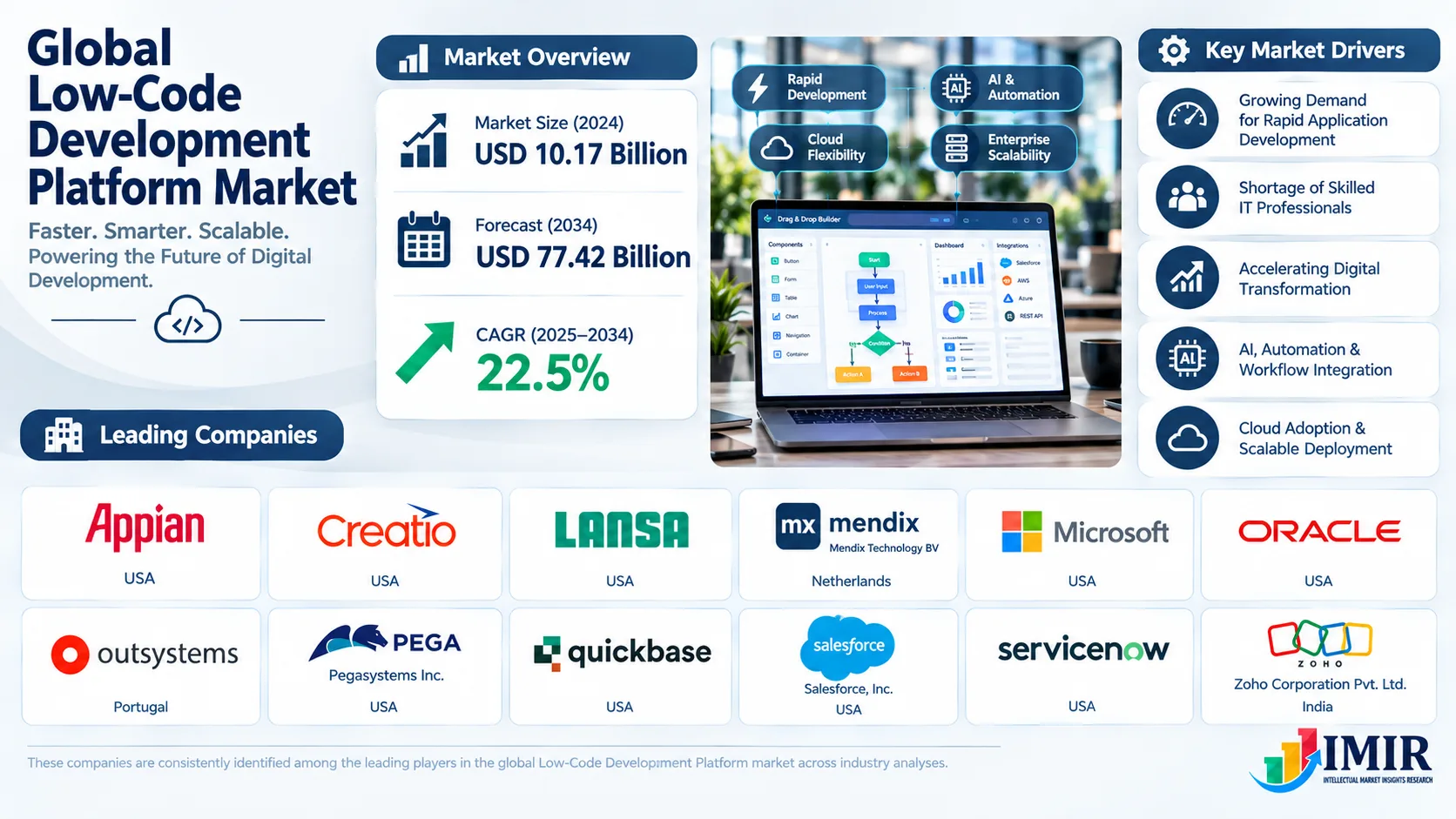
Global Low-Code Development Platform Market: Top Companies, Trends, and Future Outlook
Introduction
Low-code development platforms allow businesses to build software applications using visual, drag-and-drop interfaces and pre-built components rather than traditional hand-coding, dramatically reducing the time, cost, and specialized technical expertise required to deliver custom applications. Aimed at both professional developers seeking faster delivery and "citizen developers" within business units who lack formal programming training, low-code platforms have become a central pillar of enterprise digital transformation strategies.
The global low-code development platform market spans platform and services components, cloud and on-premises deployment models, web-based and mobile application types, and small/medium and large enterprise customer segments, deployed across IT and telecom, BFSI, healthcare, government, and other verticals. This article provides a research-based analysis of the global low-code development platform market, the companies shaping it, and the technological forces driving its growth toward the mid-2030s.
Market Overview
Published low-code development platform market estimates vary considerably by research provider, but most converge on a picture of very strong, sustained growth from a base in the tens of billions of dollars:
| Parameter | Details |
|---|---|
| Market Size (2024) | USD 10.17 billion |
| Projected Market Size (2034) | USD 77.42 Billion |
| CAGR | 22.5% |
| Leading Region | North America (largest share, approx. 30–34%); Asia-Pacific (fastest growth) |
| Key Segments (by Component) | Platform, Services |
| Key Segments (by Deployment) | Cloud-Based, On-Premises |
| Key Segments (by Application Type) | Web-Based, Mobile |
| Key Segments (by Organization Size) | Small and Medium Enterprises (SMEs), Large Enterprises (holding the dominant share, over 60% by some estimates) |
| Key Segments (by Vertical) | IT & Telecom, BFSI, Healthcare, Government & Public Sector, Retail, Manufacturing, Others |
Why the estimates differ so widely: the wide spread in published figures largely reflects differences in market definition, i.e., whether a study counts only dedicated low-code application platforms, or the much broader category of no-code/low-code tools, workflow automation software, and citizen-development platforms. Every major forecaster agrees on the underlying trend: this is one of the fastest-growing segments of enterprise software, driven by accelerating digital transformation and a persistent shortage of professional software developers.
Why the Low-Code Development Platform Market Is Growing
1. Accelerating Enterprise Digital Transformation
Organizations across virtually every industry continue to pursue digital transformation initiatives, and low-code platforms offer a faster, more cost-effective route to building the custom applications needed to modernize legacy systems and streamline operations.
2. Persistent Shortage of Professional Software Developers
A well-documented global shortage of skilled software developers is pushing organizations toward low-code platforms that allow both professional developers and business-unit "citizen developers" to build functional applications without deep programming expertise.
3. Growing Demand for Faster Time-to-Market
Competitive pressure to deliver new applications and features faster than traditional development cycles allow continues to drive adoption of low-code platforms, which can compress development timelines from months to weeks or days.
4. Rising Adoption Among Large Enterprises
Large enterprises continue to drive the majority of market demand, leveraging low-code platforms' scalability and agility to modernize legacy systems, standardize governance, and streamline development processes across large, complex organizations.
5. Increasing Digital Transformation in Financial Services and Government
Financial institutions and government agencies, both bound by complex legacy systems and strict operational requirements, continue to expand low-code adoption to drive operational efficiency and process automation.
6. Integration of AI and Agentic Capabilities
Leading platforms are increasingly incorporating AI-powered development assistance and agentic capabilities, exemplified by Appian's 2025 introduction of Agent Studio for building AI agents within business processes, further accelerating adoption and expanding platform capability.
Market Opportunities & Restraints
A key opportunity lies in AI-augmented and agentic low-code development: as platforms increasingly integrate generative AI and autonomous agent capabilities directly into the development experience, exemplified by Appian's Agent Studio and Mendix's role as a core enabler of Siemens's broader "agentic enterprise" system, vendors that successfully combine low-code simplicity with AI-driven automation stand to capture a new, higher-value tier of enterprise spending as organizations look to modernize both application development and business process automation simultaneously. On the restraint side, governance, security, and vendor lock-in concerns remain persistent headwinds, as enterprises adopting low-code platforms at scale must carefully manage application sprawl, data governance, and security compliance across citizen-developer-built applications, while the proprietary nature of most platforms raises legitimate concerns about long-term vendor lock-in and migration costs.
Companies Associated with the Low-Code Development Platform Market
| Company | Headquarters | Founded | Employees | Revenue | Overview |
|---|---|---|---|---|---|
| Microsoft Corporation | Redmond, Washington, USA | 1975 | Approx. 228,000+ | Approx. USD 281.7 Billion (total company) | Power Platform (Power Apps, Power Automate) deeply integrated with Microsoft 365/Azure; Gartner Leader in 2025. |
| Salesforce, Inc. | San Francisco, California, USA | 1999 | Approx. 76,000+ | Approx. USD 37.9 Billion | Lightning App Builder and Flow; newly promoted to Gartner Leader status in 2025. |
| ServiceNow, Inc. | Santa Clara, California, USA | 2004 | Approx. 29,187 | Approx. USD 13.28 Billion | App Engine (Now Platform); crossed $10B revenue in 2024 with 26% subscription CAGR (2020-2024). |
| OutSystems | Boston, Massachusetts, USA | 2001 | Approx. 1,800+ | Not publicly disclosed (private) | Enterprise-grade, developer-centric platform; Gartner Leader, strong for legacy system replacement. |
| Mendix (Siemens AG) | Rotterdam, Netherlands | 2005 | Approx. 1,000+ | Part of Siemens Digital Industries Software | Gartner Leader; core enabler of Siemens's agentic "Intelligence Center X" enterprise system. |
| Appian Corporation | McLean, Virginia, USA | 1999 | Approx. 2,243 (2023) | Approx. USD 545 Million (2023) | Business process automation leader; introduced Agent Studio (2025); won $2.04B suit vs. Pegasystems (2022). |
| Oracle Corporation | Austin, Texas, USA | 1977 | Approx. 160,000+ | Multi-billion dollar diversified company | Low-code capabilities integrated within its broader cloud applications and infrastructure portfolio. |
| Pegasystems Inc. | Cambridge, Massachusetts, USA | 1983 | Approx. 5,700+ | Approx. USD 1.4+ Billion | BPM and low-code provider; lost a $2.04B trade secret damages verdict to Appian in 2022. |
| Zoho Corporation | Chennai, India | 1996 | Approx. 15,000+ | Approx. USD 1+ Billion (private) | Offers Zoho Creator low-code platform alongside its broader business application suite. |
| Google LLC | Mountain View, California, USA | 1998 | Tens of thousands (Alphabet) | Multi-billion dollar diversified company | Participates via AppSheet and Google Cloud application development tools. |
Competitive Landscape
The global low-code development platform market is led by a group of six vendors recognized as "Leaders" in Gartner's Magic Quadrant for Enterprise Low-Code Application Platforms: Mendix, OutSystems, Microsoft (Power Apps), ServiceNow, Appian, and Salesforce, with Salesforce being the newest addition, having moved up from the Challengers category in the 2025 report. Platform ecosystem giants Microsoft and Salesforce leverage their massive existing enterprise software footprints, Microsoft through its Microsoft 365/Azure ecosystem and Salesforce through its dominant CRM position, to drive low-code adoption among their existing customer bases. Pure-play and specialist vendors OutSystems, Mendix, and Appian compete through deep platform capability and enterprise-grade scalability, with Mendix notably operating as a subsidiary of Siemens AG and serving as a foundational piece of Siemens's broader industrial software strategy. Business process automation specialists Appian and Pegasystems have a notably contentious history, highlighted by Appian's 2022 landmark USD 2.04 billion trade secret damages award against Pegasystems, underscoring how competitive and high-stakes this market has become. Diversified technology and SaaS companies Oracle, Zoho, and Google round out the competitive field, integrating low-code capabilities into much broader cloud and business application portfolios.
Regional Analysis
North America
North America dominates the global low-code development platform market, holding an estimated 30–34% revenue share, driven by high enterprise digital transformation spending, the concentration of leading vendors such as Microsoft, Salesforce, ServiceNow, Appian, and OutSystems, and strong adoption within U.S. financial services and government sectors.
Europe
Europe represents a significant low-code development platform market, anchored by Mendix (headquartered in the Netherlands as a Siemens subsidiary), alongside strong enterprise digital transformation initiatives across Germany, France, and the UK.
Asia-Pacific
Asia-Pacific is expected to register the fastest growth, driven by rapid digital transformation across emerging economies, rising IT and telecom sector investment, and the presence of significant regional players such as Zoho Corporation, headquartered in India.
Latin America & Middle East and Africa
Latin America and the Middle East & Africa represent emerging growth markets for low-code development platforms, with adoption tied to expanding enterprise digital transformation initiatives and growing government sector modernization programs.
Emerging Trends in the Low-Code Development Platform Market
1. Integration of AI and Agentic Development Capabilities: Leading platforms are increasingly embedding generative AI and autonomous agent capabilities directly into the low-code development experience, exemplified by Appian's 2025 Agent Studio and Mendix's role as a core enabler of Siemens's agentic enterprise system.
2. Shifting Competitive Rankings Among Gartner Magic Quadrant Leaders: Salesforce's promotion to the Leaders section of Gartner's 2025 Magic Quadrant for Enterprise Low-Code Application Platforms, after previously being positioned as a Challenger, illustrates the market's continued competitive dynamism even among established players.
3. Business Process Automation Convergence: The low-code market continues to converge with broader business process automation and orchestration technologies, reflected in Gartner's parallel recognition of platforms like Appian in its Business Orchestration and Automation Technologies (BOAT) Magic Quadrant.
4. High-Stakes Intellectual Property Competition: Appian's landmark 2022 USD 2.04 billion trade secret damages award against Pegasystems illustrates how valuable proprietary low-code and process automation technology has become, with vendors increasingly willing to litigate aggressively to protect their intellectual property.
5. Growth of Citizen Development and Governance Tools: As large enterprises expand low-code adoption beyond IT departments into business units, platforms are increasingly investing in governance, security, and standardization tools to manage the resulting application sprawl.
Future Outlook (2025–2034)
Given the wide range of published forecasts for this market (from roughly USD 92 billion to over USD 375 billion by the early-to-mid 2030s, at CAGRs of approximately 9% to nearly 33%), the underlying consensus across independent research is that low-code development platforms will continue to grow very rapidly through 2034, driven by accelerating digital transformation, persistent developer shortages, and deepening integration of AI and agentic capabilities into the development experience.
Key investment themes for 2025–2034 include continued AI and agentic capability integration by leaders such as Appian, Mendix, and Microsoft, ongoing competitive repositioning among Gartner Magic Quadrant Leaders as illustrated by Salesforce's 2025 promotion, and continued convergence between low-code development and broader business process automation technology. As AI-augmented development, governance tooling, and business process automation convergence continue to reshape the industry, the companies that combine platform scalability with AI-driven innovation will be best positioned to capture growth through 2034.
Frequently Asked Questions (FAQ)
1. What is the current size of the global low-code development platform market?
The Low-code Development Platform Market size was valued at around 10.17 billion in 2024 and is expected to reach a value of USD 77.42 Billion by 2034, at a CAGR of 22.5% over the forecast period (2025–2034).
2. Who are the top companies in the low-code development platform market?
The six vendors recognized as Leaders in Gartner's 2025 Magic Quadrant for Enterprise Low-Code Application Platforms are Mendix, OutSystems, Microsoft (Power Apps), ServiceNow, Appian, and Salesforce, alongside other significant players including Oracle, Pegasystems, Zoho Corporation, and Google.
3. Which region dominates the low-code development platform market?
North America dominates the market with an estimated 30–34% revenue share, while Asia-Pacific is expected to register the fastest growth, driven by rapid digital transformation and the presence of regional players such as Zoho Corporation.
4. What is the forecast CAGR for the low-code development platform market?
Independent research estimates range widely from approximately 9% to nearly 33% CAGR depending on the source and market scope used, with most estimates clustering between 11% and 30%.
5. What are the main growth drivers for this market?
Key drivers include accelerating enterprise digital transformation, a persistent shortage of professional software developers, growing demand for faster time-to-market, rising adoption among large enterprises, and increasing integration of AI and agentic capabilities.
6. What recent developments have shaped competition in this market?
Notable developments include Salesforce's 2025 promotion to Leader status in Gartner's Magic Quadrant, Appian's 2025 launch of Agent Studio for AI agent development, and Appian's landmark 2022 USD 2.04 billion trade secret damages award against Pegasystems.
7. Which organization size segment leads the low-code development platform market?
Large enterprises hold the dominant market share, estimated at over 60% by some research providers, leveraging low-code platforms' scalability and agility to modernize legacy systems and standardize governance across complex organizations.
Conclusion
The global low-code development platform market sits at the intersection of accelerating enterprise digital transformation and the growing integration of AI-driven, agentic development capabilities. While published market size and growth estimates vary widely depending on scope, every major forecaster agrees this remains one of the fastest-growing segments of enterprise software.
Mendix, OutSystems, Microsoft, ServiceNow, Appian, and Salesforce, recognized as the six Leaders in Gartner's 2025 Magic Quadrant, continue to set the competitive pace, while Oracle, Pegasystems, Zoho, and Google round out a broader field integrating low-code capabilities into diverse enterprise software portfolios. As AI-augmented development, business process automation convergence, and intensifying competitive dynamics continue to reshape the industry, the companies that combine platform scalability with continuous AI innovation will define market leadership through 2034 and beyond.


