
Natural Surfactants Market Trends, Growth & Forecast to 2034
Author:
Intellectual Market Insights Research
Published Date:
28 Jul 2026
Introduction
Behind every foaming shampoo, plant-based dish soap, and "clean label" household cleaner sits a class of ingredients working quietly to lift dirt, blend oil and water, and create the lather consumers associate with cleanliness. As shoppers grow warier of petrochemical additives, formulators across personal care, home care, and industrial cleaning are turning to surfactants derived from renewable plant and animal sources making this one of the more consumer-driven corners of the specialty chemicals industry.
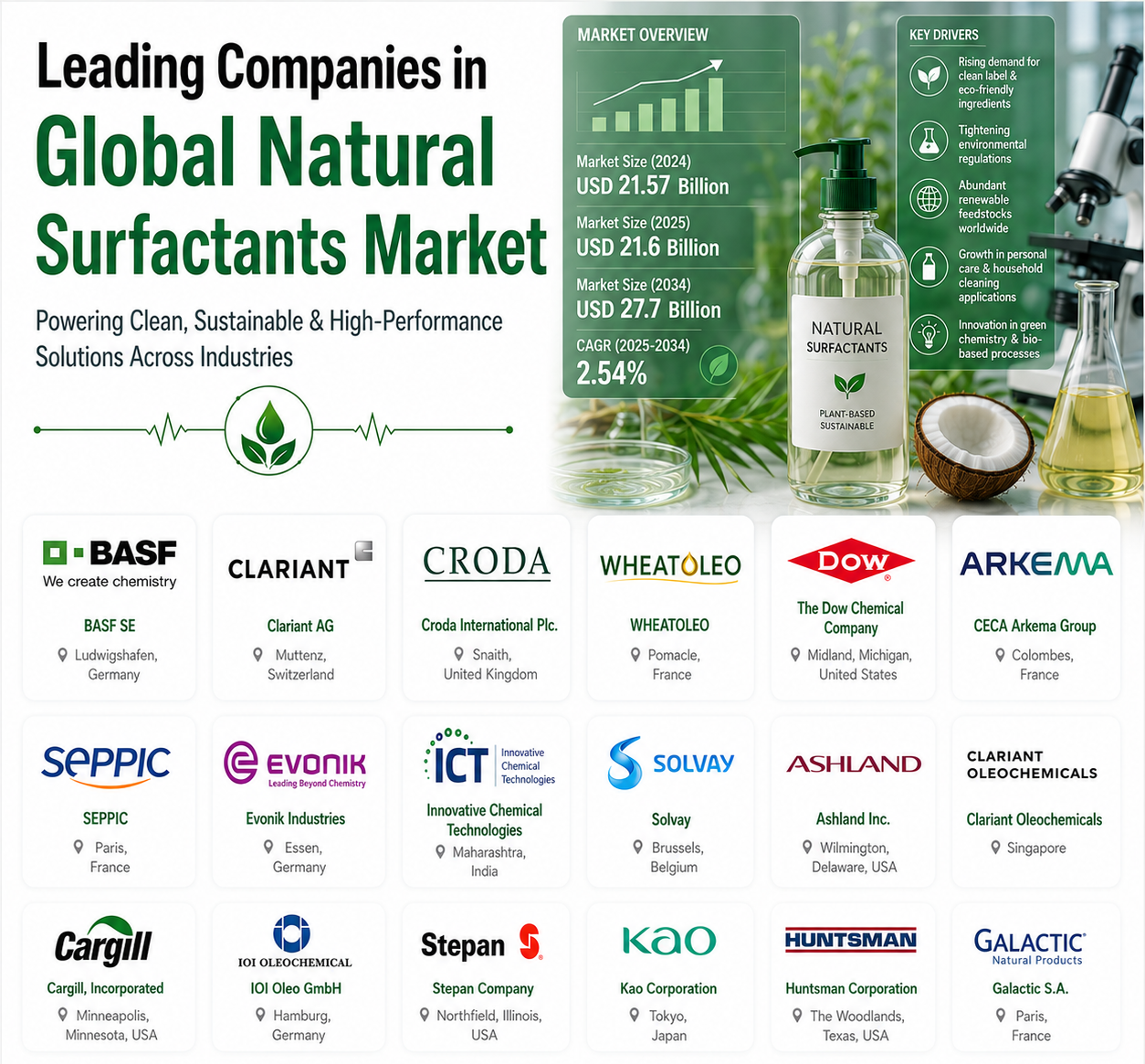
According to the latest market intelligence from Intellectual Market Insights Research (IMIR), the Natural Surfactants Market was valued at USD 21.57 billion in 2024 and is poised to grow from USD 21.6 billion in 2025 to USD 27.7 billion by 2034, advancing at a CAGR of 2.54% across the forecast period of 2025–2034. This steady expansion underscores a durable, if gradual, shift away from purely synthetic formulations toward bio-based alternatives across some of the world's largest consumer categories.
At its core, the natural surfactants market covers surface-active agents derived from renewable sources such as coconut oil, palm oil, sugarcane, corn, and soy, engineered to reduce surface tension between substances like oil and water so that cleaning, foaming, and emulsification can occur. Product types span anionic, non-ionic, cationic, and amphoteric surfactants, sourced from either plant-based or animal-based feedstocks, and applied across personal care, household cleaning, industrial and institutional cleaning, agriculture, and food processing.
The industry's growth is being driven by a convergence of regulatory and consumer forces. First, tightening environmental regulation such as the EU's REACH framework and U.S. EPA oversight is pressuring formulators to move away from petrochemical-derived surfactants that resist biodegradation and contribute to aquatic toxicity. Second, the rise of clean-label, vegan, and cruelty-free personal care products is pushing brands to reformulate around plant-derived ingredients like alkyl polyglycolides and cocamidopropyl betaine. Third, abundant renewable feedstocks across Asia-Pacific, Latin America, and Africa are opening new, cost-advantaged production hubs for bio-based surfactant manufacturing.
At the same time, the market faces real friction: natural surfactants remain meaningfully more expensive to produce than their synthetic counterparts, given the technical complexity of enzymatic and fermentation-based extraction processes, and price-sensitive segments like mass-market household cleaning continue to favor cheaper synthetic alternatives. Feedstock price variability tied to agricultural cycles adds further cost uncertainty. Even so, the long-term trajectory remains firmly positive, anchored by sustained consumer demand for safer, greener formulations and continuing regulatory tailwinds.
This article profiles the leading companies shaping the global Natural Surfactants Market in 2026, examines segmentation and regional dynamics, and looks ahead at the trends set to define the industry through 2034.
Market Overview
|
Parameter |
Details |
|---|---|
|
Market Size (2024) |
USD 21.57 Billion |
|
Market Size (2025) |
USD 21.6 Billion |
|
Market Size (2034) |
USD 27.7 Billion |
|
CAGR (2025–2034) |
2.54% |
|
Forecast Period |
2025–2034 |
|
Base Year |
2024 |
|
Historical Data |
2019–2024 |
|
By Type |
Anionic Surfactants, Non-Ionic Surfactants, Cationic Surfactants, Amphoteric Surfactants |
|
By Source |
Plant-Based, Animal-Based |
|
By Application |
Personal Care & Cosmetics, Household Cleaning Products, Industrial & Institutional Cleaning, Agriculture, Food Processing |
|
Key Regions |
North America, Europe, Asia-Pacific, Latin America, MEA |
|
Dominant Region |
Europe |
|
Fastest Growing Region |
Asia-Pacific |
Key Market Drivers:
- Tightening environmental regulation on synthetic, petrochemical-derived surfactants (REACH, EPA)
- Rising consumer demand for biodegradable, non-toxic, clean-label ingredients
- Rapid growth of vegan and cruelty-free personal care and cosmetics
- Growing preference for gentle, skin-friendly formulations in baby care and sensitive-skin products
- Expanding household and industrial cleaning demand for eco-friendly alternatives
Key Market Opportunities:
- Expansion of production capacity in Asia-Pacific, Latin America, and Africa, where raw feedstocks are abundant and labor costs are lower
- Growing middle-class demand for green, sustainable personal and home care products in emerging economies
- Government incentives supporting green chemistry and sustainable industrial development
- Innovation in fermentation and enzymatic processing to reduce production costs
Key Market Challenges:
- Higher production costs relative to synthetic surfactants
- Price volatility tied to agricultural feedstock cycles
- Limited price competitiveness in cost-sensitive mass-market segments
- Technical complexity of large-scale bio-based extraction and purification processes
Why the Natural Surfactants Market Is Growing
The steady climb of the natural surfactants market reflects a durable convergence of regulation, consumer values, and formulation science.
1. Regulatory Pressure on Synthetic Ingredients
Frameworks such as the EU's REACH regulation and oversight from the U.S. Environmental Protection Agency are pushing manufacturers away from petrochemical surfactants linked to water pollution and aquatic toxicity, and toward biodegradable, plant-derived alternatives.
2. The Clean Beauty and Vegan Personal Care Movement
Consumers, particularly Millennials and Gen Z, are increasingly favoring products free of animal-derived ingredients, harsh chemicals, and synthetic additives. This clean-label, cruelty-free shift is driving reformulation across shampoos, body washes, and facial cleansers around ingredients like alkyl polyglycolides and cocamidopropyl betaine.
3. Demand for Gentle, Skin-Friendly Formulations
Natural surfactants are prized for their mildness and low irritation potential, making them a preferred choice for baby care products, facial cleansers, and formulations for sensitive skin qualities that many synthetic surfactants cannot match.
4. Abundant Renewable Feedstocks in Emerging Markets
Asia-Pacific, Latin America, and Africa hold substantial reserves of coconut oil, palm oil, and sugarcane the core raw materials for bio-based surfactants. This gives manufacturers in these regions a structural cost advantage in sourcing and production.
5. Household and Industrial Cleaning Reformulation
Beyond personal care, household and industrial cleaning product manufacturers are increasingly incorporating natural surfactants to meet both regulatory requirements and growing consumer expectations around environmental responsibility.
6. Corporate Sustainability Commitments
Major personal care and chemical companies are integrating sustainability into core product development and brand positioning, treating natural surfactant adoption as both a compliance measure and a competitive differentiator.
Leading Companies in the Global Natural Surfactants Market
- BASF SE
- Clariant AG
- Croda International Plc.
- The Dow Chemical Company
- Evonik Industries
- CECA Arkema Group
- SEPPIC
- WHEATOLEO
- Innovative Chemical Technologies
1. BASF SE (Germany)
|
Category |
Details |
|---|---|
|
Company Name |
BASF SE |
|
Headquarters |
Ludwigshafen, Germany |
|
Industry Focus |
Specialty & Performance Chemicals, Surfactants |
|
Global Presence |
Operations across Europe, North America, Asia-Pacific, and Latin America |
|
Company Overview |
BASF is one of the world's largest chemical companies and a major supplier of bio-based surfactants for home care, personal care, and industrial formulators. The company has actively strengthened its natural surfactants portfolio through strategic partnerships focused on sustainable production processes. |
|
Key Products & Services |
Bio-based surfactants for personal care, household cleaning, and industrial applications, including sophorolipid-based formulations. |
|
Market Position |
A global leader in surfactant chemistry with an expanding natural and bio-based product portfolio. |
|
Recent Developments |
Formed a strategic alliance with Holiferm Ltd. (UK) to develop advanced production processes for bio-based surfactants, and partnered with Allied Carbon Solutions on sophorolipid technology and commercialization. |
|
Strategic Advantages |
Global scale, deep R&D capabilities, diversified chemical portfolio, and established relationships with major personal care and home care manufacturers. |
2. Clariant AG (Switzerland)
|
Category |
Details |
|---|---|
|
Company Name |
Clariant AG |
|
Headquarters |
Muttenz, Switzerland |
|
Industry Focus |
Specialty Chemicals, Surfactants |
|
Global Presence |
Operations across Europe, North America, Asia-Pacific, and Latin America |
|
Company Overview |
Clariant is a global specialty chemicals company with a dedicated focus on sustainable surfactant solutions for personal care, home care, and industrial cleaning applications, supported by strong sustainability-driven R&D. |
|
Key Products & Services |
Bio-based and renewable surfactants for cosmetics, household cleaning, and industrial and institutional applications. |
|
Market Position |
A recognized specialty chemicals leader with growing emphasis on green and sustainable surfactant chemistry. |
|
Strategic Advantages |
Strong sustainability positioning, technical formulation expertise, and a diversified global customer base across consumer and industrial segments. |
3. Croda International Plc. (United Kingdom)
|
Category |
Details |
|---|---|
|
Company Name |
Croda International Plc. |
|
Headquarters |
Snaith, United Kingdom |
|
Industry Focus |
Specialty Chemicals, Personal Care Ingredients |
|
Global Presence |
Operations across Europe, North America, Asia-Pacific, and Latin America |
|
Company Overview |
Croda is a leading specialty ingredients company with a strong focus on bio-based and renewable surfactants for the personal care industry, positioning sustainability as a core element of its innovation strategy. |
|
Key Products & Services |
100% bio-based and renewable surfactant ranges for personal care and cosmetics formulations. |
|
Market Position |
A recognized innovator in bio-based personal care ingredients, particularly within premium and sustainability-focused formulations. |
|
Recent Developments |
Launched and certified its ECO range of bio-based surfactants, marketed as fully renewable and sustainably sourced. |
|
Strategic Advantages |
Strong innovation pipeline, premium brand positioning within personal care ingredients, and early leadership in certified bio-based surfactant ranges. |
4. The Dow Chemical Company (United States)
|
Category |
Details |
|---|---|
|
Company Name |
The Dow Chemical Company |
|
Headquarters |
Midland, Michigan, USA |
|
Industry Focus |
Specialty & Performance Chemicals, Surfactants |
|
Global Presence |
Operations across North America, Europe, Asia-Pacific, and Latin America |
|
Company Overview |
Dow is a global materials science company supplying surfactant technologies across personal care, household cleaning, and industrial applications, leveraging deep formulation science to support the shift toward renewable-based ingredients. |
|
Key Products & Services |
Surfactant and emulsifier solutions for personal care, home care, and industrial and institutional cleaning applications. |
|
Market Position |
A major global surfactant supplier with a broad presence across both synthetic and renewable-based product lines. |
|
Strategic Advantages |
Extensive R&D infrastructure, global manufacturing footprint, and long-standing relationships with major consumer and industrial goods manufacturers. |
5. Evonik Industries (Germany)
|
Category |
Details |
|---|---|
|
Company Name |
Evonik Industries AG |
|
Headquarters |
Essen, Germany |
|
Industry Focus |
Specialty Chemicals, Personal Care & Household Ingredients |
|
Global Presence |
Operations across Europe, North America, Asia-Pacific, and Latin America |
|
Company Overview |
Evonik is a global specialty chemicals company supplying surfactants and bio-based ingredients for personal care, household cleaning, and industrial applications, with a strong emphasis on sustainability-driven product development. |
|
Key Products & Services |
Bio-based and renewable surfactants and specialty ingredients for cosmetics and cleaning formulations. |
|
Market Position |
A well-established specialty ingredients supplier with an expanding sustainable surfactants portfolio. |
|
Strategic Advantages |
Strong technical expertise, diversified specialty chemicals portfolio, and global reach across consumer and industrial end markets. |
Competitive Landscape
The global natural surfactants market is moderately fragmented, comprising large diversified specialty chemical companies alongside smaller, regionally focused bio-based ingredient producers.
Global specialty chemical leaders including BASF, Clariant, Dow, and Evonik command significant scale advantages through diversified product portfolios, established R&D infrastructure, and long-standing customer relationships across personal care, home care, and industrial cleaning segments. Meanwhile, focused ingredient specialists such as Croda International, CECA Arkema Group, SEPPIC, WHEATOLEO, and Innovative Chemical Technologies compete on formulation innovation, sustainability credentials, and close customer partnerships within the personal care and cosmetics space.
Key Competitive Trends:
Strategic Partnerships: Companies are increasingly forming alliances to accelerate bio-based production technology for example, BASF's partnerships with Holiferm Ltd. and Allied Carbon Solutions to advance sophorolipid and bio-based surfactant manufacturing.
Sustainability Certification: Producers are launching certified bio-based and renewable surfactant ranges, such as Croda's ECO range, to meet growing demand for verifiable sustainability claims.
Innovation Strategies: Leading players are investing in fermentation and enzymatic processing technologies to lower production costs and improve the price competitiveness of natural surfactants against synthetic alternatives.
Regional Analysis
Europe
Europe leads the global natural surfactants market, driven by stringent environmental regulation and a well-developed personal care industry. The EU's focus on banning harmful synthetic ingredients and promoting biodegradable alternatives has strongly supported plant-based surfactant adoption in household cleaning, cosmetics, and industrial applications. Germany, France, and the UK are at the forefront of sustainability standards and green chemistry innovation.
North America
North America is rapidly closing the gap with Europe, with the United States and Canada registering strong demand for natural surfactants, especially in personal care and household products. Growing consumer preference for clean-label and organic formulations, alongside heightened concern over the health and environmental impact of synthetic chemicals, continues to drive regional growth.
Asia-Pacific
Asia-Pacific is the fastest-growing regional market, underpinned by abundant raw material supply including coconut oil, palm oil, and sugarcane. Rising middle-class populations, rapid urbanization, and growing environmental awareness in China, India, Indonesia, and the Philippines are driving demand for eco-friendly personal and household care products, while the region also serves as a key low-cost manufacturing base attracting global producers.
Latin America
Latin America's natural surfactants market remains in an early stage of development but holds considerable long-term potential, supported by rich natural resources and a growing consumer base inclined toward green alternatives.
Middle East & Africa
The Middle East and Africa market is similarly nascent, with future growth expected to be supported by government initiatives promoting sustainable industries and a gradual shift toward eco-conscious consumption patterns.
Emerging Trends Shaping the Natural Surfactants Market
- Fermentation and Enzymatic Process Innovation Companies are investing in advanced biotechnological processes, including fermentation-based production of sophorolipids and other bio-surfactants, to improve yield and reduce the cost gap with synthetic alternatives.
- Certified Bio-Based Product Ranges Producers are increasingly launching certified, verifiably renewable surfactant lines to meet growing consumer and regulatory demand for transparent sustainability claims.
- Strategic Alliances for Technology Access Partnerships between established chemical majors and specialized biotech firms are accelerating commercialization of next-generation bio-based surfactant technologies.
- Expansion into Emerging-Market Manufacturing Producers are increasingly establishing manufacturing operations closer to raw material sources in Asia-Pacific, Latin America, and Africa to reduce transportation costs and stabilize supply chains.
- Formulation for Sensitive-Skin and Baby Care Segments Growing demand for gentle, low-irritation formulations is driving continued innovation in mild amphoteric and non-ionic natural surfactants such as cocamidopropyl betaine and alkyl polyglycolides.
Future Outlook (2026–2034)
The global Natural Surfactants Market is set for steady, incremental growth through 2034, underpinned by durable regulatory and consumer-driven tailwinds.
Growth Projections: The market is expected to grow from USD 21.6 billion in 2025 to USD 27.7 billion by 2034, at a CAGR of 2.54%, with Asia-Pacific likely to be the fastest-growing region even as Europe retains its position as the largest market.
Investment Opportunities: The most compelling opportunities lie in fermentation and enzymatic processing technology, manufacturing expansion in emerging economies with abundant renewable feedstocks, and formulation innovation for premium personal care and sensitive-skin applications.
Industry Transformation: The natural surfactants industry is expected to gradually narrow its cost gap with synthetic alternatives as processing technologies mature, positioning bio-based surfactants for broader adoption beyond premium and niche segments.
Regulatory Evolution: Environmental regulation governing synthetic surfactants is expected to tighten further across major markets, reinforcing the structural tailwind supporting natural and bio-based alternatives over the coming decade.
FAQ Section: Natural Surfactants Market
Q1: What is the current size of the global Natural Surfactants Market?
The global Natural Surfactants Market was valued at USD 21.57 billion in 2024 and is poised to grow from USD 21.6 billion in 2025 to USD 27.7 billion by 2034, at a CAGR of 2.54% over the forecast period.
Q2: Who are the leading companies in the Natural Surfactants Market?
The leading companies include BASF SE, Clariant AG, Croda International Plc., The Dow Chemical Company, Evonik Industries, CECA Arkema Group, SEPPIC, WHEATOLEO, and Innovative Chemical Technologies.
Q3: Which region dominates the Natural Surfactants Market?
Europe currently leads the global Natural Surfactants Market, supported by strict environmental regulation and a mature personal care industry, while Asia-Pacific is expected to be the fastest-growing region through 2034.
Q4: What are the primary growth drivers of the Natural Surfactants Market?
Key drivers include tightening environmental regulation on synthetic surfactants, rising demand for clean-label and vegan personal care products, growing preference for gentle and skin-friendly formulations, and expanding adoption in household and industrial cleaning.
Q5: What is the projected CAGR of the Natural Surfactants Market?
The Natural Surfactants Market is forecast to grow at a CAGR of 2.54% from 2025 to 2034.
Q6: What are the main types of natural surfactants?
Key types include anionic, non-ionic, cationic, and amphoteric surfactants, sourced from either plant-based feedstocks (coconut oil, palm oil, sugarcane, corn, soy) or animal-based sources such as tallow.
Q7: What are the main applications of natural surfactants?
The primary applications are personal care and cosmetics, household cleaning products, industrial and institutional cleaning, agriculture, and food processing.
Conclusion
The global Natural Surfactants Market reflects a steady, structural shift toward sustainable, bio-based ingredients across some of the world's most consumer-facing product categories. Growing from USD 21.57 billion in 2024 to a projected USD 27.7 billion by 2034 at a CAGR of 2.54%, the market's trajectory is shaped by tightening environmental regulation, the rise of clean beauty and vegan personal care, and continuing innovation in fermentation-based surfactant production.
The companies profiled in this article from global specialty chemical leaders like BASF, Clariant, Dow, and Evonik, to focused ingredient innovators such as Croda International, CECA Arkema Group, and SEPPIC collectively represent the breadth of a market balancing sustainability ambitions against the practical realities of cost and scale.
For investors, procurement professionals, and brand decision-makers, understanding the interplay between regulatory pressure, consumer demand for transparency, and the ongoing narrowing of the cost gap with synthetic alternatives will be key to identifying where the greatest opportunity lies. As green chemistry continues to mature, natural surfactants are positioned to move beyond a premium niche and become an increasingly mainstream component of personal care, household, and industrial formulations worldwide.


