
Global Oil Storage Market Leading Companies
Author:
Intellectual Market Insights Research
Published Date:
09 Sep 2026
Introduction
Oil storage infrastructure forms a critical link in the global petroleum supply chain, providing the tanks, terminals, and handling systems needed to buffer the gap between crude oil production, refining, and end-use consumption of fuels such as gasoline, middle distillates, and aviation fuel. Strategic storage capacity allows producers, refiners, traders, and governments to manage price volatility, maintain strategic petroleum reserves, and ensure supply continuity during production disruptions or seasonal demand swings.
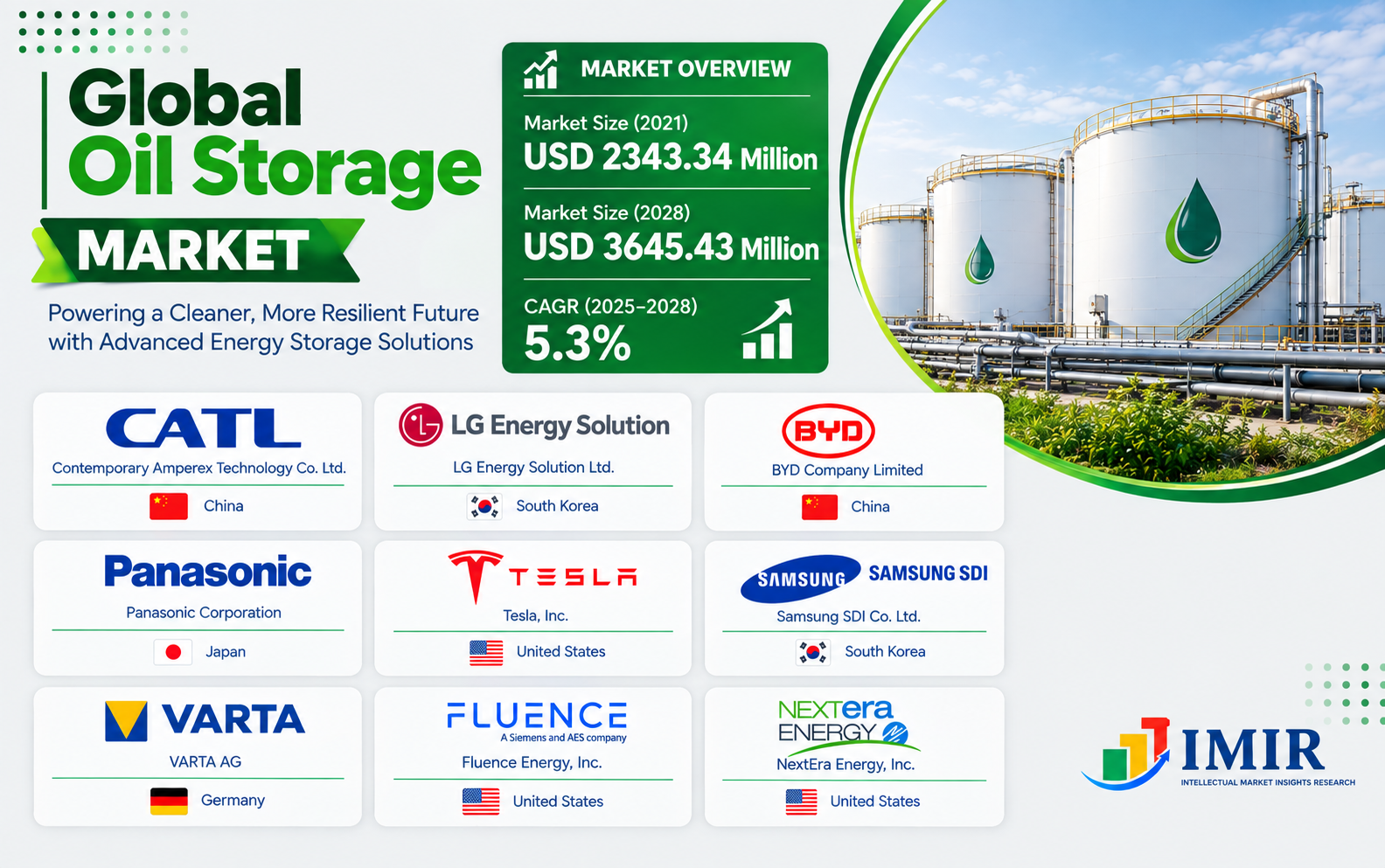
Global Oil Storage Market size was valued at USD 2343.34 Million in 2025 and is projected to reach USD 3645.43 Million by 2034, growing at a CAGR of 5.3% from 2025 to 2034 according to a new report by Intellectual Market Insights Research.
The global oil storage market spans a range of tank configurations, including open top, fixed roof, and floating roof tanks, each suited to different products and volatility profiles, deployed across applications ranging from crude oil and middle distillates to gasoline and aviation fuel. This article provides a research-based analysis of the global oil storage market, the companies shaping it, and the regional and competitive forces driving its growth toward 2034.
Market Overview
|
Parameter |
Details |
|---|---|
|
Market Size (2021) |
USD 2,343.34 Million |
|
Projected Market Size (2028) |
USD 3645.43 Million |
|
CAGR (2021–2028) |
5.3% |
|
Base Year |
2024 |
|
Historic Year |
2020–2023 |
|
Forecast Period |
2025–2034 |
|
Leading Region |
North America (largest revenue share); Asia-Pacific (significant growth) |
|
Key Segments (by Application) |
Crude Oil, Middle Distillates, Gasoline, Aviation Fuel, Others |
|
Key Segments (by Product) |
Open Top, Fixed Roof, Floating Roof, Others |
Why the Oil Storage Market Is Growing
Rising Global Demand for Refined Petroleum Products
Sustained global consumption of gasoline, middle distillates, and aviation fuel continues to require robust storage infrastructure at ports, refineries, and distribution hubs, supporting steady investment in new and expanded tank capacity.
Strategic Petroleum Reserve Expansion
Governments across major economies continue to build and expand strategic petroleum reserves to buffer against supply disruptions and price shocks, driving demand for large-scale crude oil and refined product storage capacity.
Growth in Cross-Border Oil Trading and Terminal Infrastructure
The expansion of global oil trading activity is driving demand for independent tank terminal operators that provide flexible, multi-client storage and blending services at strategic trade route locations, particularly around major shipping lanes and refining hubs.
Aging Infrastructure Replacement and Modernization
A significant share of existing oil storage infrastructure was built decades ago and requires replacement or modernization to meet current environmental, safety, and regulatory standards, creating ongoing demand for new tank construction and retrofitting.
Expansion of Aviation Fuel Storage Demand
Growth in commercial aviation activity, particularly in emerging markets, is driving expansion of dedicated aviation fuel storage infrastructure at airports and fuel distribution hubs.
Regulatory and Environmental Compliance Requirements
Increasingly stringent environmental and safety regulations governing tank design, corrosion protection, and spill containment are prompting operators to invest in advanced storage technologies such as fiberglass-reinforced composite tanks and improved floating roof designs.
Market Opportunities & Restraints
A key opportunity lies in terminal infrastructure modernization and diversification: as global energy trade patterns shift and environmental standards tighten, independent terminal operators have an opportunity to expand and upgrade multi-product storage capacity, including diversification into biofuels, chemicals, and low-carbon energy carriers alongside traditional oil products, positioning legacy terminal networks for a longer operating life. On the restraint side, volatile oil price cycles and high capital costs remain the primary headwinds, as fluctuating crude oil prices can quickly alter storage demand and utilization rates, while the substantial capital investment required to build or retrofit large-scale storage terminals, combined with increasing regulatory compliance costs, continues to constrain new capacity additions, particularly for smaller regional operators.
Companies Associated with the Oil Storage Market
-
Koninklijke Vopak NV
- Vitol Tank Terminals International BV (VTTI)
- Oiltanking GmbH
- Buckeye Partners, L.P.
- Shawcor Ltd. (Mattr Corp.)
- Containment Solutions, Inc.
- ZCL Composites
- Belco Manufacturing
- Zepnotek Storage
- Columbian Steel Tank
Koninklijke Vopak NV
|
Category |
Details |
|---|---|
|
Headquarters |
Rotterdam, Netherlands |
|
Founded |
1999 (predecessor operations date back much further) |
|
Employees |
Approx. 5,600–5,700 |
|
Revenue |
Approx. USD 1.5–1.6 Billion |
|
Overview |
Vopak is an independent tank storage company that stores and handles liquid chemicals, gases, and oil products, operating a global network of terminals across the Netherlands, Asia & Middle East, China & North Asia, Singapore, and the USA & Canada. |
|
Recent Developments |
Continues expanding into biofuels, sustainable aviation fuel, and gas storage alongside its traditional oil terminal business, reflecting a broader industry shift toward multi-product terminal diversification. |
Vitol Tank Terminals International BV (VTTI)
|
Category |
Details |
|---|---|
|
Headquarters |
Rotterdam, Netherlands |
|
Founded |
2006 |
|
Employees |
Approx. 500–1,000 |
|
Revenue |
Not separately disclosed (owned by Vitol, IFM Global Infrastructure Fund, and ADNOC) |
|
Overview |
VTTI is a global energy storage and infrastructure company providing independent tank terminal storage for oil, gas, and related products at strategic trade route locations worldwide. |
|
Recent Developments |
Completed a 50% stake acquisition in the Dragon LNG terminal in the UK and secured EU co-funding for its "Amplifhy" hydrogen and renewable energy infrastructure projects at its Rotterdam and Antwerp terminals as part of its "Strategy 2034" diversification plan. |
Oiltanking GmbH
|
Category |
Details |
|---|---|
|
Headquarters |
Hamburg, Germany |
|
Founded |
1972 |
|
Employees |
Approx. 3,000–3,300 |
|
Revenue |
Not separately disclosed (subsidiary of Marquard & Bahls AG) |
|
Overview |
Oiltanking is a global logistics service provider operating tank terminals for petroleum products, chemicals, and gases, with a history dating back to becoming Germany's terminal logistics market leader in the late 1990s. |
|
Recent Developments |
Continues operating as part of the Marquard & Bahls group, maintaining a global terminal network built through decades of joint ventures and terminal acquisitions across Europe, Asia, and the Americas. |
Buckeye Partners, L.P.
|
Category |
Details |
|---|---|
|
Headquarters |
Houston, Texas, USA |
|
Founded |
1886 (as Buckeye Pipeline Company) |
|
Employees |
Approx. 1,800–2,000 |
|
Revenue |
Approx. USD 6.6+ Billion (last publicly disclosed figures prior to going private) |
|
Overview |
Buckeye Partners is one of the largest independent oil pipeline and terminal operators in the United States, providing pipeline transportation, terminalling, and storage services for petroleum products across the East and Midwest. |
|
Recent Developments |
Operates as a private company under IFM Investors ownership since 2019, continuing to invest in its pipeline and terminal network across the United States. |
Shawcor Ltd. (Mattr Corp.)
|
Category |
Details |
|---|---|
|
Headquarters |
Toronto, Ontario, Canada |
|
Founded |
1968 (as Shawcor; rebranded to Mattr Corp. in 2023) |
|
Employees |
Approx. 1,800–6,000 (varies by reporting period following divestitures) |
|
Revenue |
Approx. CAD 862–925 Million (Infratech segment); consolidated Mattr revenue approx. USD 1.29 Billion |
|
Overview |
Shawcor, now operating as Mattr Corp., is a materials technology company whose Composite Technologies segment manufactures fiberglass-reinforced plastic (FRP) underground storage tanks under the Xerxes brand for fuel, water, and oil and gas markets. |
|
Recent Developments |
Acquired ZCL Composites in 2019 to strengthen its underground composite storage tank portfolio, and subsequently divested its legacy pipe coating business to Tenaris in 2023 to focus on composite technologies and connection systems. |
Other Notable Players
- Containment Solutions, Inc. — A U.S.-based manufacturer of fiberglass underground and aboveground storage tanks for fuel, water, and wastewater applications.
- ZCL Composites — North America's largest manufacturer of fiberglass-reinforced plastic underground storage tanks prior to its 2019 acquisition by Shawcor (now Mattr Corp.), operating today under the Xerxes brand.
- Belco Manufacturing — A specialty manufacturer of steel storage tanks and related equipment for petroleum and industrial storage applications.
- Zepnotek Storage — A storage tank solutions provider serving petroleum and industrial storage markets.
- Columbian Steel Tank — A long-established manufacturer of steel storage tanks for petroleum, water, and industrial applications across North America.
Competitive Landscape
The global oil storage market brings together a mix of large independent tank terminal operators and specialized tank manufacturers. Global independent terminal operators Koninklijke Vopak, VTTI, Oiltanking, and Buckeye Partners hold particularly strong positions, built on extensive multi-product terminal networks at strategic global trade route locations and decades of operating experience. Specialty tank manufacturers including Shawcor/Mattr (via its Xerxes brand), Containment Solutions, ZCL Composites, Belco Manufacturing, Zepnotek Storage, and Columbian Steel Tank compete through materials innovation, particularly in fiberglass-reinforced composite tank technology, regional manufacturing footprint, and long-standing customer relationships across the fragmented global oil storage tank manufacturing base.
Regional Analysis
North America
North America holds the highest revenue share in the oil storage market, supported by extensive existing pipeline and terminal infrastructure, ongoing strategic petroleum reserve investment, and ongoing modernization of aging storage assets across the United States and Canada.
Europe
Europe remains a significant oil storage market, anchored by major terminal operators such as Vopak, VTTI, and Oiltanking operating extensive terminal networks across key ports including Rotterdam, Antwerp, and Hamburg, with growing diversification into biofuels and low-carbon energy storage.
Asia-Pacific
Asia-Pacific is expected to register significant growth, driven by the presence of key oil storage companies in economies such as Japan and China, alongside rising refined product demand and continued expansion of port and terminal infrastructure across the region.
Latin America & Middle East and Africa
Latin America and the Middle East & Africa represent emerging growth markets for oil storage infrastructure, with investment tied to expanding refining capacity, strategic reserve development, and growing cross-border oil trading activity.
Emerging Trends in the Oil Storage Market
Terminal Diversification Beyond Traditional Oil Products: Leading terminal operators are increasingly diversifying storage capacity into biofuels, sustainable aviation fuel, hydrogen, and chemicals alongside traditional crude oil and refined product storage, extending the operating life of legacy terminal infrastructure.
Growth of Fiberglass-Reinforced Composite Tanks: Composite underground and aboveground storage tanks are gaining share over traditional steel tanks due to superior corrosion resistance and lower lifecycle maintenance costs, particularly in fuel retail and smaller industrial storage applications.
Consolidation Among Tank Manufacturers: Acquisition activity, such as Shawcor's 2019 purchase of ZCL Composites, illustrates ongoing consolidation among specialty tank manufacturers as larger materials technology companies seek to broaden their storage product portfolios.
Strategic Reserve and Energy Security Investment: Rising geopolitical uncertainty continues to drive government and private investment in strategic petroleum reserves and independent terminal storage capacity to buffer against supply disruptions.
Environmental and Safety Regulation Compliance: Increasingly stringent regulations governing spill containment, corrosion protection, and emissions are pushing operators toward advanced floating roof designs and improved tank monitoring technologies.
Future Outlook (2025–2034)
The global oil storage market's trajectory toward USD 5241 million by 2034 reflects steady, moderate growth driven by continued global demand for refined petroleum products, ongoing strategic reserve investment, and ongoing modernization of aging terminal infrastructure. The 6.3% CAGR forecast through 2034 assumes stable global oil trade patterns, continued diversification of terminal operators into adjacent energy storage segments, and gradual replacement of legacy steel tanks with advanced composite alternatives.
Key investment themes include continued terminal network expansion and diversification by independent operators such as Vopak, VTTI, and Oiltanking, ongoing consolidation among specialty tank manufacturers following patterns set by Shawcor's acquisition of ZCL Composites, and steady demand for strategic petroleum reserve capacity amid ongoing global energy security concerns. As terminal operators balance traditional oil storage demand against the need to diversify into biofuels and lower-carbon energy carriers, the companies that combine global terminal reach with materials and technology innovation will be best positioned to capture growth through 2028.
Frequently Asked Questions (FAQ)
1. What is the current size of the global oil storage market?
The global oil storage market was valued at USD 2,343.34 million in 2025 and is projected to reach USD 3,645.43 million by 2034, growing at a CAGR of 5.3% from 202 to 2034.
2. Who are the top companies in the oil storage market?
Leading companies include Koninklijke Vopak NV, Vitol Tank Terminals International BV (VTTI), Oiltanking GmbH, Buckeye Partners L.P., Shawcor Ltd. (now Mattr Corp.), Containment Solutions Inc., ZCL Composites, Belco Manufacturing, Zepnotek Storage, and Columbian Steel Tank.
3. Which region dominates the oil storage market?
North America holds the highest revenue share in the oil storage market, while Asia-Pacific is expected to register significant growth due to the presence of key companies in economies such as Japan and China.
4. What is the forecast CAGR for the oil storage market?
The market is forecast to grow at a CAGR of 5.3% from 2025 to 2034.
5. What are the main growth drivers for this market?
Key drivers include rising global demand for refined petroleum products, strategic petroleum reserve expansion, growth in cross-border oil trading, aging infrastructure replacement, and expanding aviation fuel storage demand.
6. What tank types are used in the oil storage market?
The market is segmented by product into open top, fixed roof, floating roof, and other tank types, each suited to different storage applications based on product volatility and evaporation control requirements.
7. What applications does the oil storage market serve?
Oil storage infrastructure serves crude oil, middle distillates, gasoline, aviation fuel, and other refined petroleum product storage applications across the global supply chain.
Conclusion
The global oil storage market sits at the intersection of steady global fuel demand and the ongoing modernization of aging terminal and tank infrastructure. With a projected size of USD 3,645.43 million by 2034 at a 5.3% CAGR, the market offers stable, infrastructure-driven growth across crude oil, refined product, and aviation fuel storage applications.
Vopak, VTTI, Oiltanking, and Buckeye Partners continue to lead the independent terminal operator segment on the strength of extensive global networks and decades of operating experience, while Shawcor/Mattr and other specialty tank manufacturers compete through materials innovation and regional manufacturing scale. As terminal diversification, composite tank adoption, and strategic reserve investment continue to shape the industry, the companies that combine global reach with technology and materials innovation will define market leadership through 2034 and beyond.