
Global Optical Network Equipment Market Leading Companies
Author:
Intellectual Market Insights Research
Published Date:
03 Sep 2026
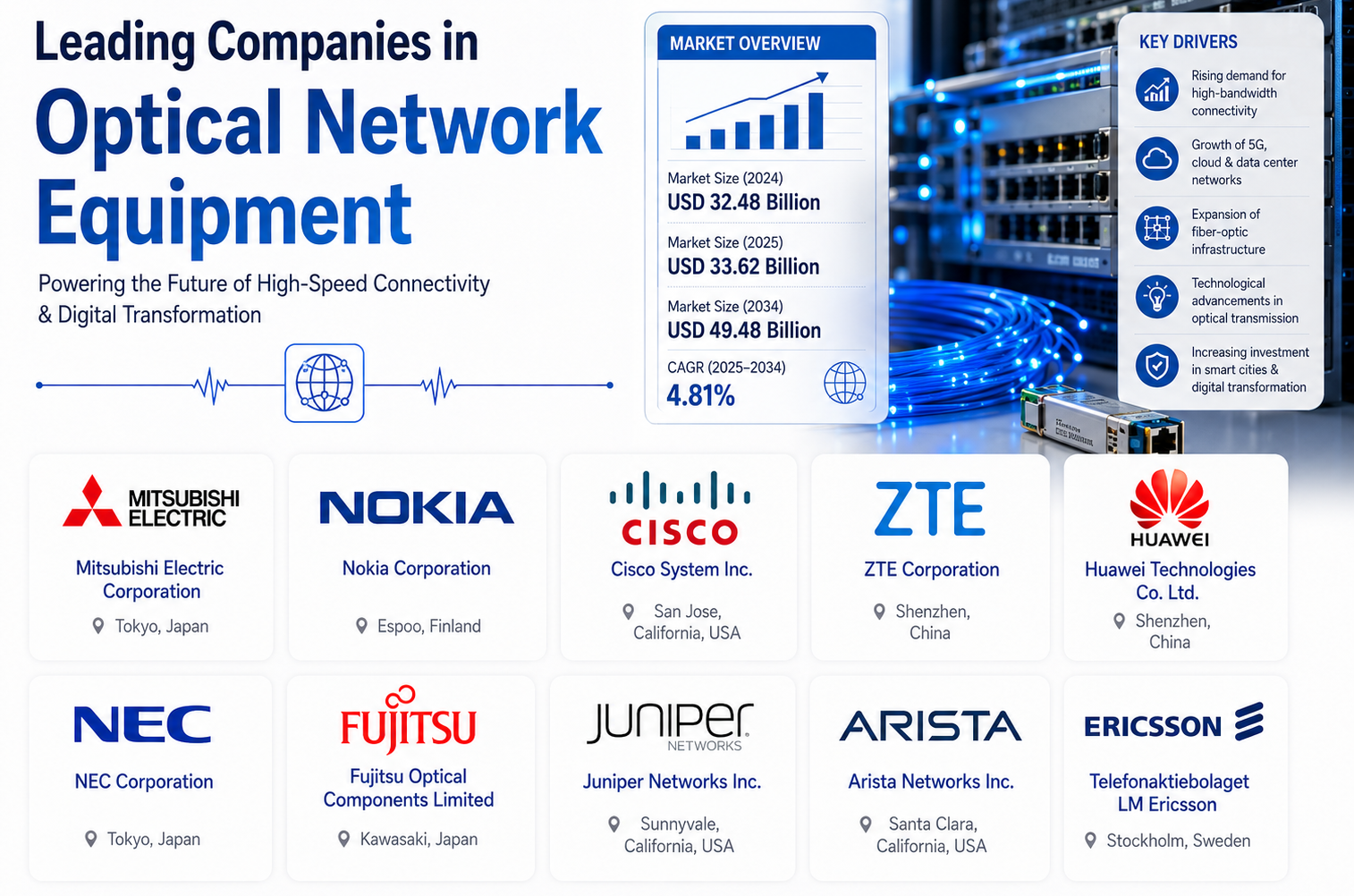
Top Companies in the World Offering Optical Network Equipment
Optical network equipment, spanning optical fiber, transceivers, switches, and wavelength-division multiplexing (WDM) systems, forms the physical backbone of global data transmission, carrying the overwhelming majority of the world's internet, voice, and enterprise data traffic. As AI workloads, cloud computing, and 5G backhaul push data volumes ever higher, telecom operators, hyperscalers, and enterprises alike are investing heavily in higher-capacity, lower-latency optical infrastructure to keep pace with demand.
The global optical network equipment market was valued at USD 32.48 billion in 2025 and is projected to reach USD 49.48 billion by 2034, growing at a compound annual growth rate (CAGR) of 4.81% from 2025 to 2034. Growth is being driven by the explosion of AI-related data center traffic, continued 5G network buildout, and rising demand for high-capacity optical transceivers and switching equipment across the IT & telecom, BFSI, military defense, oil & gas, and medical & healthcare verticals.
The competitive landscape includes networking giants Cisco Systems and Huawei, telecom infrastructure leaders Nokia and Ericsson, and specialized Japanese electronics and optical component manufacturers including NEC, Fujitsu Optical Components, and Mitsubishi Electric, alongside Chinese vendor ZTE and enterprise networking players Arista Networks and Juniper Networks. This article provides a research-based analysis of the top companies shaping the global optical network equipment market, their positioning, flagship offerings, and the regional and technological forces driving the industry forward.
Market Overview
|
Parameter |
Details |
|---|---|
|
Market Size (2025) |
USD 32.48 Billion |
|
Projected Market Size (2034) |
USD 49.48 Billion |
|
CAGR (2025–2034) |
4.81% |
|
Base Year |
2024 |
|
Historic Year |
2018–2023 |
|
Forecast Period |
2025–2034 |
|
Leading Region |
North America |
|
Fastest-Growing Region |
Asia-Pacific |
|
Key Segments (by Component) |
Optical Fiber, Transceiver, Switch, Others |
|
Key Segments (by Technology) |
SONET, WDM, Fiber Channel |
|
Key Segments (by Industry Vertical) |
IT & Telecom, BFSI, Military Defense, Oil & Gas, Medical & Healthcare |
Why the Optical Network Equipment Market Is Growing
1. Surging AI and Data Center Traffic
The rapid scale-up of AI training and inference workloads is dramatically increasing network traffic within and between data centers, driving demand for high-speed coherent optics, pluggable transceivers, and optical switching systems capable of handling AI-scale bandwidth requirements.
2. Continued 5G Network Expansion
5G deployment requires dense fiber backhaul and fronthaul infrastructure to support ultra-low latency and high-bandwidth connectivity, sustaining demand for optical transmission equipment across telecom operator networks.
3. Growth in Cloud and Hyperscale Infrastructure
Expanding cloud computing and hyperscale data center footprints are driving investment in high-capacity WDM and optical switching equipment to interconnect data centers and support rising enterprise cloud workloads.
4. Rising Demand Across Non-Telecom Verticals
Sectors such as BFSI, military defense, oil & gas, and medical & healthcare are increasingly adopting optical network infrastructure for secure, high-bandwidth, low-latency data transmission, broadening demand beyond traditional telecom applications.
5. Transceiver and Switch Technology Advancement
Continuous innovation in higher-speed transceivers and more efficient optical switching architectures is improving network capacity and energy efficiency, encouraging network operators to upgrade legacy optical infrastructure.
6. Submarine and Long-Haul Cable Investment
Ongoing investment in submarine cable systems and long-haul optical transmission networks to connect regions and support growing international data traffic continues to drive demand for optical network equipment globally.
Top 10 Companies in the Optical Network Equipment Market
- Cisco Systems Inc.
- Huawei Technologies Co., Ltd.
- Nokia Corporation
- Telefonaktiebolaget LM Ericsson
- NEC Corporation
- ZTE Corporation
- Mitsubishi Electric Corporation
- Fujitsu Optical Components Limited
- Juniper Networks Inc. (now part of HPE Networking)
- Arista Networks Inc.
1. Cisco Systems Inc.
|
Category |
Details |
|---|---|
|
Company Name |
Cisco Systems, Inc. |
|
Headquarters |
San Jose, California, USA |
|
Founded |
1984 |
|
Employees |
Approx. 80,000–86,000 |
|
Revenue (FY2025) |
Approx. USD 56.65 Billion (total company revenue) |
|
Company Overview |
Cisco is the world's largest networking equipment provider, offering routed optical networking systems and pluggable optic solutions designed to transform the economics of building and operating high-capacity networks. |
|
Key Products |
Cisco 8000 series routers built on Cisco Silicon One, routed optical networking systems, and Acacia coherent pluggable optics for high-speed data transmission. |
|
Market Position |
A top-tier global optical networking vendor, with its Acacia optics business alone generating over USD 1 billion in orders in a single quarter and shipping more than 850,000 400-gig and 75,800 800-gig coherent pluggable optics to date. |
|
Recent Developments |
Reported networking product revenue growth of 28% year-over-year driven by triple-digit growth in AI infrastructure and service provider routing/Acacia optics, and is developing multi-rail optical systems to support AI-driven "scale-across" network traffic. |
|
Strategic Advantages |
Massive global scale and distribution, deep integration between routing silicon and optical technology, and a fast-growing position supplying optical infrastructure for AI data center buildouts. |
2. Huawei Technologies Co., Ltd.
|
Category |
Details |
|---|---|
|
Company Name |
Huawei Technologies Co., Ltd. |
|
Headquarters |
Shenzhen, China |
|
Founded |
1987 |
|
Employees |
Approx. 207,000 |
|
Revenue |
Approx. USD 92 Billion (total company revenue across all business segments) |
|
Company Overview |
Huawei is a global leader in telecommunications and optical network infrastructure, offering a comprehensive portfolio of optical transmission, transceiver, and switching equipment for telecom operators and enterprises worldwide. |
|
Key Products |
Huawei's optical network portfolio spans WDM transmission systems, optical transceivers, and packet-optical switching equipment supporting 5G backhaul and metro/long-haul networks. |
|
Market Position |
The dominant optical network equipment vendor across Asia-Pacific, with a rapidly increasing presence in Africa, Latin America, and the Middle East. |
|
Recent Developments |
Continues to expand its optical transmission and transceiver portfolio as part of its broader ICT infrastructure strategy to support 5G and AI-driven data traffic growth across emerging telecom markets. |
|
Strategic Advantages |
Massive manufacturing scale, cost-competitive offerings, deep integration with its own telecom infrastructure business, and a dominant position in fast-growing Asia-Pacific, African, and Latin American markets. |
3. Nokia Corporation
|
Category |
Details |
|---|---|
|
Company Name |
Nokia Corporation |
|
Headquarters |
Espoo, Finland |
|
Founded |
1865 |
|
Employees |
Approx. 87,000 |
|
Revenue |
Approx. USD 25 Billion |
|
Company Overview |
Nokia is a global leader in optical and IP networking infrastructure, with its optical networks business, and majority-owned Alcatel Submarine Networks unit, among the world's leading submarine and terrestrial optical transmission providers. |
|
Key Products |
Nokia's optical networking portfolio spans WDM and IP transport systems, alongside submarine cable systems delivered through Alcatel Submarine Networks (ASN), one of the top three global submarine cable providers. |
|
Market Position |
A leading global optical network equipment vendor with strong market share in Europe and North America, and a top-three global position in submarine cable systems through ASN. |
|
Recent Developments |
Continues expanding cloud-native and AI-enabled capabilities across its optical networking portfolio, while ASN, majority-owned by the French state since a November 2024 transaction, continues major submarine cable deployment projects globally. |
|
Strategic Advantages |
Combined strength in optical transport and IP networking, a leading global submarine cable position via ASN, and strong European carrier relationships. |
4. Telefonaktiebolaget LM Ericsson
|
Category |
Details |
|---|---|
|
Company Name |
Telefonaktiebolaget LM Ericsson (Ericsson AB) |
|
Headquarters |
Stockholm, Sweden |
|
Founded |
1876 |
|
Employees |
Approx. 100,000 |
|
Revenue |
Approx. USD 25.6 Billion |
|
Company Overview |
Ericsson is a global leader in telecommunications infrastructure, providing optical transport and fronthaul/backhaul networking equipment that underpins 5G radio access and core network deployments worldwide. |
|
Key Products |
Optical transport and network management solutions integrated with Ericsson's radio access network and core network portfolios to support high-capacity 5G backhaul. |
|
Market Position |
A top-tier global optical and telecom infrastructure vendor that cross-sells integrated optical transport solutions to the same carrier base it serves with radio access network equipment. |
|
Recent Developments |
Continues expanding its enterprise wireless and private 5G portfolio, building on its 2023 acquisition of Cradlepoint, which strengthens Ericsson's broader enterprise networking and connectivity offering. |
|
Strategic Advantages |
Deep integration between radio access network infrastructure and optical transport equipment, strong global carrier relationships, and an expanding enterprise networking portfolio. |
5. NEC Corporation
|
Category |
Details |
|---|---|
|
Company Name |
NEC Corporation |
|
Headquarters |
Tokyo, Japan (NEC Supertower, Minato) |
|
Founded |
1899 |
|
Employees |
Approx. 105,000 |
|
Revenue |
Approx. USD 23 Billion (JPY 3.48 Trillion) |
|
Company Overview |
NEC is a leading Japanese technology group with a strong optical networking heritage, offering submarine cable systems, optical transmission networks, and fiber optic devices as part of its broader ICT infrastructure business. |
|
Key Products |
Submarine cable systems, optical transmission network equipment, and fiber optic devices supporting long-haul, subsea, and terrestrial network infrastructure. |
|
Market Position |
One of the world's top three submarine cable system providers alongside Alcatel Submarine Networks and SubCom, with a strong position in Asia-Pacific optical transmission infrastructure. |
|
Recent Developments |
Completed construction of the East Micronesia Cable System (May 2026), a submarine cable connecting the Federated States of Micronesia, Kiribati, and Nauru, handed over to the respective national telecom operators. |
|
Strategic Advantages |
Deep submarine cable engineering expertise spanning over a century, a strong Asia-Pacific optical infrastructure position, and integration of optical networking with NEC's broader IT and biometrics business. |
Competitive Landscape
The global optical network equipment market brings together several distinct types of competitors. Networking and IT infrastructure giants Cisco and Huawei compete at massive scale, integrating optical transceivers and transport systems with their broader routing, switching, and IT infrastructure portfolios. Telecom infrastructure leaders Nokia and Ericsson bundle optical transport equipment with their core radio access network and IP networking businesses, cross-selling to the same global carrier base, with Nokia holding a particularly strong position in submarine cable systems through Alcatel Submarine Networks. Japanese optical and electronics specialists, including NEC, Fujitsu Optical Components, and Mitsubishi Electric, bring deep optical component and submarine cable engineering heritage, competing on technical precision and long-standing carrier relationships across Asia-Pacific. Enterprise networking vendors ZTE and Arista Networks round out the competitive field, with ZTE competing on cost-effective optical infrastructure in emerging markets and Arista focused on high-performance data center switching and optical connectivity for cloud and AI workloads. Notably, Juniper Networks, historically a significant enterprise and service-provider networking vendor, was acquired by Hewlett Packard Enterprise in a deal completed in July 2025 and now operates as HPE Networking, doubling the size of HPE's networking business and creating a combined AI-native networking portfolio.
Regional Analysis
North America
North America accounts for the highest market share by revenue in the optical network equipment market, driven by growing adoption of optical networking equipment, heavy investment in AI data center infrastructure, and the presence of major vendors such as Cisco, Arista Networks, and HPE Networking.
Europe
Europe remains an important optical network equipment market, anchored by Nokia and Ericsson's deep telecom infrastructure relationships and continued 5G and fiber network investment across the region.
Asia-Pacific
The Asia-Pacific region is expected to witness significant growth, driven by the presence of key optical network equipment companies in economies such as Japan and China, including Huawei, NEC, ZTE, Mitsubishi Electric, and Fujitsu Optical Components.
Latin America & Middle East and Africa
Latin America and the Middle East & Africa represent developing optical network equipment markets, with demand tied to expanding telecom infrastructure investment and growing fiber and submarine cable connectivity projects across the regions.
Emerging Trends in the Optical Network Equipment Market
1. AI-Driven Optical Infrastructure Investment: Surging AI training and inference workloads are driving unprecedented demand for high-speed coherent optics and optical switching systems, with vendors like Cisco reporting triple-digit growth in AI infrastructure-related networking revenue.
2. Consolidation Among Enterprise Networking Vendors: Major industry consolidation, exemplified by HPE's completed acquisition of Juniper Networks, is reshaping the competitive landscape as companies combine networking portfolios to compete more effectively in AI-native networking.
3. Coherent Pluggable Optics Adoption: Growing adoption of high-speed coherent pluggable optics, such as 400-gig and 800-gig transceivers, is transforming the economics of building and operating high-capacity optical networks.
4. Submarine Cable Expansion: Continued investment in submarine cable systems connecting island nations and emerging regions, as seen in NEC's East Micronesia Cable System, is expanding global optical network connectivity.
5. Multi-Rail and Open Optical Systems: Development of multi-rail optical systems and open line systems is enabling more flexible, scalable optical network architectures suited to AI-driven "scale-across" data center networking.
Future Outlook (2025–2034)
The global optical network equipment market's trajectory toward USD 49.48 billion by 2034 reflects the critical role optical infrastructure plays in supporting AI, cloud, and 5G-driven data growth. The 4.81% CAGR forecast through 2034 assumes sustained AI data center buildout, continued 5G network expansion, and growing optical infrastructure demand across non-telecom verticals such as BFSI, military defense, and healthcare.
Key investment themes include continued growth in coherent pluggable optics and AI-driven networking infrastructure, expansion of submarine cable systems to connect underserved regions, and ongoing consolidation among enterprise networking vendors as demonstrated by HPE's acquisition of Juniper Networks. Cisco and Huawei are likely to retain leading positions at global scale, Nokia and Ericsson continue leveraging their integrated telecom infrastructure relationships, and Japanese optical specialists NEC, Fujitsu Optical Components, and Mitsubishi Electric maintain strong positions in submarine cable and precision optical component manufacturing.
Frequently Asked Questions (FAQ)
1. What is the current size of the global optical network equipment market?
The global optical network equipment market was valued at USD 32.48 billion in 2025 and is projected to reach USD 49.48 billion by 2034, growing at a CAGR of 4.81%.
2. Who are the top companies in the optical network equipment market?
Leading companies include Cisco Systems, Huawei Technologies, Nokia, Ericsson, NEC Corporation, ZTE Corporation, Mitsubishi Electric, Fujitsu Optical Components, Juniper Networks (now part of HPE Networking), and Arista Networks.
3. Which region dominates the optical network equipment market?
North America accounts for the highest market share by revenue, while the Asia-Pacific region is expected to witness significant growth due to the presence of key optical network equipment companies in economies such as Japan and China.
4. What is the forecast CAGR for the optical network equipment market?
The market is forecast to grow at a CAGR of 4.81% from 2025 to 2034.
5. What are the main growth drivers for this market?
Key drivers include surging AI and data center traffic, continued 5G network expansion, growth in cloud and hyperscale infrastructure, rising demand across non-telecom verticals, and ongoing submarine and long-haul cable investment.
6. What are the main technology types in the optical network equipment market?
The market is segmented by technology into SONET, WDM (Wavelength-Division Multiplexing), and Fiber Channel, with WDM playing a central role in high-capacity long-haul and metro network transmission.
7. What industries use optical network equipment beyond telecom?
Beyond IT & Telecom, optical network equipment is increasingly adopted across BFSI, military defense, oil & gas, and medical & healthcare industries for secure, high-bandwidth, low-latency data transmission.
Conclusion
The global optical network equipment market sits at the center of the infrastructure buildout needed to support the world's AI, cloud, and 5G-driven data growth. With a projected size of USD 49.48 billion by 2034 at a 4.81% CAGR, the market offers steady, technology-driven growth as coherent optics, submarine cable systems, and AI-optimized network architectures become central to global connectivity.
Cisco and Huawei continue to lead at global scale, while Nokia and Ericsson leverage their integrated telecom infrastructure relationships, and NEC, Fujitsu Optical Components, and Mitsubishi Electric maintain deep optical engineering expertise across Asia-Pacific. As AI-driven data traffic reshapes network architecture and industry consolidation continues, exemplified by HPE's acquisition of Juniper Networks, the companies that combine optical hardware innovation with AI-scale networking capability will define market leadership through 2034 and beyond.