
Global Printed Circuit Heat Exchanger Market Leading Companies
Author:
Intellectual Market Insights Research
Published Date:
12 Sep 2026
Introduction
Printed circuit heat exchangers (PCHEs) are advanced, ultra-compact heat transfer devices manufactured by chemically etching precise flow channels into metal plates, which are then diffusion-bonded together to form a single solid block capable of withstanding extreme pressures and temperatures. Compared to conventional shell-and-tube heat exchangers, PCHEs deliver significantly higher thermal efficiency in a much smaller footprint, making them a critical enabling technology for demanding industrial processes ranging from cryogenic gas processing to hydrogen refueling infrastructure.
The global printed circuit heat exchanger market spans a range of construction materials, including stainless steel, aluminum, and nickel, deployed across hydrocarbon processing, petrochemical, and refining industry applications where compact footprint, structural durability, and resistance to extreme operating conditions are essential. This article provides a research-based analysis of the global printed circuit heat exchanger market, the companies shaping it, and the regional and technological forces driving its growth toward 2032.
Market Overview
| Parameter | Details |
|---|---|
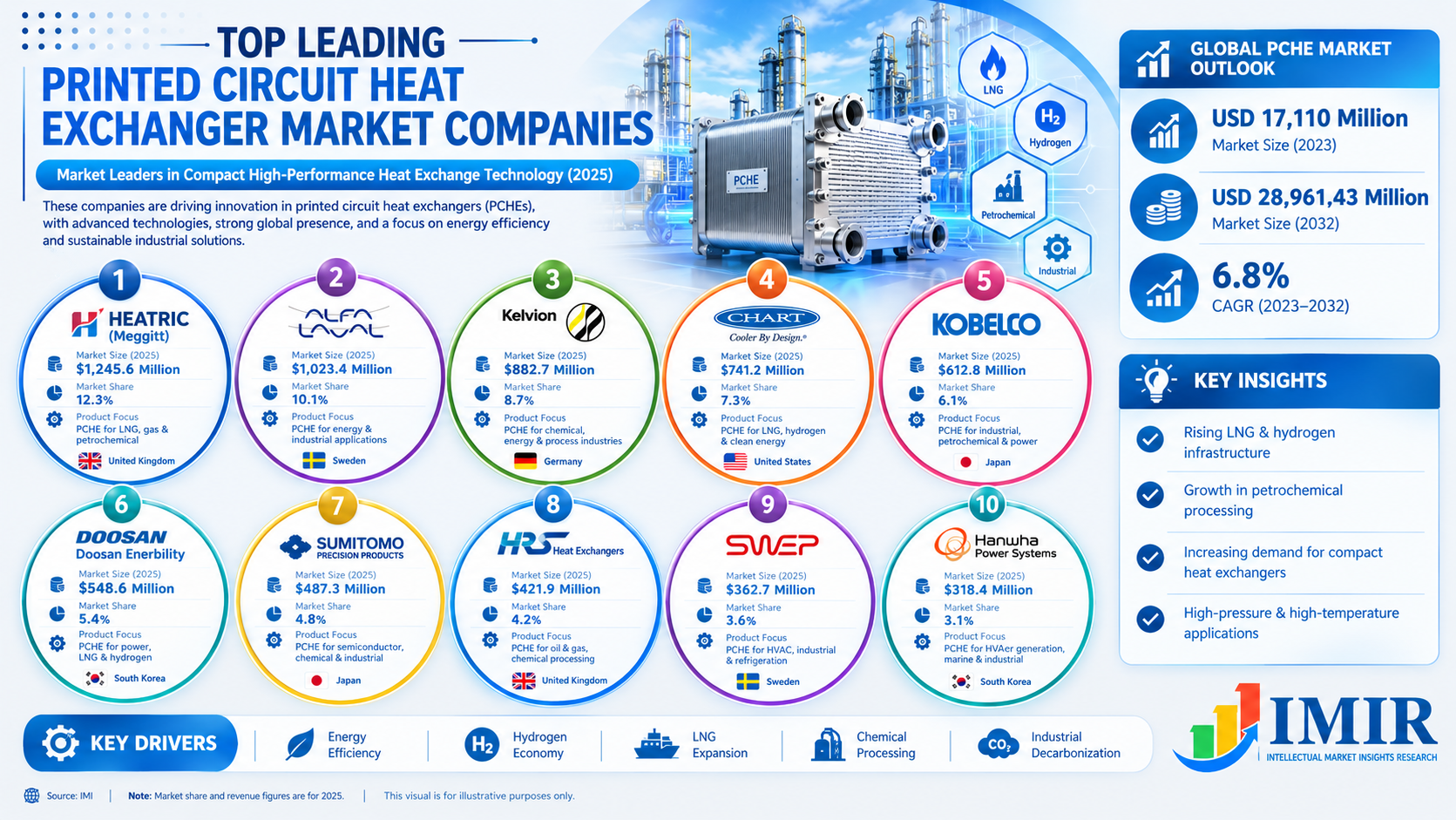
| Market Size (2023) | USD 17,110 Million |
| Projected Market Size (2032) | USD 28,961.43 Million |
| CAGR (2023–2032) | 6.8% |
| Base Year | 2023 |
| Historic Year | 2018–2022 |
| Forecast Period | 2024–2033 |
| Leading Region | North America (highest revenue share); Asia-Pacific (significant growth) |
| Key Segments (by Material) | Stainless Steel, Aluminum, Nickel, Others |
| Key Segments (by Application) | Hydrocarbon Processing, Petrochemical, Refining Industries, Others |
Why the Printed Circuit Heat Exchanger Market Is Growing
Rising Demand for Compact, High-Efficiency Thermal Solutions
Industries under pressure to reduce equipment footprint while improving thermal performance are increasingly turning to PCHEs, which deliver significantly higher surface-area-to-volume ratios than conventional shell-and-tube heat exchangers.
Expansion of Hydrocarbon Processing and LNG Infrastructure
Continued global investment in liquefied natural gas (LNG) liquefaction and regasification infrastructure is driving demand for PCHEs capable of handling cryogenic temperatures and high-pressure gas processing applications.
Growth in Petrochemical and Refining Capacity
Expanding global petrochemical and refining capacity, particularly in emerging economies, continues to drive demand for durable, corrosion-resistant heat exchange equipment capable of withstanding harsh process conditions.
Emerging Hydrogen Economy Infrastructure
The build-out of hydrogen production, storage, and refueling infrastructure is creating a fast-growing new application segment for PCHEs, particularly for hydrogen pre-cooling heat exchangers used at high-pressure refueling stations.
Growing Adoption in Nuclear and Next-Generation Power Applications
Advanced and small modular nuclear reactor designs are increasingly specifying PCHEs for their compact size, structural strength, and ability to safely manage high-temperature, high-pressure heat transfer applications.
Increasing Focus on Energy Efficiency and Emissions Reduction
Regulatory and corporate pressure to improve industrial energy efficiency is driving replacement of older, less efficient heat exchange equipment with compact, high-performance PCHE technology across process industries.
Market Opportunities & Restraints
A key opportunity lies in hydrogen and clean energy infrastructure expansion: as governments and industry accelerate investment in hydrogen production, storage, and refueling infrastructure, manufacturers have a significant opportunity to develop specialized PCHEs, including hydrogen pre-cooling exchangers, positioning early movers to capture share in one of the fastest-growing thermal equipment segments. On the restraint side, high manufacturing costs and complex production processes remain the primary headwind, as PCHEs require precision chemical etching and diffusion bonding processes that demand specialized equipment and expertise, resulting in higher upfront costs compared to conventional heat exchangers and limiting adoption among cost-sensitive customers and smaller-scale industrial operations.
Companies Associated with the Printed Circuit Heat Exchanger Market (Details in Table)
| Company | Headquarters | Founded | Employees | Revenue | Overview |
|---|---|---|---|---|---|
| Alfa Laval | Lund, Sweden | 1883 | Approx. 20,000+ | Approx. USD 7.5 Billion (total company) | A global leader in heat transfer, separation, and fluid handling technology, offering printed circuit heat exchangers rated for cryogenic to 800°C operating temperatures across energy, marine, and process industries. |
| Heatric (Parker Meggitt / Parker Hannifin) | Poole, Dorset, UK | 1985 | Part of Parker Hannifin (57,950 group-wide) | Parker Hannifin total revenue approx. USD 19.9 Billion | A pioneer of diffusion-bonded printed circuit heat exchanger technology, Heatric now operates as a division within Parker Hannifin's Filtration Group following Parker's 2022 acquisition of Meggitt PLC. |
| HEXCES | Not publicly disclosed | Not publicly disclosed | Not publicly disclosed | Not publicly disclosed | A specialized manufacturer of compact heat exchange solutions, including printed circuit and microchannel heat exchanger designs for industrial process applications. |
| TANKTECH CO., LTD. | South Korea | Not publicly disclosed | Not publicly disclosed | Not publicly disclosed | A South Korean manufacturer of industrial storage tanks and heat exchange equipment serving petrochemical and energy sector customers. |
| Asvotec Termoindustrial | Monte Mor, São Paulo, Brazil | 1965 | Not publicly disclosed | Not publicly disclosed | A Brazilian metallurgical company specializing in industrial valves and heat exchange equipment, serving the electricity, oil and gas, energy, and utilities industries. |
| DongHwa Entec Co., Ltd. | Busan, South Korea | 1980 | Not publicly disclosed | Not publicly disclosed | A heat exchanger manufacturing and system engineering firm serving the power generation, petrochemical, and shipbuilding industries, with an R&D center focused on high-efficiency heat exchanger development. |
| Vacuum Process Engineering (VPE) | Sacramento, California, USA | 1976 | Not publicly disclosed | Not publicly disclosed | A thermal engineering and manufacturing company specializing in precision brazing, diffusion bonding, and diffusion-bonded microchannel/printed circuit heat exchangers for aerospace, medical, semiconductor, and defense applications through its VPE Thermal subsidiary. |
Competitive Landscape
The global printed circuit heat exchanger market brings together a mix of large diversified industrial equipment manufacturers and specialized thermal engineering firms. Global heat transfer technology leaders Alfa Laval and Heatric (now part of Parker Hannifin's Filtration Group) hold particularly strong positions, built on decades of engineering expertise in diffusion bonding and compact heat exchanger design, serving demanding energy, marine, aerospace, and nuclear applications worldwide. Specialized regional manufacturers including HEXCES, TANKTECH, Asvotec Termoindustrial, DongHwa Entec, and Vacuum Process Engineering (VPE) compete through deep application-specific expertise, regional manufacturing presence, and customization capabilities, particularly in hydrocarbon processing, marine, and defense-related applications. The market's consolidation trend, exemplified by Parker Hannifin's acquisition of Meggitt PLC (and by extension the Heatric business), illustrates the ongoing wave of integration among larger diversified industrial conglomerates seeking specialized thermal technology capabilities.
Regional Analysis
North America
North America accounts for the highest revenue share in the printed circuit heat exchanger market, supported by extensive hydrocarbon processing and LNG infrastructure investment, growing hydrogen refueling infrastructure development, and the presence of specialized manufacturers such as Vacuum Process Engineering (VPE).
Europe
Europe represents a significant printed circuit heat exchanger market, anchored by major manufacturers such as Alfa Laval and Heatric, alongside strong industrial and energy sector demand across Germany, France, and the UK.
Asia-Pacific
The Asia-Pacific market is expected to witness significant growth, driven by the presence of key printed circuit heat exchanger companies in economies such as Japan and China, alongside expanding petrochemical and refining capacity and growing shipbuilding and marine equipment demand in South Korea.
Latin America & Middle East and Africa
Latin America and the Middle East & Africa represent emerging growth markets for printed circuit heat exchangers, with demand tied to expanding petrochemical and refining capacity, growing energy infrastructure investment, and the presence of regional manufacturers such as Asvotec Termoindustrial in Brazil.
Emerging Trends in the Printed Circuit Heat Exchanger Market
Growth of Hydrogen Pre-Cooling Heat Exchangers: Rising investment in hydrogen refueling infrastructure is driving demand for specialized PCHEs capable of pre-cooling hydrogen to the extreme low temperatures required for fast, safe vehicle refueling.
Adoption of Additive Manufacturing in PCHE Production: Manufacturers are increasingly integrating additive manufacturing techniques into PCHE production to reduce material waste and enable more complex internal flow channel geometries.
Expansion into Aerospace and Defense Applications: Growing use of lightweight, high-performance PCHEs in aerospace and defense applications, including jet fuel systems, is broadening the market beyond its traditional hydrocarbon processing base.
Development of Titanium-Based and High-Performance Alloy Exchangers: Continued materials innovation is driving adoption of titanium-based and other high-performance alloy PCHEs for extreme pressure and corrosive service environments.
Consolidation Among Industrial Thermal Technology Providers: Acquisition activity, such as Parker Hannifin's 2022 purchase of Meggitt PLC (and its Heatric PCHE business), reflects ongoing consolidation as larger diversified industrial conglomerates seek to add specialized compact heat exchanger capabilities to their portfolios.
Growing Specification in Small Modular Reactor and Advanced Nuclear Designs: Advanced and small modular nuclear reactor developers are increasingly specifying PCHEs for their compact footprint and ability to safely manage high-temperature, high-pressure heat transfer, opening a promising long-term growth avenue for the technology.
Future Outlook (2025–2034)
Building on the underlying report's original 2023–2032 forecast window (USD 17,110 million in 2023 to USD 28,961.43 million by 2032 at a 6.8% CAGR), the market's momentum is expected to continue through 2034 as hydrogen infrastructure buildout, LNG capacity expansion, and advanced nuclear reactor development remain long-term structural growth drivers. Extending the trend, continued mid-single-digit growth would be supported by sustained hydrocarbon processing and petrochemical capacity additions, growing hydrogen refueling infrastructure investment, and expanding adoption of PCHEs in aerospace, defense, and next-generation nuclear power applications.
Key investment themes for 2025–2034 include continued materials innovation by global leaders such as Alfa Laval and Heatric (Parker Hannifin), growing specialization by regional manufacturers such as DongHwa Entec and Vacuum Process Engineering (VPE) in defense, aerospace, and hydrogen applications, and sustained consolidation activity as larger industrial conglomerates seek to acquire specialized compact heat exchanger technology capabilities. As hydrogen economy infrastructure, LNG capacity, and advanced nuclear power development continue to accelerate globally, the companies that combine precision manufacturing expertise with application-specific innovation will be best positioned to capture growth through 2034.
Frequently Asked Questions (FAQ)
1. What is the current size of the global printed circuit heat exchanger market?
The global printed circuit heat exchanger market was valued at USD 17,110 million in 2023 and is projected to reach USD 28,961.43 million by 2032, growing at a CAGR of 6.8% from 2023 to 2032, according to the underlying market report.
2. Who are the top companies in the printed circuit heat exchanger market?
Leading companies include Alfa Laval, Heatric (now part of Parker Hannifin's Filtration Group), HEXCES, TANKTECH CO., LTD., Asvotec Termoindustrial, DongHwa Entec Co., Ltd., and Vacuum Process Engineering (VPE).
3. Which region dominates the printed circuit heat exchanger market?
North America accounts for the highest revenue share in the printed circuit heat exchanger market, while the Asia-Pacific region is expected to register significant growth due to the presence of key companies in economies such as Japan and China.
4. What is the forecast CAGR for the printed circuit heat exchanger market?
The underlying report forecasts a CAGR of 6.8% from 2023 to 2032; this growth trajectory is expected to broadly continue through 2034 given sustained hydrogen infrastructure, LNG, and advanced nuclear investment.
5. What are the main growth drivers for this market?
Key drivers include rising demand for compact, high-efficiency thermal solutions, expansion of hydrocarbon processing and LNG infrastructure, growth in petrochemical and refining capacity, emerging hydrogen economy infrastructure, and growing adoption in nuclear and next-generation power applications.
6. What materials are used to manufacture printed circuit heat exchangers?
The market is segmented by material into stainless steel, aluminum, nickel, and other specialty alloys, each selected based on the specific pressure, temperature, and corrosion resistance requirements of the application.
7. What applications does the printed circuit heat exchanger market serve?
Printed circuit heat exchangers are primarily used in hydrocarbon processing, petrochemical, and refining industry applications, in addition to emerging uses in hydrogen infrastructure, aerospace, defense, and advanced nuclear power generation.
Conclusion
The global printed circuit heat exchanger market sits at the intersection of demand for compact, high-efficiency thermal solutions and the ongoing expansion of hydrocarbon processing, LNG, and emerging hydrogen infrastructure. With a projected size of USD 28,961.43 million by 2032 at a 6.8% CAGR — and structural growth drivers expected to persist through 2034 — the market offers steady, application-diverse growth across hydrocarbon processing, petrochemical, and refining segments.
Alfa Laval and Heatric (now part of Parker Hannifin) continue to lead on the strength of decades of diffusion bonding and compact heat exchanger engineering expertise, while specialized manufacturers such as DongHwa Entec, Vacuum Process Engineering (VPE), Asvotec Termoindustrial, HEXCES, and TANKTECH compete through deep application-specific expertise and regional manufacturing presence. As hydrogen infrastructure development, advanced nuclear reactor design, and materials innovation continue to reshape the industry, the companies that combine precision manufacturing capability with application-specific innovation will define market leadership through 2034 and beyond.


