
Top 10 Talc Companies Driving Industry Growth and Industrial Minerals Innovation in 2026
Author:
Intellectual Market Insights Research
Published Date:
13 Jun 2026
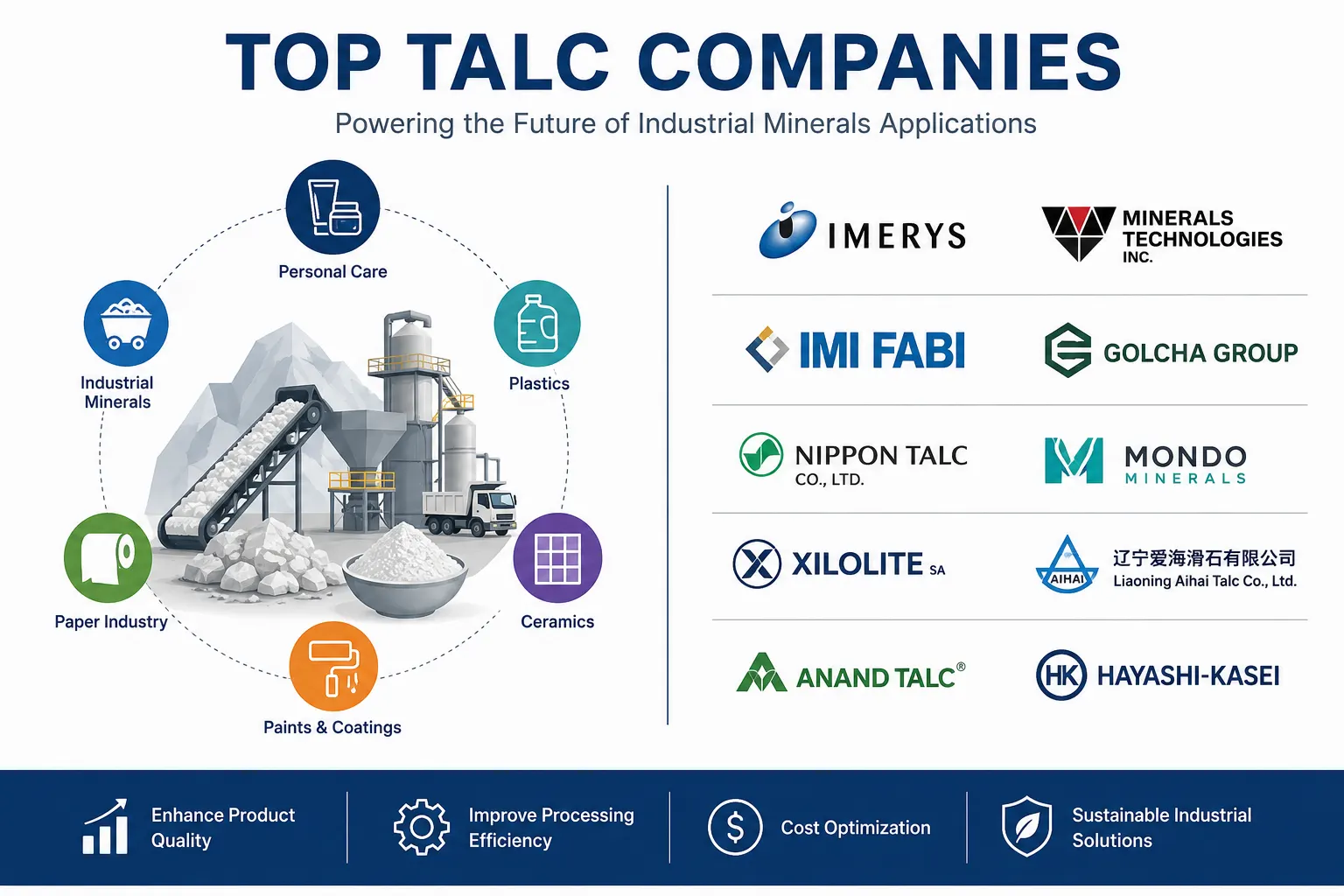
Top 10 Talc Companies Driving Industry Growth
Talc is no longer viewed as a simple industrial mineral used primarily as a filler material.
It has become a strategic raw material supporting a wide range of industries, including plastics, paints and coatings, ceramics, paper, pharmaceuticals, agriculture, and personal care products. Manufacturers are increasingly seeking materials that improve product performance, reduce production costs, enhance durability, and support sustainability objectives. The response across industries has been consistent: adopt high-performance mineral solutions that deliver greater efficiency and value.
That shift is creating a new generation of winners among talc companies.
What makes 2026 different is not simply growing demand. It is the changing expectation from buyers. Procurement teams are moving beyond basic mineral sourcing and increasingly evaluating suppliers based on product consistency, processing capabilities, technical expertise, sustainability practices, and global supply reliability.
As a result, the talc market is entering a new competitive phase where resource availability still matters—but processing technology, product quality, application expertise, and customer support are becoming stronger differentiators.
For investors, industrial buyers, and market researchers, the opportunity extends beyond raw material demand. The real value sits in specialty mineral formulations, value-added processing, long-term supply agreements, and expanding applications across advanced manufacturing sectors.
The companies leading this market are not simply supplying talc—they are helping manufacturers improve product quality, optimize production processes, and enhance operational performance.
Market Snapshot: Talc Market
The global talc market continues to expand as industrial manufacturers increasingly utilize mineral additives to improve product performance, processing efficiency, and cost competitiveness across diverse applications.
Current Market Size (2021): USD 3.28 Billion
Forecast Market Value (2028): USD 5.85 Billion
Expected CAGR (2021–2028): 5.24%
Growth momentum is being supported by a combination of industrial expansion, growing plastics consumption, increasing construction activity, and rising demand for specialty mineral solutions.
Major Growth Drivers Include:
- Rising demand from plastics manufacturing
- Growth in paints and coatings applications
- Expansion of ceramics production worldwide
- Increasing use in personal care products
- Growing demand from the paper industry
- Industrial filler applications across manufacturing sectors
- Infrastructure and construction development
- Rising consumption in emerging economies
Industries Generating the Strongest Demand Include:
- Plastics
- Automotive
- Construction
- Ceramics
- Paints & Coatings
- Paper & Pulp
- Cosmetics & Personal Care
- Pharmaceuticals
Key Takeaways
- Demand for high-purity and specialty-grade talc continues to increase across industrial applications.
- Processed mineral products are generating greater value than commodity-grade materials.
- Sustainability and responsible mining practices are becoming major competitive differentiators.
- Asia-Pacific remains one of the fastest-growing regional markets for talc consumption.
- Value-added processing capabilities are increasingly influencing supplier selection decisions.
Featured Snippet
What is driving the talc market?
The talc market is being driven by increasing demand from plastics, ceramics, paints and coatings, paper, pharmaceutical, and personal care industries. Manufacturers increasingly utilize talc to improve product performance, reduce production costs, enhance durability, and optimize manufacturing efficiency. Growing industrialization, infrastructure development, and demand for specialty mineral solutions are further supporting market expansion globally.
The 2026 Buyer Playbook: What Really Drives Purchase Decisions
Buying talc products has become less transactional.
Decision-makers increasingly evaluate mineral suppliers based on long-term performance outcomes rather than simply comparing raw material prices.
Functional Benefits
Product consistency remains non-negotiable.
Buyers prioritize:
- Product purity
- Particle size consistency
- Processing efficiency
- Performance enhancement
- Regulatory compliance
- Technical support
The strongest talc suppliers position themselves around measurable manufacturing improvements rather than commodity pricing alone.
Pricing Psychology
Procurement behavior has evolved.
Low-cost sourcing rarely wins long-term contracts anymore.
Industrial buyers increasingly evaluate:
- Total cost of ownership
- Product performance consistency
- Processing efficiencies
- Supply reliability
- Transportation costs
- Long-term supply agreements
Premium-quality talc products often justify higher pricing through improved manufacturing outcomes.
Trust Factors
Industrial purchasing decisions create operational risk.
That is why buyers favor talc suppliers with:
- Proven mining operations
- Consistent quality standards
- Global distribution capabilities
- Industry certifications
- Strong technical expertise
Trust increasingly acts as a competitive advantage.
Convenience
Reliable supply matters.
Industrial customers increasingly prefer suppliers that provide:
- Consistent inventory availability
- Global logistics support
- Customized product grades
- Technical consultation
- Faster delivery timelines
Integrated service capabilities create purchasing advantages.
Brand Perception
Market leaders benefit from more than recognition.
Industrial buyers associate established talc brands with higher product quality, greater operational reliability, stronger technical support, and lower procurement risk.
Top Leading Companies Driving the Global Talc Market
1. Imerys
Overview
Imerys is one of the world's largest producers of specialty minerals and a leading participant in the global Talc Market. The company supplies high-performance talc products to industries including plastics, paints, paper, ceramics, agriculture, and personal care. With operations spanning multiple continents, Imerys maintains a strong international presence and extensive customer network.
Recent Moves
- Expanded specialty mineral production capabilities.
- Increased investment in sustainable mining operations.
- Strengthened research and development programs.
- Enhanced product offerings for engineering plastics applications.
Competitive Edge
Imerys benefits from its vertically integrated business model, advanced processing technologies, extensive mineral reserves, and strong global distribution network.
Future Outlook
The company is expected to continue expanding its portfolio of premium mineral solutions while investing in sustainability initiatives and next-generation industrial applications.
2. IMI Fabi
Overview
IMI Fabi is among the most recognized talc producers globally. The company specializes in high-purity talc products designed for plastics, coatings, paper, cosmetics, and industrial applications.
Recent Moves
- Expanded micronized talc production capacity.
- Strengthened partnerships in key international markets.
- Increased focus on automotive and polymer applications.
- Enhanced sustainability initiatives across operations.
Competitive Edge
Its reputation for consistent quality, technical expertise, and global customer support positions the company among the leading talc suppliers worldwide.
Future Outlook
IMI Fabi is expected to focus on specialty talc grades and advanced industrial applications to support future growth.
3. Golcha Group
Overview
Golcha Group is one of India's largest talc producers and exporters. The company has established a strong presence in global markets through its extensive mining operations and high-quality mineral products.
Recent Moves
- Expanded export activities.
- Increased investments in mineral processing technologies.
- Strengthened global distribution channels.
- Enhanced production efficiency initiatives.
Competitive Edge
The company's extensive mineral reserves, cost-efficient operations, and integrated supply chain provide significant competitive advantages.
Future Outlook
Golcha Group is expected to benefit from growing industrialization and rising global demand for talc-based products.
4. Minerals Technologies Inc.
Overview
Minerals Technologies is a leading provider of engineered mineral solutions serving various industrial sectors worldwide.
Recent Moves
- Expanded specialty mineral product offerings.
- Increased investments in advanced manufacturing technologies.
- Strengthened customer-focused innovation programs.
Competitive Edge
The company combines mineral expertise with advanced engineering capabilities to deliver value-added industrial solutions.
Future Outlook
Future growth is expected to be supported by innovation and expansion into emerging industrial applications.
5. Nippon Talc Co., Ltd.
Overview
Nippon Talc is a prominent Japanese manufacturer supplying talc products to plastics, ceramics, automotive, and industrial sectors.
Recent Moves
- Introduced advanced talc grades for engineering plastics.
- Enhanced manufacturing efficiency.
- Expanded regional distribution capabilities.
Competitive Edge
Strong quality standards and technical expertise enable the company to maintain a competitive position.
Future Outlook
The company is expected to capitalize on increasing demand for high-performance industrial materials.
6. American Talc Company
Overview
American Talc Company supplies industrial-grade talc products to customers across North America and international markets.
Recent Moves
- Expanded customer support capabilities.
- Improved operational efficiency.
- Increased focus on customized mineral solutions.
Competitive Edge
The company's reliable supply chain and strong industry expertise support long-term customer relationships.
Future Outlook
Growth is expected through diversification and product innovation initiatives.
7. Liaoning Aihai Talc Co., Ltd.
Overview
Liaoning Aihai Talc is one of China's major talc manufacturers with strong export capabilities and extensive production facilities.
Recent Moves
- Expanded export operations.
- Increased processing capabilities.
- Enhanced product portfolio.
Competitive Edge
Large-scale production and competitive manufacturing costs provide a strong market position.
Future Outlook
The company is expected to benefit from increasing industrial demand throughout Asia-Pacific.
8. Haicheng Xinda Mining Industry Co., Ltd.
Overview
Haicheng Xinda specializes in talc mining, processing, and industrial mineral manufacturing.
Recent Moves
- Modernized production facilities.
- Increased production capacity.
- Expanded international customer base.
Competitive Edge
Strong access to mineral reserves and efficient operations support business growth.
Future Outlook
Continued expansion and modernization efforts are expected to strengthen market presence.
9. Magris Performance Materials
Overview
Magris Performance Materials provides specialty mineral solutions designed to improve performance across industrial applications.
Recent Moves
- Expanded specialty product offerings.
- Increased customer-focused innovation.
- Strengthened global market reach.
Competitive Edge
Technical expertise and strong product development capabilities differentiate the company.
Future Outlook
Future growth is expected through advanced materials development and strategic partnerships.
10. Sun Minerals
Overview
Sun Minerals is a leading Indian producer of talc and specialty mineral products serving domestic and international markets.
Recent Moves
- Expanded manufacturing operations.
- Increased exports.
- Enhanced product quality programs.
Competitive Edge
Strong market presence and competitive pricing support long-term growth.
Future Outlook
The company is expected to benefit from growing demand across industrial and consumer sectors.
Market Drivers
Several factors are contributing to the growth of the global Talc Market:
- Rising demand from plastics and polymer industries.
- Increasing automotive production worldwide.
- Growing use in paints and coatings formulations.
- Expansion of the cosmetics and personal care sector.
- Rapid infrastructure and construction development.
- Increasing demand for industrial fillers and additives.
- Growth in pharmaceutical manufacturing.
- Advancements in mineral processing technologies.
Current Growth Trends
Sustainable Mining Practices
Manufacturers are increasingly adopting environmentally responsible mining and processing techniques.
Demand for High-Purity Talc
Industries such as cosmetics and pharmaceuticals are driving demand for premium-grade talc products.
Growth of Automotive Plastics
Automotive manufacturers continue to adopt talc-filled plastics to improve vehicle performance and reduce weight.
Advanced Polymer Applications
Talc is increasingly used in engineering plastics and high-performance composites.
Digital Transformation
Mining and mineral processing companies are investing in automation and smart manufacturing technologies.
Segmentation Analysis
By Deposit Type
Talc Carbonate
Talc Carbonate remains the dominant segment due to its superior industrial performance and broad range of applications.
Talc Chlorite
This segment continues to gain traction in specialized industrial applications requiring enhanced thermal and mechanical properties.
By Application
Plastics
The largest application segment due to extensive use in automotive and packaging industries.
Paints & Coatings
Demand is increasing due to improved durability, weather resistance, and surface finish.
Cosmetics & Personal Care
High-purity talc is widely used in powders, skincare products, and personal care formulations.
Paper & Pulp
Talc improves printability and paper quality.
Ceramics
Used to enhance strength and thermal properties.
Pharmaceuticals
Functions as an excipient and anti-caking agent.
Construction
Utilized in construction materials and specialty coatings.
Regional Analysis
North America
Strong demand from automotive, plastics, and construction industries continues to support market growth.
Europe
The region benefits from advanced manufacturing capabilities and growing adoption of specialty mineral products.
Asia-Pacific
Asia-Pacific dominates the global Talc Market due to rapid industrialization, strong manufacturing activity, and expanding infrastructure development across China, India, and Southeast Asia.
Latin America
Industrial development and growing construction activities are supporting market expansion.
Middle East & Africa
The region is witnessing increasing demand from construction, consumer goods, and industrial sectors.
Competitive Landscape
The global Talc Market is moderately consolidated, with leading companies focusing on:
- Capacity expansion
- Product innovation
- Sustainable mining practices
- Strategic acquisitions
- Research and development
- Global distribution expansion
Competition is expected to intensify as demand for high-performance industrial minerals continues to grow.
Investment Opportunities
- Significant opportunities exist across several high-growth areas:
- Automotive lightweight materials
- Specialty plastics
- Cosmetic-grade talc
- Pharmaceutical applications
- Sustainable mining technologies
- Emerging market expansion
- Advanced industrial coatings
SWOT Analysis
Strengths
- Wide range of industrial applications.
- Cost-effective performance enhancer.
- Strong global demand.
- Excellent thermal and chemical properties.
Weaknesses
- Dependence on mining operations.
- Environmental concerns.
- Regulatory challenges.
Opportunities
- Growth in automotive manufacturing.
- Rising cosmetics consumption.
- Expansion of advanced polymer applications.
- Increasing industrialization in emerging economies.
Threats
- Alternative filler materials.
- Raw material price volatility.
- Environmental regulations.
- Supply chain disruptions.
Frequently Asked Questions (FAQs)
What is driving growth in the Talc Market?
Growing demand from plastics, automotive, paints & coatings, pharmaceuticals, and personal care industries is driving market expansion.
Which region dominates the global Talc Market?
Asia-Pacific currently dominates due to strong manufacturing activity and rapid industrialization.
What is the largest application segment?
Plastics remain the largest application segment owing to increasing use in automotive and packaging industries.
Who are the leading companies in the Talc Market?
Major players include Imerys, IMI Fabi, Golcha Group, Minerals Technologies Inc., Nippon Talc, American Talc Company, Liaoning Aihai Talc, Haicheng Xinda, Magris Performance Materials, and Sun Minerals.
What are the major market trends?
Sustainable mining, premium-grade talc products, advanced polymer applications, and digital transformation are among the key trends.
What challenges does the market face?
Environmental regulations, competition from alternative fillers, and supply chain disruptions remain major challenges.
Conclusion
The global Talc Market is expected to maintain a positive growth trajectory as industries continue seeking cost-effective, high-performance, and sustainable material solutions. Rising demand from plastics, automotive, paints & coatings, pharmaceuticals, cosmetics, and construction sectors will continue to create significant opportunities for manufacturers and investors alike.
Leading companies such as Imerys, IMI Fabi, Golcha Group, Minerals Technologies Inc., Nippon Talc, and Magris Performance Materials are actively investing in innovation, sustainability, and production expansion to strengthen their competitive positions. As industrialization accelerates across emerging economies and demand for specialty minerals increases, the Talc Market is poised to remain an essential component of global manufacturing and industrial development for years to come.