
Top 10 HDPE Pipes Companies Driving Global Market Growth
Author:
Intellectual Market Insights Research
Published Date:
09 Sep 2026
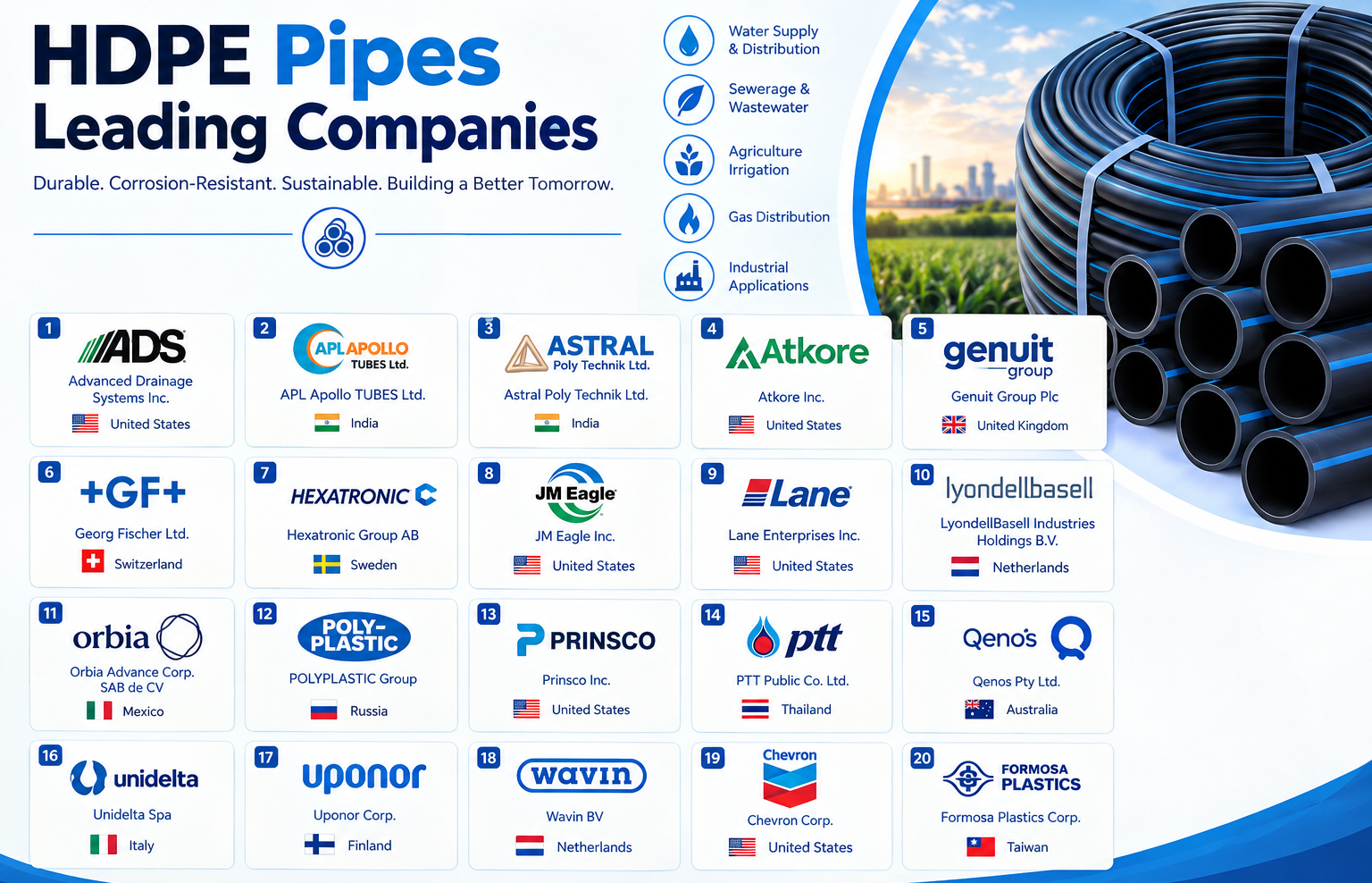
Top Companies in the World Offering HDPE Pipes
High-density polyethylene (HDPE) pipes have become the material of choice across water supply, sewage, agricultural irrigation, gas distribution, and industrial fluid-transfer networks, prized for their corrosion resistance, flexibility, leak-free fused joints, and multi-decade service life compared with legacy metal and concrete piping. As governments worldwide upgrade aging water infrastructure and expand irrigation and gas-distribution networks, HDPE has steadily displaced traditional materials such as ductile iron, PVC, and concrete in many applications.
The global HDPE pipes market was valued at USD 21.4 billion in 2025 and is projected to reach USD 34.3 billion by 2034, growing at a compound annual growth rate (CAGR) of 5.4% from 2025 to 2034. Growth is being driven by rising global investment in water and wastewater infrastructure, expanding agricultural irrigation networks in water-stressed regions, growing use of HDPE in gas distribution as a safer alternative to steel, and continued replacement of aging metal and concrete pipe networks in mature economies.
The competitive landscape includes global chemicals and building-materials leaders such as Advanced Drainage Systems, Georg Fischer, Orbia, and LyondellBasell, alongside large regional pipe manufacturers such as APL Apollo Tubes, Astral Poly Technik, and JM Eagle. This article provides a research-based analysis of the top companies shaping the global HDPE pipes market, their positioning, flagship offerings, and the regional and technological forces driving the industry forward.
Market Overview
|
Parameter |
Details |
|---|---|
|
Market Size (2025) |
USD 21.4 Billion |
|
Projected Market Size (2034) |
USD 34.3 Billion |
|
CAGR (2025–2034) |
5.4% |
|
Historic Year |
2019–2023 |
|
Base Year |
2024 |
|
Forecast Period |
2025–2034 |
|
Leading Region |
North America (highest revenue share) |
|
Fastest-Growing Region |
Asia-Pacific |
|
Key Segments (by Type) |
PE 100, PE 80, PE 63 |
|
Key Segments (by Application) |
Water Supply, Agricultural Irrigation, Sewage System, Oil & Gas, Others |
Why the HDPE Pipes Market Is Growing
1. Rising Global Investment in Water and Wastewater Infrastructure
Governments across both developed and developing economies are funding large-scale water-supply and sewage-network upgrades, and HDPE's corrosion resistance and leak-free heat-fused joints make it a preferred material for these long-life underground networks.
2. Expansion of Agricultural Irrigation Networks
Water-stressed agricultural regions across Asia-Pacific, the Middle East, and parts of Africa are rapidly expanding piped irrigation systems, where HDPE's flexibility, light weight, and resistance to soil chemicals make it well suited to large-scale field deployment.
3. Growing Adoption in Gas Distribution
HDPE piping is increasingly replacing steel in natural-gas distribution networks, valued for its resistance to corrosion, ease of installation, and lower long-term maintenance costs relative to metal alternatives.
4. Replacement of Aging Metal and Concrete Infrastructure
Many water and sewage networks across North America and Europe were built with cast iron or concrete pipe decades ago; ongoing rehabilitation programs are steadily replacing this legacy infrastructure with modern HDPE systems.
5. Advances in Pipe-Grade Resin and Jointing Technology
Continued development of higher-performance PE100 and next-generation PE resins is improving pressure ratings and service life, widening the range of applications where HDPE can substitute for traditional pipe materials.
6. Rapid Infrastructure Build-Out in Asia-Pacific
Large-scale urbanization, industrialization, and government-backed water and irrigation programs in China, India, and Southeast Asia are driving the fastest regional growth in HDPE pipe demand.
Market Opportunities & Restraints
A key opportunity lies in expanding trenchless and no-dig installation methods: HDPE's flexibility and weldable joints make it especially well suited to horizontal directional drilling and pipe-bursting rehabilitation techniques, allowing municipalities to replace aging infrastructure with minimal surface disruption and opening new demand in dense urban environments. On the restraint side, volatility in polyethylene resin prices, which are tied to crude oil and natural-gas feedstock costs, creates margin pressure and pricing uncertainty for manufacturers and can slow project commitments among cost-sensitive municipal and agricultural buyers.
Top 10 Companies in the HDPE Pipes Market
- Advanced Drainage Systems, Inc.
- Georg Fischer Ltd. (including Uponor)
- Orbia Advance Corp. SAB de CV (including Wavin)
- LyondellBasell Industries Holdings B.V.
- JM Eagle Inc.
- APL Apollo Tubes Ltd.
- Astral Poly Technik Ltd.
- POLYPLASTIC Group
- Atkore Inc.
- PTT Public Co. Ltd.
1. Advanced Drainage Systems, Inc.
|
Category |
Details |
|---|---|
|
Company Name |
Advanced Drainage Systems, Inc. (NYSE: WMS) |
|
Headquarters |
Hilliard, Ohio, USA |
|
Founded |
1966 |
|
Employees |
Approx. 5,800–6,000 |
|
Revenue |
Approx. USD 2.7 Billion (recent fiscal year) |
|
Company Overview |
ADS is a leading North American manufacturer of HDPE pipe, septic systems, and water-management products for stormwater, agricultural drainage, and wastewater applications. |
|
Key Products |
Corrugated HDPE drainage pipe, dual-wall and triple-wall pipe systems, septic tanks, and stormwater retention/detention chambers. |
|
Market Position |
One of the largest HDPE pipe and water-management product manufacturers in North America, holding a leading share of the U.S. plastic pipe and parts manufacturing industry. |
|
Recent Developments |
Continues expanding its water-management product portfolio and manufacturing footprint to serve growing U.S. stormwater and agricultural drainage demand. |
|
Strategic Advantages |
Extensive North American manufacturing and distribution network, a broad product portfolio spanning drainage and water-management systems, and strong brand recognition. |
2. Georg Fischer Ltd.
|
Category |
Details |
|---|---|
|
Company Name |
Georg Fischer AG (GF Piping Systems) |
|
Headquarters |
Schaffhausen, Switzerland |
|
Founded |
1802 |
|
Employees |
Approx. 19,000 (group-wide) |
|
Revenue |
Approx. CHF 4.78 Billion (2024, group-wide) |
|
Company Overview |
Georg Fischer's Piping Systems division supplies plastic and metal piping for water, gas, and industrial fluid transport, and expanded significantly with its 2023 acquisition of Finland's Uponor. |
|
Key Products |
HDPE and other plastic piping systems, fittings, valves, and jointing technology for utility, industrial, and building applications, plus Uponor's plumbing and infrastructure product lines. |
|
Market Position |
A leading global piping-systems provider with sales operations in more than 100 countries and manufacturing sites across Europe, Asia, and the Americas. |
|
Recent Developments |
Completed its roughly EUR 2.2 billion acquisition of Uponor in 2023, expanding its building-flow-solutions and infrastructure piping portfolio. |
|
Strategic Advantages |
Global manufacturing and sales scale, deep engineering expertise across plastics and metal piping, and an expanded portfolio following the Uponor acquisition. |
3. Orbia Advance Corp. SAB de CV
|
Category |
Details |
|---|---|
|
Company Name |
Orbia Advance Corp. SAB de CV (Wavin) |
|
Headquarters |
Mexico City, Mexico (Wavin: Zwolle, Netherlands) |
|
Company Overview |
Orbia is a global materials and chemicals company whose Building & Infrastructure business, operating under the Wavin brand, is one of Europe's largest suppliers of plastic piping systems. |
|
Key Products |
HDPE and PVC piping for water supply, drainage, sewage, and climate-control applications under the Wavin brand. |
|
Market Position |
A leading European and Latin American piping-systems supplier, backed by Orbia's global polymer and materials manufacturing base. |
|
Recent Developments |
Continues integrating Wavin's piping portfolio within Orbia's broader precision-agriculture, building-infrastructure, and polymer-solutions businesses. |
|
Strategic Advantages |
Vertically integrated access to polymer feedstock through Orbia's chemicals operations, and Wavin's strong distribution network across Europe and Latin America. |
4. LyondellBasell Industries Holdings B.V.
|
Category |
Details |
|---|---|
|
Company Name |
LyondellBasell Industries Holdings B.V. |
|
Headquarters |
Rotterdam, Netherlands / Houston, Texas, USA |
|
Founded |
2007 (merger of Lyondell Chemical and Basell) |
|
Company Overview |
LyondellBasell is one of the world's largest producers of polyethylene resin, supplying the pipe-grade PE100 and PE80 resins that HDPE pipe manufacturers process into finished piping products. |
|
Key Products |
Pipe-grade high-density polyethylene resins (including its Hostalen and Alathon product lines) used across the HDPE pipe value chain. |
|
Market Position |
A dominant upstream resin supplier underpinning the HDPE pipes market, rather than a finished-pipe manufacturer itself. |
|
Recent Developments |
Continues investing in advanced polyethylene resin technology to improve pipe-grade performance, pressure ratings, and sustainability credentials. |
|
Strategic Advantages |
Massive global polymer production scale and deep technical expertise in polyethylene resin formulation feeding the broader HDPE pipe supply chain. |
5. JM Eagle Inc.
|
Category |
Details |
|---|---|
|
Company Name |
JM Eagle Inc. |
|
Headquarters |
Los Angeles, California, USA |
|
Founded |
1982 |
|
Employees |
Approx. 500–1,000 |
|
Revenue |
Approx. USD 2.3 Billion |
|
Company Overview |
JM Eagle is one of the world's largest plastic-pipe manufacturers, producing PVC, HDPE, and PEX piping for water, sewer, gas, and irrigation applications. |
|
Key Products |
HDPE and PE piping for water, sewer, and gas distribution, alongside its broader PVC and PEX pipe product lines. |
|
Market Position |
A leading privately held plastic-pipe manufacturer with an extensive North American manufacturing footprint. |
|
Recent Developments |
Continues expanding manufacturing capacity to serve growing municipal water, sewer, and irrigation infrastructure demand across the U.S. |
|
Strategic Advantages |
Large-scale, vertically integrated manufacturing operations and a broad product range spanning multiple pipe materials and applications. |
Competitive Landscape
The global HDPE pipes market brings together a mix of specialized pipe manufacturers, diversified building-materials conglomerates, and upstream resin producers. Diversified piping and building-materials leaders such as Advanced Drainage Systems, Georg Fischer (including Uponor), Orbia (Wavin), and Atkore compete on manufacturing scale, distribution reach, and integrated product portfolios spanning multiple piping materials. Large regional pipe manufacturers, including JM Eagle, APL Apollo Tubes, Astral Poly Technik, POLYPLASTIC Group, and Unidelta, compete on regional manufacturing density and cost-competitive production for domestic infrastructure markets. Upstream resin producers such as LyondellBasell, Chevron, and Formosa Plastics underpin the entire value chain by supplying the pipe-grade polyethylene resins that finished-pipe manufacturers process into HDPE piping.
Regional Analysis
North America
North America holds the largest share of the global HDPE pipes market, supported by sustained investment in municipal water and wastewater infrastructure, extensive agricultural drainage networks, and a mature base of large domestic manufacturers such as Advanced Drainage Systems and JM Eagle.
Asia-Pacific
Asia-Pacific is expected to register the fastest growth, driven by rapid urbanization, expanding irrigation infrastructure, and large government-backed water-supply and gas-distribution programs across China, India, and Southeast Asia, supported by a strong base of regional manufacturers including APL Apollo Tubes and Astral Poly Technik.
Europe
Europe represents a mature, steadily growing market shaped by ongoing water-infrastructure rehabilitation programs, strict environmental regulations favoring corrosion-resistant piping, and the presence of major manufacturers such as Georg Fischer, Uponor, and Wavin.
Latin America & Middle East and Africa
Latin America and the Middle East & Africa remain developing HDPE pipe markets, expected to grow steadily alongside expanding water-supply, irrigation, and oil-and-gas infrastructure investment across these regions.
Emerging Trends in the HDPE Pipes Market
1. Growth of Trenchless Installation Methods: Rising adoption of horizontal directional drilling and pipe-bursting rehabilitation techniques is expanding HDPE's use in dense urban infrastructure upgrades with minimal surface disruption.
2. Higher-Performance PE Resin Grades: Continued development of next-generation pipe-grade polyethylene resins is improving pressure ratings, crack resistance, and service life, widening HDPE's addressable applications.
3. Expansion into Gas Distribution Networks: Utilities are increasingly favoring HDPE over steel for natural-gas distribution given its corrosion resistance and lower long-term maintenance requirements.
4. Industry Consolidation Among Major Manufacturers: Recent large-scale moves, such as Georg Fischer's acquisition of Uponor, point to continued consolidation as diversified piping companies build broader, more integrated product portfolios.
5. Growing Focus on Recycled-Content and Sustainable Piping: Manufacturers are increasingly incorporating recycled polyethylene content and pursuing lower-carbon production processes in response to tightening environmental regulations and customer sustainability requirements.
Future Outlook (2025–2034)
The global HDPE pipes market's trajectory toward USD 34.3 billion by 2034 reflects steady, infrastructure-driven demand growth across water, sewage, irrigation, and gas-distribution applications. The 5.4% CAGR forecast through 2034 assumes continued global investment in water and wastewater infrastructure, ongoing replacement of aging metal and concrete pipe networks, and ongoing expansion of agricultural irrigation systems in water-stressed regions.
Key investment themes include continued adoption of trenchless installation methods, development of higher-performance pipe-grade resins, and further industry consolidation among diversified piping and building-materials companies. Manufacturers such as Advanced Drainage Systems, Georg Fischer, and Orbia are likely to retain strong positions built on integrated manufacturing and distribution networks, while regional specialists such as JM Eagle, APL Apollo Tubes, and Astral Poly Technik continue to compete on cost-competitive, high-volume production across domestic infrastructure markets.
Frequently Asked Questions (FAQ)
1. What is the current size of the global HDPE pipes market?
The global HDPE pipes market was valued at approximately USD 21.4 billion in 2025 and is projected to reach USD 34.3 billion by 2034, growing at a CAGR of 5.4%.
2. Who are the top companies in the HDPE pipes market?
Leading companies include Advanced Drainage Systems, Inc., Georg Fischer Ltd. (including Uponor), Orbia Advance Corp. SAB de CV (including Wavin), LyondellBasell Industries Holdings B.V., JM Eagle Inc., APL Apollo Tubes Ltd., Astral Poly Technik Ltd., POLYPLASTIC Group, Atkore Inc., and PTT Public Co. Ltd.
3. Which region dominates the HDPE pipes market?
North America currently holds the largest market share, while Asia-Pacific is expected to be the fastest-growing region, driven by rapid urbanization and infrastructure investment.
4. What is the forecast CAGR for the HDPE pipes market?
The market is forecast to grow at a CAGR of 5.4% from 2025 to 2034.
5. What are the main growth drivers for this market?
Key drivers include rising investment in water and wastewater infrastructure, expansion of agricultural irrigation networks, growing adoption of HDPE in gas distribution, and replacement of aging metal and concrete pipe systems.
6. What are the main HDPE pipe grades used in the market?
The market is segmented by pipe grade into PE 100, PE 80, and PE 63, with PE 100 generally offering the highest pressure rating and increasingly favored for demanding water and gas applications.
7. What are the primary applications for HDPE pipes?
Key applications include water supply, agricultural irrigation, sewage systems, and oil and gas transport, alongside a range of other industrial fluid-handling uses.
Conclusion
The global HDPE pipes market sits at the intersection of aging infrastructure replacement and expanding water, irrigation, and gas-distribution networks worldwide. With a projected size of USD 34.3 billion by 2034 at a 5.4% CAGR, the market offers steady, infrastructure-driven growth across both mature and developing economies.
Advanced Drainage Systems, Georg Fischer, and Orbia continue to lead on the strength of integrated manufacturing and distribution networks, JM Eagle brings large-scale vertically integrated production, and upstream resin suppliers such as LyondellBasell underpin the entire value chain. As trenchless installation methods, higher-performance resins, and industry consolidation reshape the competitive landscape, the companies that combine manufacturing scale with broad geographic reach will define market leadership through 2032 and beyond.