
Global Home Improvement Market: Size, Leading Companies, Trends and Outlook (2025–2034)
Author:
Intellectual Market Insights Research
Published Date:
12 Oct 2026
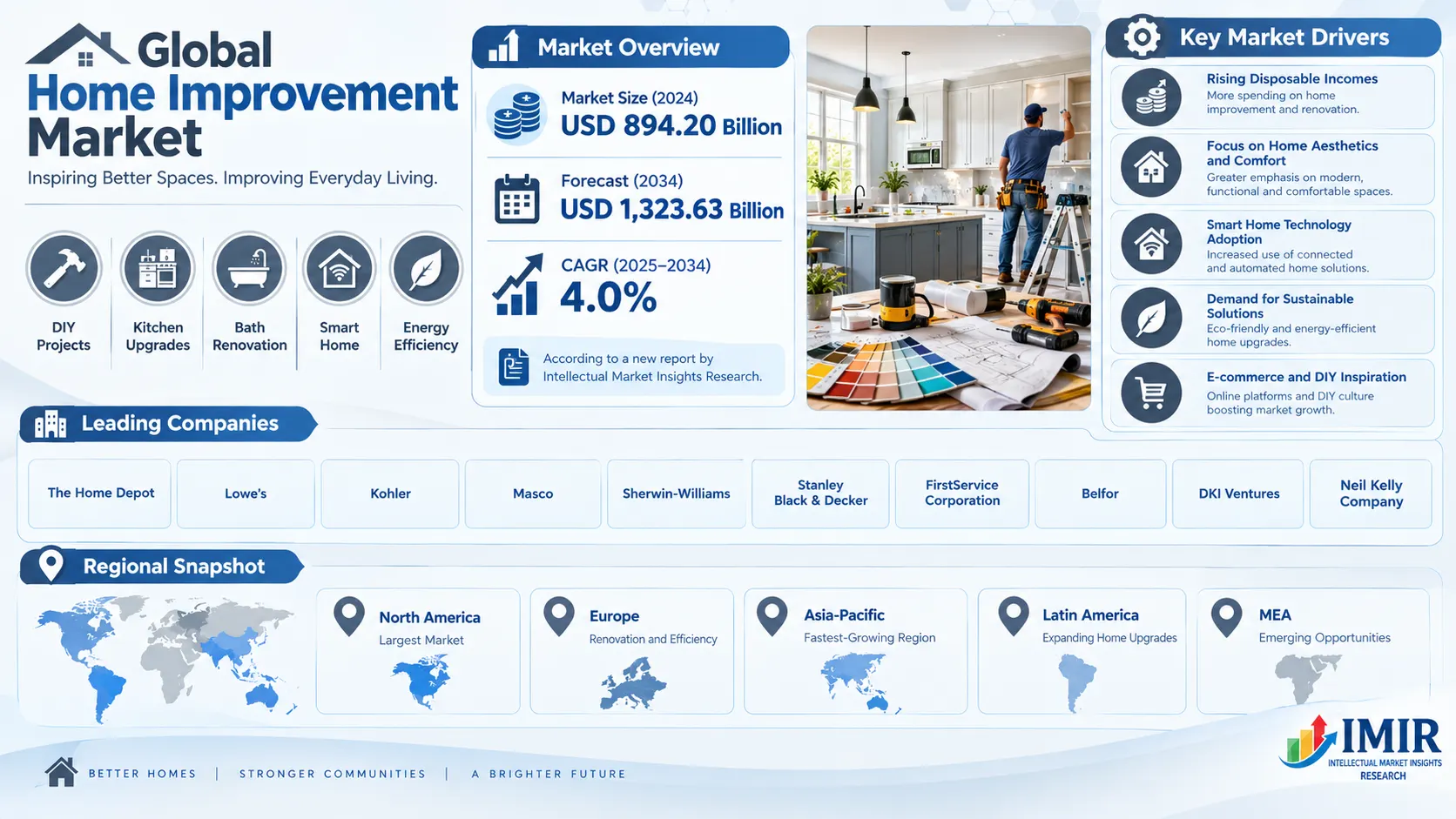
Global Home Improvement Market: Size, Leading Companies, Trends and Outlook (2025–2034)
Note on sources: Market size and CAGR are taken from the Intellectual Market Insights Research (IMIR) Home Improvement Market report (imi-000026): about USD 894.20 billion in 2024 to USD 1,323.63 billion by 2034, CAGR 4.0% (base year 2024, forecast period 2025–2034). IMIR's regional share figures are placeholders on the report page, so the regional section is qualitative. IMIR's report and its "leading companies" blog name different company sets (service and building-products firms versus retailers); both are covered below. Company facts were checked against public sources up to October 2026.
Introduction
Home improvement covers everything households spend to repair, maintain, upgrade and decorate their homes: building materials, tools, paint, kitchens and bathrooms, flooring, plumbing, roofing and exteriors, and the contractors and services that install or restore them. The market is served through do-it-yourself (DIY) buying at home-improvement stores and do-it-for-me (DIFM) projects done by professionals.
Spending is driven by the age of the housing stock, home equity, mortgage rates and consumer confidence. In 2026 the industry is in a "slow but steady" phase: demand from professional contractors and large projects is holding up, DIY spending is under pressure, and companies are dealing with tariffs and consolidation. This blog covers the size of the market, what drives it, the companies named by IMIR and recent results, and the outlook to 2034.
Why the Home Improvement Market Is Growing
1. Aging housing stock. In the US, a large share of homes are decades old and need roofs, kitchens, bathrooms, windows and systems replaced. In Europe, renovation of older buildings is also a policy priority.
2. Homeowners staying put. When mortgage rates are high, many owners renovate rather than move, which supports spending on existing homes.
3. Home equity. Rising home values give owners the funds and confidence to invest in upgrades.
4. Professional (Pro) demand. Contractors and specialist trades are growing faster than DIY. Home Depot and Lowe's have both expanded into Pro distribution through acquisitions, and Lowe's reported growth in Pro, online and home services in Q2 2026.
5. Energy efficiency and climate resilience. Insulation, heat pumps, windows, roofing and storm-repair work are supported by incentives and weather-related damage. This is also what supports the disaster-repair and restoration segment.
6. Digital tools and online sales. Lowe's online sales rose 15.7% in Q2 2026, and retailers are adding delivery, visualisation tools and installation services.
7. Rising demand in emerging markets. Urbanisation and growing incomes in Asia-Pacific, Latin America and the Middle East & Africa drive housing and fit-out spending.
Companies Associated with the Home Improvement Market
IMIR's report names 16 companies: American Exteriors, Belfor, Coit Services, Crane Renovation Group, DKI Ventures, FirstService, Henkel, Kohler, Lowe's, Masco, Handyman (Handyman Connection), Neil Kelly Company, Sherwin-Williams, Stanley Black & Decker, The Home Depot and Venturi Restoration. IMIR's separate leading-companies blog adds retailers such as Kingfisher, Menards, Travis Perkins, ADEO, Bunnings and Hornbach. The main companies are profiled below in bullet form and then compared in a table.
| Company | HQ | Role | Latest Verifiable Point |
|---|---|---|---|
| The Home Depot | Atlanta, USA | Retail and Pro distribution | Q2 FY26 sales USD 47.9B (+5.7%); comps +1.7% |
| Lowe's | Mooresville, USA | Retail and Pro distribution | Q2 2026 sales USD 26.0B; comps +0.2%; guidance trimmed |
| Sherwin-Williams | Cleveland, USA | Paints and coatings | Q3 2026 sales USD 6.86B (+7.9%) |
| Stanley Black & Decker | New Britain, USA | Tools | Q2 2026 sales USD 4.0B; organic +3% |
| Masco | Livonia, USA | Plumbing and paint | Q2 2026 sales USD 1.99B (-3%) |
| Henkel | Düsseldorf, Germany | Adhesives and sealants | H1 2026 Adhesives sales EUR 5.53B; +4.5% organic |
| FirstService | Toronto, Canada | Property services, restoration | Q2 2026 revenue USD 1.45B (+2%) |
| Kohler | Kohler, USA | Kitchen and bath | Private; not disclosed |
| BELFOR | Birmingham, USA | Disaster restoration | Private; not disclosed |
| American Exteriors, Coit, Crane Renovation, DKI, Handyman, Neil Kelly, Venturi | Mostly USA | Renovation and restoration services | Data not confirmed |
Competitive Landscape
- Two retail giants dominate the US. Home Depot and Lowe's together account for the bulk of US big-box home improvement retail, and both have turned to Pro customers and distribution acquisitions to grow.
- Pro versus DIY. In 2026 Pro demand and home services are growing, while DIY spending is under pressure, which is why Lowe's trimmed its guidance but kept comparable sales positive.
- Brands and suppliers. Sherwin-Williams, Masco, Stanley Black & Decker, Kohler and Henkel supply the retailers and contractors and compete on brand, innovation and distribution. In 2026 several of them reported benefits from tariff refunds, which flatter reported earnings and should not be read as underlying growth.
- Services and restoration. Companies such as FirstService (Paul Davis, First On-Site) and BELFOR compete in disaster recovery and repair, where demand follows weather events and insurance claims.
- Global retail. In Europe, Kingfisher, ADEO, Hornbach and Travis Perkins serve a more fragmented market, while Bunnings leads in Australia and New Zealand.
- Consolidation. Retailers buying distributors (SRS, GMS, FBM, ADG) and paint makers buying regional brands (Suvinil) show a move toward integrated Pro supply.
- Tariff exposure. Imported products and materials expose margins to trade policy. The 2026 tariff refunds mentioned in company results are one-off items.
Regional Analysis
IMIR's regional percentages are placeholders, so this section is qualitative.
North America is the largest market, led by the US. Ageing homes, home equity and the Pro segment support demand, while high mortgage rates and weak DIY spending are headwinds.
Europe is mature and renovation-led, supported by energy-efficiency regulation (insulation, heating systems) and a large stock of older buildings. Retail is split between national leaders such as Kingfisher, ADEO and Hornbach.
Asia-Pacific is the fastest-growing region, with China, India, Japan and ASEAN driven by urbanisation, rising incomes and housing upgrades. Bunnings leads in Australia and New Zealand.
Latin America. Brazil and Mexico show growing renovation and DIY markets, and Sherwin-Williams' Suvinil acquisition shows interest in Brazil's paint market.
Middle East & Africa. Saudi Arabia, the UAE and South Africa are driven by construction, fit-out and housing programmes.
Emerging Trends
- Pro-focused growth. Retailers and manufacturers are building distribution, delivery and credit services for contractors.
- Home services. Installation, repair and design services bundled with product sales are one of the fastest-growing areas.
- Online and omnichannel. Online sales growth (for example Lowe's +15.7% in Q2 2026), same-day delivery and in-store pickup are now normal.
- Energy-efficient upgrades. Heat pumps, insulation, solar-ready roofing and efficient windows.
- Smart home integration. Connected thermostats, locks, lighting and water monitoring are standard additions to remodels.
- Resilience and restoration. More extreme weather increases demand for roofing, flood and fire restoration.
- Supply-chain and tariff management. Companies shift sourcing and pricing to manage trade policy.
- Data centres and non-residential demand. FirstService reports that about 15% of its Century Fire backlog is tied to data centres, showing how adjacent building services benefit from other construction cycles.
Future Outlook (2025–2034)
IMIR's forecast covers 2025–2034: from about USD 894 billion in 2024 to USD 1.32 trillion in 2034, at a 4.0% CAGR.
- 2025–2027. Slow but positive growth, led by Pro, services and repair work, with DIY recovering gradually as housing turnover improves. Tariffs and interest rates influence the pace.
- 2028–2030. Replacement cycles for roofs, kitchens, bathrooms and systems in older housing, plus energy-efficiency retrofits, support steady growth.
- 2031–2034. Growth is helped by emerging markets and integrated product-plus-service models, with online and Pro distribution holding a larger share.
Risks: high interest rates and weak housing turnover, tariffs and input-cost inflation, weak DIY demand, labour shortages among contractors, and weather-driven volatility. Tariff refunds booked in 2026 may not repeat.
Opportunities: Pro distribution, home services, energy-efficient retrofits, restoration and resilience, and expansion in Asia-Pacific and Latin America.
FAQ
Q1. How big is the global home improvement market?
IMIR values it at about USD 894.20 billion in 2024, rising to USD 1,323.63 billion by 2034.
Q2. What is the expected growth rate?
A CAGR of 4.0% from 2025 to 2034, per IMIR.
Q3. Who are the leading companies?
The Home Depot and Lowe's lead in retail, with Sherwin-Williams, Stanley Black & Decker, Masco, Henkel, Kohler, FirstService and BELFOR among the key suppliers and service providers named by IMIR.
Q4. What is the difference between DIY and DIFM?
DIY means homeowners do the work themselves. DIFM ("do-it-for-me") means they hire professionals. IMIR says DIFM has consistently been the larger segment.
Q5. Which end-use leads?
Kitchen upgrades lead, followed by bath upgrades, exterior and interior replacements, system upgrades, property improvements and disaster repairs.
Q6. How are the leading companies performing in 2026?
Home Depot's Q2 sales rose 5.7% (comparable sales +1.7%), Lowe's comparable sales were up 0.2%, Sherwin-Williams' Q3 sales rose 7.9%, and Masco's Q2 sales fell 3%.
Q7. Which region will grow fastest?
Asia-Pacific is generally expected to grow fastest, while North America is the largest market.
Q8. What are the main challenges?
Interest rates, weak DIY demand, tariffs, labour shortages and the effect of weather on repair demand.
Q9. What is driving Pro demand?
Contractors and specialty trades are spending on housing repairs, remodelling and large projects, and retailers are adding Pro distribution and services to serve them.
Conclusion
The home improvement market is large, mature and growing at a steady pace. IMIR projects growth from about USD 894 billion in 2024 to USD 1.32 trillion by 2034, a 4.0% CAGR, supported by older housing, home equity, energy-efficiency upgrades and Pro-driven demand.
Recent results show a split market: the leading retailers and paint companies are growing modestly, while DIY demand is weak and tariffs create noise in earnings. For suppliers, the best strategy combines Pro-focused distribution, strong brands and services. For service providers, restoration, repair and energy-efficiency retrofits offer the most resilient demand. Because growth is gradual, careful cost control and good channel partnerships matter more than headline market size.