
Bearing Manufacturers in 2026
Author:
Intellectual Market Insights Research
Published Date:
31 Jul 2026
Top Bearing Market Leading Companies And Growth Forecast, Global Industry Outlook to 2034
Precision Motion Technology Powering Global Industry
Bearings sit quietly at the center of nearly every rotating machine in the modern economy from automotive drivetrains and wind turbines to steel mills, railways, and aerospace engines. As industries push toward greater energy efficiency, higher operating speeds, and longer maintenance-free service life, the bearing industry is undergoing a steady technological evolution. Manufacturers are moving beyond simple friction-reduction hardware toward smart, sensor-integrated components that support predictive maintenance and the broader shift toward electrification and automation.
Global Bearing Market size was valued at approximately USD 143.25 billion in 2025 and is projected to reach nearly USD 330.86 billion by 2034, growing at a CAGR of around 9.73% during the forecast period.
The rapid adoption of precision ball, roller, and specialty bearings has enabled manufacturers to build components that redefine how industries approach power transmission, load management, and operational reliability. From heavy-duty tapered roller bearings supporting mining and construction machinery to miniature precision bearings used in robotics and electric vehicle motors, bearing technology is transforming how organizations design and maintain rotating equipment.
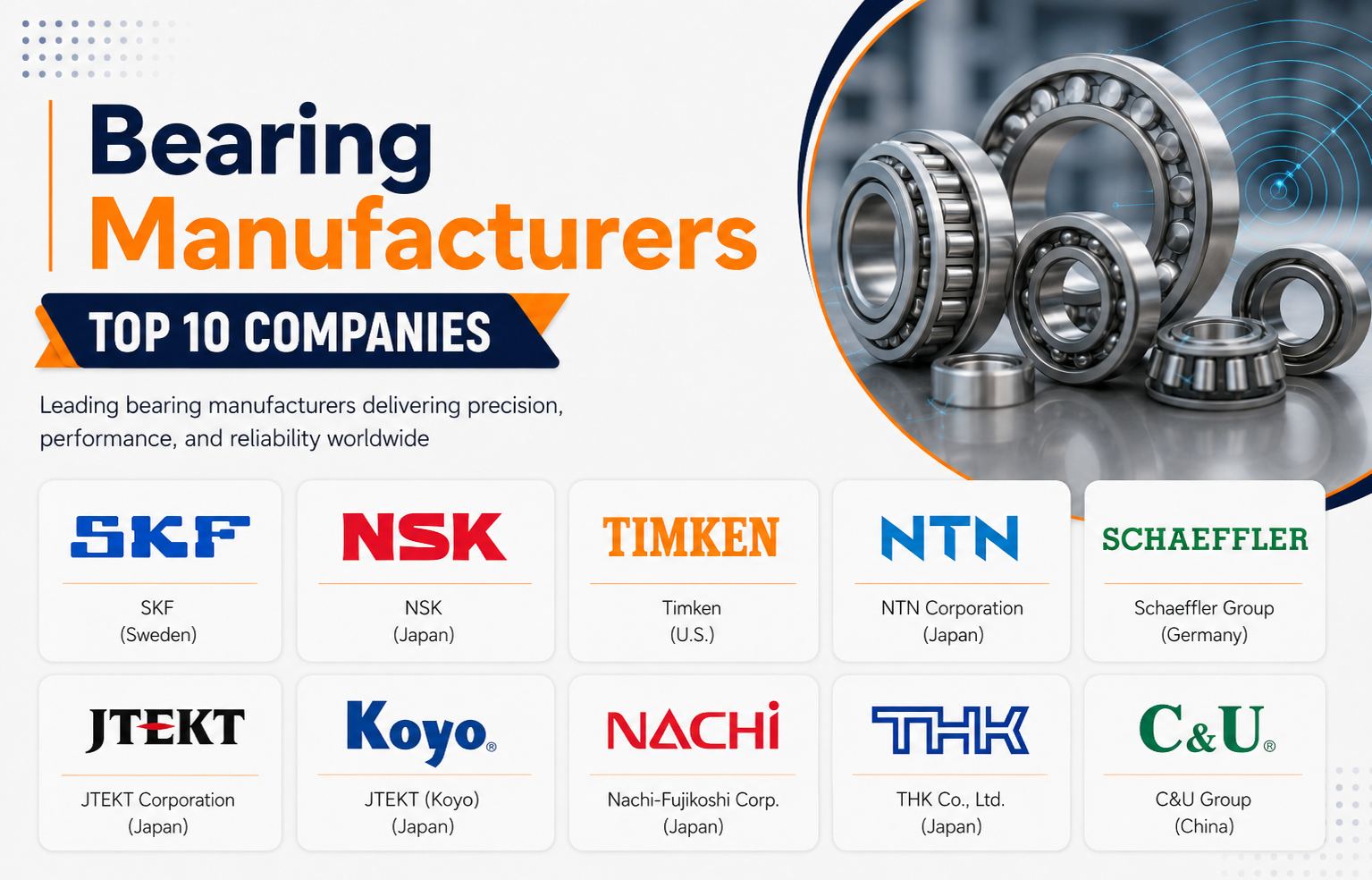
This article highlights the Top 10 Leading Companies in the Global Bearing Market, profiling organizations that are driving innovation, expanding manufacturing capacity, and shaping the future of precision motion technology.
What is a Bearing?
A bearing is a mechanical component that constrains relative motion and reduces friction between moving parts, allowing rotational or linear movement while supporting radial and axial loads. It encompasses a broad range of industrial, automotive, and precision equipment, including ball bearings, roller bearings, tapered bearings, plain bearings, and specialty linear motion products.
The industry includes automotive wheel and transmission bearings, industrial machinery bearings, railway and aerospace bearings, agricultural equipment bearings, and precision bearings for robotics, machine tools, and semiconductor equipment. These components enable manufacturers across automotive, industrial, energy, and infrastructure sectors to improve equipment efficiency, extend service life, and reduce unplanned downtime.
As electrification, automation, and renewable energy priorities accelerate across industrial and automotive sectors, bearings are becoming an increasingly engineered, application-specific product category. The growing emphasis on energy efficiency and reduced friction losses is encouraging manufacturers to invest in advanced materials, coatings, and sensor-integrated designs that improve performance beyond traditional mechanical bearings.
Global Bearing Market Overview
The global Bearing market has expanded steadily as automotive production, industrial automation, renewable energy installation, and infrastructure investment push manufacturers toward higher-precision, longer-lasting rotating components. Facilities across automotive, steel, paper and pulp, petrochemical, mining and construction, agriculture, and railway and aerospace industries are increasingly turning to advanced bearing designs for load management, friction reduction, and equipment reliability.
Modern bearing systems now integrate multiple technologies, including advanced steel metallurgy, ceramic hybrid elements, specialized coatings, and sensor-enabled condition monitoring, alongside precision manufacturing and quality control processes. These capabilities allow operators to extend component life, reduce maintenance costs, and maintain consistent performance across demanding operating environments.
The market is also witnessing substantial investment from multinational industrial conglomerates, automotive suppliers, and specialized bearing manufacturers. Strategic collaborations between OEMs, aftermarket distributors, and bearing technology providers are accelerating the deployment of application-specific bearing solutions across passenger vehicles, commercial vehicles, industrial machinery, and renewable energy infrastructure.
Governments and industrial operators worldwide are investing heavily in manufacturing automation, electric vehicle production, and renewable energy capacity, creating strong long-term opportunities for bearing manufacturers. Regions with expanding automotive and industrial manufacturing bases are expected to represent significant sources of future demand, while established markets continue to upgrade existing machinery with higher-efficiency bearing platforms.
Key Market Drivers
Several factors are contributing to the rapid growth of the global Bearing market:
Rising Automotive Production and Electrification
Growing vehicle production, along with the shift toward electric vehicles, is driving demand for specialized bearings designed for high-speed electric motors, transmissions, and wheel hub assemblies.
Expansion of Industrial Automation
Manufacturers across steel, paper and pulp, and petrochemical industries are increasingly adopting automated machinery, which requires precision bearings capable of sustained high-load, high-speed operation.
Growth in Renewable Energy Infrastructure
Wind turbine installations and other renewable energy systems require large, high-load-capacity bearings, broadening the addressable market beyond traditional industrial and automotive applications.
Expansion of Railway and Aerospace Applications
Bearing technology is increasingly used across rail transport and aerospace systems, where reliability and precision are critical to safety and performance.
Technological Advancements in Materials and Design
Continued innovation in advanced steels, ceramic hybrid bearings, and low-friction coatings is enabling manufacturers to deliver longer service life and lower energy loss, improving the economics of large-scale adoption.
Emerging Trends Shaping the Industry
The Bearing industry is evolving rapidly with continuous technological advancements. Some of the most significant trends include:
- Sensor-integrated smart bearings for predictive maintenance
- Ceramic hybrid bearings for high-speed applications
- Advanced steel and coating technologies for extended service life
- Miniaturized precision bearings for robotics and automation
- Growth of bearings tailored for electric vehicle motors and transmissions
- Increasing demand for corrosion-resistant bearings in harsh environments
- Modular and pre-lubricated sealed bearing units
- Expansion of bearing use in renewable energy and wind turbine systems
- Digital twin and condition-monitoring integration
- Rising adoption of additive manufacturing for specialty bearing components
These innovations are enabling more efficient, durable, and data-driven rotating equipment while creating new opportunities for technology providers across automotive, industrial, and infrastructure segments.
Top 10 Leading Companies in the Global Bearing Market
- SKF
- Schaeffler Group
- Timken Company
- NSK Ltd.
- NTN Corporation
- JTEKT Corporation
- THK Co., Ltd.
- RBC Bearings Inc.
- Nachi-Fujikoshi Corp.
- C&U Group
Company Profile
1. SKF
|
Category |
Details |
|---|---|
|
Company Name |
AB SKF |
|
Headquarters |
Gothenburg, Sweden |
|
Founded |
1907 |
|
Industry Focus |
Bearings, Seals, Lubrication Systems, Condition Monitoring |
|
Global Presence |
Operations across roughly 130 countries, with approximately 37,000–42,000 employees and annual revenue of roughly USD 9–9.5 billion |
|
Company Overview |
Founded in 1907, SKF holds patents dating back to the self-aligning ball bearing and maintains its global headquarters in Gothenburg, Sweden. SKF and Schaeffler Group are widely regarded as the top two global ball bearing suppliers, followed by Timken, NSK, NTN, and JTEKT, with these six companies together supplying roughly 60% of the world's ball bearings. |
|
Key Products & Services |
Deep groove ball bearings, spherical and tapered roller bearings, industrial seals, lubrication systems, condition monitoring equipment, power transmission products |
|
Market Position |
Widely recognized as one of the two largest global ball bearing suppliers, with an extensive manufacturing and distribution footprint. |
|
Recent Developments |
SKF has continued to expand sustainability initiatives, including decarbonizing manufacturing facilities globally. |
|
Strategic Advantages |
Extensive global manufacturing footprint, strong brand heritage, broad product range spanning automotive and industrial segments, and continuous investment in condition-monitoring technology. |
2. Schaeffler Group
|
Category |
Details |
|---|---|
|
Company Name |
Schaeffler AG |
|
Headquarters |
Herzogenaurach, Germany |
|
Founded |
1946 |
|
Industry Focus |
Automotive Technologies, Automotive Aftermarket, Industrial Bearings and Motion Systems |
|
Global Presence |
Operations with over 100,000 employees worldwide and annual revenue of roughly EUR 16–17 billion |
|
Company Overview |
Schaeffler Technologies, also known as the Schaeffler Group, is a German manufacturer of rolling element bearings for automotive, aerospace, and industrial uses, including the FAG brand, founded in 1946 by brothers Wilhelm and Georg Schaeffler. The company organizes its business around Automotive Technologies, Automotive Aftermarket, and Industrial divisions. |
|
Key Products & Services |
Rolling and plain bearings (FAG and INA brands), e-mobility components, chassis systems, industrial bearing solutions, precision components |
|
Market Position |
One of the two largest global bearing manufacturers, with deep automotive supplier relationships and a diversified industrial portfolio. |
|
Recent Developments |
Schaeffler reorganized around four product-oriented divisions E-Mobility, Powertrain & Chassis, Vehicle Lifetime Solutions, and Bearings & Industrial Solutions while grouping humanoid robotics and defense business into a separate growth-focused division. |
|
Strategic Advantages |
Deep automotive OEM integration, strong industrial bearings portfolio, large-scale European and Asian manufacturing base, and continued diversification into e-mobility and robotics applications. |
3. Timken Company
|
Category |
Details |
|---|---|
|
Company Name |
The Timken Company |
|
Headquarters |
North Canton, Ohio, United States |
|
Founded |
1899 |
|
Industry Focus |
Engineered Bearings, Industrial Motion Products |
|
Global Presence |
Operations across roughly 45 countries with approximately 19,000 employees and annual revenue of roughly USD 4.6 billion |
|
Company Overview |
Founded in 1899 by Henry Timken and headquartered in North Canton, Ohio, Timken designs bearings, chain, couplings, clutches, seals, and related industrial motion products. Timken posted roughly USD 4.6 billion in sales and employs approximately 19,000 people globally, operating across 45 countries. |
|
Key Products & Services |
Tapered, ball, and plain bearings, housed units, linear guides, couplings, industrial brakes, seals, offered under Timken, GGB, Philadelphia Gear, Cone Drive, and Rollon brands |
|
Market Position |
A leading North American engineered bearings manufacturer with a significant share of the global ball and tapered roller bearing manufacturing industry. |
|
Recent Developments |
Continues expanding its Engineered Bearings and Industrial Motion segments through targeted acquisitions and new product lines for renewable energy and industrial automation customers. |
|
Strategic Advantages |
Strong North American manufacturing base, diversified industrial motion portfolio, established aftermarket distribution network, and long-standing engineering expertise in heavy-duty bearing applications. |
4. NSK Ltd.
|
Category |
Details |
|---|---|
|
Company Name |
NSK Ltd. |
|
Headquarters |
Tokyo, Japan |
|
Founded |
1916 |
|
Industry Focus |
Industrial Machinery Bearings, Automotive Bearings and Components, Precision Machinery |
|
Global Presence |
Operations across roughly 30 countries with approximately 24,000–30,000 employees and annual revenue of roughly USD 6 billion |
|
Company Overview |
NSK Ltd. is a large global manufacturer of bearings and the largest bearing manufacturer in Japan, producing industrial machinery bearings, precision machinery and parts, and automotive bearings and components, with a technology network spanning more than 65 production plants across 14 countries. |
|
Key Products & Services |
Ball and roller bearings, electric power steering systems, automatic transmission components, linear motion products, condition-monitoring devices |
|
Market Position |
One of the world's top-three bearing manufacturers by revenue, and the top domestic bearing supplier in Japan. |
|
Recent Developments |
NSK signed a landmark 2026 merger memorandum of understanding with NTN Corporation, which if completed would create a combined entity with annual revenue exceeding roughly JPY 1.8 trillion, positioning the merged group as the world's second-largest bearing manufacturer behind SKF. |
|
Strategic Advantages |
Deep century-long expertise in bearing materials science and precision manufacturing, strong automotive OEM relationships, and a broadening global manufacturing footprint. |
5. NTN Corporation
|
Category |
Details |
|---|---|
|
Company Name |
NTN Corporation |
|
Headquarters |
Osaka, Japan |
|
Founded |
1918 |
|
Industry Focus |
Bearings, Constant-Velocity Joints, Precision Equipment |
|
Global Presence |
Operations spanning dozens of countries with over 60 production plants and roughly 24,000 employees |
|
Company Overview |
NTN Corporation is a Japanese manufacturer of bearings and related components tracing its origins to Nishizono Ironworks, founded in 1918, and produces bearings and friction-reducing products such as constant-velocity joints for automotive and industrial applications. |
|
Key Products & Services |
Ball and roller bearings, constant-velocity joints, wheel hub bearing units, precision equipment, aftermarket components |
|
Market Position |
Widely regarded as the world's third-largest bearing manufacturer, with over 68 plants worldwide and roughly a century of manufacturing history. |
|
Recent Developments |
Engaged in a proposed 2026 merger of equals with NSK, aimed at consolidating manufacturing scale and R&D capacity to better compete with SKF and Schaeffler globally. |
|
Strategic Advantages |
Strong position in automotive constant-velocity joints and wheel bearing units, long operating history in precision manufacturing, and an extensive global plant network. |
Competitive Landscape
The global Bearing market is highly competitive, with diversified industrial conglomerates, automotive-focused suppliers, and specialized bearing manufacturers competing to deliver efficient, durable, and application-specific motion solutions. Market participants are increasingly investing in advanced steel metallurgy, ceramic hybrid designs, sensor integration, and manufacturing automation to strengthen their competitive positioning across automotive, industrial, and infrastructure segments.
Strategic partnerships and consolidation activity including the proposed NSK-NTN merger are reshaping the competitive landscape, as manufacturers seek greater scale to fund research and development and compete more effectively with the largest global suppliers. Companies are also pursuing product innovation, capacity expansion, and distribution network growth to broaden their addressable markets and strengthen their positions in emerging economies.
Market Segmentation
By Product Type
- Ball
- Roller
- Others
By Application
- Electrical
- Steel Industry
- Paper and Pulp Industry
- Petrochemical
- Automotive
- Mining & Construction
- Agriculture
- Railway & Aerospace
- Automotive Aftermarket
- Others
By Distribution Channel
- OEM
- Aftermarket
Regional Analysis
North America
North America represents a significant Bearing market driven by established automotive and industrial manufacturing infrastructure, along with strong demand from the aerospace and railway sectors.
Europe
Europe continues to see steady growth supported by advanced automotive engineering, strong industrial manufacturing bases, and rising adoption of renewable energy infrastructure requiring high-load-capacity bearings.
Asia-Pacific
Asia-Pacific is expected to register strong growth, supported by rapid industrialization, expanding automotive production, and the presence of key bearing manufacturers in economies such as Japan and China.
Latin America
Growing investment in industrial manufacturing and expanding automotive assembly operations are creating new opportunities for bearing technology adoption across Latin America.
Middle East & Africa
The region is gradually increasing adoption of industrial and infrastructure-related bearing applications as manufacturing investment and construction activity expand.
Key Market Trends
- Sensor-integrated bearings for predictive maintenance
- Ceramic hybrid and advanced steel bearing materials
- Growth of bearings for electric vehicle drivetrains
- Miniaturized precision bearings for robotics and automation
- Expansion of renewable energy and wind turbine bearing applications
- Increasing industry consolidation among leading manufacturers
- Modular, pre-lubricated, and sealed bearing units
- Rising demand for corrosion- and temperature-resistant bearings
- Digital twin and condition-monitoring integration
- Growing adoption of additive manufacturing for specialty components
Future Outlook
The global Bearing market is expected to witness steady growth over the coming years as automotive electrification, industrial automation, and renewable energy expansion continue to reshape manufacturing and infrastructure strategies. Companies are increasingly investing in advanced materials, sensor-enabled monitoring platforms, and precision manufacturing capabilities that enable more durable, efficient rotating equipment.
Growing industrial investment, expanding automotive applications, and continuous technological advancement alongside ongoing industry consolidation are expected to support long-term market expansion through 2034. Organizations capable of combining advanced materials engineering with intelligent monitoring software and strong global distribution will likely strengthen their competitive positions and capture new growth opportunities across automotive, industrial, and infrastructure segments.
Frequently Asked Questions (FAQs)
1. What is a Bearing?
A bearing is a mechanical component that reduces friction between moving parts and supports radial or axial loads, enabling smooth rotational or linear motion in machinery and equipment.
2. Which companies are leading the global Bearing market?
Leading companies include SKF, Schaeffler Group, Timken Company, NSK Ltd., NTN Corporation, JTEKT Corporation, THK Co., Ltd., RBC Bearings Inc., Nachi-Fujikoshi Corp., and C&U Group.
3. What factors are driving market growth?
Rising automotive production and electrification, expanding industrial automation, growth in renewable energy infrastructure, and increasing railway and aerospace applications are major growth drivers.
4. Which region dominates the Bearing market?
North America and Europe hold significant market share due to established automotive and industrial manufacturing infrastructure, while Asia-Pacific is projected to experience the fastest growth.
5. What are the major applications of bearings?
Major applications include automotive powertrain and wheel systems, industrial machinery, steel and paper processing equipment, mining and construction machinery, agriculture, and railway and aerospace systems.
Conclusion
The global Bearing market is reshaping the future of industrial and automotive motion technology through continuous innovation in materials science, precision manufacturing, and sensor integration. The companies featured in this report are playing a critical role in advancing durable, energy-efficient bearing solutions that improve automotive, industrial, and infrastructure outcomes worldwide.
As electrification, automation, and industry consolidation continue to reshape the competitive landscape, demand for efficient, data-driven bearing solutions will accelerate. Organizations that invest in research and development, expand their global manufacturing networks, and deliver reliable, high-performance components will remain at the forefront of this steadily growing industry. With increasing industrial investment and continuous technological advancement, the Bearing market is well positioned for sustained growth through 2034, creating significant opportunities for technology providers, investors, manufacturers, and other industry stakeholders.