
Top 10 Infusion Pumps and Accessories Companies Driving Market Growth
Author:
Intellectual Market Insights Research
Published Date:
12 Sep 2026
Introduction
In nearly every hospital ward, from intensive care units to outpatient chemotherapy suites, infusion pumps quietly perform one of medicine's most precise and safety-critical jobs: delivering exact doses of fluids, medications, and nutrients into a patient's body over carefully controlled periods of time. As treatment protocols grow more complex and patients increasingly receive care outside traditional hospital settings, these devices spanning volumetric pumps, syringe pumps, ambulatory pumps, and their accompanying sets, catheters, and accessories have become indispensable infrastructure across nearly every area of modern healthcare.
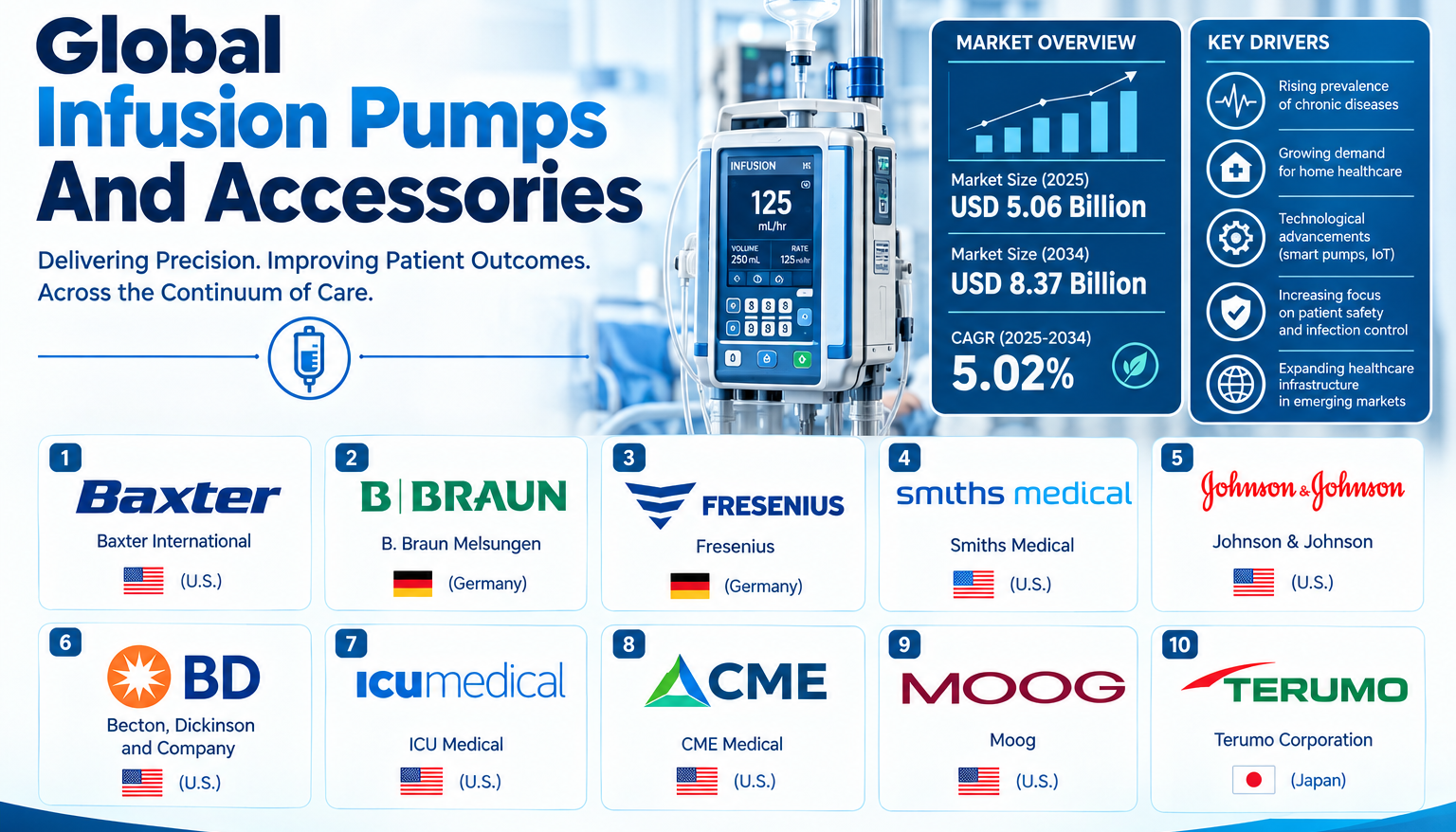
The global infusion pumps and accessories market is estimated at approximately USD 5.06 billion in 2025 and is projected to reach USD 8.37 billion by 2034, expanding at a compound annual growth rate (CAGR) of 5.02% over the forecast period. Growth is being driven by technological advancements in smart infusion technology, rising chronic disease prevalence, and continued investment in improving healthcare infrastructure and patient safety across both developed and emerging markets.
The competitive landscape is dominated by large, diversified medical device companies that combine deep regulatory expertise with global hospital distribution networks, alongside specialist infusion technology providers competing on precision engineering and safety features. Because infusion pumps sit at the intersection of critical patient safety and complex device engineering, the market rewards companies that combine rigorous quality control with continuous innovation in smart dosing, wireless connectivity, and electronic health record integration.
Understanding which companies lead this safety-critical market is essential for hospital procurement teams, healthcare systems, and clinicians relying on accurate, reliable drug delivery. This article provides a research-based analysis of the top companies in the global infusion pumps and accessories market, their positioning, flagship offerings, and the regulatory and technological forces shaping the competitive landscape.
Market Overview
|
Parameter |
Details |
|---|---|
|
Market Size (2025) |
USD 5.06 Billion |
|
Projected Market Size (2034) |
USD 8.37 Billion |
|
CAGR (2025–2034) |
5.02% |
|
Base Year |
2023/2024 |
|
Historic Period |
2019–2023 |
|
Forecast Period |
2025–2034 |
|
Leading Region |
North America |
|
Fastest-Growing Region |
Asia-Pacific, led by China, India, and Japan |
|
Key Growth Drivers |
Technological advancements in smart infusion pumps, rising chronic disease prevalence, growing healthcare infrastructure investment |
|
Key Challenges |
Market saturation in developed regions, adverse events and litigation risk tied to device malfunctions |
|
Key Opportunities |
Smart infusion pump innovation, expansion in emerging markets, wireless connectivity and EHR integration |
Why the Infusion Pumps and Accessories Market Is Growing
1. Technological Advancements in Smart Infusion Pumps
New infusion pumps with dose error reduction algorithms, wireless connectivity, and real-time monitoring capabilities are improving accuracy and safety in medication delivery, helping avoid dosing errors and driving hospitals to upgrade from older, more basic pump models.
2. Rising Chronic Disease Prevalence
Increasing diagnosis rates for chronic conditions such as diabetes, cancer, and cardiovascular disease are driving demand for reliable, long-term infusion systems capable of supporting continued therapy and medication management over extended treatment periods.
3. Focus on Patient Safety and Regulatory Standards
Strict safety and quality regulations from agencies like the FDA and EMA are pushing healthcare providers toward advanced infusion systems engineered to meet high performance standards, reinforcing demand for technologically sophisticated pumps.
4. Growth in Chronic Disease Management Programs
Healthcare systems and organizations are investing in advanced infusion technologies as part of broader chronic disease management initiatives, supporting accurate dosage delivery, real-time monitoring, and safety alerts for complex, long-term treatment regimens.
5. Expansion in Emerging Market Healthcare Infrastructure
Rising healthcare expenditure and infrastructure development in developing economies are creating strong demand for modern infusion systems as hospitals and clinics in these regions upgrade their medical equipment.
6. Growth in Home Healthcare and Ambulatory Settings
Portable ambulatory and elastomeric infusion pumps are enabling more patients to receive insulin, chemotherapy, and antibiotic therapies outside traditional hospital settings, expanding the market into home healthcare and outpatient use cases.
Top Companies in the Global Infusion Pumps and Accessories Market
- Baxter International (U.S.)
- B. Braun Melsungen (Germany)
- Fresenius (Germany)
- Smiths Medical (U.S.)
- Johnson & Johnson (U.S.)
- Becton, Dickinson and Company (U.S.)
- ICU Medical (U.S.)
- CME Medical (U.S.)
- Moog (U.S.)
- Terumo Corporation (Japan)
1. Baxter International
|
Category |
Details |
|---|---|
|
Company Name |
Baxter International Inc. |
|
Headquarters |
Deerfield, Illinois, United States |
|
Founded |
1931 |
|
Employees |
Approx. 34,700–38,000 |
|
Revenue |
Approx. USD 11.24 Billion (FY2025) |
|
Company Overview |
Baxter is a diversified global healthcare company whose Infusion Therapies and Technologies division, part of its broader Medical Products and Therapies business, manufactures intravenous products, infusion systems, and devices used in the delivery of fluids and drugs to patients across hospital and home care settings. |
|
Key Products |
Large-volume and ambulatory infusion pumps, IV solutions and administration sets, and premixed drug and drug-reconstitution systems. |
|
Market Position |
A leading global infusion therapy provider, leveraging Baxter's broad hospital-focused portfolio spanning renal care, IV solutions, and infusion systems following recent portfolio reshaping including the 2025 divestiture of its kidney care business. |
|
Recent Developments |
Continued reshaping its portfolio following the 2023 spin-off of its kidney care business and the early 2025 divestiture of additional non-core operations, sharpening its focus on core hospital and infusion therapy products. |
|
Strategic Advantages |
Deep, decades-long relationships with hospital systems, a broad portfolio spanning IV solutions, infusion pumps, and clinical nutrition, and continued strategic portfolio refinement to focus on higher-margin core businesses. |
2. B. Braun Melsungen
|
Category |
Details |
|---|---|
|
Company Name |
B. Braun Melsungen SE |
|
Headquarters |
Melsungen, Germany (U.S. headquarters in Bethlehem, Pennsylvania) |
|
Founded |
1839 |
|
Employees |
Approx. 63,000–66,800 |
|
Revenue |
Approx. USD 9.5–10.6 Billion |
|
Company Overview |
B. Braun is a family-owned German medical technology company with more than 5,000 healthcare products across its Hospital Care, Aesculap, and Avitum divisions, with infusion therapy representing a core part of its Hospital Care business serving more than 60 countries. |
|
Key Products |
Infusion pumps, IV administration sets, and safety-engineered IV catheters including the Introcan Safety 2 IV Catheter designed to protect clinicians during device access. |
|
Market Position |
One of the largest privately held medical device companies globally, with deep infusion therapy expertise built over more than 180 years and a broad international manufacturing and distribution footprint. |
|
Recent Developments |
Partnered with Ascom and Dräger to launch the Silent ICU solution at the ESICM LIVES 2025 Congress, and continued expanding its safety-engineered IV catheter portfolio. |
|
Strategic Advantages |
Family ownership enabling long-term strategic investment horizons, manufacturing 95% of its own products in-house, and deep integration across infusion therapy, surgical, and dialysis technology businesses. |
3. ICU Medical
|
Category |
Details |
|---|---|
|
Company Name |
ICU Medical, Inc. |
|
Headquarters |
San Clemente, California, United States |
|
Founded |
1984 |
|
Employees |
Approx. 9,100–14,000 |
|
Revenue |
Approx. USD 2.2–2.3 Billion |
|
Company Overview |
ICU Medical is a medical technology company focused on infusion therapy, vascular access, and vital care, having significantly expanded its infusion pump portfolio through the 2017 acquisition of Hospira Infusion Systems and the 2022 acquisition of Smiths Medical. |
|
Key Products |
Plum 360 large-volume infusion pump system, ambulatory and syringe IV pumps, and IV Performance Platform precision pumps recently expanded with new FDA clearances. |
|
Market Position |
A global infusion systems provider competing head-to-head with larger rivals including BD, Baxter, and B. Braun, with its Plum platform holding meaningful but not installed-base-leading share in the U.S. large-volume infusion pump segment. |
|
Recent Developments |
Continued integration efforts following its Smiths Medical acquisition while posting Infusion Systems revenue growth driven by increased large-volume pump hardware and dedicated set sales through 2025. |
|
Strategic Advantages |
A complete infusion therapy and vascular access product line strengthened through major acquisitions, award-winning pump technology recognized for eight consecutive years as Best in KLAS, and deep expertise spanning oncology and critical care applications. |
4. Becton, Dickinson and Company (BD)
|
Category |
Details |
|---|---|
|
Company Name |
Becton, Dickinson and Company |
|
Headquarters |
Franklin Lakes, New Jersey, United States |
|
Founded |
1897 |
|
Employees |
Approx. 70,000–74,000 |
|
Revenue |
Approx. USD 21.4–21.8 Billion (FY2025) |
|
Company Overview |
BD is a global medical technology leader whose BD Medical segment includes the Alaris infusion pump platform, one of the most widely installed large-volume infusion systems in U.S. hospitals, alongside a broader portfolio spanning medication management, life sciences, and interventional products. |
|
Key Products |
BD Alaris Infusion System, including large-volume pumps, syringe pumps, patient-controlled analgesia pumps, and bi-directional EMR interoperability features. |
|
Market Position |
The dominant installed-base leader in U.S. large-volume infusion pumps through its Alaris platform, now live with EMR interoperability at more than 960 U.S. hospital sites across all three leading electronic health record systems. |
|
Recent Developments |
Achieved FDA clearance for its updated Alaris Infusion System with enhanced cybersecurity and interoperability features, while also navigating a 2025 software correction and recall tied to automated programming request delays. |
|
Strategic Advantages |
The dominant U.S. installed base in large-volume infusion pumps, deep integration with all major EHR systems, and BD's scale as the largest U.S. manufacturer of medical devices supporting long-term contracting leverage. |
5. Terumo Corporation
|
Category |
Details |
|---|---|
|
Company Name |
Terumo Corporation |
|
Headquarters |
Tokyo, Japan |
|
Founded |
1921 |
|
Employees |
Tens of thousands globally across Terumo's three core business segments |
|
Revenue |
Multi-billion-dollar revenue across Terumo's Cardiac and Vascular, General Hospital, and Blood and Cell Technologies segments |
|
Company Overview |
Terumo is a major Japanese medical device company whose General Hospital Company segment includes syringe and infusion pump technology alongside a broad portfolio spanning cardiovascular devices, blood management systems, and diabetes care products. |
|
Key Products |
Terufusion syringe pumps and infusion pump systems used across hospital, oncology, and critical care settings globally. |
|
Market Position |
A leading global medical device manufacturer with strong infusion technology presence, particularly across Asia-Pacific markets where the company maintains deep regional distribution relationships. |
|
Recent Developments |
Continued investing in expanding its infusion and general hospital product portfolio as part of its broader global medical technology strategy spanning cardiovascular, hospital, and blood technology businesses. |
|
Strategic Advantages |
A century of medical device manufacturing heritage, strong brand recognition and distribution depth across Asia-Pacific, and a diversified portfolio that supports sustained R&D investment in infusion technology. |
Competitive Landscape
The global infusion pumps and accessories market is led by a concentrated group of large, diversified medical device companies, with BD's Alaris platform holding the dominant installed base in U.S. large-volume infusion pumps, while Baxter, B. Braun, and ICU Medical compete closely across infusion systems, IV solutions, and vascular access products.
Installed Base as a Structural Advantage: Because hospitals rarely switch infusion pump platforms once deployed given training, EHR integration, and procurement complexity, companies with the largest existing installed base, such as BD's Alaris system, hold a durable competitive advantage over newer entrants.
Regulatory Rigor as a Barrier to Entry: Infusion pumps face some of the strictest safety and quality regulatory requirements in medical devices, given their critical role in patient care, favoring established manufacturers with the compliance infrastructure and clinical validation experience to navigate FDA and EMA approval pathways.
Consolidation Through Acquisition: Companies like ICU Medical have significantly expanded their market position through major acquisitions, including Hospira Infusion Systems and Smiths Medical, reflecting a broader industry pattern of consolidation to achieve scale and product breadth.
EHR Interoperability as a Differentiator: Deep integration with electronic health record systems, as demonstrated by BD's Alaris EMR Interoperability now live across all three leading U.S. EHR platforms, is increasingly becoming a key competitive differentiator for hospital procurement decisions.
Regional Analysis
North America
North America remains the hub market, driven by advanced healthcare infrastructure, high healthcare spending, and early adoption of smart and programmable infusion pumps with advanced safety features, supported by major medical device manufacturers headquartered in the region.
Europe
Europe benefits from rigorous regulatory demands and increasing focus on patient care quality, with leading economies including Germany, France, and the UK showing strong interest in high-tech infusion systems that improve safety and treatment outcomes.
Asia-Pacific
Asia-Pacific is growing rapidly, driven by increasing healthcare investment, expanding healthcare infrastructure, and rising patient populations, with China, India, and Japan leading efforts to modernize healthcare facilities and adopt advanced medical devices amid a growing incidence of chronic diseases.
Latin America
Latin America is experiencing growth driven by investments to improve health infrastructure, with Brazil and Mexico as key markets concentrating on upgrading healthcare facilities and increasing demand for quality medical equipment.
Middle East and Africa
The Middle East and Africa region is seeing growth opportunities from rising healthcare investments, with Saudi Arabia, UAE, and South Africa emerging as leaders in introducing advanced infusion pumps to improve precision and safety in patient care.
Emerging Trends in the Infusion Pumps and Accessories Market
1. Smart Infusion Pump Adoption: Infusion pumps with dose error reduction algorithms, real-time monitoring, and wireless connectivity are becoming the standard for modern healthcare environments, replacing traditional basic infusion pumps in leading hospital systems.
2. EHR and Digital System Integration: Bi-directional interoperability between infusion pumps and electronic health record systems is expanding, improving patient safety and workflow efficiency by reducing manual programming errors.
3. Growth in Home and Ambulatory Infusion: Portable ambulatory and elastomeric pumps are increasingly supporting outpatient and home-based chemotherapy, antibiotic, and insulin therapies, extending infusion technology beyond traditional hospital settings.
4. Consolidation Through M&A: Infusion pump manufacturers continue pursuing acquisitions to expand product breadth and market share, following patterns set by major deals like ICU Medical's acquisitions of Hospira Infusion Systems and Smiths Medical.
5. Heightened Focus on Device Safety and Recalls: Given the safety-critical nature of infusion pumps, manufacturers face intense regulatory scrutiny, with recent software corrections and recalls underscoring the importance of continuous quality control and cybersecurity investment.
Future Outlook (2025–2034)
The global infusion pumps and accessories market's trajectory toward USD 8.37 billion by 2034 reflects steady, foundational demand for precise drug delivery technology even as developed markets approach saturation. The 5.02% CAGR forecast through 2034 assumes continued adoption of smart infusion technology, rising chronic disease prevalence, and continued healthcare infrastructure investment across emerging markets.
Key investment themes include continued expansion of smart and programmable infusion pump technology, growth in home healthcare and ambulatory infusion applications, and deepening EHR interoperability as a competitive differentiator. Leading companies including BD, Baxter, B. Braun, and ICU Medical are likely to retain strong market positions by combining large installed bases with continued investment in device safety, wireless connectivity, and regulatory compliance, while emerging market expansion offers meaningful growth opportunities beyond increasingly saturated developed markets.
Frequently Asked Questions (FAQ)
1. What is the current size of the global infusion pumps and accessories market?
The global infusion pumps and accessories market is estimated at approximately USD 5.06 billion in 2025 and is projected to reach USD 8.37 billion by 2034, growing at a CAGR of 5.02%.
2. Who are the top companies in the infusion pumps and accessories market?
Leading companies include Baxter International, B. Braun Melsungen, Fresenius, Smiths Medical, Johnson & Johnson, Becton, Dickinson and Company (BD), ICU Medical, CME Medical, Moog, and Terumo Corporation.
3. Which region dominates the infusion pumps and accessories market?
North America currently leads the market, while Asia-Pacific is expected to grow the fastest, driven by rising healthcare investment and infrastructure expansion in China, India, and Japan.
4. What is the forecast CAGR for the infusion pumps and accessories market?
The market is forecast to grow at a CAGR of 5.02% from 2025 to 2034.
5. What are the main growth drivers for this market?
Key drivers include technological advancements in smart infusion pumps, rising chronic disease prevalence, and growing healthcare infrastructure investment in emerging markets.
6. What challenges does the infusion pump industry face?
The industry's primary challenges are market saturation in developed regions, where most healthcare institutions already have functional infusion systems, and the significant legal and financial liabilities associated with device malfunctions or adverse events.
7. Which company holds the dominant U.S. market position?
BD's Alaris platform retains the dominant installed base in U.S. large-volume infusion pumps, giving the company significant contracting leverage over competitors including ICU Medical, Baxter, and B. Braun.
Conclusion
The global infusion pumps and accessories market sits at the intersection of patient safety and precision engineering, supporting the accurate, continuous drug and nutrient delivery that underpins modern critical care, oncology, and chronic disease management. With a projected size of USD 8.37 billion by 2034 at a 5.02% CAGR, the sector offers steady growth potential for companies that can combine large installed bases with continued innovation in smart, connected infusion technology.
Established leaders like BD, Baxter, and B. Braun leverage decades of hospital relationships and manufacturing scale, while ICU Medical has built a stronger competitive position through major acquisitions, and Terumo maintains deep strength across Asia-Pacific markets. The companies that successfully balance continued smart pump innovation with rigorous safety and regulatory compliance will define market leadership through 2034 and beyond.