Leading Companies in Global Drug Discovery Informatics Market 2025
Author:
Intellectual Market Insights Research
Published Date:
25 Sep 2026
Leading Companies in the Global Drug Discovery Informatics Market
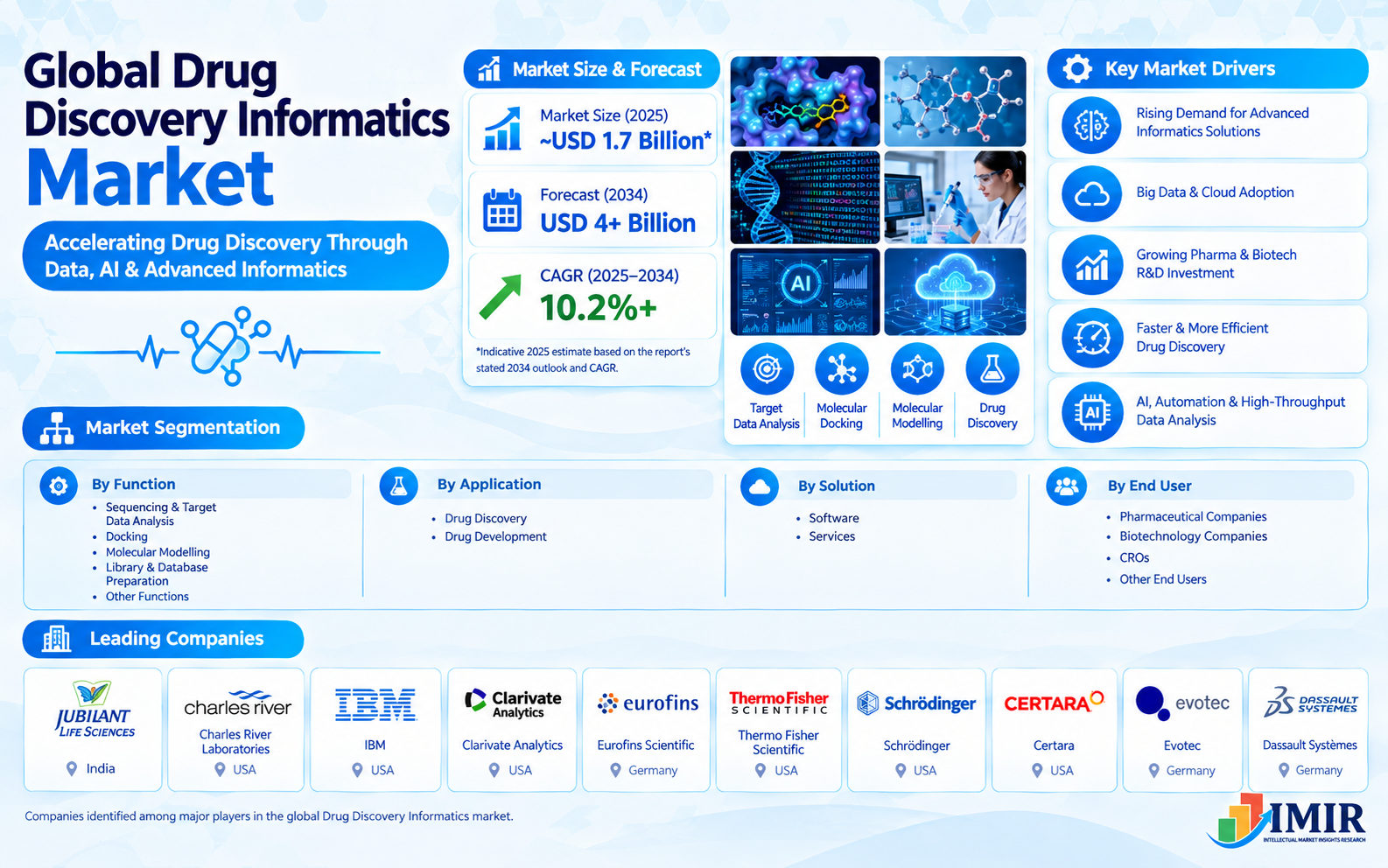
The global Drug Discovery Informatics Market is entering a phase of rapid transformation, as pharmaceutical and biotechnology companies increasingly rely on advanced computational platforms to speed up early-stage research and reduce the soaring cost of bringing new drugs to market. Rising R&D investment, growing focus on rare-disease research, and the fast integration of AI and machine learning into discovery workflows are pushing this market toward strong, sustained growth through the early 2030s.
Market Overview
According to the IMIR Market Research report:
- Forecast Period: 2025–2034
- Expected CAGR: More than 10.2%
- Projected Market Size by 2034: More than USD 4 Billion
- Key Growth Drivers: Big-data adoption, cloud-based technologies, increasing pharmaceutical and biotechnology R&D investment, and demand for faster and more efficient drug discovery.
- Major Applications: Drug discovery and drug development.
- Key End Users: Pharmaceutical companies, biotechnology companies, CROs, and other research organizations.
Leading Companies in the Drug Discovery Informatics Market
The IMIR report identifies a broad competitive landscape that includes technology companies, life-science companies, CROs, software providers, and specialist drug-discovery organizations. Major players identified in the report include:
1. Charles River Laboratories (US)
Offers end-to-end services from target discovery through candidate validation. Known for an aggressive M&A strategy, having integrated numerous technology firms in recent years to strengthen its informatics capabilities and supply chain.
2. Jubilant Life Sciences / Jubilant Biosys (India)
Built its market position primarily through strategic collaborations — notably its 2017 partnership with Orion Corporation — positioning itself as a preferred outsourced provider of drug discovery informatics services.
3. Certara (US)
A leader in biosimulation, offering platforms like D360 and Phoenix for compound data management, modeling, and simulation. Its Simcyp PBPK simulator is widely used for predicting drug behavior in specialized populations.
4. Boehringer Ingelheim International GmbH (Germany)
Leverages advanced informatics tools internally to integrate biological and chemical data, streamlining translational research and early-development pipelines.
5. IBM (US)
Brings enterprise-scale AI and data infrastructure to pharma R&D, supporting large-scale data mining, predictive modeling, and computational drug discovery.
6. Accenture (Ireland) and Infosys Ltd.
Major IT consulting firms that have expanded into life sciences, offering digital transformation, data management, and informatics infrastructure to pharmaceutical clients.
7. Clarivate Analytics (US)
Known for its scientific and intellectual property data platforms, supporting decision-making across the drug discovery and development lifecycle.
8. Other Notable Players
Depending on report segmentation, additional key vendors frequently cited include Oracle, Illumina, Agilent Technologies, Eurofins Scientific, Collaborative Drug Discovery (CDD), ChemAxon, Albany Molecular Research, Novo Informatics, and Selvita.
Key Growth Drivers
-
Rising R&D expenditure across pharma and biotech
- Increasing focus on rare and orphan disease research
- Growing adoption of AI/ML in molecular modeling and target identification
- Expansion of cloud-based, collaborative data platforms
- Growing volume of genomic, proteomic, and compound-library data requiring advanced analysis tools
Competitive Landscape & Recent Developments
The competitive landscape is shaped by a mix of established CROs, specialized informatics vendors, and enterprise tech giants, all racing to embed AI deeper into the drug discovery pipeline:
- AI-native platforms are gaining traction — Insilico Medicine received FDA Orphan Drug Designation in 2023 for a molecule discovered through its generative AI platform, signaling AI's expanding role in rare-disease drug development.
- Strategic partnerships are accelerating — Evotec expanded its multi-target drug discovery agreement with Related Sciences in 2023, extending collaboration through 2030.
- Cloud-based collaboration is becoming standard — platforms like CDD Vault enable secure, real-time data sharing across pharma, biotech, and academic partners.
- Lab automation funding is rising — companies like Automata Labs and Strateos have raised significant capital to automate and remotely manage preclinical research workflows.
Conclusion
The Drug Discovery Informatics Market is consolidating around three broad player types: legacy CROs (Charles River, Jubilant), specialized informatics vendors (Certara, CDD, ChemAxon), and enterprise technology firms (IBM, Oracle, Accenture, Infosys). As R&D budgets expand and computational biology matures, continued M&A activity, AI integration, and cross-sector partnerships are expected to define competition in this space through 2030 and beyond.