
Leading Companies in the Global 4PL Logistics Market
Author:
Intellectual Market Insights Research
Published Date:
03 Oct 2026
Global 4PL Logistics Market: Top Companies, Trends, and Future Outlook
Introduction
Fourth-party logistics (4PL) providers sit above traditional third-party logistics (3PL) companies in the supply chain hierarchy, taking full responsibility for designing, managing, and optimizing a client's entire supply chain rather than simply executing individual transportation or warehousing tasks. A 4PL provider acts as a single point of accountability, coordinating multiple 3PLs, carriers, technology platforms, and service providers to deliver an integrated, centralized view of the supply chain, allowing businesses to reduce complexity, cut costs, and respond more quickly to market changes.
The global 4PL logistics market spans supply chain optimization, transportation management, inventory management, warehouse management, order fulfillment, and distribution solutions, deployed across retail, manufacturing, automotive, healthcare, and e-commerce industries worldwide. This article provides a research-based analysis of the global 4PL logistics market, the companies shaping it, and the technological and consolidation forces driving its growth toward 2032.
Market Overview
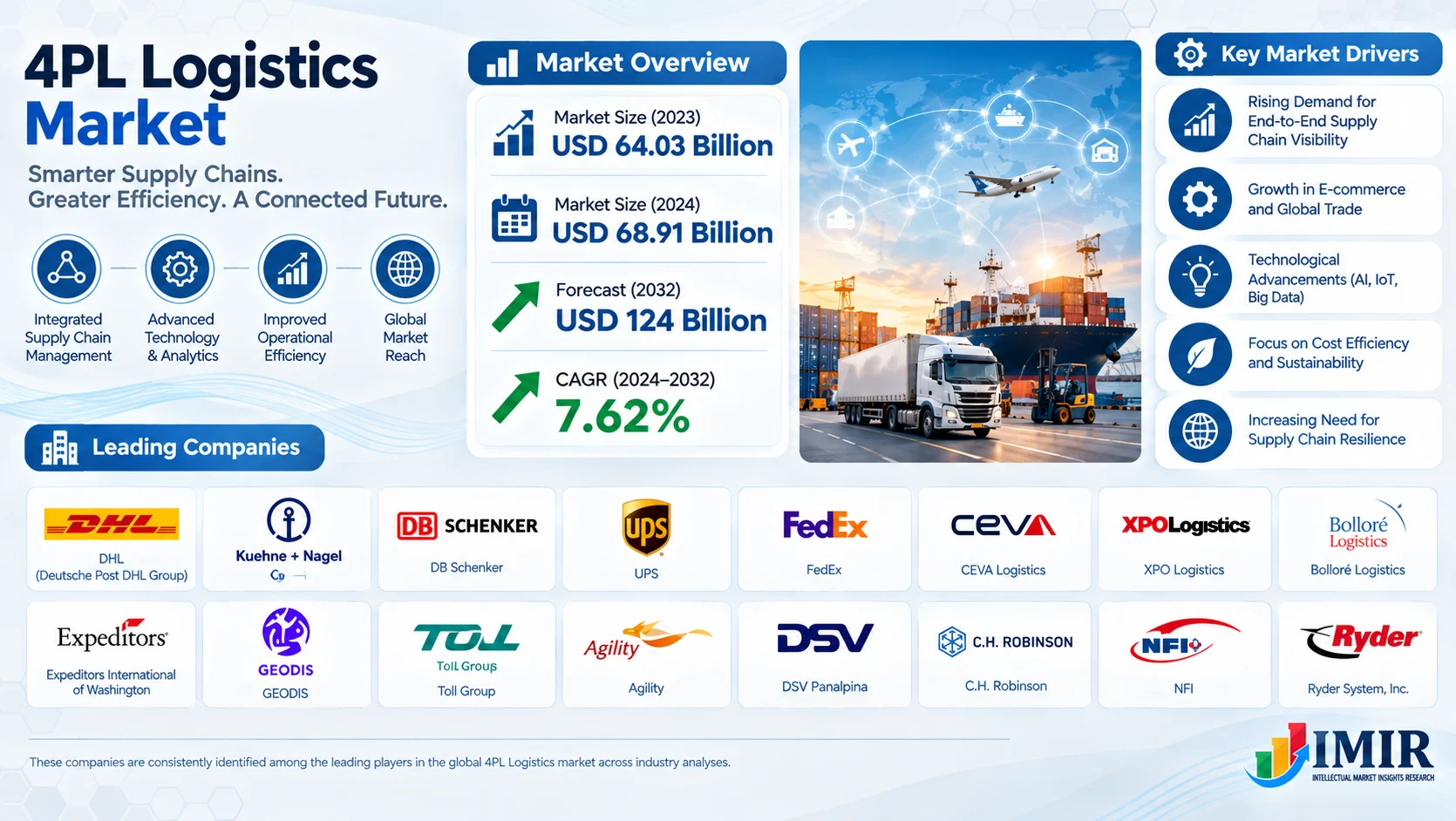
The 4PL logistics market size was valued at USD 64.03 Billion in 2023. The 4PL logistics industry is projected to grow from USD 68.91 Billion in 2024 to USD 124 Billion by 2032, exhibiting a compound annual growth rate (CAGR) of 7.62% during the forecast period (2024–2032).
| Parameter | Details |
|---|---|
| Market Size (2023) | USD 64.03 Billion |
| Market Size (2024) | USD 68.91 Billion |
| Projected Market Size (2032) | USD 124 Billion |
| CAGR (2024–2032) | 7.62% |
| Forecast Period | 2024–2032 |
| Leading Region | North America (strong adoption, advanced logistics infrastructure); Europe (mature 4PL market); Asia-Pacific (fastest growth) |
| Key Segments (by Solution) | Supply Chain Optimization, Transportation Management, Inventory Management, Warehouse Management, Order Fulfillment, Distribution |
| Key Segments (by End-User) | Retail, Manufacturing, Automotive, Healthcare, E-commerce, Others |
Why the 4PL Logistics Market Is Growing
1. Rising Demand for Centralized Supply Chain Visibility
As more businesses begin to understand the value brought by integrated logistics solutions, demand for 4PL services continues to increase, driven by the need for a single, centralized view of increasingly complex, multi-vendor supply chain networks.
2. Growing Supply Chain Complexity Requiring Expert Orchestration
Fourth-party logistics providers manage end-to-end supply chain solutions, coordinating multiple 3PLs, carriers, and technology providers to optimize efficiency, a capability increasingly essential as global supply chains grow more complex and geographically dispersed.
3. Adoption of AI and Automation in Logistics
The integration of AI and automation in logistics presents a significant opportunity for 4PL providers, with control tower technology and AI-driven decision support enabling cost reductions of 8–15% and improved service reliability for client organizations.
4. Strategic Partnerships Between Logistics and Technology Providers
Partnerships such as DHL Supply Chain and Maersk's integrated ocean freight and logistics collaboration, and UPS Supply Chain Solutions' work with IBM on supply chain visibility platforms, reflect the industry's push toward combining logistics expertise with advanced technology capabilities.
5. Expansion into Emerging Markets and Developing Economies
New growth opportunities are emerging from developing markets as more businesses in these regions begin adopting integrated logistics solutions, broadening the global addressable market for 4PL providers.
6. Growing Emphasis on Sustainability and Carbon-Neutral Logistics
Meeting the growing demand for eco-friendly solutions has become crucial for 4PL providers, with companies investing in green technologies, carbon-neutral transportation, and sustainable packaging to attract environmentally conscious clients.
Market Opportunities & Restraints
A key opportunity lies in AI-driven control towers and digital supply chain platforms: with the global AI in logistics market estimated to reach several billion dollars, 4PL providers that successfully integrate AI and automation into control tower services, delivering measurable cost reductions and improved reliability, stand to capture premium, higher-margin engagements from large enterprise clients seeking data-driven supply chain orchestration. On the restraint side, dependence on complex IT systems and coordination challenges remains the primary headwind, as 4PL providers must seamlessly integrate data and workflows across numerous third-party carriers, technology platforms, and client systems, and any breakdown in this coordination can undermine the core value proposition of centralized supply chain visibility that defines the 4PL model.
Companies Associated with the 4PL Logistics Market
| Company | Headquarters | Founded | Employees | Revenue | Overview |
|---|---|---|---|---|---|
| DHL Supply Chain (DHL Group) | Bonn, Germany | 1969 | Approx. 579,000+ | Approx. USD 99 Billion (total company) | Dominant 4PL force; October 2023 Maersk partnership; September 2025 acquisition of SDS Rx healthcare logistics. |
| Kuehne + Nagel International AG | Schindellegi, Switzerland | 1890 | Approx. 85,000–97,000 | Approx. CHF 24.5–24.8 Billion | Key 4PL/contract logistics provider in ~100 countries; launched Net Zero Carbon program (2023). |
| CEVA Logistics (CMA CGM) | Marseille, France | 2007 | Approx. 69,000–110,000 | Approx. USD 10–18.7 Billion | Strong automotive, healthcare, e-commerce presence; managed GM's ventilator supply chain (2020). |
| DB Schenker (DSV) | Essen, Germany | 1872 | Approx. 71,000 | Approx. EUR 19 Billion | Acquired by DSV for ~€14.3B in April 2025; blockchain platform partnership with IBM/Trafigura (2023). |
| GEODIS S.A. | Levallois-Perret, France | 1944 | Approx. 53,000 | Approx. EUR 11.3 Billion (2024) | 4PL contract logistics and e-commerce fulfillment; acquired Pecom Logistics (2023) and Trans-o-flex (2023). |
| XPO Logistics / XPO, Inc. | Greenwich, Connecticut, USA | 2011 | Approx. 37,000–38,000 | Approx. USD 8.16 Billion | Refocused on LTL trucking after 2021 GXO Logistics spin-off of contract logistics business. |
| Penske Logistics | Reading, Pennsylvania, USA | 1969 | Approx. 40,000 (parent) | Approx. USD 8.4 Billion (parent); ~$1.8B (Penske Logistics) | 4PL transportation management and fleet optimization subsidiary of Penske Truck Leasing. |
| Ryder System, Inc. | Miami, Florida, USA | 1933 | Approx. 14,000+ | Approx. USD 18 Billion (gross) | 4PL integrated logistics, fleet leasing, and managed supply chain solutions. |
| Accenture plc | Dublin, Ireland | 1989 | Approx. 774,000+ | Approx. USD 68+ Billion | Global consulting firm shaping 4PL through digital innovation and integrated service design. |
Competitive Landscape
The global 4PL logistics market brings together massive integrated logistics conglomerates, specialized contract logistics providers, and technology-driven consulting firms. Global logistics giants DHL, Kuehne + Nagel, CEVA Logistics, and DB Schenker (now part of DSV) hold particularly strong positions, built on decades of multimodal transport expertise, extensive global networks spanning 100+ countries, and increasingly sophisticated digital supply chain platforms. The market's structure continues to be reshaped by major consolidation, most notably DSV's EUR 14.3 billion acquisition of DB Schenker from Deutsche Bahn in April 2025, which created one of the world's largest transport and logistics groups, and CMA CGM's earlier 2019 acquisition of CEVA Logistics, reflecting how large shipping and transport conglomerates are acquiring 4PL and contract logistics capabilities to build end-to-end supply chain platforms. Fleet and transportation-focused providers Penske Logistics and Ryder System leverage deep fleet management expertise to offer 4PL transportation management and logistics services. Consulting and technology-led entrants such as Accenture compete by bringing digital innovation and systems integration expertise to supply chain orchestration, often working alongside traditional logistics providers rather than replacing them. GEODIS and XPO Logistics (following its 2021 GXO Logistics spin-off) round out the competitive field with more specialized regional and service-line-specific positioning.
Regional Analysis
North America
North America represents a strong 4PL logistics market, driven by advanced logistics infrastructure, sophisticated enterprise supply chain requirements, and the presence of major providers such as XPO Logistics, Penske Logistics, Ryder System, and the North American operations of DHL Supply Chain.
Europe
Europe represents a mature and highly consolidated 4PL logistics market, anchored by major European logistics groups including DHL, Kuehne + Nagel, DB Schenker (now part of DSV), CEVA Logistics, and GEODIS, with the region also serving as home to several of the industry's most significant recent M&A transactions.
Asia-Pacific
The Asia-Pacific region is expected to witness significant growth in the 4PL logistics market, driven by expanding manufacturing and e-commerce activity, rising global trade participation, and the presence of key logistics companies across China, Japan, and India.
Latin America & Middle East and Africa
Latin America and the Middle East & Africa represent emerging growth markets for 4PL logistics, with growth drivers including infrastructure development and increasing global trade participation, supported by expanding regional operations from DHL, GEODIS, and CEVA.
Emerging Trends in the 4PL Logistics Market
1. Major Industry Consolidation Through Large-Scale Acquisitions: DSV's April 2025 completion of its approximately EUR 14.3 billion acquisition of DB Schenker from Deutsche Bahn represents one of the most significant consolidation events in the logistics industry's history, creating one of the world's largest transport and logistics groups.
2. Growth of AI-Driven Control Tower Services: 4PL providers increasingly offer AI-driven control tower services that deliver measurable 8–15% logistics cost reductions and improved service reliability, reflecting the industry's shift toward data-driven supply chain orchestration.
3. Blockchain Integration for Supply Chain Transparency: DB Schenker's July 2023 partnership with IBM and Trafigura to create a blockchain-powered platform for tracking and financing commodities shipments illustrates growing interest in blockchain technology for supply chain transparency and trade finance.
4. Expansion Through Regional and Specialty Acquisitions: GEODIS's 2023 acquisitions of Pecom Logistics (Latin America) and Trans-o-flex (Germany) reflect a broader industry trend of expanding geographic reach and service capabilities through targeted, smaller-scale acquisitions.
5. Sustainability-Focused Service Differentiation: Kuehne + Nagel's August 2023 launch of its Net Zero Carbon program for carbon-neutral air and sea freight services illustrates how sustainability is becoming a key competitive differentiator among major 4PL providers.
6. Strategic Logistics-Technology Partnerships: Collaborations such as DHL Supply Chain's partnership with Maersk and UPS Supply Chain Solutions' work with IBM reflect the industry's push to combine deep logistics expertise with advanced technology platforms to deliver more integrated, visible supply chain solutions.
Future Outlook (2025–2034)
Building on the underlying market's original 2024–2032 forecast window (USD 68.91 billion in 2024 to USD 124 billion by 2032 at a 7.62% CAGR), the market's growth momentum is expected to continue through 2034 as supply chain complexity, AI-driven control tower adoption, and continued industry consolidation remain long-term structural growth drivers. Extending the trend, continued mid-to-high single-digit growth would be supported by the ongoing integration of DSV's newly acquired DB Schenker business, expanding AI and automation adoption across the industry, and continued geographic expansion into emerging markets.
Key investment themes for 2025–2034 include the integration execution of DSV's landmark DB Schenker acquisition, continued AI-driven control tower innovation by DHL, Kuehne + Nagel, and CEVA Logistics, and sustained expansion through targeted regional acquisitions following the pattern set by GEODIS. As industry consolidation, AI-powered supply chain visibility, and sustainability-focused service differentiation continue to reshape the industry, the companies that combine global network scale with digital innovation will be best positioned to capture growth through 2034.
Frequently Asked Questions (FAQ)
1. What is the current size of the global 4PL logistics market?
The 4PL logistics market size was valued at USD 64.03 billion in 2023. The 4PL logistics industry is projected to grow from USD 68.91 billion in 2024 to USD 124 billion by 2032, exhibiting a CAGR of 7.62% during the forecast period (2024–2032).
2. Who are the top companies in the 4PL logistics market?
Leading companies include DHL Supply Chain, Kuehne + Nagel International AG, CEVA Logistics (CMA CGM), DB Schenker (now part of DSV), GEODIS S.A., XPO Logistics, Penske Logistics, Ryder System, Inc., and Accenture plc.
3. Which region dominates the 4PL logistics market?
Europe represents a mature and highly consolidated 4PL logistics market anchored by major European logistics groups, North America shows strong adoption driven by advanced logistics infrastructure, and the Asia-Pacific region is expected to witness significant growth.
4. What is the forecast CAGR for the 4PL logistics market?
The market is forecast to grow at a CAGR of 7.62% from 2024 to 2032.
5. What are the main growth drivers for this market?
Key drivers include rising demand for centralized supply chain visibility, growing supply chain complexity requiring expert orchestration, adoption of AI and automation in logistics, strategic partnerships between logistics and technology providers, and expansion into emerging markets.
6. What major acquisition recently reshaped the 4PL logistics market?
In April 2025, Danish logistics giant DSV completed its acquisition of DB Schenker from Deutsche Bahn for approximately EUR 14.3 billion, creating one of the world's largest transport and logistics groups.
7. What solutions make up the 4PL logistics market?
The market is segmented by solution into supply chain optimization, transportation management, inventory management, warehouse management, order fulfillment, and distribution services.
Conclusion
The global 4PL logistics market sits at the intersection of growing supply chain complexity and the ongoing wave of industry consolidation reshaping the competitive landscape. With a projected size of USD 124 billion by 2032 at a 7.62% CAGR, the market offers strong, technology- and consolidation-driven growth across supply chain optimization, transportation management, and warehouse management segments.
DHL, Kuehne + Nagel, and CEVA Logistics continue to lead on the strength of extensive global networks and decades of multimodal transport expertise, while DSV's landmark 2025 acquisition of DB Schenker illustrates the scale of consolidation reshaping the industry. As AI-driven control towers, blockchain-enabled supply chain transparency, and continued strategic acquisitions reshape the market, the companies that combine global network scale with digital innovation will define market leadership through 2034 and beyond.