
Leading Companies in the Global Agritech Market: An Industry Analysis
Author:
Intellectual Market Insights Research
Published Date:
22 Sep 2026
Introduction
Agritech, also known as agricultural technology or agtech, refers to the use of digital tools and advanced technologies, including precision agriculture, IoT sensors, artificial intelligence, robotics, data analytics, and biotechnology, to improve productivity, sustainability, and efficiency across the agricultural industry. As global food demand rises alongside a growing population and mounting climate pressure, agritech has moved from a niche innovation category into a core pillar of modern farming strategy for growers, equipment manufacturers, and agribusinesses worldwide.
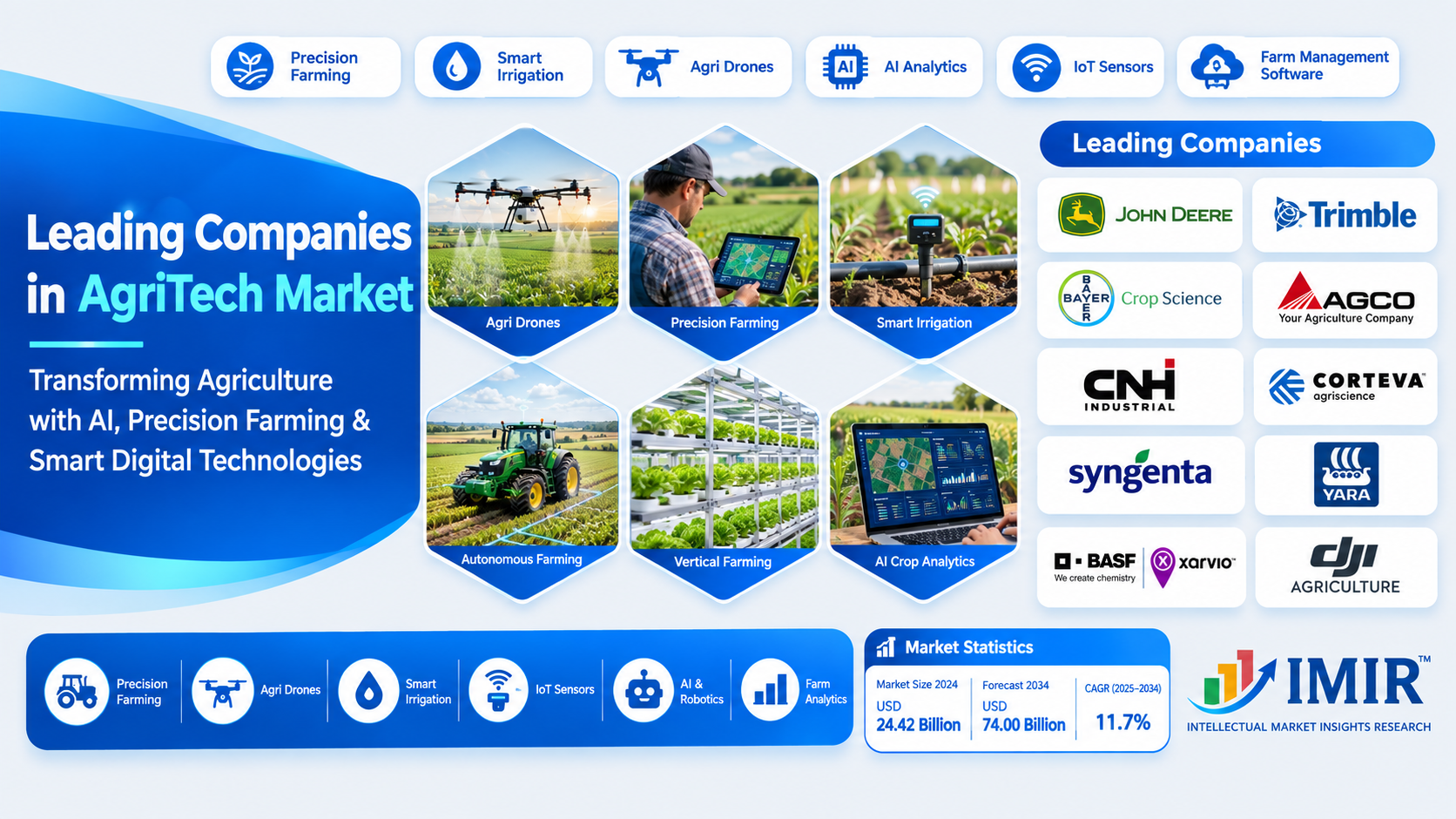
The agritech market size was valued at around USD 24.42 billion in 2024 and is expected to reach a value of USD 74 billion by 2034, growing at a CAGR of 11.7% over the forecast period (2025–2034), according to IMIR Market Research. Growth is being driven by rising demand for precision agriculture, growing adoption of autonomous farm equipment, expanding IoT and sensor-based crop monitoring, and mounting pressure to improve resource efficiency in the face of climate change and shrinking arable land.
Market Overview
| Parameter | Details |
|---|---|
| Market Size (2024) | USD 24.42 Billion |
| Projected Market Size (2034) | USD 74 Billion |
| CAGR (2025–2034) | 11.7% |
| Forecast Period | 2025–2034 |
| Leading Region | North America (largest revenue share); Asia-Pacific (fastest growth) |
| Key Segments (by Type) | Precision Agriculture, Data Analytics, Robotics and Automation, IoT Sensors, Genetic Engineering |
| Key Segments (by Application) | Farm Management, Crop Monitoring, Supply Chain Optimization, Market Access |
Why the Agritech Market Is Growing
1. Rising Global Food Demand and Population Growth
The world's population continues to climb toward a projected 9.7–9.8 billion by 2050, intensifying demand for agricultural productivity gains that agritech solutions such as precision farming and data analytics are uniquely positioned to deliver.
2. Growing Adoption of Precision Agriculture
Technologies including GPS-guided equipment, variable-rate application, and satellite imagery analytics are allowing farmers to optimize input use, reduce waste, and improve yields, driving sustained investment in precision agriculture platforms.
3. Expansion of Autonomous Farm Equipment
Rising adoption of autonomous tractors, robotic weeders, and self-driving farm machinery is helping address persistent agricultural labor shortages while improving operational efficiency across large-scale farming operations.
4. Proliferation of IoT Sensors and Big Data Analytics
Widespread deployment of IoT-enabled soil, weather, and crop-health sensors, combined with advanced data analytics platforms, is enabling farmers to make more informed, real-time decisions about irrigation, fertilization, and pest management.
5. Increasing Government Support and Policy Incentives
Governments across North America, the European Union, and South Asia continue to incorporate digital agriculture initiatives into national food security strategies, providing sustained, policy-backed demand for agritech adoption.
6. Growing Investment in Agritech Startups
Rising venture capital and strategic investment in agritech startups developing IoT crop intelligence, vertical farming, and AI-driven advisory tools continues to accelerate innovation and market expansion across the sector.
Market Opportunities & Restraints
A key opportunity lies in autonomous robotics and AI-driven farm management platforms: as labor shortages persist and farmers seek to reduce input waste, equipment manufacturers and software providers have significant opportunity to expand affordable autonomous robotics and integrated data platforms that combine IoT sensing, satellite imagery, and AI-driven advisory tools into a single farm management ecosystem. On the restraint side, high initial investment costs and limited access to technology infrastructure remain the primary headwind, as sophisticated agritech equipment and platforms require substantial upfront capital that can be prohibitive for smallholder and resource-constrained farmers, particularly in emerging markets lacking reliable connectivity and digital infrastructure.
Leading Companies in the Agritech Market
Below is a table of the top leading agritech companies, along with their company details.
| Company | Headquarters | Founded | Employees | Revenue | Overview |
|---|---|---|---|---|---|
| Deere & Company (John Deere) | Moline, Illinois, USA | 1837 | Approx. 73,100 (2025) | Approx. USD 45.7 Billion (fiscal 2025) | The clear market leader in the global agritech space, commanding an estimated 15–18% share through advanced solutions such as autonomous tractors and the John Deere Operations Center, a farm data platform connecting more than 400 million acres worldwide. Its tight integration between precision agriculture technology and dominant equipment market share (over 50% of the U.S. tractor market) has made its data platform a central battleground for agricultural input companies seeking farmer relationships. |
| Trimble Inc. (PTx Trimble) | Westminster, Colorado, USA | 1978 | Several thousand | Multi-billion dollar diversified positioning and technology company | Recognized for its GPS technologies and field analytics, historically following John Deere as a leading precision agriculture technology provider. In September 2023, AGCO announced it would acquire an 85% stake in Trimble's agriculture business, creating a new joint venture called PTx Trimble, which closed in April 2024, consolidating two major precision agriculture technology players under shared ownership. |
| Bayer Crop Science (Bayer AG) | Monheim am Rhein, Germany | 2013 (following the Monsanto acquisition lineage) | Tens of thousands (division of Bayer AG) | Multi-billion dollar division of Bayer AG | Holds an estimated 8–10% share of the agritech market through its Climate FieldView platform, which integrates data analytics with on-field applications to offer predictive analytics for crop performance and pest management. Expanded FieldView's availability in Europe with AI-enhanced capabilities, reinforcing its position as a leading digital agronomy provider. |
| AGCO Corporation | Duluth, Georgia, USA | 1990 | Approx. 22,000–27,900 | Approx. USD 10.4 Billion (trailing twelve months) | Contributes an estimated 7–9% of the agritech market through its Fendt, Massey Ferguson, and Valtra brands, integrating IoT and telemetry into its agricultural machinery under its PTx precision agriculture umbrella. Its 2023–2024 acquisition of an 85% stake in Trimble's agriculture business, forming PTx Trimble, significantly expanded its precision agriculture technology capabilities. |
| CNH Industrial N.V. | Basildon, UK (operational HQ: Amsterdam, Netherlands) | 2013 (merger of Fiat Industrial and CNH Global) | Tens of thousands | Multi-billion dollar diversified equipment company | Through its New Holland and Case IH brands, holds a significant share of the global agritech market, providing telematics and data-driven solutions across its equipment lineup. Continues to invest in precision agriculture technology as part of its broader strategy spanning agricultural and construction equipment. |
| Corteva, Inc. (Corteva Agriscience) | Indianapolis, Indiana, USA | 2018/2019 (spun off from DowDuPont) | Approx. 21,500 (2025) | Approx. USD 17.4 Billion (2025) | Formed from the DowDuPont spinoff combining Dow AgroSciences and DuPont's agricultural division, focuses on digital agronomy, seed technology, and sustainable agricultural solutions through its Granular farm management software and Pioneer Hi-Bred seed business. |
| Kubota Corporation | Osaka, Japan | 1890 | Tens of thousands (group-wide) | Multi-billion dollar diversified agricultural and industrial equipment company | One of the top farm machinery companies globally, holding a significant share alongside Deere, CNH Industrial, and AGCO in the global agricultural equipment and agritech space. Continues to expand its precision agriculture and digital farming technology portfolio, including through its majority-owned Indian subsidiary Escorts Kubota Limited. |
| Syngenta AG | Basel, Switzerland | 2000 (Syngenta Group formed 2020) | Approx. 50,000+ across the Syngenta Group | Approx. USD 17.0 Billion | A global agricultural technology leader spanning crop protection, seeds, and digital agronomy solutions, competing directly with Bayer Crop Science and Corteva in the seed technology and crop protection segments of the agritech landscape while expanding its biologicals and precision agriculture capabilities. |
Competitive Landscape
The global agritech market brings together large diversified farm equipment manufacturers, agricultural biotechnology majors, and specialized precision agriculture technology providers. Farm equipment leaders John Deere, AGCO, CNH Industrial, and Kubota hold particularly strong positions, together capturing an estimated 45–50% of the global farm machinery market, built on decades of manufacturing scale and increasingly sophisticated telematics and autonomous equipment technology. Agricultural biotechnology and crop science majors Bayer Crop Science, Corteva, and Syngenta compete through digital agronomy platforms, seed technology, and crop protection solutions that integrate data analytics directly into farming decision-making. The market's structure continues to evolve through consolidation, exemplified by AGCO's 2023–2024 acquisition of an 85% stake in Trimble's agriculture business to form the PTx Trimble joint venture, illustrating how equipment manufacturers are acquiring precision agriculture technology capabilities to strengthen their competitive positioning against John Deere's dominant, tightly integrated data platform.
Regional Analysis
North America
North America holds the largest agritech market share, supported by extensive farm mechanization, early adoption of precision agriculture technology, and the presence of major manufacturers such as John Deere, AGCO, and Corteva.
Europe
Europe represents a significant agritech market, anchored by major players such as Bayer Crop Science, Syngenta, and CNH Industrial, alongside strong regulatory and policy support for sustainable and digital agriculture initiatives across the European Union.
Asia-Pacific
Asia-Pacific is expected to register the fastest growth, driven by expanding agricultural mechanization, rising government investment in digital agriculture, and the presence of major regional manufacturers such as Kubota Corporation and its Indian subsidiary Escorts Kubota.
Latin America & Middle East and Africa
Latin America and the Middle East & Africa represent emerging growth markets for agritech, with adoption tied to expanding large-scale farming operations, growing precision agriculture investment, and increasing government support for agricultural modernization.
Emerging Trends in the Agritech Market
1. Consolidation Between Equipment Manufacturers and Precision Ag Technology Providers: AGCO's acquisition of an 85% stake in Trimble's agriculture business, forming PTx Trimble, illustrates a broader trend of farm equipment manufacturers acquiring specialized precision agriculture technology companies to compete more effectively with John Deere's integrated data platform.
2. Growth of Autonomous and Affordable Robotics: Falling costs for computer vision-equipped autonomous robots, such as solar-powered weeding robots that fell below USD 50,000 in 2025, are opening agritech adoption to mid-sized farms that previously relied on manual labor.
3. Expansion of Farm Data Platform Competition: Rising competition for the "farmer data platform relationship" among John Deere Operations Center, Bayer's Climate FieldView, and Corteva's Granular software reflects the growing strategic importance of data as a driver of seed, fertilizer, and chemical recommendation influence.
4. Rise of Vertical Farming and Controlled Environment Agriculture: Growing investment in vertical farming and controlled environment agriculture, exemplified by Walmart's 2023 partnership with Plenty Inc. to introduce vertically farmed produce across hundreds of U.S. stores, is expanding agritech applications beyond traditional field-based farming.
5. Increasing AI Integration in Farm Management Software: Platforms such as IBM's Watson Decision Platform for Agriculture illustrate the broader trend of AI-driven predictive analytics and weather forecasting becoming central to modern farm management software offerings.
Future Outlook (2025–2034)
The global agritech market's trajectory toward USD 74 billion by 2034 reflects sustained demand growth driven by rising global food demand, climate-driven resource efficiency pressure, and continued digitization of farming operations worldwide. The 11.7% CAGR forecast through 2034 assumes continued precision agriculture adoption, expanding autonomous equipment penetration, and sustained government policy support for digital agriculture initiatives across major and emerging markets.
Key investment themes for 2025–2034 include continued consolidation between equipment manufacturers and precision agriculture technology providers, following the pattern set by AGCO's PTx Trimble joint venture, growing competition among farm data platforms led by John Deere, Bayer, and Corteva, and expanding affordability of autonomous robotics bringing agritech adoption to mid-sized and smallholder farms. As precision agriculture, autonomous robotics, and AI-driven farm management continue to reshape the industry, the companies that combine manufacturing scale with data platform innovation will be best positioned to capture growth through 2034.
Frequently Asked Questions (FAQ)
1. What is the current size of the global agritech market?
The agritech market size was valued at around USD 24.42 billion in 2024 and is expected to reach a value of USD 74 billion by 2034, growing at a CAGR of 11.7% over the forecast period 2025–2034, according to IMIR Market Research.
2. Who are the top companies in the agritech market?
Leading companies include Deere & Company (John Deere), Trimble Inc. (now PTx Trimble), Bayer Crop Science, AGCO Corporation, CNH Industrial N.V., Corteva, Inc., Kubota Corporation, and Syngenta AG.
3. Which region dominates the agritech market?
North America holds the largest agritech market share, while Asia-Pacific is expected to register the fastest growth due to expanding agricultural mechanization and rising government investment in digital agriculture.
4. What is the forecast CAGR for the agritech market?
The market is forecast to grow at a CAGR of 11.7% from 2025 to 2034.
5. What are the main growth drivers for this market?
Key drivers include rising global food demand and population growth, growing adoption of precision agriculture, expansion of autonomous farm equipment, proliferation of IoT sensors and big data analytics, and increasing government support and policy incentives.
6. What technologies make up the agritech market?
The market spans precision agriculture, data analytics, robotics and automation, IoT sensors, and genetic engineering technologies applied across farm management, crop monitoring, supply chain optimization, and market access applications.
7. What is driving consolidation in the agritech market?
Consolidation is being driven by equipment manufacturers seeking to acquire precision agriculture technology capabilities, exemplified by AGCO's acquisition of an 85% stake in Trimble's agriculture business to form the PTx Trimble joint venture, as companies compete for the strategic farmer data platform relationship.
Conclusion
The global agritech market sits at the intersection of rising global food demand and the accelerating digitization of farming operations worldwide. With a projected size of USD 74 billion by 2034 at an 11.7% CAGR, the market offers strong, technology-driven growth across precision agriculture, robotics, and data analytics segments.
John Deere continues to lead the market on the strength of its dominant equipment market share and tightly integrated Operations Center data platform, while AGCO, CNH Industrial, and Kubota compete through their own precision agriculture technology investments, and Bayer Crop Science, Corteva, and Syngenta bring deep digital agronomy and seed technology expertise. As consolidation between equipment manufacturers and precision ag technology providers, autonomous robotics affordability, and AI-driven farm management continue to reshape the industry, the companies that combine manufacturing scale with data platform innovation will define market leadership through 2034 and beyond.