
Global Battery Recycling Market, Top Companies, Trends, and Future Outlook
Author:
Intellectual Market Insights Research
Published Date:
03 Oct 2026
Global Battery Recycling Market: Top Companies, Trends, and Future Outlook
Introduction
Battery recycling is the process of recovering critical metals, including lithium, cobalt, nickel, manganese, and lead, from end-of-life batteries and manufacturing scrap, converting what would otherwise be hazardous waste into valuable, reusable materials for new battery production. As electric vehicle adoption accelerates and the first generation of EV batteries begins reaching end-of-life, battery recycling has evolved from a niche environmental service into a strategically critical industry for securing domestic supply chains of battery metals and reducing dependence on mined, often geopolitically concentrated raw materials.
The global battery recycling market spans lead-acid, lithium-ion, nickel-metal hydride, and other battery chemistries, recovered from automotive, consumer electronics, industrial, and grid-scale energy storage sources, processed through hydrometallurgical, pyrometallurgical, and direct recycling methods. This article provides a research-based analysis of the global battery recycling market, the companies shaping it, and the consolidation and technological forces driving its growth toward 2034.
Market Overview
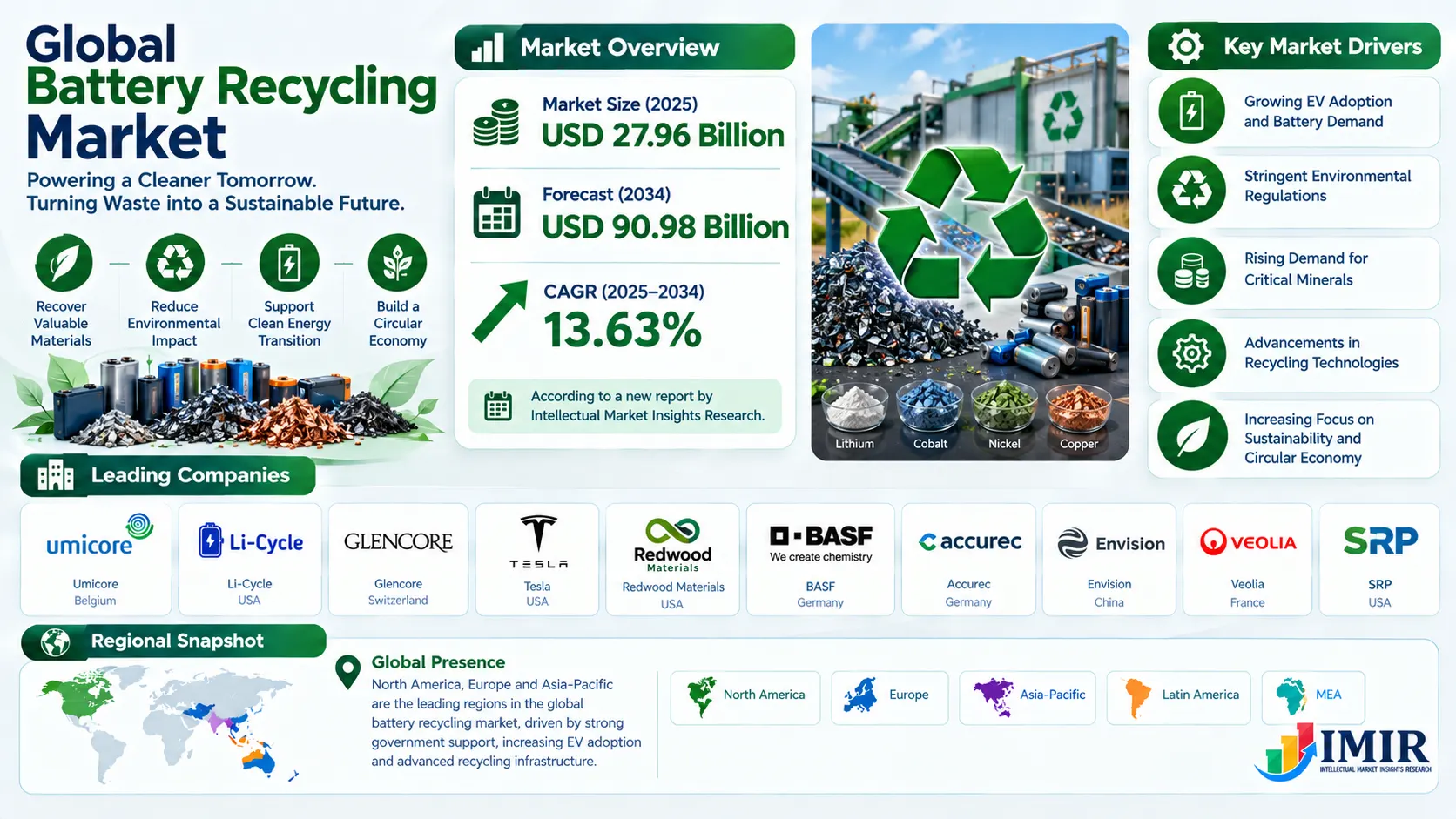
Global Battery Recycling Market size was valued at USD 27.96 Billion in 2025 and is projected to reach USD 90.98 Billion by 2034, growing at a CAGR of 13.63% from 2025 to 2034, according to a new report by Intellectual Market Insights Research.
| Parameter | Details |
|---|---|
| Market Size (2025) | USD 27.96 Billion |
| Projected Market Size (2034) | USD 90.98 Billion |
| CAGR (2025–2034) | 13.63% |
| Forecast Period | 2025–2034 |
| Leading Region | Asia-Pacific (dominant, approx. 34% share, led by China's EV ecosystem); North America & Europe (fast-growing, policy-driven) |
| Key Segments (by Chemistry) | Lithium-ion, Lead-Acid, Nickel-Metal Hydride, Others |
| Key Segments (by Source) | Automotive, Consumer Electronics, Industrial, Energy Storage Systems |
| Key Segments (by Recycling Process) | Hydrometallurgical, Pyrometallurgical, Direct Recycling |
Note on market concentration: independent industry data suggests this market remains notably fragmented, with the top 10 players accounting for well under 20% of total market revenue by some estimates, reflecting the large number of regional recyclers and the relatively early, rapidly consolidating stage of the industry's development.
Why the Battery Recycling Market Is Growing
1. Rising Volumes of End-of-Life Electric Vehicle Batteries
The first wave of mass-market electric vehicles sold in the early-to-mid 2010s is now approaching end-of-life, creating a rapidly growing volume of spent lithium-ion batteries that must be processed, directly expanding the addressable market for recyclers.
2. Critical Minerals Supply Chain Security Concerns
Growing geopolitical concern over the concentration of lithium, cobalt, and nickel supply chains in a small number of countries is pushing governments and automakers to invest in domestic battery recycling capacity as a strategic alternative to new mining.
3. Government Mandates and Recycling Regulations
Regulatory mandates, such as the EU Battery Regulation requiring minimum recycled content in new batteries, are compelling manufacturers to secure reliable recycled material supply chains, directly driving demand for battery recycling capacity.
4. Scaling of Direct Recycling and Advanced Recovery Technologies
Companies are increasingly scaling hydrometallurgical and direct-recycling technologies to increase recovery efficiency and lower processing costs, improving the economics of battery recycling relative to virgin material extraction.
5. Strategic Partnerships Between Automakers and Recyclers
Partnerships such as Redwood Materials' relationships with Panasonic, Ford, Volkswagen, Volvo, Toyota, and Amazon illustrate the industry's shift toward integrated, closed-loop supply chains connecting automakers directly with recycling and materials refining partners.
6. Growth of Battery Energy Storage System (BESS) End-of-Life Volumes
As grid-scale battery energy storage deployments from the early 2020s begin reaching end-of-life, an emerging new volume source is developing alongside automotive batteries, further expanding the market's long-term addressable base.
Market Opportunities & Restraints
A key opportunity lies in second-life battery repurposing and integrated materials production: companies that successfully extend battery value beyond simple material recovery, as demonstrated by Redwood Materials' 2025 launch of Redwood Energy, which deploys repurposed EV battery packs as grid-scale energy storage for AI data centers before those batteries eventually enter the recycling pipeline, can capture an additional, higher-margin revenue stream while maximizing the useful life of each battery. On the restraint side, industry consolidation risk and execution challenges remain a notable headwind, as illustrated vividly by Northvolt's November 2024 Chapter 11 bankruptcy filing (followed by a Swedish bankruptcy filing in March 2025) despite having raised over USD 14 billion in funding, demonstrating that even well-capitalized, high-profile battery companies face substantial execution risk in scaling complex manufacturing and recycling operations, a cautionary signal for the broader industry's growth trajectory.
Companies Associated with the Battery Recycling Market
| Company | Headquarters | Founded | Employees | Revenue | Overview |
|---|---|---|---|---|---|
| Redwood Materials, Inc. | Carson City, Nevada, USA | 2017 | Approx. 1,100–1,600 | Approx. USD 200–485 Million | Largest North American Li-ion recycler; launched Redwood Energy (2025) for repurposed battery grid storage. |
| Li-Cycle Holdings Corp. (Glencore) | Toronto, Ontario, Canada | 2016 | Approx. 384+ | Not separately disclosed | "Spoke and Hub" recycling model; acquired by Glencore in 2025, including facilities in 5 countries. |
| Umicore | Brussels, Belgium | 2001 | Approx. 10,200–11,150 | Approx. EUR 3.6 Billion | Market leader with 15%+ share (2025); proprietary "pyro-hydro" process; 150,000-tonne EU facility planned by 2026. |
| Ecobat | Irving, Texas, USA | 1888/2019 | Several thousand | Not publicly disclosed | Top-5 global recycler; expanded from lead-acid into lithium-ion battery recycling. |
| American Battery Technology Company | Reno, Nevada, USA | 2011 | Several hundred | 400%+ YoY growth (recent disclosures) | Integrated critical minerals recycler; received DOC approval for $100M black mass export. |
| Lyten, Inc. | San Jose, California, USA | 2015 | Not publicly disclosed | Not publicly disclosed (private) | Lithium-sulfur specialist; acquired bankrupt Northvolt's European assets in 2025. |
| Exide Industries Limited | Kolkata, India | 1947 | Several thousand | Multi-billion (local currency) | Indian battery manufacturer and recycler across lead-acid and growing lithium-ion segments. |
| EnerSys | Reading, Pennsylvania, USA | 2000 | Approx. 10,000–11,000 | Approx. USD 3.6 Billion (FY2025) | Industrial battery and energy storage company with recycling technology capabilities. |
| Fortum Oyj | Espoo, Finland | 1998 | Several thousand | Multi-billion dollar diversified company | Finnish energy company with hydrometallurgical Li-ion recycling facilities in Scandinavia. |
| Glencore plc | Baar, Switzerland | 1974 | Approx. 150,000+ (group) | Multi-billion dollar mining/commodities giant | Global mining giant entered battery recycling via its 2025 acquisition of Li-Cycle. |
Competitive Landscape
The global battery recycling market is moderately-to-highly fragmented, with the top 10 players collectively accounting for a relatively modest share of total market revenue by some estimates, reflecting the industry's still-early, rapidly consolidating stage of development. Umicore currently holds the clear leadership position, with over 15% share of the lithium-ion battery recycling segment in 2025, built on more than a century of mining and smelting heritage combined with its proprietary pyro-hydro recovery process. Redwood Materials has established itself as the dominant North American player, leveraging deep automaker relationships (Panasonic, Ford, Volkswagen, Toyota) and an estimated 70% U.S. market share as of mid-2025. The competitive landscape is being actively reshaped by major M&A activity: Glencore's 2025 acquisition of Li-Cycle brought a major mining and commodities conglomerate directly into battery recycling, while Lyten's 2025 acquisition of bankrupt Northvolt's European assets illustrates how recycling and advanced battery material companies are opportunistically absorbing failed competitors' manufacturing infrastructure. Diversified industrial players EnerSys, Exide Industries, and Ecobat bring established battery manufacturing expertise into the recycling segment, while regional specialists such as Fortum (Scandinavia) and American Battery Technology Company (U.S.) compete through geographic focus and government-backed critical minerals initiatives.
Regional Analysis
Asia-Pacific
Asia-Pacific accounted for the largest share of the battery recycling market, at approximately 34%, benefiting from the world's largest EV manufacturing ecosystem, strong government recycling mandates, and rapidly growing volumes of end-of-life lithium-ion battery packs, with China's CATL and other major battery makers also active in the recycling value chain through subsidiaries such as Guangdong Brunp Recycling Technology.
North America
North America represents a fast-growing battery recycling market, anchored by Redwood Materials, Li-Cycle (now under Glencore), and American Battery Technology Company, supported by U.S. policy incentives favoring domestic critical minerals production and reduced reliance on imported battery materials.
Europe
Europe represents a significant but recently disrupted battery recycling market following Northvolt's November 2024 and March 2025 bankruptcy filings, a major setback for the region's ambitions of homegrown battery production and recycling capacity; Fortum in Scandinavia and Lyten's newly acquired Polish and Swedish facilities (from the Northvolt bankruptcy) remain key regional players, alongside Umicore's planned 150,000-tonne European recycling facility by 2026.
Latin America & Middle East and Africa
Latin America and the Middle East & Africa represent emerging growth markets for battery recycling, with adoption tied to expanding EV infrastructure investment and growing government emphasis on critical minerals supply chain development.
Emerging Trends in the Battery Recycling Market
1. Major Industry Consolidation Through M&A: Glencore's 2025 acquisition of Li-Cycle represents a significant consolidation event, bringing a major global mining and commodities conglomerate directly into the battery recycling value chain.
2. Distressed Asset Acquisition Following Industry Shakeout: Lyten's 2025 acquisition of bankrupt Northvolt's European manufacturing and energy storage assets illustrates how the industry's overall growth masks significant individual company risk, with well-funded market entrants also facing potential failure.
3. Expansion into Second-Life Battery Energy Storage: Redwood Materials' June 2025 launch of Redwood Energy, repurposing EV battery packs for grid-scale AI data center energy storage, reflects a broader industry trend of extracting additional value from batteries before final material recycling.
4. Scaling of Domestic Critical Minerals Production: American Battery Technology Company's reported 400%+ year-over-year revenue growth and U.S. Department of Commerce-approved black mass export sales reflect growing government and private investment in domestic critical minerals recycling infrastructure.
5. Technology Investment in Hydrometallurgical and Direct Recycling: Key players continue scaling hydrometallurgical and direct-recycling technologies to increase recovery efficiency and lower processing costs, improving the underlying economics of battery recycling.
Future Outlook (2025–2034)
The global battery recycling market's trajectory toward USD 90.98 billion by 2034 reflects sustained demand growth driven by rising end-of-life EV battery volumes, critical minerals supply chain security concerns, and continued regulatory support for recycled content requirements. The 13.63% CAGR forecast through 2034 assumes continued industry consolidation, further scaling of hydrometallurgical and direct recycling technologies, and successful navigation of the execution risks highlighted by Northvolt's 2024–2025 bankruptcy.
Key investment themes for 2025–2034 include integration execution following Glencore's acquisition of Li-Cycle and Lyten's acquisition of Northvolt's European assets, continued technology leadership by Umicore and Redwood Materials, and growing domestic critical minerals production supported by government policy in the U.S., EU, and China. As industry consolidation, second-life battery applications, and domestic supply chain security continue to reshape the market, the companies that combine proven recycling technology with disciplined execution will be best positioned to capture growth through 2034, a lesson underscored by Northvolt's cautionary collapse.
Frequently Asked Questions (FAQ)
1. What is the current size of the global battery recycling market?
Global Battery Recycling Market size was valued at USD 27.96 billion in 2025 and is projected to reach USD 90.98 billion by 2034, growing at a CAGR of 13.63% from 2025 to 2034, according to a new report by Intellectual Market Insights Research.
2. Who are the top companies in the battery recycling market?
Leading companies include Redwood Materials, Inc., Li-Cycle Holdings Corp. (now part of Glencore), Umicore, Ecobat, American Battery Technology Company, Lyten, Inc., Exide Industries Limited, EnerSys, Fortum Oyj, and Glencore plc.
3. Which region dominates the battery recycling market?
Asia-Pacific accounted for the largest share of the market at approximately 34%, benefiting from the world's largest EV manufacturing ecosystem, while North America and Europe represent fast-growing, policy-driven markets.
4. What is the forecast CAGR for the battery recycling market?
The market is forecast to grow at a CAGR of 13.63% from 2025 to 2034.
5. What are the main growth drivers for this market?
Key drivers include rising volumes of end-of-life electric vehicle batteries, critical minerals supply chain security concerns, government mandates and recycling regulations, scaling of direct recycling and advanced recovery technologies, and strategic partnerships between automakers and recyclers.
6. What happened to Northvolt, and how does it affect the battery recycling market?
Northvolt, a Swedish battery manufacturer previously cited among leading industry players, filed for Chapter 11 bankruptcy in the U.S. in November 2024 and for bankruptcy in Sweden in March 2025. Its European battery manufacturing and energy storage assets were subsequently acquired by U.S. startup Lyten in 2025, illustrating significant execution risk even among well-funded industry participants.
7. What major acquisition recently reshaped the battery recycling market?
In 2025, mining and commodities giant Glencore acquired Li-Cycle Holdings Corp., a major lithium-ion battery recycler, in a deal including facilities in Germany, Arizona, Alabama, New York, and Ontario.
Conclusion
The global battery recycling market sits at the intersection of accelerating electric vehicle adoption and the critical need for secure, domestic battery materials supply chains. With a projected size of USD 90.98 billion by 2034 at a 13.63% CAGR, the market offers strong, policy- and technology-driven growth, though Northvolt's dramatic 2024–2025 bankruptcy serves as a stark reminder that rapid growth projections do not eliminate significant execution risk for individual companies.
Umicore and Redwood Materials continue to lead through proven recycling technology and deep automaker relationships, while major consolidation activity, Glencore's acquisition of Li-Cycle and Lyten's acquisition of Northvolt's European assets, is actively reshaping the competitive landscape. As second-life battery applications, domestic critical minerals production, and continued industry consolidation reshape the market, the companies that combine proven technology with disciplined execution will define market leadership through 2034 and beyond.