
Leading Companies in the Global Bio Plasticizers Market
Author:
Intellectual Market Insights Research
Published Date:
07 Oct 2026
Global Bio Plasticizers Market: Top Companies, Trends, and Future Outlook
Introduction
Bio plasticizers are renewable, plant- and bio-based additives used to impart flexibility, softness, and workability to plastics, primarily PVC, as a safer and more sustainable alternative to traditional phthalate-based plasticizers. Derived from feedstocks such as vegetable oils, citrates, succinic acid, and epoxidized soybean oil (ESBO), bio plasticizers address growing health and environmental concerns around conventional phthalate plasticizers, which face increasing regulatory restriction across major markets due to links to endocrine disruption and other health risks.
The global bio plasticizers market spans epoxidized soybean oil (ESBO), citrates, castor oil-based, succinic acid, and other bio-based plasticizer types, used across packaging materials, medical devices, consumer goods, wires and cables, building and construction, and automotive applications. This article provides a research-based analysis of the global bio plasticizers market, the companies shaping it, and the regulatory and technological forces driving its growth toward 2028 and beyond.
Market Overview
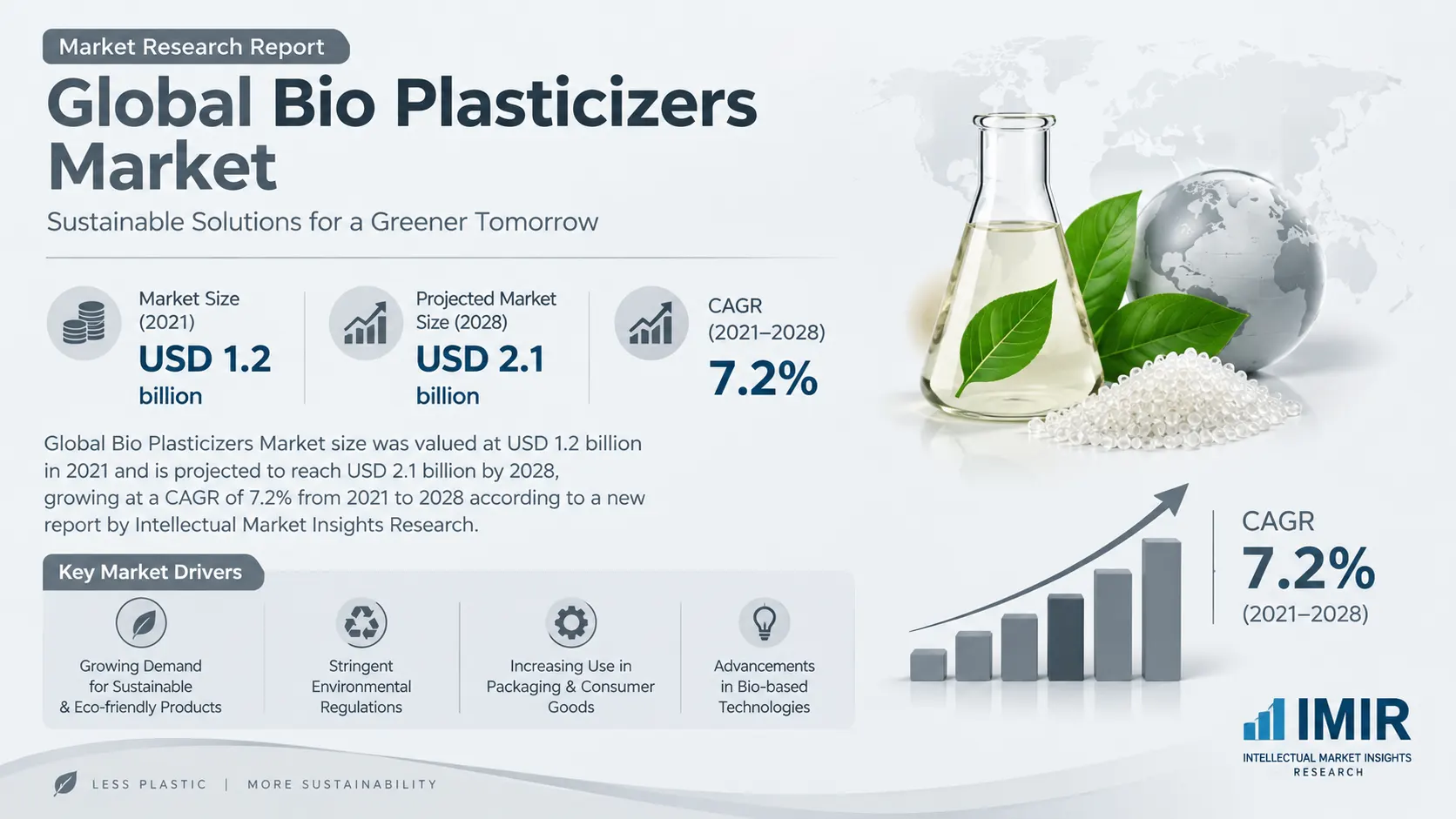
Global Bio Plasticizers Market size was valued at USD 1.2 Billion in 2021 and is projected to reach USD 2.1 Billion by 2028, growing at a CAGR of 7.2% from 2021 to 2028, according to a new report by Intellectual Market Insights Research.
| Parameter | Details |
|---|---|
| Market Size (2021) | USD 1.2 Billion |
| Projected Market Size (2028) | USD 2.1 Billion |
| CAGR (2021–2028) | 7.2% |
| Forecast Period | 2021–2028 |
| Leading Region | Europe (strong regulatory-driven demand); Asia-Pacific (fastest growth, led by China and India) |
| Key Segments (by Type) | Epoxidized Soybean Oil (ESBO), Citrates, Castor Oil-Based, Succinic Acid, Others |
| Key Segments (by Application) | Packaging Materials, Medical Devices, Consumer Goods, Wires & Cables, Building & Construction, Automotive & Transportation, Others |
Additional context worth noting: independent market research estimates for bio plasticizers vary by scope and forecast window, with some providers citing figures in the USD 3+ billion range for more recent base years (2025–2026) and projecting growth toward USD 5–8 billion by the early-to-mid 2030s at CAGRs ranging from roughly 6% to 9%. This confirms the general growth trajectory and mid-single-digit-to-high-single-digit CAGR range used in the figures above are consistent with the broader research consensus for this market.
Why the Bio Plasticizers Market Is Growing
1. Health Risk Awareness Around Conventional Phthalate Plasticizers
The key driver for the global bio plasticizers market is the growing awareness about the health risks of conventionally used plasticizers, such as phthalates, pushing manufacturers and consumers toward safer, bio-based alternatives.
2. Stringent Regulatory Restrictions on Traditional Plasticizers
Regulatory restrictions on conventional phthalate-based plasticizers across major markets, including the European Union and the United States, have accelerated the shift toward bio-based alternatives that meet tightening chemical safety standards.
3. Continued Use of Bio Plasticizers in Widely Popular Polymers
The use of bio plasticizers in widely popular polymers such as PVC remains a crucial driver for the global bio plasticizers market, as PVC continues to dominate flexible plastic applications across packaging, medical devices, and construction.
4. Rising Demand from Packaging, Construction, and Medical Device Manufacturers
Strong demand from packaging, construction, and medical device manufacturers seeking safer material solutions continues to drive adoption, as these industries increasingly prioritize non-toxic, biodegradable material inputs.
5. Growing Consumer Awareness Regarding Health and Sustainability
Rising consumer awareness regarding health and sustainability further supports adoption of bio plasticizers, as environmental impact reduction while maintaining polymer flexibility and durability becomes an increasingly important purchasing consideration.
6. Technological Advancements in Bio-Based Formulations
Continued research and development of bio plasticizers with superior properties, including improved heat resistance and biodegradability, is helping these materials achieve performance parity with conventional phthalate-based alternatives.
Market Opportunities & Restraints
A key opportunity lies in ISCC PLUS-certified and biomass-balanced product innovation: manufacturers offering biomass-balanced grades that match the performance of conventional plasticizers while cutting carbon intensity, along with vertically integrated feedstock supply strategies that insulate margins from price volatility, stand to capture premium positioning as medical device, automotive, and construction customers increasingly require ISO 10993-tested, certified sustainable material inputs. On the restraint side, high cost of bio plasticizers relative to conventional alternatives remains the primary headwind, as bio-based feedstocks and specialized production processes typically result in meaningfully higher per-unit costs than petroleum-derived phthalate plasticizers, limiting adoption among price-sensitive manufacturers and markets despite growing regulatory and consumer pressure favoring bio-based alternatives.
Companies Associated with the Bio Plasticizers Market (Details in Table)
| Company | Headquarters | Founded | Employees | Revenue | Overview |
|---|---|---|---|---|---|
| BASF SE | Ludwigshafen am Rhein, Germany | 1865 | Approx. 111,000 | Approx. EUR 65 Billion (total company) | Offers ISCC PLUS-certified, biomass-balanced bio-plasticizer grades matching conventional performance with lower carbon intensity. |
| The Dow Chemical Company | Midland, Michigan, USA | 1897/2019 | Approx. 36,000 | Multi-billion dollar diversified company | One of the earliest and most consistently cited bio plasticizer market participants across independent research. |
| Evonik Industries AG | Essen, Germany | 2007 | Approx. 31,000 | Approx. EUR 14.1 Billion (2025) | Offers bio-plasticizers for food packaging, medical devices, and automotive components. |
| Cargill, Incorporated | Minnetonka, Minnesota, USA | 1865 | Approx. 155,000 | Approx. USD 154 Billion (2025) | Vertically integrated soybean supply chain insulates ESBO bio-plasticizer margins from price volatility. |
| Eastman Chemical Company | Kingsport, Tennessee, USA | 1920/1994 | Approx. 13,000–14,000 | Approx. USD 8.8 Billion (2025) | Global specialty materials company competing on performance-validated, bio-based plasticizer grades. |
| Avient Corporation | Avon Lake, Ohio, USA | 2000/2020 | Approx. 9,200 | Approx. USD 3.28 Billion | Formerly PolyOne; expanded sustainable solutions via 2020 Clariant acquisition and 2022 DSM Protective Materials deal. |
| Solvay S.A. | Brussels, Belgium | 1863 | Approx. 9,000 | Approx. EUR 4.88 Billion | Tier-2 bio plasticizers player; specialty chemicals following its December 2023 Syensqo demerger. |
| DIC Corporation | Tokyo, Japan | 1908 | Approx. 20,000+ | Multi-billion dollar diversified company | Japanese chemical manufacturer consistently named among leading bio-plasticizers players globally. |
| Emery Oleochemicals LLC | Kuala Lumpur, Malaysia | 1840/2011 | Approx. 1,000+ | Not publicly disclosed | Oleochemicals specialist with strong technical expertise in bio-based plasticizer formulations. |
| LANXESS AG | Cologne, Germany | 2004 | Approx. 12,800+ | Approx. EUR 6.1+ Billion | Bayer spin-off offering sustainability-focused specialty chemical solutions including bio-plasticizers. |
Competitive Landscape
The global bio plasticizers market is moderately fragmented, bringing together large diversified chemical majors, agribusiness giants, and specialty materials companies. Global chemical giants BASF, Dow, and Evonik hold particularly strong positions, built on massive manufacturing scale, extensive R&D infrastructure, and diversified bio-plasticizer portfolios spanning food packaging, medical devices, and automotive applications. Vertically integrated feedstock players such as Cargill enjoy a distinct structural advantage in the ESBO segment, with vertically integrated soybean supply chains insulating margins from feedstock price volatility in a way that pure chemical manufacturers cannot easily replicate. Specialty materials and performance-focused companies Eastman Chemical, Avient, LANXESS, and DIC Corporation compete through performance-validated, bio-based product grades and targeted application certifications, including ISO 10993 medical device testing. Smaller entrants continue to exploit white-space opportunities such as roofing membranes and antimicrobial interior skins, leveraging technical services to guide customers through specialized regulatory testing requirements that larger, more diversified competitors may deprioritize.
Regional Analysis
Europe
Europe represents a strong bio plasticizers market, driven by stringent EU regulatory restrictions on conventional phthalate-based plasticizers and the presence of major European chemical manufacturers including BASF, Evonik, Solvay, and LANXESS, all headquartered in Germany or Belgium.
North America
North America represents a significant bio plasticizers market, anchored by Dow, Cargill, Eastman Chemical, and Avient, supported by growing regulatory scrutiny of phthalates and rising demand from packaging and medical device manufacturers.
Asia-Pacific
Asia-Pacific is expected to register significant growth, driven by rising industrial activity, expanding packaging and construction sectors in China and India, and the presence of major regional manufacturers including DIC Corporation (Japan) and Emery Oleochemicals (Malaysia).
Latin America & Middle East and Africa
Latin America and the Middle East & Africa represent emerging growth markets for bio plasticizers, with adoption tied to expanding packaging and construction industry activity and growing regulatory emphasis on chemical safety standards.
Emerging Trends in the Bio Plasticizers Market
1. Growth of Biomass-Balanced and ISCC PLUS-Certified Products: Manufacturers including BASF are increasingly offering ISCC PLUS-certified, biomass-balanced bio-plasticizer grades that match conventional performance while reducing carbon intensity, appealing to sustainability-focused customers.
2. Vertically Integrated Feedstock Supply Strategies: Companies with vertically integrated feedstock supply chains, such as Cargill's soybean operations, are increasingly positioned to insulate margins from price volatility, a structural advantage that pure chemical manufacturers find difficult to replicate.
3. Expansion into Specialized Medical and Automotive Certifications: Growing emphasis on ISO 10993 testing and automotive and medical certification portfolios is helping manufacturers differentiate performance-validated, bio-based product grades for highly regulated end-use applications.
4. Emergence of Novel High-Performance Bio-Plasticizer Chemistries: Companies are increasingly developing novel bio-plasticizers with improved heat resistance and biodegradability, helping these materials achieve closer performance parity with conventional phthalate-based alternatives.
5. Research Collaboration for Medical-Grade Bio-Based Plastics: Collaborative research initiatives, such as the "Bio_K_Sub" project between Frankfurt University of Applied Sciences and BIOVOX GmbH developing bio-based plastics for infusion bags, blood bags, and medical tubing, illustrate growing academic-industry partnership in advancing medical-grade bio-plasticizer applications.
Future Outlook (2025–2034)
Building on the underlying report's original 2021–2028 forecast window (USD 1.2 billion in 2021 to USD 2.1 billion by 2028 at a 7.2% CAGR), the market's growth momentum is expected to continue through 2034 as tightening phthalate regulations, growing sustainability awareness, and continued bio-based formulation innovation remain long-term structural growth drivers. Extending the trend, continued mid-to-high single-digit growth would be supported by expanding medical device and automotive certification requirements, growing biomass-balanced and certified sustainable product adoption, and continued regulatory pressure on conventional phthalate plasticizers across major markets.
Key investment themes for 2025 and beyond include continued biomass-balanced and certified sustainable product innovation by global majors such as BASF, Dow, and Evonik, structural feedstock advantages for vertically integrated players such as Cargill, and continued performance-validated product development by specialty players such as Eastman Chemical, Avient, and LANXESS. As regulatory tightening, sustainability certification requirements, and novel bio-based chemistries continue to reshape the industry, the companies that combine manufacturing scale with certified, performance-validated bio-based formulations will be best positioned to capture growth through 2034.
Frequently Asked Questions (FAQ)
1. What is the current size of the global bio plasticizers market?
Global Bio Plasticizers Market size was valued at USD 1.2 billion in 2021 and is projected to reach USD 2.1 billion by 2028, growing at a CAGR of 7.2% from 2021 to 2028, according to a new report by Intellectual Market Insights Research.
2. Who are the top companies in the bio plasticizers market?
Leading companies include BASF SE, The Dow Chemical Company, Evonik Industries AG, Cargill, Incorporated, Eastman Chemical Company, Avient Corporation, Solvay S.A., DIC Corporation, Emery Oleochemicals LLC, and LANXESS AG.
3. Which region dominates the bio plasticizers market?
Europe represents a strong bio plasticizers market driven by stringent EU regulatory restrictions on conventional phthalate-based plasticizers, while Asia-Pacific is expected to register significant growth driven by rising industrial activity in China and India.
4. What is the forecast CAGR for the bio plasticizers market?
The market is forecast to grow at a CAGR of 7.2% from 2021 to 2028, according to IMIR Market Research.
5. What are the main growth drivers for this market?
Key drivers include growing health risk awareness around conventional phthalate plasticizers, stringent regulatory restrictions on traditional plasticizers, continued use of bio plasticizers in popular polymers such as PVC, rising demand from packaging and medical device manufacturers, and growing consumer awareness regarding health and sustainability.
6. What types of bio plasticizers are covered in this market?
The market is segmented by type into epoxidized soybean oil (ESBO), citrates, castor oil-based plasticizers, succinic acid, and other bio-based plasticizer types.
7. What applications does the bio plasticizers market serve?
Bio plasticizers are primarily used in packaging materials, medical devices, consumer goods, wires and cables, building and construction, and automotive and transportation applications.
Conclusion
The global bio plasticizers market sits at the intersection of tightening phthalate regulation and growing demand for sustainable, non-toxic plastic additives. With a projected size of USD 2.1 billion by 2028 at a 7.2% CAGR, the market offers steady, regulation-driven growth across packaging, medical device, and construction applications.
BASF, Dow, and Evonik continue to lead on the strength of massive manufacturing scale and diversified bio-plasticizer portfolios, while Cargill's vertically integrated soybean supply chain provides a distinct structural advantage in the ESBO segment, and specialty players Eastman Chemical, Avient, LANXESS, and DIC Corporation compete through performance-validated, certified product development. As biomass-balanced certification, specialized medical and automotive qualifications, and novel high-performance chemistries continue to reshape the industry, the companies that combine manufacturing scale with sustainable innovation will define market leadership through 2034 and beyond.