
Leading Companies in the Global Biochemical Analyzer Market 2025
Author:
Intellectual Market Insights Research
Published Date:
12 Sep 2026
Introduction
Behind nearly every routine blood test, liver panel, or metabolic screening ordered by a doctor sits a biochemical analyzer, quietly running thousands of chemical reactions a day to measure everything from glucose and cholesterol to liver enzymes and kidney function. These instruments form the backbone of clinical chemistry laboratories worldwide, converting a small vial of blood or serum into the quantitative data that underpins modern diagnosis and treatment decisions.
The global biochemical analyzer market was valued at approximately USD 4.4 billion in 2025 and is projected to reach USD 7.25 billion by 2034, expanding at a compound annual growth rate (CAGR) of 5.7% over the forecast period. Growth is being driven by rising demand for routine and preventive diagnostic testing, expanding laboratory automation, and growing healthcare infrastructure investment across both developed and emerging markets.
The competitive landscape is dominated by large, diversified in vitro diagnostics (IVD) companies that combine deep analytical chemistry expertise with global distribution and service networks, alongside specialist manufacturers that compete on cost efficiency and regional market depth. Because biochemical analyzers must deliver consistent, clinical-grade accuracy across thousands of daily tests while integrating smoothly into laboratory information systems, the market rewards companies that combine instrument reliability with strong reagent and consumables businesses that generate recurring, razor-and-blade-style revenue.
Understanding which companies lead this foundational diagnostics market is essential for hospital laboratories, reference labs, and healthcare systems investing in clinical chemistry infrastructure. This article provides a research-based analysis of the top companies in the global biochemical analyzer market, their positioning, flagship offerings, and the technological and competitive forces shaping the landscape.
Market Overview
|
Parameter |
Details |
|---|---|
|
Market Size (2025) |
USD 4.4 Billion |
|
Projected Market Size (2034) |
USD 7.25 Billion |
|
CAGR (2025–2034) |
5.7% |
|
Key Growth Drivers |
Rising demand for routine diagnostic testing, growing laboratory automation, expanding healthcare infrastructure in emerging markets |
|
Key Challenges |
High instrument acquisition and maintenance costs, pricing pressure from centralized procurement programs in some regions |
|
Key Opportunities |
Point-of-care and compact analyzer growth, AI-enabled quality control, expansion in underserved regional markets |
Why the Biochemical Analyzer Market Is Growing
1. Rising Demand for Routine and Preventive Diagnostic Testing
Growing awareness of preventive healthcare and rising rates of chronic conditions such as diabetes and cardiovascular disease are driving higher volumes of routine blood chemistry testing, sustaining steady demand for biochemical analyzer instruments and reagents.
2. Expanding Laboratory Automation
Hospitals and reference laboratories are increasingly investing in automated, high-throughput biochemical analyzers integrated into total laboratory automation systems, reducing manual handling and improving turnaround times for high test volumes.
3. Growth in Emerging Market Healthcare Infrastructure
Rising healthcare investment across Asia-Pacific, Latin America, and the Middle East is expanding laboratory capacity in previously underserved regions, creating new demand for both benchtop and compact biochemical analyzers.
4. Recurring Reagent and Consumables Revenue
The razor-and-blade business model common in clinical chemistry, where instrument placement drives recurring reagent and consumables sales, continues to incentivize manufacturers to expand their installed base of analyzers globally.
5. Integration with Digital Health and AI Quality Control
Growing integration of biochemical analyzers with laboratory information systems and AI-enabled quality control tools is improving result reliability and supporting more efficient laboratory workflows.
6. Point-of-Care and Compact Analyzer Expansion
Demand for smaller, more affordable biochemical analyzers suited to physician offices, smaller clinics, and decentralized testing settings is expanding the market beyond traditional centralized hospital laboratories.
Top Companies in the Global Biochemical Analyzer Market
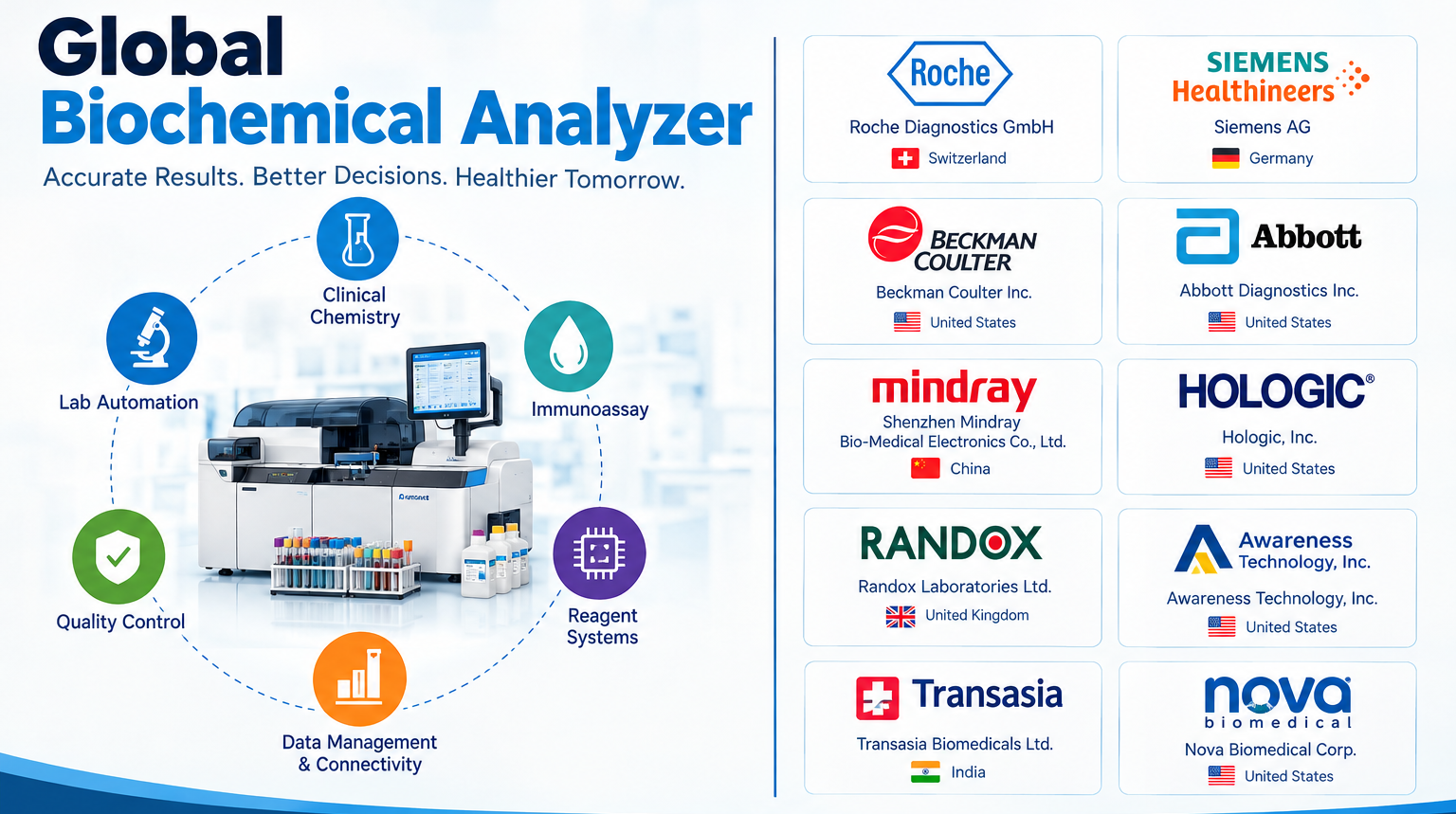
- Roche Diagnostics GmbH
- Siemens AG (Siemens Healthineers)
- Beckman Coulter Inc.
- Abbott Diagnostics Inc.
- Shenzhen Mindray Bio-Medical Electronics Co., Ltd.
- Hologic, Inc.
- Randox Laboratories Ltd.
- Awareness Technology, Inc.
- Transasia Biomedicals Ltd.
- Nova Biomedical Corp.
1. Roche Diagnostics GmbH
|
Category |
Details |
|---|---|
|
Company Name |
Roche Diagnostics GmbH (division of Roche Holding AG) |
|
Headquarters |
Penzberg and Mannheim, Germany (parent Roche headquartered in Basel, Switzerland) |
|
Founded |
Roche founded 1896; Diagnostics division built through decades of organic growth and acquisitions including Ventana |
|
Employees |
Part of Roche's approximately 112,774 global workforce |
|
Revenue |
Roche's Diagnostics division is one of four business areas within a group generating CHF 61.5 Billion in total revenue (FY2025) |
|
Company Overview |
Roche Diagnostics is one of the world's largest in vitro diagnostics companies, with clinical chemistry and immunodiagnostic analyzers forming a core part of its centralized and point-of-care diagnostics portfolio. |
|
Key Products |
Cobas-branded clinical chemistry and immunoassay analyzer platforms used for routine biochemical testing in hospital and reference laboratories worldwide. |
|
Market Position |
A global leader in in vitro diagnostics, leveraging Roche's scale, R&D investment, and long-standing relationships with hospital laboratories across more than 100 countries. |
|
Recent Developments |
Continued expanding its diagnostics assay portfolio, including recent FDA approvals for new companion diagnostic tests, while maintaining its centralized and point-of-care testing infrastructure globally. |
|
Strategic Advantages |
Deep R&D investment capacity backed by one of the world's largest healthcare companies, an extensive global service and distribution network, and a broad diagnostics portfolio spanning chemistry, immunoassay, and molecular testing. |
2. Siemens Healthineers (Siemens AG)
|
Category |
Details |
|---|---|
|
Company Name |
Siemens Healthineers AG (Diagnostics segment; majority owned by Siemens AG) |
|
Headquarters |
Erlangen, Germany |
|
Founded |
2017 (spun off from Siemens AG); diagnostics heritage dating back decades further |
|
Employees |
Approx. 74,000 (group-wide, FY2025) |
|
Revenue |
Approx. €23.4 Billion (group-wide, FY2025); Diagnostics segment revenue of approximately €4.3–4.4 Billion |
|
Company Overview |
Siemens Healthineers' Diagnostics segment provides in vitro diagnostic products and services for laboratory, molecular, and point-of-care diagnostics, including clinical chemistry and biochemical analyzer platforms, as part of a broader medical technology portfolio spanning imaging and advanced therapies. |
|
Key Products |
Atellica and Dimension-branded clinical chemistry and immunoassay analyzer systems used in hospital and reference laboratories. |
|
Market Position |
One of the largest global diagnostics and medical imaging companies, with its Diagnostics segment facing recent performance headwinds tied to centralized procurement pressures in China. |
|
Recent Developments |
Announced that its Diagnostics segment will pursue its own strategy under its own set-up as part of a broader corporate restructuring, following steady sales pressure and margin declines in the segment. |
|
Strategic Advantages |
Extensive global service infrastructure spanning more than 70 countries, deep integration with broader medical imaging and AI capabilities, and a long-standing brand reputation in clinical laboratory diagnostics. |
3. Beckman Coulter Inc.
|
Category |
Details |
|---|---|
|
Company Name |
Beckman Coulter, Inc. (subsidiary of Danaher Corporation) |
|
Headquarters |
Brea, California, United States |
|
Founded |
1935 (as National Technical Laboratories) |
|
Employees |
More than 11,000 global team members |
|
Revenue |
Approx. USD 3 Billion (Beckman Coulter Diagnostics) |
|
Company Overview |
Beckman Coulter is a long-established leader in advanced clinical diagnostics, providing biomedical testing instruments and systems found in hospitals, reference laboratories, and physician office settings around the world. |
|
Key Products |
Synchron and AU-series clinical chemistry analyzers, alongside DxC and DxI series diagnostic instrument platforms spanning chemistry, immunoassay, and hematology testing. |
|
Market Position |
A global leader in advanced diagnostics with more than 80 years of laboratory instrumentation heritage, leveraging Danaher's operational excellence framework, the Danaher Business System, to drive continuous improvement. |
|
Recent Developments |
Continued strengthening its diagnostics leadership team with senior hires bringing deep experience across molecular medicine and cell therapy, reflecting ongoing investment in expanding its clinical testing capabilities. |
|
Strategic Advantages |
Decades of clinical chemistry engineering heritage, the operational rigor of the Danaher Business System, and a broad installed base across hospital and reference laboratory settings worldwide. |
4. Abbott Diagnostics Inc.
|
Category |
Details |
|---|---|
|
Company Name |
Abbott Diagnostics (division of Abbott Laboratories) |
|
Headquarters |
Abbott Park, Illinois, United States |
|
Founded |
Abbott Laboratories founded 1888 |
|
Employees |
Part of Abbott's approximately 114,000+ global workforce; Diagnostics represents roughly 20% of total company revenue |
|
Revenue |
Abbott's Diagnostics business is a multi-billion-dollar segment within a group that reported strong growth across core laboratory diagnostics excluding COVID-19 testing in 2025 |
|
Company Overview |
Abbott Diagnostics provides a broad range of clinical chemistry, immunoassay, and molecular diagnostic testing platforms through its Core Laboratory Diagnostics business, serving hospital and reference laboratories worldwide. |
|
Key Products |
Alinity-branded clinical chemistry and immunoassay analyzer systems designed for high-throughput laboratory testing environments. |
|
Market Position |
A leading global diagnostics company benefiting from solid routine diagnostics demand, with Core Laboratory Diagnostics posting steady growth in recent quarters even as COVID-19 testing revenue has declined. |
|
Recent Developments |
Continued expanding its diagnostics footprint globally, supported by growing demand for routine, non-COVID diagnostic testing across international markets. |
|
Strategic Advantages |
Broad diversification across Abbott's medical devices, diagnostics, and nutrition businesses, a large global commercial infrastructure, and continued investment in expanding routine diagnostics capacity. |
5. Shenzhen Mindray Bio-Medical Electronics Co., Ltd.
|
Category |
Details |
|---|---|
|
Company Name |
Shenzhen Mindray Bio-Medical Electronics Co., Ltd. |
|
Headquarters |
Shenzhen, Guangdong, China |
|
Founded |
1991 |
|
Employees |
Approx. 21,000+ |
|
Revenue |
Approx. USD 5.1 Billion (2024); CNY 33.07 Billion trailing-twelve-month revenue as of Q3 2025 |
|
Company Overview |
Mindray is a leading global provider of medical devices spanning patient monitoring and life support, in vitro diagnostics, and medical imaging, with its diagnostics business covering hematology and chemistry analyzers, chemiluminescence immunoassay systems, and related reagents. |
|
Key Products |
Chemistry and hematology analyzer platforms, chemiluminescence immunoassay products, and total laboratory automation systems serving hospital and reference laboratories globally. |
|
Market Position |
One of the largest Chinese medical device manufacturers and a fast-growing global diagnostics competitor, with international revenue, particularly in Europe, posting strong double-digit growth even as domestic China sales have faced headwinds. |
|
Recent Developments |
Reported continued international expansion with Europe delivering more than 20% year-over-year growth in Q3 2025, helping offset softer domestic performance tied to centralized procurement dynamics in China. |
|
Strategic Advantages |
Cost-competitive manufacturing scale, rapidly expanding international distribution particularly across Europe and emerging markets, and a broad multi-category medical device portfolio spanning diagnostics, monitoring, and imaging. |
Competitive Landscape
The global biochemical analyzer market is led by a concentrated group of large, diversified in vitro diagnostics companies, including Roche Diagnostics, Siemens Healthineers, Beckman Coulter, and Abbott Diagnostics, alongside a fast-growing Chinese competitor in Mindray and a group of specialist manufacturers including Randox Laboratories, Awareness Technology, Transasia Biomedicals, and Nova Biomedical.
Reagent and Consumables Revenue as a Structural Advantage: Because clinical chemistry follows a razor-and-blade business model, companies with the largest installed base of analyzers, such as Roche and Beckman Coulter, benefit from recurring, high-margin reagent and consumables revenue that compounds over an instrument's operating life.
Corporate Restructuring Reshaping the Field: Siemens Healthineers' decision to let its Diagnostics segment pursue its own strategy under its own set-up reflects broader pressure across the industry, as diagnostics units face margin headwinds from centralized procurement programs, particularly in China.
Chinese Manufacturers Gaining International Share: Mindray's strong international revenue growth, especially in Europe, illustrates how cost-competitive Chinese manufacturers are increasingly challenging established Western and Japanese incumbents in global laboratory markets.
Specialist Players Competing on Regional Depth: Companies like Randox Laboratories, Transasia Biomedicals, and Nova Biomedical compete by focusing on specific regional markets or specialized analyzer niches, differentiating from the broader diversified diagnostics conglomerates.
Emerging Trends in the Biochemical Analyzer Market
1. Centralized Procurement Pressure in China: Volume-based public procurement programs in China are compressing pricing and margins for biochemical analyzer and reagent sales, prompting some global diagnostics companies to reassess their China strategy and business structures.
2. Corporate Carve-Outs and Restructuring: Large diversified medical technology companies are increasingly considering carve-outs or independent strategic paths for underperforming diagnostics segments, as seen with Siemens Healthineers' Diagnostics unit.
3. Growth of Compact and Point-of-Care Analyzers: Rising demand for smaller, more affordable analyzers suited to decentralized testing environments is expanding opportunities beyond traditional centralized hospital laboratory settings.
4. International Expansion by Chinese Manufacturers: Companies like Mindray are increasingly directing growth investment toward international markets, particularly Europe, as domestic Chinese procurement dynamics create margin pressure at home.
5. AI-Enabled Laboratory Quality Control: Diagnostics companies are increasingly integrating artificial intelligence into laboratory workflows to improve quality control, flag anomalous results, and support more efficient, automated testing processes.
Future Outlook (2025–2034)
The global biochemical analyzer market's trajectory toward USD 7.25 billion by 2034 reflects steady, foundational demand for clinical chemistry testing even as the competitive landscape continues to evolve. The 5.7% CAGR forecast through 2034 assumes continued growth in routine diagnostic testing volumes, expanding laboratory automation, and continued healthcare infrastructure investment across emerging markets.
Key investment themes include continued expansion of compact and point-of-care analyzer offerings, growing competition from cost-competitive Chinese manufacturers expanding internationally, and potential corporate restructuring among diversified diagnostics companies facing margin pressure in key markets like China. Leading companies including Roche Diagnostics, Beckman Coulter, Abbott Diagnostics, and Mindray are likely to retain strong market positions by combining recurring reagent revenue streams with continued investment in analyzer reliability, automation, and international distribution expansion.
Frequently Asked Questions (FAQ)
1. What is the current size of the global biochemical analyzer market?
The global biochemical analyzer market was valued at approximately USD 4.4 billion in 2025 and is projected to reach USD 7.25 billion by 2034, growing at a CAGR of 5.7%.
2. Who are the top companies in the biochemical analyzer market?
Leading companies include Roche Diagnostics, Siemens Healthineers (Siemens AG), Beckman Coulter, Abbott Diagnostics, Shenzhen Mindray Bio-Medical Electronics, Hologic, Randox Laboratories, Awareness Technology, Transasia Biomedicals, and Nova Biomedical.
3. What is the forecast CAGR for the biochemical analyzer market?
The market is forecast to grow at a CAGR of 5.7% from 2025 to 2034.
4. What are the main growth drivers for this market?
Key drivers include rising demand for routine and preventive diagnostic testing, expanding laboratory automation, and growing healthcare infrastructure investment in emerging markets.
5. Why are some diagnostics companies facing margin pressure?
Centralized, volume-based public procurement programs, particularly in China, have compressed pricing for biochemical analyzers and reagents, prompting companies like Siemens Healthineers to reconsider the strategic structure of their diagnostics segments.
6. How is the competitive landscape shifting in this market?
Cost-competitive Chinese manufacturers like Mindray are gaining international market share, particularly in Europe, even as established Western diagnostics companies navigate pricing pressure and potential restructuring in certain regional markets.
7. What role do reagents play in the biochemical analyzer business model?
Clinical chemistry follows a razor-and-blade business model, where instrument placement drives ongoing, high-margin reagent and consumables sales, making installed base size a key competitive advantage for leading manufacturers.
Conclusion
The global biochemical analyzer market sits at the foundation of modern clinical diagnostics, supporting the routine blood chemistry testing that underpins millions of medical decisions every day. With a projected size of USD 7.25 billion by 2034 at a 5.7% CAGR, the sector offers steady, if moderate, growth potential for companies that can combine reliable instrument performance with the recurring reagent revenue that makes clinical chemistry a durable, high-margin business.
Established leaders like Roche Diagnostics, Beckman Coulter, and Abbott Diagnostics continue to leverage their large installed bases and global service networks, while Siemens Healthineers navigates a strategic reset for its Diagnostics segment and Mindray demonstrates how cost-competitive Chinese manufacturers are increasingly winning share in international markets. The companies that successfully balance instrument innovation, recurring reagent revenue, and adaptation to shifting regional procurement dynamics will define market leadership through 2034 and beyond.