
Leading Companies of Bispecific Antibody Market
Author:
Intellectual Market Insights Research
Published Date:
07 Sep 2026
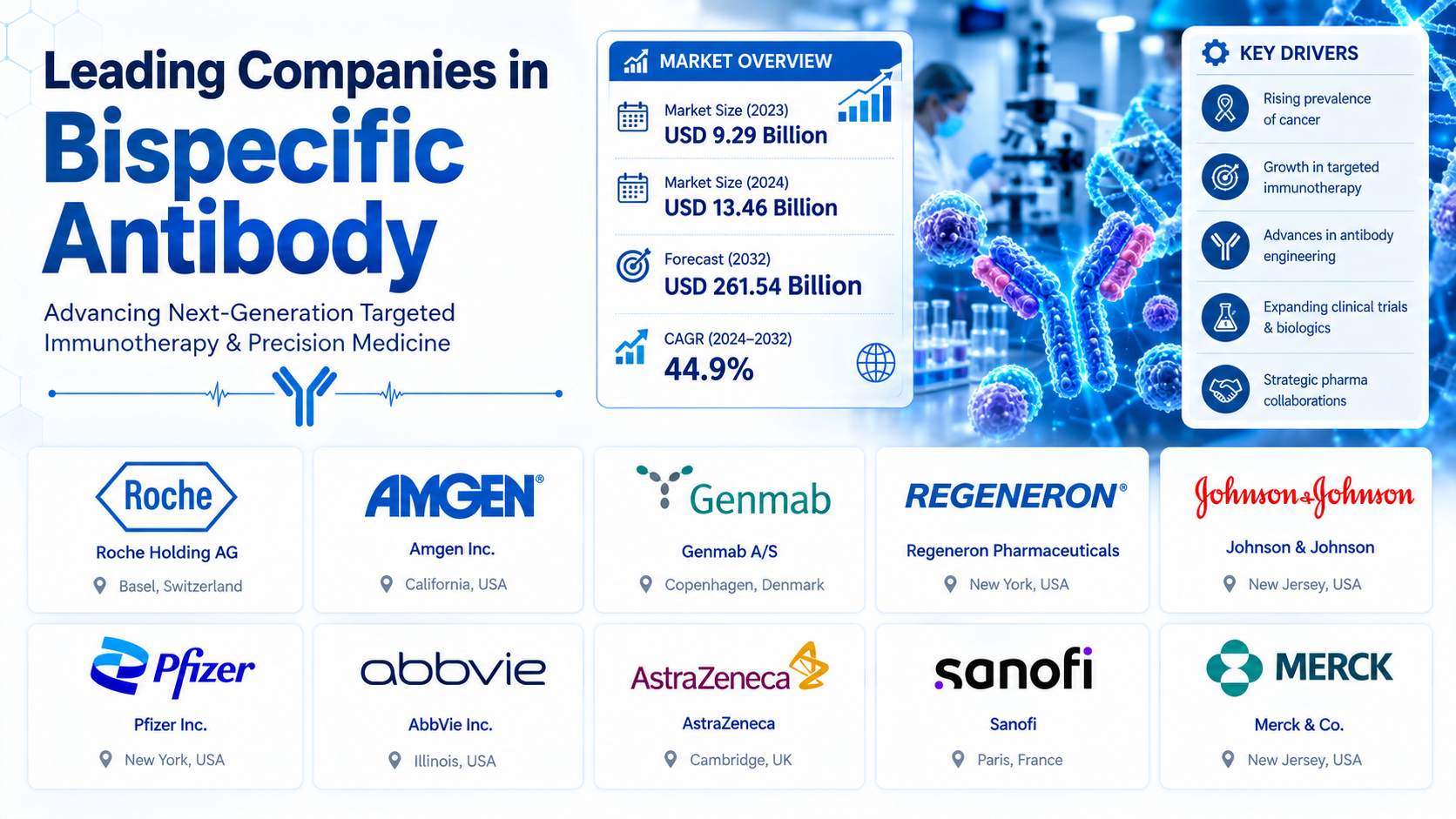
Top Companies in the World Offering Bispecific Antibodies
Bispecific antibodies are engineered proteins capable of binding two different antigens or epitopes simultaneously, giving them therapeutic advantages that traditional monoclonal antibodies cannot match. By redirecting immune cells directly to tumor cells, blocking multiple signaling pathways at once, or neutralizing diverse disease mediators, bispecific antibodies have become a backbone technology for next-generation treatments in oncology, immunology, and beyond.
The global bispecific antibody market was valued at USD 9.29 billion in 2023 and is poised to grow from USD 13.46 billion in 2024 to USD 261.54 billion by 2032, growing at a compound annual growth rate (CAGR) of 44.9% from 2024 to 2032. Growth is being driven by groundbreaking advances in antibody engineering platforms such as DuoBody, CrossMab, and knob-in-hole technology, a wave of breakthrough regulatory approvals validating bispecific mechanisms in oncology and hematology, and expanding applications beyond cancer into autoimmune, inflammatory, and infectious disease treatment.
The competitive landscape is anchored by large global pharmaceutical and biotechnology leaders including Roche/Genentech, Amgen, Sanofi, and Johnson & Johnson's Janssen, alongside fast-rising innovators such as Akeso, and a broader base of specialized biopharmaceutical companies advancing bispecific pipelines. This article provides a research-based analysis of the top companies shaping the global bispecific antibody market, their positioning, flagship offerings, and the regional and technological forces driving the industry forward.
Market Overview
|
Parameter |
Details |
|---|---|
|
Market Size (2023) |
USD 9.29 Billion |
|
Market Size (2024) |
USD 13.46 Billion |
|
Projected Market Size (2032) |
USD 261.54 Billion |
|
CAGR (2024–2032) |
44.9% |
|
Base Year |
2023 |
|
Historic Year |
2019–2022 |
|
Forecast Period |
2024–2032 |
|
Leading Region |
North America |
|
Key Segments (by Indication) |
Cancer, Inflammatory & Autoimmune Disorder, Others |
|
Key Segments (by Distribution Channel) |
Hospital Pharmacies, Retail Pharmacies, Drugstores, Online Pharmacies |
Why the Bispecific Antibody Market Is Growing
Revolutionary Advancements in Antibody Engineering
Cutting-edge platforms such as DuoBody, CrossMab, and knob-in-hole design have improved the assembly, stability, and manufacturability of bispecific antibodies, allowing them to precisely target two different antigens simultaneously and enhancing therapeutic outcomes across cancer, autoimmune diseases, and infectious diseases.
Breakthrough Regulatory Approvals of Bispecific Therapies
Landmark approvals, such as blinatumomab for acute lymphoblastic leukemia, have demonstrated strong clinical efficacy and built confidence among researchers, investors, and healthcare providers. Expedited regulatory pathways, including Breakthrough Therapy Designation and Priority Review from agencies like the FDA and EMA, are accelerating the journey of promising bispecific candidates from trial to market.
Expanding Applications Beyond Oncology
While bispecific antibodies first gained prominence in cancer therapy, their ability to bind two different antigens simultaneously is opening opportunities in autoimmune diseases such as rheumatoid arthritis, lupus, and multiple sclerosis, as well as in infectious disease treatment, where dual-target neutralization can block multiple points of pathogen entry.
Integration of AI and Computational Biology
The application of artificial intelligence and computational biology to antibody design is improving epitope targeting, reducing off-target effects, and simplifying production processes, accelerating the path from discovery to clinical use.
Growing Pharma-Biotech Collaboration
Strategic alliances and acquisitions between large pharmaceutical companies and biotechnology innovators are accelerating the discovery-to-commercialization pipeline by combining complementary antibody engineering capabilities.
Strong Momentum in Hematologic and Solid Tumor Indications
Bispecific T-cell engagers (BiTEs) that reposition T-cells alongside cancer cells to enhance immune response have driven a surge of research and investment across a widening range of cancer types, from hematologic malignancies to solid tumors.
Market Opportunities & Restraints
A key opportunity lies in expanding bispecific antibody applications beyond oncology: the versatility of dual-antigen targeting is opening new therapeutic frontiers in autoimmune, inflammatory, and infectious diseases, addressing complex immunological pathways that single-target monoclonal antibodies cannot fully reach, while advances in AI-driven target discovery are expanding the pool of viable bispecific candidates. On the restraint side, potential safety concerns and off-target effects remain the primary headwind, as the dual-antigen cross-linking mechanism raises the risk of unintended interactions with non-targeted tissues, including cytokine release syndrome from T-cell-engaging bispecific antibodies, requiring extensive safety evaluation, sophisticated engineering strategies, and costly, time-consuming regulatory review before these therapies can reach patients.
Top Companies in the Bispecific Antibody Market
- Roche (Genentech)
- Amgen Inc.
- Sanofi S.A.
- Johnson & Johnson (Janssen)
- Akeso, Inc.
- Portola Pharmaceuticals
- Taisho Pharmaceutical
- Immunocore
Roche (Genentech)
|
Category |
Details |
|---|---|
|
Company Name |
F. Hoffmann-La Roche Ltd (Genentech, a wholly owned member of the Roche Group) |
|
Headquarters |
Basel, Switzerland (Genentech: South San Francisco, California, USA) |
|
Founded |
1896 (Roche); 1976 (Genentech) |
|
Employees |
Approx. 103,000 (Roche Group); approx. 11,900 (Genentech) |
|
Revenue |
Approx. CHF 62.4 Billion (total company revenue) |
|
Company Overview |
Roche is a global pharmaceuticals and diagnostics leader whose Genentech subsidiary pioneered antibody-based cancer therapy and continues to develop bispecific antibody candidates across oncology and neurology. |
|
Key Products |
Hemlibra (bispecific antibody for hemophilia A), NXT007 (next-generation bispecific in clinical development), and the investigational Brainshuttle bispecific antibody for Alzheimer's disease. |
|
Market Position |
One of the world's leading biopharmaceutical companies, with deep antibody-engineering expertise built through Genentech. |
|
Recent Developments |
Announced plans in 2025 to establish the Roche Genentech Innovation Center Boston, and advanced Phase I/II data on NXT007 showing hemostatic normalization in hemophilia A patients, with Phase III studies expected in 2026. |
|
Strategic Advantages |
Decades of antibody-engineering heritage through Genentech, a broad oncology and neurology pipeline, and substantial R&D investment across bispecific platforms. |
Amgen Inc.
|
Category |
Details |
|---|---|
|
Company Name |
Amgen Inc. |
|
Headquarters |
Thousand Oaks, California, USA |
|
Founded |
1980 |
|
Employees |
Approx. 31,500 |
|
Revenue |
Approx. USD 36.8 Billion (2025) |
|
Company Overview |
Amgen is a major American biotechnology company that pioneered one of the first FDA-approved bispecific T-cell engagers and continues to expand its bispecific pipeline across oncology. |
|
Key Products |
Blincyto (blinatumomab), a bispecific T-cell engager approved for acute lymphoblastic leukemia, and xaluritamig, an investigational bispecific T-cell engager targeting STEAP1 for prostate cancer. |
|
Market Position |
A pioneer of the bispecific T-cell engager (BiTE) technology platform and a top-tier global biotechnology company. |
|
Recent Developments |
In June 2024, the FDA approved an expanded indication for blinatumomab in adult and pediatric patients with Ph-negative BCP ALL in the consolidation phase of chemotherapy; the company continues to advance Phase 3 trials of xaluritamig in prostate cancer. |
|
Strategic Advantages |
Proprietary BiTE antibody engineering platform (strengthened by its Teneobio acquisition), a validated regulatory track record, and a broad oncology-focused development pipeline. |
Sanofi S.A.
|
Category |
Details |
|---|---|
|
Company Name |
Sanofi S.A. |
|
Headquarters |
Paris, France |
|
Founded |
1973 |
|
Employees |
Approx. 82,000–90,000 |
|
Revenue |
Approx. EUR 43.6 Billion (2025) |
|
Company Overview |
Sanofi is a global biopharmaceutical company that has repositioned itself as a focused, pure-play biopharma organization, with bispecific antibodies among its core modalities alongside monoclonal antibodies, antibody-drug conjugates, and Nanobody technology. |
|
Key Products |
A pipeline of bispecific antibody candidates spanning immunology and oncology, developed alongside its Nanobody single-domain antibody platform gained through the Ablynx acquisition. |
|
Market Position |
A top global biopharmaceutical company with a diversified modality portfolio spanning small molecules, biologics, and next-generation antibody formats. |
|
Recent Developments |
Completed the separation of its consumer healthcare division (Opella) in 2025 to sharpen its focus on immunology, vaccines, and advanced biologics, including its bispecific and multispecific antibody pipeline. |
|
Strategic Advantages |
A diversified antibody-engineering toolkit spanning bispecifics and Nanobody formats, strong immunology franchise experience through Dupixent, and global commercial reach. |
Johnson & Johnson (Janssen)
|
Category |
Details |
|---|---|
|
Company Name |
Johnson & Johnson (Innovative Medicine / Janssen) |
|
Headquarters |
New Brunswick, New Jersey, USA (Janssen: Beerse, Belgium) |
|
Founded |
1886 (Johnson & Johnson); 1953 (Janssen) |
|
Employees |
Approx. 138,000 (Johnson & Johnson Group) |
|
Revenue |
Approx. USD 94.2 Billion (total company, 2025) |
|
Company Overview |
Johnson & Johnson's Innovative Medicine division, through Janssen, has developed some of the first approved bispecific T-cell engager antibodies for multiple myeloma. |
|
Key Products |
Tecvayli (teclistamab), the first bispecific T-cell engager antibody approved for relapsed or refractory multiple myeloma, and talquetamab, a bispecific antibody in the same disease area. |
|
Market Position |
A leading global pharmaceutical company with an established multiple myeloma bispecific antibody franchise. |
|
Recent Developments |
Received conditional marketing authorization for teclistamab from the European Medicines Agency in July 2022 and filed a Biologics License Application for talquetamab with the FDA; also acquired global rights to Numab Therapeutics' bispecific candidate NM26 for atopic dermatitis. |
|
Strategic Advantages |
Deep hematology-oncology commercial infrastructure, an established regulatory track record for bispecific approvals, and continued pipeline expansion through licensing and acquisitions. |
Akeso, Inc.
|
Category |
Details |
|---|---|
|
Company Name |
Akeso, Inc. |
|
Headquarters |
Zhongshan, Guangdong Province, China |
|
Founded |
2012 |
|
Employees |
Approx. 3,000–3,800 |
|
Revenue |
Approx. USD 490 Million (trailing twelve months) |
|
Company Overview |
Akeso is a Chinese biopharmaceutical company built around bispecific antibody discovery, using its proprietary Tetrabody technology and ACE end-to-end R&D platform to develop a broad pipeline of antibody therapeutics. |
|
Key Products |
Cadonilimab, the world's first approved PD-1/CTLA-4 bispecific antibody for tumor immunotherapy, and ivonescimab (PD-1/VEGF bispecific), which beat pembrolizumab head-to-head in a randomized Phase III lung cancer trial. |
|
Market Position |
A fast-rising global bispecific antibody innovator, with ivonescimab's ex-China rights licensed to Summit Therapeutics for development across the U.S., Canada, Europe, and Japan. |
|
Recent Developments |
Ivonescimab received breakthrough therapy designations from China's National Medical Products Administration, and its Phase III head-to-head data against pembrolizumab has drawn significant global oncology attention. |
|
Strategic Advantages |
Proprietary Tetrabody bispecific antibody platform, a deep pipeline of more than 50 drug candidates including 15 bispecific and multispecific assets, and a global partnership model that extends its reach beyond China. |
Competitive Landscape
The global bispecific antibody market brings together a broad and diverse set of competitors. Large global pharmaceutical majors Roche (Genentech), Amgen, Sanofi, and Johnson & Johnson (Janssen) hold particularly strong positions, built on decades of antibody-engineering R&D, established regulatory track records, and deep oncology and immunology commercial infrastructure. Fast-rising biotechnology innovators such as Akeso are reshaping the competitive landscape with proprietary bispecific platforms and global licensing partnerships that extend their reach into Western markets. A broader base of specialized biopharmaceutical companies, including Immunocore, Taisho Pharmaceutical, and Portola Pharmaceuticals, compete through niche indication focus, novel antibody engineering formats, and targeted strategic collaborations across the fragmented global bispecific pipeline.
Regional Analysis
North America
North America dominates the global bispecific antibody market, supported by advanced healthcare infrastructure, strong FDA support for expedited approval pathways, substantial R&D investment from large biopharmaceutical companies, and high prevalence of cancer and autoimmune diseases driving demand for advanced targeted therapies.
Europe
Europe represents a significant bispecific antibody market, supported by strong regulatory frameworks through the EMA, established biopharmaceutical manufacturing infrastructure, and growing clinical adoption of bispecific therapies for oncology and hematologic malignancies.
Asia-Pacific
Asia-Pacific is expected to register significant growth, driven by the presence of key bispecific antibody innovators in economies such as China and Japan, expanding clinical trial infrastructure, and rising government support for domestic biopharmaceutical innovation.
Latin America & Middle East and Africa
Latin America and the Middle East & Africa remain emerging markets for bispecific antibody therapies, with growth tied to improving healthcare access, expanding oncology treatment infrastructure, and increasing participation in global clinical trials.
Emerging Trends in the Bispecific Antibody Market
1. Expansion Beyond Oncology: Growing research into bispecific antibodies for autoimmune, inflammatory, and infectious diseases is broadening the addressable market beyond cancer, targeting conditions such as rheumatoid arthritis, lupus, and multiple sclerosis.
2. AI-Driven Antibody Design: Integration of artificial intelligence and computational biology into antibody engineering is improving epitope targeting precision, reducing off-target effects, and accelerating candidate discovery.
3. Novel Engineering Platforms: Continued advancement of platforms such as DuoBody, CrossMab, Tetrabody, and knob-in-hole technology is improving the stability, manufacturability, and clinical efficacy of new bispecific antibody candidates.
4. Cross-Border Licensing and Partnerships: Deals such as Akeso's licensing of ivonescimab to Summit Therapeutics illustrate a growing trend of Chinese biotech innovators partnering with Western companies to accelerate global development and commercialization.
5. Safety-Focused Engineering Refinement: Growing focus on optimizing binding affinities and target selectivity is helping companies mitigate risks such as cytokine release syndrome and off-target effects while preserving therapeutic potency.
Future Outlook (2024–2032)
The global bispecific antibody market's trajectory toward USD 261.54 billion by 2032 reflects one of the fastest growth rates in the biopharmaceutical industry, driven by continued regulatory validation, expanding indications, and accelerating antibody-engineering innovation. The 44.9% CAGR forecast through 2032 assumes sustained approval momentum for bispecific T-cell engagers and checkpoint-targeting bispecifics, growing application beyond oncology into autoimmune and infectious disease treatment, and deepening collaboration between large pharmaceutical companies and biotechnology innovators.
Key investment themes include continued expansion of bispecific T-cell engager platforms, growing integration of AI-driven target discovery, and increasing cross-border licensing activity connecting emerging bispecific innovators with established global commercial infrastructure. Global leaders Roche, Amgen, Sanofi, and Johnson & Johnson are likely to retain strong positions built on antibody-engineering scale and regulatory experience, while Akeso and other rising innovators continue to expand their global footprint through strategic partnerships, and a broader base of specialized companies compete on indication-specific engineering across the fast-growing bispecific antibody pipeline.
Frequently Asked Questions (FAQ)
1. What is the current size of the global bispecific antibody market?
The global bispecific antibody market was valued at USD 9.29 billion in 2023 and is poised to grow from USD 13.46 billion in 2024 to USD 261.54 billion by 2032, at a CAGR of 44.9%.
2. Who are the top companies in the bispecific antibody market?
Leading companies include Roche (Genentech), Amgen Inc., Sanofi S.A., Johnson & Johnson (Janssen), Akeso, Inc., Portola Pharmaceuticals, Taisho Pharmaceutical, and Immunocore.
3. Which region dominates the bispecific antibody market?
North America dominates the market, supported by developed healthcare infrastructure, strong regulatory support from the FDA, and high biopharmaceutical R&D investment.
4. What is the forecast CAGR for the bispecific antibody market?
The market is forecast to grow at a CAGR of 44.9% from 2024 to 2032.
5. What are the main growth drivers for this market?
Key drivers include advancements in antibody engineering platforms, breakthrough regulatory approvals of bispecific therapies, and expanding applications beyond oncology into autoimmune and infectious diseases.
6. Which indication segment leads the bispecific antibody market?
Cancer leads the indication segments, driven by high unmet need in oncology and the clinical success of bispecific T-cell engagers such as blinatumomab and teclistamab.
7. What are bispecific antibodies used for?
Bispecific antibodies are engineered to bind two different antigens or epitopes simultaneously, enabling applications such as redirecting immune cells to attack tumor cells, blocking multiple disease pathways at once, and neutralizing diverse disease mediators across oncology, immunology, and infectious disease treatment.
Conclusion
The global bispecific antibody market sits at the intersection of breakthrough antibody engineering and rising demand for precision-targeted therapies. With a projected size of USD 261.54 billion by 2032 at a 44.9% CAGR, the market represents one of the fastest-growing segments of the biopharmaceutical industry, anchored by expanding applications across oncology, immunology, and infectious disease.
Roche, Amgen, Sanofi, and Johnson & Johnson continue to lead on the strength of decades of antibody-engineering expertise and proven regulatory track records, while innovators like Akeso are reshaping the competitive landscape through proprietary platforms and global licensing partnerships. As AI-driven antibody design, novel engineering platforms, and expanding non-oncology applications reshape the industry, the companies that combine deep antibody-science expertise with global commercial and regulatory reach will define market leadership through 2032 and beyond.