
Leading Companies in the Global BOPET Film Market 2025
Author:
Intellectual Market Insights Research
Published Date:
31 Aug 2026
Introduction
From the crinkly wrapper on a bag of chips to the insulating layer inside a solar panel back sheet, biaxially oriented polyethylene terephthalate (BOPET) film has quietly become one of the most versatile materials in modern manufacturing. Produced by stretching polyester film in two directions to boost its strength, clarity, and barrier properties, BOPET film combines high tensile strength, chemical stability, transparency, and excellent resistance to moisture and gases a combination that has made it indispensable across food and beverage packaging, pharmaceuticals, electronics, and renewable energy applications.
The global BOPET film market generated approximately USD 18.84 billion in revenue in 2025 and is projected to reach USD 31.52 billion by 2034, expanding at a compound annual growth rate (CAGR) of nearly 5.97% over the forecast period. Growth is being driven by rising demand for sustainable and flexible packaging, expanding consumer electronics production, and the growing food and beverage trade's need for materials that protect shelf life without adding bulk or weight.
The competitive landscape blends large diversified chemical and materials conglomerates with dedicated polyester film specialists that have built deep expertise in extrusion, stretching, and heat-setting processes across thin and thick film grades. Because BOPET film performance depends on precise control of raw material quality and energy-intensive production processes, the market rewards manufacturers that combine large-scale capacity with technical differentiation in specialty and high-barrier film grades.
Understanding which companies lead this materials-science-driven market is essential for packaging converters, electronics manufacturers, and solar module producers alike. This article provides a research-based analysis of the top companies in the global BOPET film market, their positioning, flagship offerings, and the regional and technological forces shaping the competitive landscape.
Market Overview
|
Parameter |
Details |
|---|---|
|
Market Size (2025) |
USD 18.84 Billion |
|
Projected Market Size (2034) |
USD 31.52 Billion |
|
CAGR (2025–2034) |
5.97% |
|
Base Year |
2024 |
|
Historic Period |
2019–2023 |
|
Forecast Period |
2025–2034 |
|
Leading Region |
Asia-Pacific |
|
Fastest-Growing Region |
Asia-Pacific, at a CAGR of around 7% |
|
Key Growth Drivers |
Rising demand for sustainable flexible packaging, growth in consumer electronics, expanding global food and beverage trade |
|
Key Challenges |
High and volatile PET resin raw material costs, energy-intensive extrusion and stretching production processes |
|
Key Opportunities |
Emerging markets in Asia-Pacific and Latin America, growth in solar panel back sheets, thin-film innovation for price-sensitive packaging segments |
Why the BOPET Film Market Is Growing
1. Rising Demand for Sustainable Flexible Packaging
BOPET film's recyclability and light weight make it an increasingly preferred alternative to heavier traditional plastic films, as consumers and industries alike prioritize eco-friendly packaging that also reduces transportation costs and carbon emissions.
2. Expansion of the Consumer Electronics Industry
Growing demand for consumer electronics is driving need for reliable insulation and protective materials, and BOPET film's strong dielectric properties and heat resistance make it well suited to applications such as flexible printed circuits and capacitors.
3. Growth in the Global Food and Beverage Trade
BOPET film's barrier effectiveness against moisture and gases helps extend shelf life and preserve freshness, making it a preferred material as global food trade expands and consumers increasingly favor convenient, well-protected packaging.
4. Expansion of Solar and Renewable Energy Applications
Thick BOPET films are integral to solar panel back sheets, where their mechanical strength and weather resistance provide insulation, and rising investment in renewable energy and electric vehicles is expected to further fuel this demand.
5. Growth in Emerging Markets
Rapid industrialization and urbanization in Asia-Pacific and Latin America are driving rising demand for packaged and processed goods, expanding the addressable market for BOPET films across packaging, electronics, and industrial applications.
6. Innovation in Thin-Film Products
Manufacturers are focusing on advanced thin-film products under 50 microns that minimize weight and cost while preserving barrier properties, catering to price-sensitive segments like snack and frozen food packaging that make up a large share of overall demand.
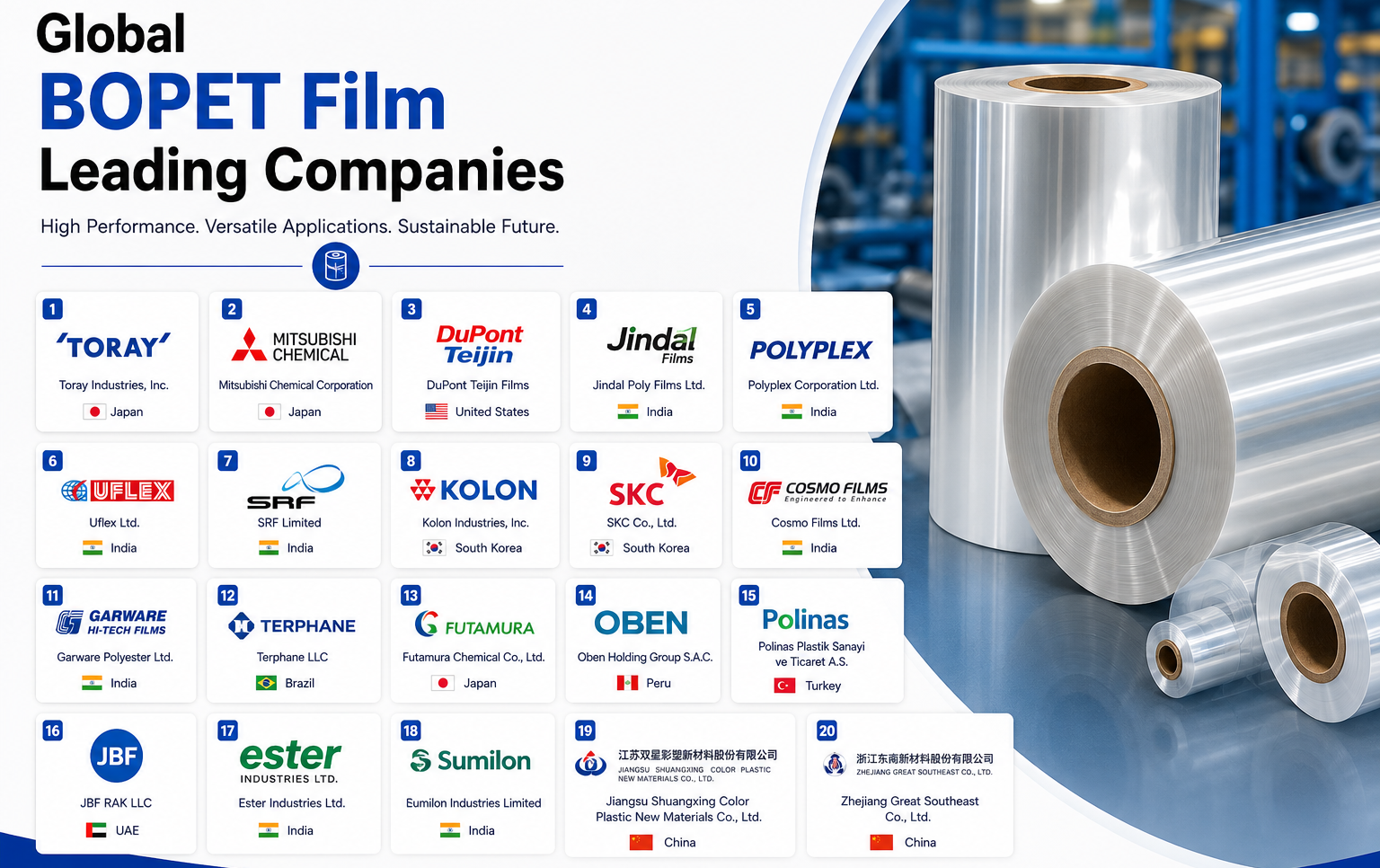
Top Companies in the Global BOPET Film Market
- Toray Industries, Inc.
- Mitsubishi Chemical Corporation
- DuPont Teijin Films
- Jindal Poly Films Ltd.
- Polyplex Corporation Ltd.
- Uflex Ltd.
- SRF Limited
- Kolon Industries, Inc.
- SKC Co., Ltd.
- Cosmo Films Ltd.
1. Toray Industries, Inc.
|
Category |
Details |
|---|---|
|
Company Name |
Toray Industries, Inc. |
|
Headquarters |
Tokyo, Japan |
|
Founded |
1926 |
|
Employees |
Approx. 48,000 (group-wide) |
|
Revenue |
Approx. ¥2.56 Trillion / USD 16.6–16.8 Billion (group-wide, FY2025) |
|
Company Overview |
Toray is a large diversified Japanese materials group whose Functional Chemicals segment manufactures polyester, polyethylene, polypropylene, and other films alongside resins, fine chemicals, and electronic materials, sitting within a broader portfolio spanning textiles, carbon fiber composites, and life sciences. |
|
Key Products |
Polyester (BOPET) films for packaging, industrial, and electronic applications, alongside processed film products serving diverse end markets globally. |
|
Market Position |
One of the world's largest and most diversified materials manufacturers, ranked among the Forbes Global 2000, with global film production and R&D capabilities spanning Japan, China, North America, and Europe. |
|
Recent Developments |
Continued expanding its global film and advanced materials footprint, including joint ventures and partnerships across battery separator films and composite materials, while maintaining a leading position in Japan's functional chemicals sector. |
|
Strategic Advantages |
Century-long materials science heritage, large-scale global manufacturing footprint, and the ability to cross-leverage R&D across its fibers, films, chemicals, and composites businesses. |
2. DuPont Teijin Films
|
Category |
Details |
|---|---|
|
Company Name |
DuPont Teijin Films (DTF) |
|
Headquarters |
Chester, Virginia, United States (50:50 joint venture with global operations) |
|
Founded |
Formed as a joint venture in 2000; over 50 years of combined polyester film heritage |
|
Employees |
Approx. 2,500 globally |
|
Revenue |
Not separately disclosed (joint venture between DuPont and Teijin Limited) |
|
Company Overview |
DuPont Teijin Films is a specialist global producer of PET and PEN polyester films, operating as a 50:50 joint venture between DuPont and Teijin, with manufacturing and technical operations spanning healthcare, alternative energy, electronics, and specialty packaging markets worldwide. |
|
Key Products |
Mylar and Melinex PET polyester films, Teijin Tetoron PET film, and Teonex PEN polyester film, used in electrical insulation, capacitors, solar back sheets, and specialty packaging. |
|
Market Position |
A leading global specialist in differentiated, high-performance polyester films, recognized for its unmatched technology platform and long-standing brand names across multiple industries. |
|
Recent Developments |
Continued close collaboration with partners such as Coveme on PET-based solar back sheet development, as the solar industry shifts away from higher-cost fluoropolymer components toward optimized PET-based constructions. |
|
Strategic Advantages |
Combined R&D strength of two major global materials companies, decades-long brand recognition through Mylar and Melinex, and deep specialization in high-performance film grades for demanding applications. |
3. SRF Limited
|
Category |
Details |
|---|---|
|
Company Name |
SRF Limited |
|
Headquarters |
Gurugram, Haryana, India |
|
Founded |
1970 |
|
Employees |
Approx. 8,000–10,000+ (group-wide) |
|
Revenue |
Approx. ?14,592 Crore / USD 1.6–1.8 Billion (group-wide) |
|
Company Overview |
SRF is a diversified Indian chemicals conglomerate whose Packaging Films business manufactures BOPET and BOPP films alongside a broader portfolio spanning fluorochemicals, specialty chemicals, and technical textiles, with eleven manufacturing plants across India, Thailand, South Africa, and Hungary. |
|
Key Products |
PETLAR-branded BOPET films and OPLAR-branded BOPP films for food packaging, industrial applications, and global converting needs. |
|
Market Position |
Ranked among the top domestic manufacturers of packaging films in India, with the Packaging Films segment posting strong double-digit revenue growth in recent quarters. |
|
Recent Developments |
Expanded its packaging films capabilities through the acquisition of a cast polypropylene film business, while continuing to navigate margin pressure in aluminum foil from lower-cost imports. |
|
Strategic Advantages |
Deep vertical integration with SRF's broader chemicals and technical textiles businesses, an extensive multi-country manufacturing footprint, and a strong domestic leadership position in India's packaging films segment. |
4. Polyplex Corporation Ltd.
|
Category |
Details |
|---|---|
|
Company Name |
Polyplex Corporation Limited |
|
Headquarters |
Noida, Uttar Pradesh, India |
|
Founded |
1984 |
|
Employees |
Approx. 3,000+ across global operations (including Polyplex Thailand) |
|
Revenue |
Approx. USD 800 Million (group-wide, trailing twelve months) |
|
Company Overview |
Polyplex is an Indian multinational and a major global producer of BOPET film, offering a wide range of polymeric films across BOPET (thin and thick), BOPP, cast polypropylene, and blown PP/PE substrates for packaging, electrical and electronic, and industrial applications. |
|
Key Products |
Sarafil-branded BOPET films, Saracote coated films, and Saralam laminated films, sold globally under a portfolio of specialty differentiated film products. |
|
Market Position |
One of the world's largest BOPET film manufacturers by capacity, deriving the majority of its revenue from outside India through a global manufacturing footprint spanning multiple countries. |
|
Recent Developments |
Completed a brownfield expansion of a new BOPET film line and offline coater in the United States in March 2025, described as the world's highest-output PET film line, enhancing cost competitiveness against domestic and offshore suppliers. |
|
Strategic Advantages |
Long-term customer relationships averaging 15–20 years, continuous capacity expansion investments, and a globally diversified manufacturing base that reduces exposure to any single regional market. |
5. Mitsubishi Chemical Corporation
|
Category |
Details |
|---|---|
|
Company Name |
Mitsubishi Chemical Corporation |
|
Headquarters |
Tokyo, Japan |
|
Founded |
1934 |
|
Employees |
Tens of thousands globally (part of Mitsubishi Chemical Group) |
|
Revenue |
Multi-billion-dollar revenue as part of the broader Mitsubishi Chemical Group |
|
Company Overview |
Mitsubishi Chemical Corporation is a major Japanese chemicals and materials company whose polyester film business, including its well-known Hostaphan and Diafoil BOPET film brands, serves packaging, industrial, electrical, and optical applications as part of a much broader global chemicals and advanced materials portfolio. |
|
Key Products |
Polyester (BOPET) films marketed under long-established brand names, used across flexible packaging, electrical insulation, optical, and industrial applications. |
|
Market Position |
A leading global polyester film producer with an extensive international manufacturing and technical service network built up over decades of specialty film development. |
|
Recent Developments |
Continues to invest in its global chemicals and advanced materials portfolio as part of the broader Mitsubishi Chemical Group's ongoing business realignment and specialty materials focus. |
|
Strategic Advantages |
Long-standing global brand recognition in specialty polyester films, deep integration with a large diversified chemicals group, and extensive technical expertise built over decades of film innovation. |
Competitive Landscape
The global BOPET film market is moderately fragmented, spanning large diversified Japanese chemical conglomerates such as Toray Industries and Mitsubishi Chemical, a global specialist joint venture in DuPont Teijin Films, and a cluster of India-based manufacturers including SRF, Polyplex, Jindal Poly Films, Uflex, and Cosmo Films that together represent a major share of global capacity.
Scale and Raw Material Access as a Barrier to Entry: Because BOPET film production is capital- and energy-intensive and highly sensitive to PET resin prices, manufacturers with large-scale, backward-integrated operations hold a structural cost advantage over smaller regional players.
India as a Global Manufacturing Hub: Indian producers including SRF, Polyplex, Jindal Poly Films, and Uflex have built substantial export-oriented capacity, positioning India as a key global supply base for both thin and thick BOPET film grades.
Specialty Film Differentiation: Companies like DuPont Teijin Films and Mitsubishi Chemical compete on high-performance, differentiated film grades for demanding electronics, solar, and healthcare applications, commanding premium pricing over commodity packaging-grade film.
Vertical Integration into Adjacent Materials: Many leading players, such as SRF and Toray, are part of broader diversified conglomerates that let them cross-subsidize R&D and capacity investment across films, chemicals, and other advanced materials businesses.
Regional Analysis
Asia-Pacific
Asia-Pacific is the largest and fastest-growing regional market, expected to grow at a CAGR of around 7%, driven by rapid industrialization, a growing middle class, and strong manufacturing capabilities in China, India, and Japan across packaging and electronics.
North America
North America represents the second-largest and most mature market, with stable demand supported by established packaging and electronics industries in the United States and continued interest in innovative, sustainable film solutions.
Europe
Europe is shaped by strong sustainability commitments and environmental regulations, with Germany, the UK, and France representing key markets across packaging, automotive, and electronics applications, and moderate but steady growth expected as new BOPET film applications emerge.
Latin America and MEA
These regions represent smaller but developing markets, with rising disposable incomes and industrialization creating growing demand for BOPET films across packaging, electronics, and industrial applications.
Emerging Trends in the BOPET Film Market
1. Sustainable and Recyclable Film Innovation: Manufacturers are investing in recyclable and lower-environmental-impact BOPET film formulations to meet rising consumer and regulatory demand for sustainable packaging alternatives.
2. Thin-Film Advancements for Cost-Sensitive Packaging: Continued innovation in films under 50 microns is helping manufacturers meet the flexibility, clarity, and cost requirements of high-volume snack, frozen food, and ready-to-eat packaging applications.
3. Growth in Solar Back Sheet Applications: Thick BOPET films are increasingly used as the core insulating layer in solar panel back sheets, benefiting from rising global investment in renewable energy and electric vehicle infrastructure.
4. Expansion into Flexible Electronics: BOPET film's dielectric properties and thermal stability are supporting growing use in flexible printed circuits and capacitors as consumer electronics demand continues to rise.
5. Capacity Expansion in Emerging Markets: Leading manufacturers are investing in new production lines and brownfield expansions, particularly in North America and Asia-Pacific, to enhance cost competitiveness and meet rising regional demand.
Future Outlook (2025–2034)
The global BOPET film market's trajectory toward USD 31.52 billion by 2034 reflects the material's expanding role across packaging, electronics, and renewable energy applications, even as manufacturers navigate volatile PET resin costs and energy-intensive production processes. The 5.97% CAGR forecast through 2034 assumes continued growth in sustainable flexible packaging demand, expanding consumer electronics production, and rising solar and renewable energy investment.
Key investment themes include continued innovation in thin-film products for price-sensitive packaging segments, growth in specialty high-barrier and solar back sheet films, and capacity expansion across Asia-Pacific and Latin America. Leading companies including Toray Industries, DuPont Teijin Films, SRF, and Polyplex Corporation are likely to retain strong market positions by combining manufacturing scale with continued investment in differentiated, sustainable film technologies, while regional players continue to compete for share as demand expands across emerging markets.
Frequently Asked Questions (FAQ)
1. What is the current size of the global BOPET film market?
The global BOPET film market generated approximately USD 18.84 billion in revenue in 2025 and is projected to reach USD 31.52 billion by 2034, growing at a CAGR of nearly 5.97%.
2. Who are the top companies in the BOPET film market?
Leading companies include Toray Industries, Mitsubishi Chemical Corporation, DuPont Teijin Films, Jindal Poly Films, Polyplex Corporation, Uflex, SRF Limited, Kolon Industries, SKC, and Cosmo Films.
3. Which region dominates the BOPET film market?
Asia-Pacific leads the market and is expected to grow at a CAGR of around 7%, driven by rapid industrialization and strong manufacturing capabilities in China, India, and Japan.
4. What is the forecast CAGR for the BOPET film market?
The market is forecast to grow at a CAGR of nearly 5.97% from 2025 to 2034.
5. What are the main growth drivers for this market?
Key drivers include rising demand for sustainable flexible packaging, growth in the consumer electronics industry, and expansion of the global food and beverage trade.
6. What challenges does the BOPET film industry face?
The industry's main challenges are high and volatile PET resin raw material costs and the energy-intensive nature of extrusion, stretching, and heat-setting production processes.
7. Which segment drives the most BOPET film demand?
Packaging remains the largest application segment due to universal demand across food and beverage industries, while thin films lead by product type given their cost and weight advantages in high-volume packaging use cases.
Conclusion
The global BOPET film market sits at the intersection of packaging innovation, materials science, and the world's growing appetite for sustainable, flexible solutions. With a projected size of USD 31.52 billion by 2034 at a 5.97% CAGR, the sector offers steady growth potential for manufacturers that can combine large-scale, cost-efficient production with continued investment in specialty and sustainable film technologies.
Diversified conglomerates like Toray Industries and Mitsubishi Chemical leverage broad materials science portfolios, while specialists like DuPont Teijin Films compete on differentiated, high-performance film grades, and India-based manufacturers such as SRF and Polyplex Corporation have built globally competitive export-oriented capacity. The companies that successfully balance cost competitiveness with innovation in thin films, solar back sheets, and sustainable packaging will define market leadership through 2034 and beyond.