
Leading Companies in the Global BOPIS Market 2025
Author:
Intellectual Market Insights Research
Published Date:
02 Oct 2026
Global BOPIS Market: Top Companies, Trends, and Future Outlook
Introduction
BOPIS (Buy Online, Pick Up In-Store) is an omnichannel retail fulfillment model that lets customers purchase products online and collect them at a nearby physical store, often within hours, rather than waiting for home delivery. By blending the convenience of e-commerce with the immediacy of brick-and-mortar retail, BOPIS has become one of the defining fulfillment strategies of modern retail, helping stores reduce shipping costs, drive incremental in-store purchases, and meet rising consumer expectations for speed and flexibility.
The global BOPIS market spans electronic devices, apparel, footwear, accessories, books, and other product categories, fulfilled through both website and mobile app platforms across North America, Europe, Asia-Pacific, Latin America, and the Middle East & Africa. This article provides a research-based analysis of the global BOPIS market, the companies shaping it, and the regional and technological forces driving its growth toward 2034.
Market Overview
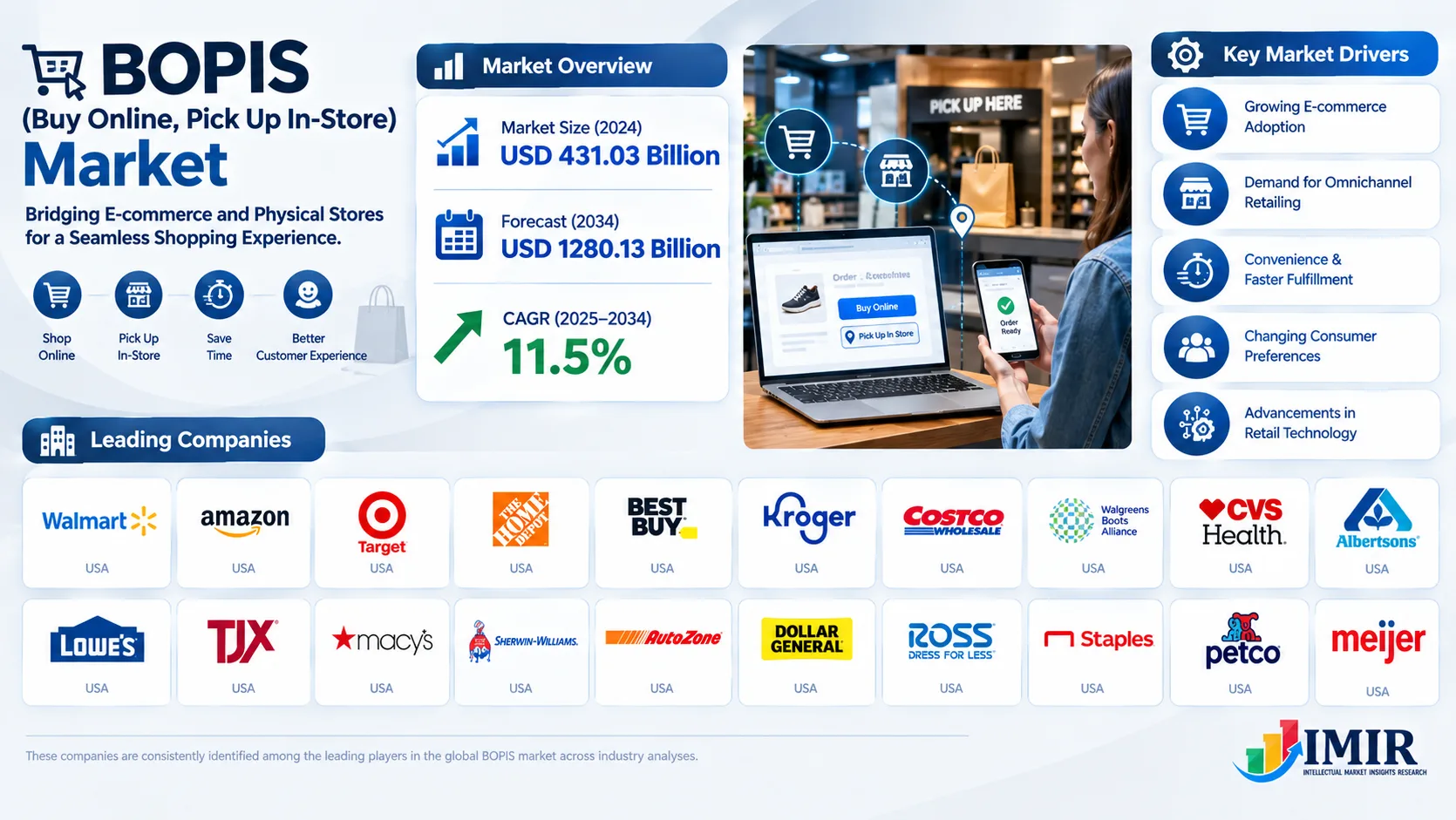
The BOPIS (Buy Online, Pick Up In-Store) Market size was valued at around USD 431.03 Billion in 2024 and is expected to reach a value of USD 1,280.13 Billion by 2034, at a CAGR of 11.5% over the forecast period (2025–2034).
| Parameter | Details |
|---|---|
| Market Size (2024) | USD 431.03 Billion |
| Projected Market Size (2034) | USD 1,280.13 Billion |
| CAGR (2025–2034) | 11.5% |
| Base Year | 2024 |
| Forecast Period | 2025–2034 |
| Leading Region | North America (dominant, led by advanced retail infrastructure); Asia-Pacific (significant growth, led by Japan and China) |
| Key Segments (by Type of Product) | Electronic Devices, Apparel, Footwear, Accessories, Books, Others |
| Key Segments (by Platform) | Website, Mobile App |
| Key Segments (by End-User) | Individual Consumers, Businesses |
Why the BOPIS Market Is Growing
1. Rising Consumer Demand for Speed and Convenience
BOPIS allows customers to secure product availability instantly while avoiding delivery wait times and shipping fees, giving it a major edge over home delivery, particularly for time-sensitive or urgent purchases, and continuing to drive strong adoption among time-pressed shoppers.
2. Real-Time Inventory Visibility and Omnichannel Integration
Retailers increasingly leverage online accessibility for real-time inventory updates and streamlined ordering, allowing customers to confirm product availability before visiting a store, which enhances the overall BOPIS experience and reduces failed pickup trips.
3. Increased Competition and Continuous Technology Innovation
Retailers are continuously innovating with new apps, self-pickup kiosks, curbside pickup lanes, and automated locker systems to differentiate their BOPIS offerings and compete for customer loyalty in an increasingly crowded fulfillment landscape.
4. Incremental In-Store Purchases During Pickup Visits
A significant share of BOPIS customers tend to make unplanned additional purchases when retrieving their online orders in-store, giving retailers a built-in mechanism to drive incremental revenue and strengthen customer loyalty through repeat visits.
5. Cost Savings for Retailers on Last-Mile Delivery
By shifting the final leg of fulfillment to the customer, BOPIS allows retailers to meaningfully reduce last-mile shipping and delivery costs compared to home-delivery fulfillment models, improving overall margins on online orders.
6. Growing E-Commerce Penetration Globally
The steady double-digit annual growth rate of e-commerce continues to expand the overall addressable base of online shoppers who can choose BOPIS as a fulfillment option at checkout, reinforcing the model's growth alongside broader online retail expansion.
Market Opportunities & Restraints
A key opportunity lies in expanding BOPIS into grocery and fresh categories, and deeper investment in omnichannel technology: retailers that extend BOPIS beyond general merchandise into fresh and frozen grocery, pharmacy, and specialty categories, while continuing to invest in real-time inventory, curbside pickup, and locker-based fulfillment technology, stand to capture a larger share of a market still representing a modest fraction of total e-commerce sales in several developed markets, leaving considerable room for continued penetration growth. On the restraint side, fulfillment accuracy and store-level operational complexity remain the primary headwinds, as retailers must maintain precise real-time inventory synchronization between online platforms and physical store shelves to avoid order cancellations or substitutions, while dedicating in-store staff and space to order picking and pickup logistics can strain store operations, particularly for retailers without mature omnichannel fulfillment infrastructure.
Companies Associated with the BOPIS Market
| Company | Headquarters | Founded | Employees | Revenue | Overview |
|---|---|---|---|---|---|
| Walmart Inc. | Bentonville, Arkansas, USA | 1962 | Approx. 2.1 Million | Approx. USD 681–713 Billion | World's largest retailer; curbside/in-store pickup across 3,000+ U.S. stores; expanded Grocery Pickup to 2,000 locations in 29 states. |
| Target Corporation | Minneapolis, Minnesota, USA | 1902/1962 | Approx. 415,000–440,000 | Approx. USD 104.8–106.6 Billion | Over 1,900 stores support BOPIS; 50%+ of digital orders fulfilled via pickup; achieved 500% BOPIS sales growth in a single year. |
| The Home Depot, Inc. | Atlanta, Georgia, USA | 1978 | Approx. 470,100 | Approx. USD 159.5–165 Billion | Largest U.S. home improvement retailer; robust BOPIS/curbside pickup for contractors and DIY customers. |
| Macy's, Inc. | New York City, New York, USA | 1858 | Approx. 90,134 | Approx. USD 22.6–22.7 Billion | Iconic department store chain (Macy's, Bloomingdale's) offering BOPIS at flagship and mall locations nationwide. |
| Kohl's Corporation | Menomonee Falls, Wisconsin, USA | 1962 | Approx. 90,000+ | Approx. USD 17–18 Billion | Major department store chain with large-format suburban stores supporting fast BOPIS/curbside pickup. |
| Zara (Inditex) | Arteixo, Galicia, Spain | 1975/1985 | Tens of thousands (Inditex) | Approx. EUR 27.78 Billion (Zara) | Leading Spanish fast-fashion retailer offering click-and-collect across its global store network. |
| Petco Health and Wellness Company | San Diego, California, USA | 1965 | Approx. 28,900–29,000 | Approx. USD 5.96 Billion | Pet health and wellness retailer; BOPIS/same-day pickup across 1,380+ stores. |
| Michaels Companies, Inc. | Irving, Texas, USA | 1973 | Several thousand | Not publicly disclosed (private) | Largest North American arts and crafts retailer offering BOPIS for time-sensitive craft projects. |
| Shopgate GmbH | Augsburg, Germany | 2010 | Small-to-mid-sized team | Not publicly disclosed | Mobile commerce/omnichannel technology provider enabling retailers to implement BOPIS capabilities. |
Competitive Landscape
The global BOPIS market exhibits a fragmented structure with a diverse array of players ranging from global retail giants to regional niche providers. Mass-merchandise and big-box leaders Walmart, Target, and Home Depot hold particularly strong positions, built on extensive store networks, sophisticated omnichannel technology investment, and the scale needed to offer fast, reliable pickup across thousands of locations. Department store and specialty retailers Macy's, Kohl's, Zara, Petco, and Michaels compete through category-specific BOPIS implementations tailored to fashion, pet care, and craft retail customer needs, often emphasizing the incremental in-store purchase opportunity that pickup visits create. Technology enablers such as Shopgate provide the underlying mobile commerce and omnichannel infrastructure that allows retailers, particularly mid-sized and regional chains without in-house development resources, to implement BOPIS capabilities without building custom technology from scratch.
Regional Analysis
North America
North America dominated the world's BOPIS market and remains a front runner due to its advanced retail infrastructure, deep e-commerce penetration, and early adoption of omnichannel retailing programs, with large North American retailers such as Walmart, Target, and Best Buy among the first to embrace and effectively scale BOPIS solutions.
Europe
Europe represents a significant and growing BOPIS market, supported by strong omnichannel adoption among major European retailers such as Zara/Inditex, alongside increasing consumer preference for flexible, convenient order fulfillment options.
Asia-Pacific
The market in APAC is expected to witness significant growth, driven by the presence of key BOPIS companies in economies such as Japan and China, alongside rapidly expanding e-commerce penetration and growing retail infrastructure investment across the region.
Latin America & Middle East and Africa
Latin America and the Middle East & Africa represent emerging growth markets for BOPIS, with adoption tied to expanding modern retail infrastructure, rising e-commerce penetration, and growing consumer demand for flexible fulfillment options.
Emerging Trends in the BOPIS Market
1. Reduction in Shopping Trips Becoming the New Normal: The shift toward fewer, more purposeful shopping trips, accelerated in the post-pandemic retail environment, continues to reinforce BOPIS as a preferred fulfillment method that consolidates errands and reduces unnecessary travel.
2. Expansion into Grocery and Fresh Categories: Major retailers including Target and Walmart continue to expand BOPIS and curbside pickup into fresh and frozen grocery categories, broadening the model beyond its traditional general merchandise base.
3. Engaging Online Customers Through In-Store Visits: Retailers increasingly view BOPIS pickup visits as an opportunity to re-engage digital-first customers with the physical store experience, often driving incremental, unplanned purchases during pickup.
4. Growth of Curbside and Drive-Up Pickup Formats: Continued investment in curbside and drive-up pickup infrastructure, including alcohol pickup capabilities piloted by Walmart, reflects the industry's push toward even faster, more convenient collection formats that minimize the time customers spend in-store.
5. Technology-Enabled Omnichannel Infrastructure Investment: Growing reliance on mobile commerce and omnichannel technology providers such as Shopgate illustrates how retailers, particularly those without large in-house technology teams, are increasingly outsourcing the infrastructure needed to compete in the BOPIS space.
Future Outlook (2025–2034)
The global BOPIS market's trajectory toward USD 1,280.13 billion by 2034 reflects sustained demand growth driven by continued e-commerce expansion, consumer preference for speed and convenience, and retailers' ongoing investment in omnichannel fulfillment infrastructure. The 11.5% CAGR forecast through 2034 assumes continued BOPIS expansion into grocery and fresh categories, growing adoption of curbside and drive-up pickup formats, and sustained technology investment by both large retailers and smaller chains leveraging third-party omnichannel platforms.
Key investment themes for 2025–2034 include continued omnichannel infrastructure investment by mass-merchandise leaders such as Walmart, Target, and Home Depot, growing category-specific BOPIS adoption among department store and specialty retailers such as Macy's, Kohl's, Zara, and Petco, and increasing reliance on technology enablers such as Shopgate to support mid-sized and regional retailer BOPIS implementations. As grocery category expansion, curbside pickup innovation, and continued e-commerce growth reshape the industry, the retailers that combine real-time inventory accuracy with fast, convenient pickup experiences will be best positioned to capture growth through 2034.
Frequently Asked Questions (FAQ)
1. What is the current size of the global BOPIS market?
The BOPIS (Buy Online, Pick Up In-Store) Market size was valued at around USD 431.03 billion in 2024 and is expected to reach a value of USD 1,280.13 billion by 2034, at a CAGR of 11.5% over the forecast period (2025–2034).
2. Who are the top companies in the BOPIS market?
Leading companies include Walmart Inc., Target Corporation, The Home Depot, Inc., Macy's, Inc., Kohl's Corporation, Zara (Inditex), Petco Health and Wellness Company, Inc., Michaels Companies, Inc., and Shopgate GmbH.
3. Which region dominates the BOPIS market?
North America dominated the world's BOPIS market and remains a front runner due to its advanced retail infrastructure and deep e-commerce penetration, while the market in APAC is expected to witness significant growth due to the presence of key companies in economies such as Japan and China.
4. What is the forecast CAGR for the BOPIS market?
The market is forecast to grow at a CAGR of 11.5% from 2025 to 2034.
5. What are the main growth drivers for this market?
Key drivers include rising consumer demand for speed and convenience, real-time inventory visibility and omnichannel integration, increased competition and continuous technology innovation, incremental in-store purchases during pickup visits, and cost savings for retailers on last-mile delivery.
6. What product categories make up the BOPIS market?
The market is segmented by type of product into electronic devices, apparel, footwear, accessories, books, and other categories, fulfilled through both website and mobile app platforms.
7. Why do retailers benefit from offering BOPIS?
Retailers benefit from BOPIS through reduced last-mile delivery costs, increased customer loyalty and repeat visits, and incremental in-store purchases, with nearly half of BOPIS customers adding extra items to their pickups when visiting the store.
Conclusion
The global BOPIS market sits at the intersection of rising consumer demand for convenience and retailers' ongoing investment in omnichannel fulfillment infrastructure. With a projected size of USD 1,280.13 billion by 2034 at a CAGR of 11.5%, the market offers strong, technology-driven growth across electronics, apparel, footwear, and other product categories.
Walmart, Target, and Home Depot continue to lead on the strength of extensive store networks and sophisticated omnichannel technology, while Macy's, Kohl's, Zara, and Petco compete through category-specific BOPIS implementations tailored to their customer bases, and technology enablers such as Shopgate support smaller and regional retailers in building out their own BOPIS capabilities. As grocery category expansion, curbside pickup innovation, and continued e-commerce growth reshape the industry, the companies that combine fast, reliable fulfillment with engaging in-store pickup experiences will define market leadership through 2034 and beyond.