
Leading Companies in the Global Brushless DC Motor Market
Author:
Intellectual Market Insights Research
Published Date:
13 Aug 2026
Introduction
Brushless DC (BLDC) motors have quietly become one of the most important building blocks of modern electromechanical design. By eliminating the brushes and commutators found in conventional DC motors, BLDC motors deliver higher efficiency, longer service life, quieter operation, and precise electronic speed control, qualities that make them the default choice wherever engineers are trying to squeeze more performance out of a smaller, cooler-running package.
The global Brushless DC Motor market was valued at approximately USD 23.9 billion in 2025 and is projected to reach USD 47.79 billion by 2034, growing at a compound annual growth rate (CAGR) of 7.7% over the forecast period, according to Intellectual Market Insights Research. Growth is being driven by the electrification of vehicles and industrial machinery, rising automation across manufacturing and robotics, and the ongoing shift toward energy-efficient motors in HVAC, aerospace, and household appliance applications.
BLDC motors sit at the intersection of the automotive, industrial machinery, aerospace, and consumer electronics industries, drawing competition from diversified industrial conglomerates, specialized motion-control manufacturers, and electrical equipment giants alike, all racing to capture share as power output requirements diversify and end-use industries demand ever-tighter performance and efficiency.
Understanding which companies lead this fast-growing market is essential for industrial investors, OEM procurement teams, and technology analysts. This article provides a research-based analysis of the top companies in the global brushless DC motor market, their positioning, flagship offerings, and the regional and technological forces shaping the competitive landscape.
Market Overview
|
Parameter |
Details |
|---|---|
|
Market Size (2025) |
USD 23.9 Billion |
|
Projected Market Size (2034) |
USD 47.79 Billion |
|
CAGR (2025–2034) |
7.7% |
|
Base Year |
2024 |
|
Forecast Period |
2025–2034 |
|
Leading Region |
North America |
|
Fastest-Growing Region |
Asia-Pacific (China, Japan, South Korea) |
|
Key Growth Drivers |
Industrial automation, EV and motor-vehicle electrification, HVAC electrification, demand for energy-efficient motors |
|
Key Challenges |
Higher upfront cost versus brushed/induction motors, complex electronic control requirements, raw-material price volatility |
|
Key Opportunities |
Robotics and cobots, aerospace actuation systems, smart appliances, high-power industrial applications above 75 kW |
Why the Brushless DC Motor Market Is Growing
1. Accelerating Industrial Automation
As factories adopt robotics, automated guided vehicles, and precision machinery, BLDC motors are increasingly favored for their high torque-to-weight ratio, precise speed control, and low maintenance compared with brushed alternatives.
2. Electrification of Motor Vehicles
Beyond EV traction, BLDC motors power a growing number of vehicle subsystems, including power steering, HVAC blowers, seat adjusters, and comfort and safety features, expanding their footprint well beyond the powertrain.
3. Growth in HVAC Equipment Demand
Energy-efficiency regulations are pushing HVAC manufacturers toward variable-speed BLDC-driven fans and compressors, which cut electricity consumption compared with traditional induction motors.
4. Expansion of Aerospace & Transportation Applications
Lightweight, high-reliability BLDC motors are increasingly used in aircraft actuation, cabin systems, and unmanned aerial vehicles, where power density and low maintenance are critical.
5. Rising Demand for Household Appliances
Manufacturers are replacing brushed motors in appliances such as vacuum cleaners, kitchen equipment, and power tools with BLDC alternatives to improve efficiency, reduce noise, and extend product lifespan.
6. Diversification Across Power Output Segments
Demand is broadening across power bands, from sub-750-watt motors for consumer electronics to above-75-kW motors for heavy industrial machinery, giving manufacturers multiple growth avenues simultaneously.
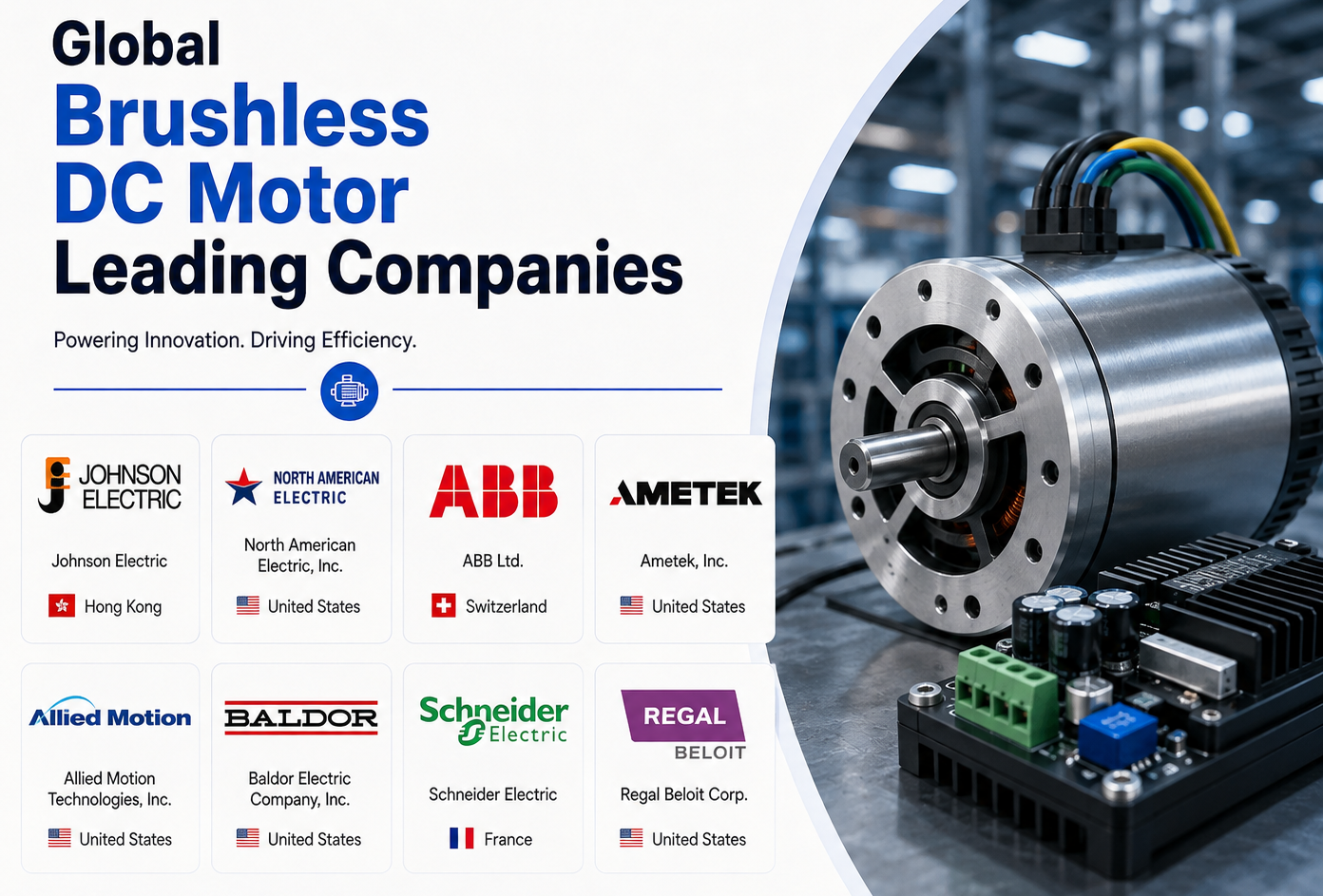
Top Companies in the Brushless DC Motor Market
- Johnson Electric
- North American Electric, Inc.
- ABB Ltd.
- Ametek, Inc.
- Allied Motion Technologies, Inc.
- Baldor Electric Company, Inc.
- Schneider Electric
- Regal Beloit Corp.
|
Category |
Details |
|---|---|
|
Company Name |
Johnson Electric Holdings Limited |
|
Headquarters |
Sha Tin, Hong Kong |
|
Founded |
1959 |
|
Employees |
Approx. 30,000+ |
|
Revenue |
Approx. USD 3.6 Billion |
|
Company Overview |
Johnson Electric is a global leader in electric motors, actuators, and motion subsystems, serving automotive, medical, home automation, business equipment, and industrial customers from manufacturing and design centers spanning more than 20 countries. |
|
Key Products |
Brush and brushless DC motors, actuators, motion subsystems, gearboxes, and electro-mechanical components. |
|
Market Position |
One of the world's largest suppliers of small and micro motors, with especially deep penetration in automotive and consumer-facing BLDC applications. |
|
Recent Developments |
Continued expansion of its motion-subsystem portfolio to support liquid cooling, robotic joints, and smart-metering applications. |
|
Strategic Advantages |
Broad end-market diversification, a long history of miniaturized-motor engineering, and an extensive low-cost global manufacturing footprint. |
2. ABB Ltd.
|
Category |
Details |
|---|---|
|
Company Name |
ABB Ltd. |
|
Headquarters |
Zurich, Switzerland |
|
Founded |
1988 (through the merger of ASEA, founded 1883, and Brown, Boveri & Cie, founded 1891) |
|
Employees |
Approx. 112,000 |
|
Revenue |
Approx. USD 35.7 Billion |
|
Company Overview |
ABB is a global technology leader in electrification, motion, and automation, operating through segments that include Motion, which manufactures and sells drives, motors, and mechanical power-transmission products across industrial and commercial applications. |
|
Key Products |
Industrial BLDC and servo motors, drives, generators, and motion-control systems, including motors under its acquired Baldor Electric brand. |
|
Market Position |
A top-tier global supplier of high-power and industrial-grade motors, with a strong presence in the above-75-kW power output segment. |
|
Recent Developments |
Ongoing portfolio streamlining, including the planned divestment of its Robotics division, to sharpen focus on electrification and motion technologies. |
|
Strategic Advantages |
Deep R&D investment, a vast global manufacturing base of more than 160 sites, and leadership positions across all of its core business areas. |
3. Ametek, Inc.
|
Category |
Details |
|---|---|
|
Company Name |
AMETEK, Inc. |
|
Headquarters |
Berwyn, Pennsylvania, U.S. |
|
Founded |
1930 |
|
Employees |
Approx. 22,500 |
|
Revenue |
Approx. USD 7.4 Billion |
|
Company Overview |
AMETEK is a diversified manufacturer of electronic instruments and electromechanical devices operating through its Electronic Instruments Group and Electromechanical Group, the latter of which produces brushless air-moving motors for aerospace, medical, and business-machine applications. |
|
Key Products |
Brushless DC and air-moving motors, precision motion components, automation solutions, and specialty electrical interconnects. |
|
Market Position |
A leading niche-market supplier of high-reliability BLDC motors for aerospace, medical, and precision-instrumentation applications. |
|
Recent Developments |
Continued acquisition-driven growth, including its 2025 acquisition of FARO Technologies, expanding its precision measurement and motion capabilities. |
|
Strategic Advantages |
A disciplined operating model built around operational excellence, technology innovation, and strategic acquisitions across niche high-margin markets. |
4. Regal Rexnord Corporation (formerly Regal Beloit Corp.)
|
Category |
Details |
|---|---|
|
Company Name |
Regal Rexnord Corporation |
|
Headquarters |
Milwaukee, Wisconsin, U.S. |
|
Founded |
1955 |
|
Employees |
Approx. 30,000 |
|
Revenue |
Approx. USD 5.9 Billion |
|
Company Overview |
Regal Rexnord, formed through the 2021 merger of Regal Beloit and Rexnord's Process & Motion Control business, is a major manufacturer of electric motors, power-transmission components, and motion-control products serving industrial, commercial, and residential markets. |
|
Key Products |
AC and DC motors, air-moving subsystems, precision motion actuators and drives, and power-transmission components sold under brands including Fasco, Genteq, and LEESON Electric. |
|
Market Position |
One of the largest global manufacturers of electric motors, with broad coverage across HVAC, industrial powertrain, and automation-motion segments. |
|
Recent Developments |
Continued integration of its Automation & Motion Control segment to expand precision motor and actuator offerings for industrial customers. |
|
Strategic Advantages |
Scale across three complementary business segments, a broad multi-brand product portfolio, and deep penetration into energy-efficient motor conversion. |
|
Category |
Details |
|---|---|
|
Company Name |
Schneider Electric SE |
|
Headquarters |
Rueil-Malmaison, France |
|
Founded |
1836 |
|
Employees |
Approx. 160,000+ |
|
Revenue |
Approx. USD 45–47 Billion |
|
Company Overview |
Schneider Electric is a global energy-management and industrial-automation leader, operating through Energy Management and Industrial Automation segments that supply motors, drives, and controls under its EcoStruxure technology platform. |
|
Key Products |
Industrial BLDC and servo motors, variable-speed drives, motion controllers, and integrated automation systems. |
|
Market Position |
A leading global supplier of automation-integrated motor solutions to industrial, building, and infrastructure customers. |
|
Recent Developments |
Expansion of AI-powered energy and automation platforms alongside continued investment in electrification technologies. |
|
Strategic Advantages |
Enormous global scale, deep software and digital-automation integration, and an end-to-end offering spanning motors, controls, and energy-management software. |
Competitive Landscape
The global brushless DC motor market is moderately consolidated at the top, dominated by large diversified industrial and electrical-equipment conglomerates such as ABB, Schneider Electric, and Regal Rexnord, alongside specialized motion and instrumentation manufacturers such as AMETEK, Johnson Electric, North American Electric, and Allied Motion Technologies (Allient).
Scale vs. Specialization: Large diversified suppliers compete on manufacturing scale, integrated automation platforms, and global OEM relationships, while specialist motion-control makers compete on precision engineering for aerospace, medical, and defense-grade applications.
Power-Band Segmentation: Competitive intensity varies by power output category, with numerous specialist players competing in the sub-750-watt consumer and appliance segment, while a smaller set of industrial conglomerates dominate the 3 kW-and-above segments used in heavy machinery.
Consolidation Activity: ABB's 2011 acquisition of Baldor Electric and Regal Rexnord's 2021 merger with Rexnord's Process & Motion Control business illustrate ongoing consolidation as companies seek broader motor and motion-control portfolios.
Efficiency and Automation Integration: Competitive differentiation increasingly centers on pairing motors with integrated drives, sensors, and software platforms rather than selling motors as standalone components.
Regional Analysis
North America
North America holds the largest share of the global brushless DC motor market, supported by strong demand from industrial machinery, motor vehicle, and aerospace end-users, alongside a dense base of established motor manufacturers.
Asia-Pacific
Asia-Pacific is expected to register the fastest growth, driven by the presence of key BLDC motor manufacturers and expanding manufacturing bases in China and Japan, along with rising demand for automation and electric vehicles.
Europe
Germany, France, and the U.K. anchor European demand, supported by strict energy-efficiency regulations and an established industrial motor manufacturing base led by companies such as Schneider Electric and ABB.
Latin America and MEA
These regions represent early-stage but emerging markets for BLDC motors, with growth tied to gradual industrial modernization and expanding manufacturing investment.
Emerging Trends in the Brushless DC Motor Market
1. Integration with Smart Controls: Motors are increasingly bundled with sensors, drives, and software for real-time monitoring and predictive maintenance.
2. Growth in High-Power Industrial Segments: Demand for motors above 75 kW is rising as heavy machinery and industrial powertrain applications electrify.
3. Miniaturization for Consumer and Medical Devices: Advances in compact, high-efficiency BLDC motor design are expanding use in medical devices, power tools, and small appliances.
4. Robotics and Automation Demand: The expansion of industrial robotics and automated guided vehicles is creating a growing category of precision BLDC motors optimized for continuous-duty operation.
5. Energy-Efficiency Regulation Pressure: Tightening efficiency standards across regions continue to push manufacturers to replace brushed and induction motors with BLDC alternatives.
Future Outlook (2025–2034)
The global brushless DC motor market's trajectory toward USD 47.79 billion by 2034 reflects the durable expansion of industrial automation, vehicle electrification, and energy-efficiency-driven motor replacement worldwide. The 7.7% CAGR forecast through 2034 assumes continued growth across all major power output categories and end-user segments, from household appliances to aerospace and transportation.
Key investment themes include the scaling of high-power industrial and robotics-oriented BLDC motors, continued infrastructure and manufacturing investment in North America and Asia-Pacific, and further consolidation among motor and motion-control manufacturers seeking broader automation-integrated portfolios. Leading companies including Johnson Electric, ABB, AMETEK, Regal Rexnord, and Schneider Electric are likely to retain leadership, while specialist and regional players continue to compete for share in fast-growing application segments.
Frequently Asked Questions (FAQ)
1. What is the current size of the global brushless DC motor market?
The global brushless DC motor market was valued at approximately USD 23.9 billion in 2025 and is projected to reach USD 47.79 billion by 2034, growing at a CAGR of 7.7%.
2. Who are the top companies in the brushless DC motor market?
Leading companies include Johnson Electric, North American Electric, Inc., ABB Ltd., AMETEK, Inc., Allied Motion Technologies, Inc., Baldor Electric Company, Schneider Electric, and Regal Rexnord Corporation (formerly Regal Beloit Corp.).
3. Which region dominates the brushless DC motor market?
North America leads the market in terms of revenue share, while Asia-Pacific is expected to register significant growth due to the presence of key manufacturers in economies such as China and Japan.
4. What is the forecast CAGR for the brushless DC motor market?
The market is forecast to grow at a CAGR of 7.7% from 2025 to 2034.
5. What are the main growth drivers for this market?
Key drivers include growing industrial automation adoption, electrification of motor vehicles, expansion of energy-efficient HVAC equipment, and rising use of BLDC motors in aerospace and household appliances.
6. What challenges does the brushless DC motor industry face?
The industry faces a higher upfront cost relative to brushed and induction motors, the complexity of the electronic control circuitry BLDC motors require, and exposure to raw-material price volatility.
7. Which power output segment holds the largest market share?
Motors in the lower power bands (0–750 Watts and 750 Watts to 3 kW) serve the largest number of applications across consumer and light industrial products, while the 3 kW–75 kW and above-75 kW segments are gaining share as heavy industrial and vehicle applications electrify.
Conclusion
The global brushless DC motor market sits at the intersection of industrial automation, vehicle electrification, and the broader push toward energy-efficient motion technology. With a projected size of USD 47.79 billion by 2034 at a 7.7% CAGR, the sector offers substantial growth potential for motor, motion-control, and automation-systems manufacturers alike.
Companies led by Johnson Electric, ABB, AMETEK, Regal Rexnord, and Schneider Electric are not just supplying motors, they are actively investing in automation-integrated, high-efficiency, and application-specific BLDC technologies to capture share across an increasingly diverse set of power output and end-user segments. The manufacturers that successfully balance manufacturing scale, technical specialization, and integration with digital controls will define market leadership through 2034 and beyond.


