
Leading Companies in the Global Clinical Perinatal Software Market
Author:
Intellectual Market Insights Research
Published Date:
21 Sep 2026
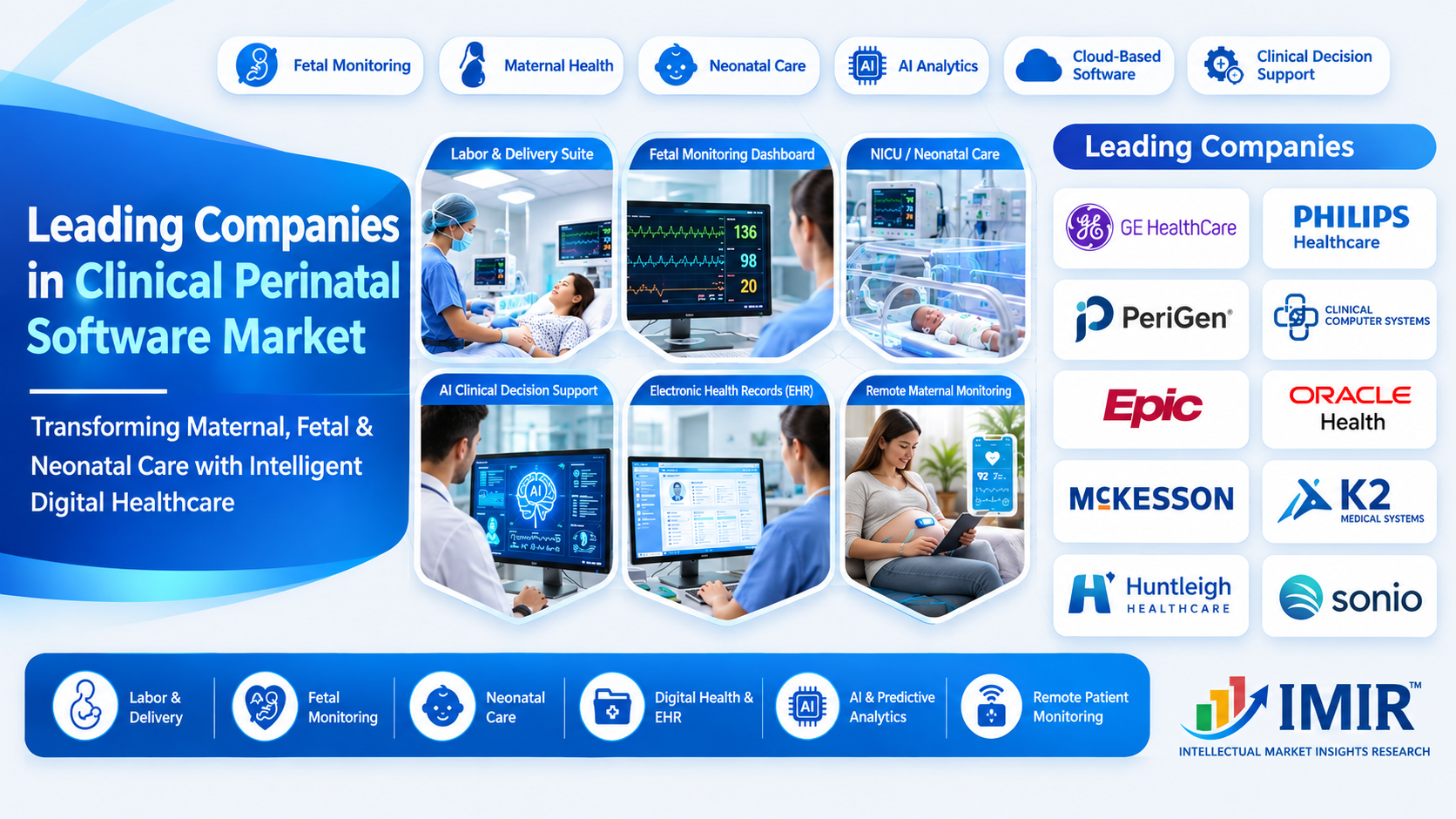
Introduction
Clinical perinatal software helps hospitals and maternity clinics document, monitor and analyze care across pregnancy, labor and delivery. It covers fetal monitor data services, workflow management and patient documentation. With more attention on maternal and neonatal outcomes, vendors are competing on AI, cloud interoperability and EHR integration.
Clinical perinatal software helps hospitals and maternity clinics document, monitor and analyze care through pregnancy, labor and delivery. Its main applications are fetal monitor data services, workflow management and patient documentation. The market is moderately fragmented, with a few large medical technology firms sharing revenue with several specialized vendors.
Market snapshot
Global Clinical Perinatal Software Market size was valued at USD 0.320 Billion in 2025 and is projected to reach USD 0.680 Billion by 2034, growing at a CAGR of 8.63% from 2025 to 2034
- Regions: North America held 43.65% of the market in 2025, and Asia-Pacific is projected to grow fastest at a 12.33% CAGR through 20377.
- Segments: Integrated software held the largest product share at 76.4% in 2025, and fetal and maternal monitoring was the largest application at 44.5%.
- Competition: The market is moderately fragmented, with a few large medical technology firms sharing revenue with several specialized vendors.
- Regions: North America held 43.65% of the market in 2025, while Asia-Pacific is projected to grow fastest at a 12.33% CAGR through 2035.
Leading companies
Koninklijke Philips N.V.
Overview: Philips is a Netherlands-based health technology company. It and GE HealthCare use their large fetal-monitor installed bases to wrap software subscriptions around hardware, which builds integrated ecosystems that keep customers tied in. Philips is also working with Georgia health plans to bring remote monitoring into payer programs, a shift toward outcome-linked solutions.
- Employees: Approx. 64,800 at the end of 2025
- Revenue (2025): Approx. EUR 17.8 billion
- Regional Influence: Strong in Europe, with continued strong order performance in North America.
GE HealthCare
Overview: GE HealthCare is a Chicago-based leader in medical technology, monitoring and imaging. In May 2025 it partnered with Raydiant Oximetry to co-develop advanced fetal monitoring solutions. In September 2023 it received a USD 44 million Gates Foundation grant to develop AI-assisted ultrasound tools for maternal and fetal health.
- Employees: Approx. 54,000
- Revenue (2025): Approx. USD 20.6 billion
- Regional Influence: Growth is driven mainly by the U.S. and EMEA
PeriGen, Inc. (Halma plc)
Overview: PeriGen is a specialist known for AI-driven solutions that improve patient safety and clinical efficiency during labor and delivery. In September 2024, Bloomlife connected its at-home monitoring patch to PeriGen's PeriWatch Vigilance software, extending continuous monitoring from hospital to home for higher-risk pregnancies.
- Employees (Halma group): Approx. 9,290
- Revenue (Halma, FY 2025/26): Over GBP 2.5 billion, a first for the group
- Regional Influence: PeriGen is US-based, and its parent Halma is headquartered in Amersham, UK.
Clinical Computer Systems, Inc. (OBIX)
Overview: CCSI makes dedicated perinatal data systems. It launched OBIX as a hosted service, removing the need for extra server infrastructure at hospitals. In January 2025, Dubai Health partnered with OBIX to implement a perinatal data system within its EPIC Salama EHR platform.
- Regional Influence: A US vendor with international reach, including the Middle East through the Dubai Health project.
Oracle (Cerner)
Overview: Oracle, through Cerner, is one of the main EHR players in perinatal care. In August 2023, Cerner unveiled an integration connecting its EHR with Babyscripts' remote monitoring tool, aimed at patient engagement and access.
- Employees: Approx. 141,000 (May 2026)
- Revenue (FY 2026): Approx. USD 67.4 billion
- Regional Influence: Americas 66%, EMEA 23%, Asia Pacific 11% of group revenue.
Epic Systems Corporation
Overview: Epic is a privately held EHR vendor. Cerner and Epic use their EHR systems to integrate perinatal care, while Clinical Computer Systems and PeriGen focus on specialized obstetric software.
- Employees: Approx. 13,000–14,000 (estimates vary)
- Revenue: Approx. USD 5.7 billion (2024, estimated)
- Regional Influence: Its workforce is 93.3% in the United States, with offices in Australia, Denmark, Finland, the Netherlands and Norway.
Trium Analysis Online GmbH
Overview: A specialist vendor that appears among the major companies in this market alongside Philips, GE HealthCare, PeriGen and Clinical Computer Systems.
|
Company |
Perinatal offering |
Key developments |
|---|---|---|
|
Philips |
Software subscriptions wrapped around its fetal-monitor installed base |
Collaboration with Georgia health plans to bring remote monitoring into payer programs |
|
GE HealthCare |
Fetal-monitor base plus software ecosystem |
May 2025: partnered with Raydiant Oximetry on fetal monitoring; Sept 2023: USD 44M Gates Foundation grant for AI-assisted ultrasound |
|
PeriGen |
AI-driven solutions for patient safety and efficiency in labor and delivery |
Sept 2024: Bloomlife's home patch connected to PeriWatch Vigilance |
|
Clinical Computer Systems |
OBIX, offered as a hosted cloud service |
Jan 2025: Dubai Health partnership to implement the system within EPIC Salama EHR |
|
Oracle (Cerner) |
EHR-led integration of perinatal care |
Aug 2023: EHR integration with Babyscripts remote monitoring |
|
Epic Systems |
EHR-led integration of perinatal care |
Specialist systems such as OBIX can be embedded in its platform (Dubai Health example) |
Emerging movers
-
McKesson launched a Maternal and Fetal Health Intelligence Platform in December 2023, giving providers real-time insight into maternal and fetal health trends and helping them spot high-risk pregnancies.
- Samsung acquired Sonio in 2024, a sign that consumer-device majors want to enter clinical verticals.
Regional analysis
-
North America: The largest market, with 43.65% share in 2025. It is home to GE HealthCare, Oracle, Epic and PeriGen.
- Europe: Vendors include Philips, Huntleigh Healthcare, K2 Medical Systems and Siemens Healthineers.
- Asia-Pacific: The fastest-growing region at 12.33% CAGR through 2031, helped by rising disposable income and supportive government initiatives.
- Middle East: New hospital projects such as the Dubai Health–OBIX deployment show growing demand.
Trends shaping competition
-
AI and predictive analytics: Rapid uptake of AI-driven predictive analytics, cloud-hosted interoperability and policy mandates that raise maternal-fetal monitoring standards underpin market growth. Mordor Intelligence
- Hospital-to-home monitoring: Wearables and remote monitoring integrations, like Bloomlife with PeriGen, are extending perinatal software beyond the labor ward.
- Regulatory barriers: Vendors invest in FDA clearances for decision-support modules and budget for SOC 2 audits, which raises barriers to entry. Mordor Intelligence
- Consolidation of ecosystems: Platforms that combine hardware telemetry, AI analytics and reimbursement-ready workflows are expected to be at the center of future consolidation. Mordor Intelligence
Outlook
The market is growing at roughly 10% a year across most estimates. Vendors with the strongest EHR integration, AI capabilities and remote-monitoring reach will be best placed. Asia-Pacific and maternity clinics are the fastest-growing areas to watch.