
Leading Companies in the Global Coffee Capsule Market
Author:
Intellectual Market Insights Research
Published Date:
30 Sep 2026
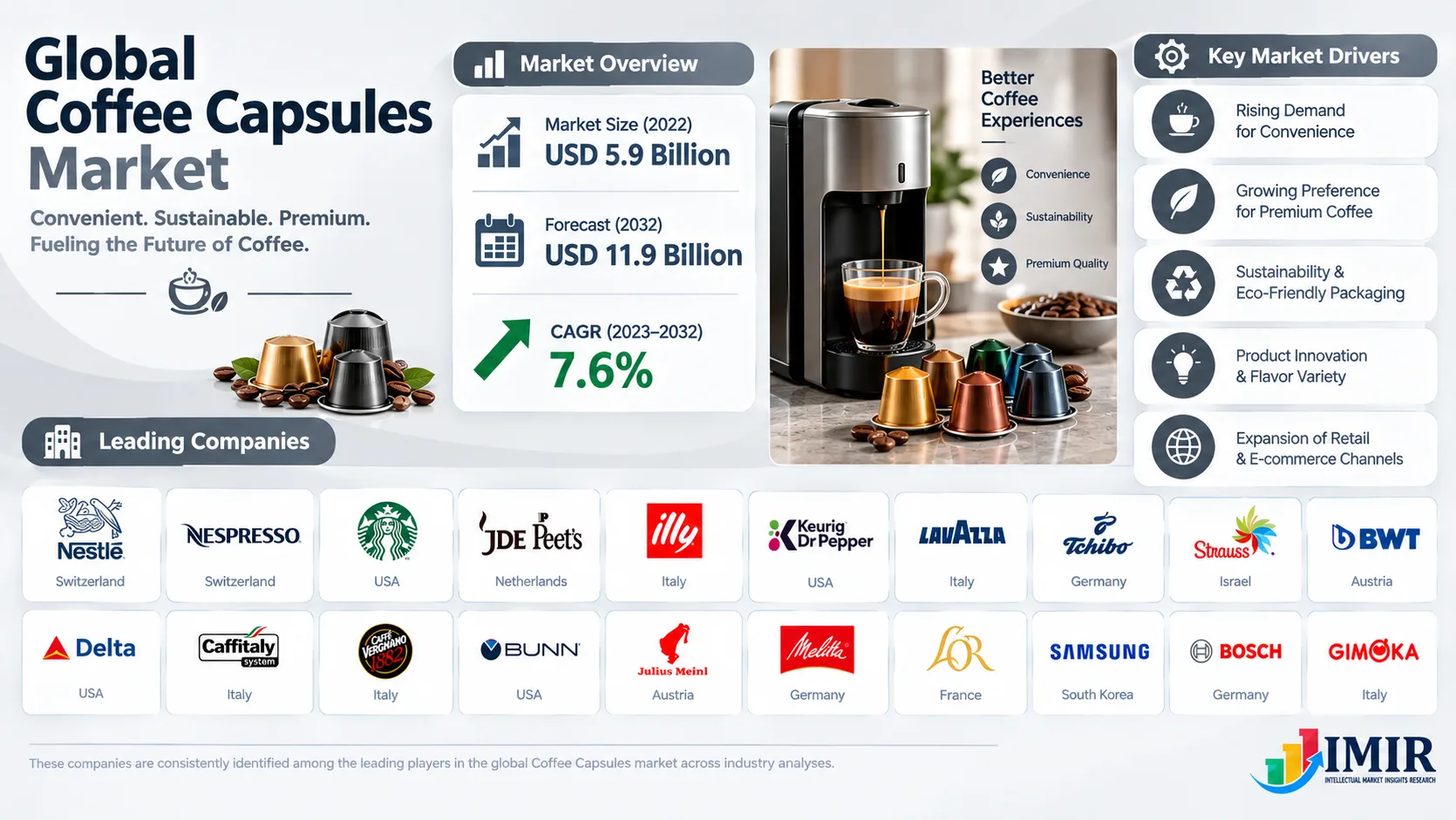
Global Coffee Capsules Market: Top Companies, Trends, and Future Outlook
Introduction
Coffee capsules, the pre-measured, pre-ground, pre-packaged pods used in single-serve brewing systems such as Nespresso, Keurig, and Dolce Gusto, have transformed home and office coffee consumption over the past two decades. Their convenience and consistency, no grinding, no measuring, no mess, have made them a fixture in millions of households, offices, hotels, and cafés worldwide, even as sustainability concerns around capsule waste continue to shape product innovation.
The global coffee capsules market spans Arabica and Robusta coffee types, aluminum, plastic, and compostable packaging materials, and closed-source (proprietary) and open-source (compatible) capsule systems, sold through hypermarkets/supermarkets, specialty stores, e-commerce, and other channels for household and commercial use. This article provides a research-based analysis of the global coffee capsules market, the companies shaping it, and the regional and competitive forces driving its growth, including a landmark 2025 acquisition that is set to reshape the industry.
Market Overview
The Global Coffee Capsules Market size was valued at approximately USD 5.9 Billion in 2022 and is projected to reach approximately USD 11.9 Billion by 2032, growing at a CAGR of 7.6% during the forecast period (2023–2032).
| Parameter | Details |
|---|---|
| Market Size (2022) | Approx. USD 5.9 Billion |
| Projected Market Size (2032) | Approx. USD 11.9 Billion |
| CAGR (2023–2032) | 7.6% |
| Forecast Period | 2023–2032 |
| Leading Region | Europe (largest share, approx. 45%); Asia-Pacific (fastest growth) |
| Key Segments (by Coffee Type) | Arabica, Robusta |
| Key Segments (by Packaging) | Aluminum, Plastic, Compostable |
| Key Segments (by System) | Closed Source System (Proprietary), Open Source System (Compatible) |
| Key Segments (by Distribution) | Hypermarkets/Supermarkets, Specialty Stores, E-commerce, Others |
| Key Segments (by Application) | Household, Commercial |
Additional context worth noting: independent estimates for this market vary considerably by scope, from roughly USD 5.9–10.3 billion in 2022–2025 for capsules-specific studies, to USD 15–34 billion when the broader "pods and capsules" category is included, with CAGRs generally clustering between 5.5% and 9.6%. This confirms the figures used here sit within the mainstream range for capsules-specific market sizing.
Why the Coffee Capsules Market Is Growing
1. Growing Consumer Preference for Convenience and Single-Serve Coffee
Time-pressed consumers continue to favor pre-measured, pre-ground, pre-packaged coffee capsules that eliminate the need for grinding, measuring, or cleanup, sustaining strong baseline household demand across developed markets.
2. Increasing Popularity of Specialty and Premium Coffee
Rising consumer interest in specialty and single-origin coffee is driving demand for premium capsule offerings, with the Arabica segment expected to contribute the largest revenue share due to its premium flavor profile and strong consumer preference.
3. Expansion of Commercial and Workplace Adoption
The commercial segment, encompassing offices, cafés, and hospitality settings, continues to grow as businesses seek to serve coffee quickly and with minimal effort, driving adoption of coffee capsule systems in workplace cafeterias and hospitality venues.
4. Retail and Online Distribution Expansion
Growing retail and e-commerce distribution channels continue to widen consumer access to coffee capsules, with patent expirations on proprietary systems (such as the original Nespresso patents) enabling a broader range of compatible, third-party capsule manufacturers to enter the market.
5. Rising Variety of Flavors and Blends
Continued product innovation in flavor variety and blend diversity keeps consumer interest high and supports repeat purchasing across both proprietary and compatible capsule systems.
6. Growing Sustainability Innovation
Rising environmental awareness is pushing manufacturers to innovate with compostable and biodegradable capsule materials, addressing one of the category's most persistent consumer criticisms while opening a new premium, eco-conscious product tier.
Market Opportunities & Restraints
A key opportunity lies in sustainable materials and proprietary technology innovation: Lavazza's June 2025 launch of its "Tabli" system, a proprietary 100% coffee tab technology backed by 15 patents, illustrates the significant opportunity for manufacturers who can combine sustainability (eliminating plastic or aluminum shells entirely) with defensible, patent-protected technology, potentially commanding premium pricing while addressing environmental criticism of the category. On the restraint side, environmental concerns over capsule waste and price premiums over traditional coffee remain the primary headwinds, as single-use capsules, particularly non-compostable aluminum and plastic formats, continue to draw criticism from environmental groups and increasingly stringent packaging regulations (such as the EU's Packaging and Packaging Waste Regulation, PPWR), while the per-cup cost of capsule coffee remains meaningfully higher than traditional ground coffee, limiting adoption among price-sensitive consumers.
Companies Associated with the Coffee Capsules Market
| Company | Headquarters | Founded | Employees | Revenue | Overview |
|---|---|---|---|---|---|
| Nestlé S.A. (Nespresso) | Vevey, Switzerland | 1866 (Nestlé); 1986 (Nespresso) | Approx. 275,000+ (Nestlé Group) | Approx. USD 278+ Billion (Nestlé Group) | Pioneer of the single-serve capsule category; estimated 25–30% global market share through Nespresso and Dolce Gusto. |
| JDE Peet's N.V. | Amsterdam, Netherlands | 2015/2019 | Approx. 20,000+ | Approx. USD 8.6+ Billion | Owns Tassimo, Senseo, and L'OR brands; agreed to be acquired by Keurig Dr Pepper in August 2025. |
| Keurig Dr Pepper Inc. | Burlington, Massachusetts, USA | 2018 | Approx. 27,000+ | Approx. USD 15+ Billion | Dominant North American K-Cup ecosystem leader; agreed to acquire JDE Peet's in August 2025 in a landmark consolidation deal. |
| Luigi Lavazza S.p.A. | Turin, Italy | 1895 | Approx. 4,000+ | Approx. USD 2.8+ Billion | Premium Italian espresso brand; launched the patented "Tabli" 100% coffee tab system in June 2025. |
| illycaffè S.p.A. | Trieste, Italy | 1933 | Approx. 1,200+ | Approx. USD 500+ Million | Premium single-origin Arabica specialist with Iperespresso and cross-compatible capsule systems. |
| Starbucks Corporation | Seattle, Washington, USA | 1971 | Approx. 361,000+ (global) | Approx. USD 36+ Billion | Participates via a Nestlé licensing arrangement producing Starbucks-branded Nespresso-compatible capsules. |
| Caffitaly System S.p.A. | Gaggio Montano, Italy | 2004 | Several hundred | Not publicly disclosed | Italian capsule system and machine manufacturer serving proprietary and private-label brands. |
| Tchibo GmbH | Hamburg, Germany | 1949 | Approx. 10,000+ | Approx. EUR 3+ Billion | German roaster offering Cafissimo and Qbo capsule systems, strong in Central Europe. |
| The J.M. Smucker Company | Orrville, Ohio, USA | 1897 | Approx. 6,700+ | Approx. USD 8.7+ Billion | Parent of Folgers; offers K-Cup compatible pods in the open-source capsule segment. |
Competitive Landscape
The global coffee capsules market is currently undergoing its most significant consolidation event in years. Nestlé remains the clear category pioneer and largest single player, holding an estimated 25–30% global share through Nespresso, its head start dating to the system's 1986 launch giving it unmatched brand recognition and distribution scale. The Keurig Dr Pepper–JDE Peet's combination, announced on August 28, 2025, will create a dominant challenger to Nestlé by merging Keurig's overwhelming North American K-Cup ecosystem with JDE Peet's strong European portfolio (Tassimo, Senseo, L'OR), giving the combined entity meaningfully greater influence over global capsule supply chain pricing and retail shelf space. Premium Italian specialists Lavazza and illycaffè compete on authenticity, quality, and increasingly on sustainability innovation, exemplified by Lavazza's patented Tabli system. Regional and private-label players Tchibo, Caffitaly, and J.M. Smucker round out the competitive field, with Smucker in particular benefiting from the open-source, Keurig-compatible capsule segment that thrives on lower-cost alternatives to proprietary systems.
Regional Analysis
Europe
Europe holds the leading global coffee capsules market share, estimated at approximately 45%, dominated by Nespresso, Lavazza, and JDE Peet's, with a growing eco-capsule push driven by EU sustainability regulations including the Packaging and Packaging Waste Regulation (PPWR).
North America
North America shows strong growth, driven primarily by widespread household use of Keurig K-Cup systems and a wide variety of premium and compatible pod offerings, with the pending Keurig Dr Pepper–JDE Peet's merger set to further consolidate the region's competitive landscape.
Asia-Pacific
Asia-Pacific is expected to grow the fastest, at an estimated 21.5% share and rising, driven by increasing incomes, expanding café culture, and deepening market presence from Nestlé and JDE Peet's alongside domestic players such as UCC Holdings (Japan) and Tata Consumer Products (India).
Latin America & Middle East and Africa
Latin America and the Middle East & Africa represent emerging growth markets for coffee capsules, with adoption tied to rising urban disposable incomes, expanding modern retail infrastructure, and growing exposure to global single-serve coffee brands.
Emerging Trends in the Coffee Capsules Market
1. Landmark Industry Consolidation: Keurig Dr Pepper's August 2025 definitive agreement to acquire JDE Peet's represents the most significant consolidation event in the category's history, merging two of the largest capsule portfolios and creating a combined entity with substantial influence over global supply chain pricing.
2. Proprietary, Patent-Protected Sustainability Innovation: Lavazza's June 2025 launch of its "Tabli" system, a 100% coffee tab technology backed by 15 patents, exemplifies a new wave of sustainability-driven innovation that eliminates plastic and aluminum shells entirely while remaining commercially defensible.
3. Regulatory-Driven Shift to Compostable Materials: The EU's Packaging and Packaging Waste Regulation (PPWR) and similar packaging mandates in other regions are accelerating manufacturer investment in compostable and biodegradable capsule materials.
4. Growth of Open-Source, Compatible Capsule Systems: Patent expirations on early proprietary systems continue to enable a growing ecosystem of compatible, third-party capsule manufacturers (such as J.M. Smucker's K-Cup compatible pods), intensifying price competition in the open-source segment.
5. Premiumization Through Specialty and Single-Origin Offerings: Rising consumer interest in specialty and single-origin coffee is driving premium capsule product launches from illycaffè, Lavazza, and other quality-focused brands.
6. Licensing as a Market Entry Strategy: Starbucks's licensing arrangement with Nestlé for Nespresso-compatible capsules illustrates how major coffee brands without their own capsule manufacturing capability can still participate in the category through strategic partnerships.
Future Outlook (2025–2034)
Building on the underlying market's trajectory (approximately USD 5.9 billion in 2022 growing toward approximately USD 11.9 billion by 2032 at a 7.6% CAGR), the market's growth is expected to continue at a similar pace through 2034, though the competitive structure will look meaningfully different following the Keurig Dr Pepper–JDE Peet's merger. Extending the trend, continued mid-to-high single-digit growth would be supported by sustained premiumization, accelerating compostable-material adoption driven by regulation, and continued expansion into fast-growing Asia-Pacific markets.
Key investment themes for 2025–2034 include integration execution risk and opportunity from the Keurig Dr Pepper–JDE Peet's combination, continued sustainability-driven product innovation following the pattern set by Lavazza's Tabli system, and sustained premiumization through specialty and single-origin capsule offerings. As industry consolidation, regulatory-driven sustainability innovation, and premiumization continue to reshape the category, the companies that combine scale, brand strength, and defensible sustainable technology will define market leadership through 2034 and beyond.
Frequently Asked Questions (FAQ)
1. What is the current size of the global coffee capsules market?
The Global Coffee Capsules Market size was valued at approximately USD 5.9 billion in 2022 and is projected to reach approximately USD 11.9 billion by 2032, growing at a CAGR of 7.6% during the forecast period (2023–2032); note that independent estimates vary by source, ranging from roughly USD 5.9–10.3 billion to as high as USD 15–34 billion when broader "pods and capsules" categories are included.
2. Who are the top companies in the coffee capsules market?
Leading companies include Nestlé S.A. (Nespresso), JDE Peet's N.V., Keurig Dr Pepper Inc., Luigi Lavazza S.p.A., illycaffè S.p.A., Starbucks Corporation, Caffitaly System S.p.A., Tchibo GmbH, and The J.M. Smucker Company.
3. Which region dominates the coffee capsules market?
Europe holds the leading global coffee capsules market share at approximately 45%, dominated by Nespresso, Lavazza, and JDE Peet's, while Asia-Pacific is expected to grow the fastest, driven by rising incomes and expanding café culture.
4. What is the forecast CAGR for the coffee capsules market?
The market is forecast to grow at a CAGR of 7.6% from 2023 to 2032, according to the primary estimate used in this analysis.
5. What major consolidation is reshaping the coffee capsules market?
On August 28, 2025, Keurig Dr Pepper entered a definitive agreement to acquire JDE Peet's, merging two of the largest coffee capsule portfolios in the world and creating a combined entity capable of significantly influencing global capsule supply chain pricing.
6. What are the main growth drivers for this market?
Key drivers include growing consumer preference for convenience and single-serve coffee, increasing popularity of specialty and premium coffee, expansion of commercial and workplace adoption, retail and online distribution expansion, and growing sustainability innovation.
7. What packaging materials are used for coffee capsules?
The market is segmented by packaging into aluminum, plastic, and compostable materials, with compostable and biodegradable options representing the fastest-growing segment amid rising environmental concerns and regulatory pressure.
Conclusion
The global coffee capsules market sits at the intersection of enduring consumer demand for convenience and a wave of consolidation and sustainability-driven innovation reshaping the competitive landscape. With a projected size of approximately USD 11.9 billion by 2032 at a 7.6% CAGR, the market offers steady, premiumization-driven growth across proprietary and compatible capsule systems.
Nestlé remains the clear category pioneer, while the pending Keurig Dr Pepper–JDE Peet's combination, announced in August 2025, is set to create a formidable second major force spanning North America and Europe. Lavazza and illycaffè continue to compete on premium quality and sustainability innovation, exemplified by Lavazza's patented Tabli system, while Tchibo, Caffitaly, and J.M. Smucker round out a competitive field balancing regional strength with open-source compatibility. As industry consolidation, regulatory-driven sustainability shifts, and continued premiumization reshape the category, the companies that combine scale with defensible innovation will define market leadership through 2034 and beyond.