
Leading Companies in the Global Digital Twin Market
Author:
Intellectual Market Insights Research
Published Date:
30 Oct 2026
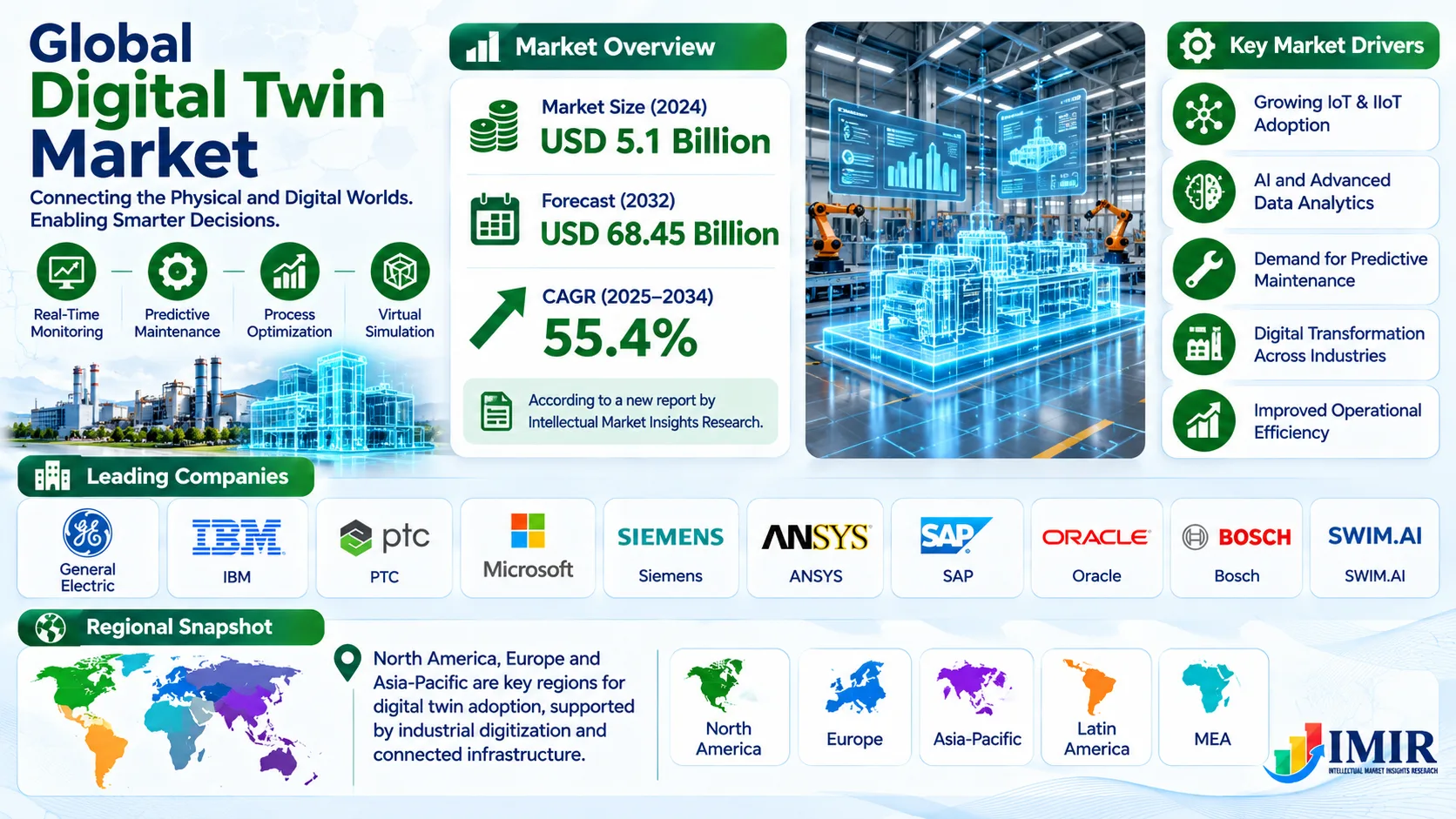
Global Digital Twin Market: Size, Leading Companies, Trends and Outlook (2025–2034)
Market Overview and Forecast: According to IMIR, the global digital twin market was valued at USD 5.1 billion in 2024 and is projected to reach USD 68.45 billion by 2032, with a stated CAGR of 55.4% over 2025–2034.
The figures on the IMIR page do not fully agree with each other: the 2032 end-value is stated alongside a 2025–2034 forecast window, and USD 5.1 billion to USD 68.45 billion over eight years implies about 38% a year, not 55.4%. The page metadata also carries older figures (a 2021 size above USD 3.6 billion and 51.4% CAGR for 2022–2028).
Introduction
A digital twin is a virtual replica of a physical product, process, system or place that is kept up to date with real-world data from sensors. Engineers use it to test designs before building, monitor equipment in real time, predict failures, optimise production and train AI systems. IMIR groups digital twins into three types: product twins (a machine or component), process twins (a production process) and system twins (a whole factory, building or grid).
Digital twins have moved quickly from pilot projects to core industrial software. Big manufacturers now run twins of factories and warehouses, utilities model power networks, hospitals model patients and equipment, and cities model infrastructure. In 2026 three trends stand out: industrial AI and 3D simulation (especially with Nvidia's Omniverse), a wave of acquisitions among software vendors, and growing demand for real-time operational twins. This blog covers the size of the market, what drives it, the companies named by IMIR, and the outlook to 2034.
| Segment | Categories |
|---|---|
| By Technology | IoT & IIoT, Blockchain, AI & Machine Learning, Augmented/Virtual/Mixed Reality, Big Data Analytics, 5G |
| By Type | Product Digital Twin, Process Digital Twin, System Digital Twin |
| By Industry | Aerospace & Defense, Automotive & Transportation, Home & Commercial, Healthcare, Energy & Utilities, Oil & Gas, Agriculture, Telecommunication, Retail, Others |
| By Region | North America, Europe, Asia-Pacific, Latin America, Middle East & Africa (North America expected to dominate) |
How to read the figures. Digital twin numbers vary a lot between research firms because the market can be defined narrowly (twin software only) or broadly (software, sensors, simulation, services and integration). IMIR's numbers show very fast growth from a small base; the implied rate from the stated endpoints is roughly 38% a year, still among the fastest in enterprise software. This blog uses IMIR's figures, with the caveats above.
Why the Digital Twin Market Is Growing
1. Industrial AI and simulation. In 2026 Siemens launched Digital Twin Composer, built with Nvidia Omniverse libraries. At launch PepsiCo reported a 20% throughput increase and 10–15% lower capital expenditure when simulating its US plants and warehouses. Nvidia's March 2026 announcements with Siemens, Synopsys, Cadence, Dassault Systèmes and PTC extended this "AI-era" engineering approach to many industries.
2. IoT and cheaper sensing. More connected sensors and edge computing allow twins to be updated in real time, which makes them useful for operations and not just design.
3. Predictive maintenance and downtime reduction. Twins let plants, utilities and fleets predict failures and plan repairs, which has a direct cost benefit.
4. Reshoring, automation and efficiency. Manufacturers rebuilding supply chains and factories use twins to plan layouts and test automation before spending capital.
5. Energy transition. Utilities and power equipment makers use twins to plan grids, turbines and storage. GE Vernova's record orders in Q3 2026 show how strongly power infrastructure is being built out.
6. Software-defined products. Cars, aircraft and machines are increasingly software-led, and system-level twins are needed to test them (for example, Siemens' PAVE360 Automotive twin for software-defined vehicles).
7. Healthcare, smart cities and buildings. Twins of patients, hospitals, buildings and city infrastructure are in early but growing use.
8. Cloud platforms. Microsoft, SAP, Oracle, IBM and others offer twin-capable services on cloud platforms, which lowers the entry barrier for mid-sized firms.
Companies Associated with the Digital Twin Market
IMIR names ten companies: General Electric, IBM, PTC, Microsoft, Siemens, ANSYS, SAP, Oracle, Robert Bosch and SWIM.AI. Several have had major ownership or structural changes, flagged below. Each is covered in bullet form and then compared in a detailed table.
| # | Company | HQ | Founded | Main Digital Twin Offering | Latest Verifiable Data / Status |
|---|---|---|---|---|---|
| 1 | Siemens | Munich / Berlin, Germany | 1847 | Xcelerator, Digital Twin Composer, Teamcenter, Simcenter, PAVE360 | Q3 FY26 revenue EUR 20.8B (+8%); software revenue EUR 1.8B (+15%); ARR EUR 5.7B |
| 2 | PTC | Boston, USA | 1985 | Creo, Windchill, Onshape, Codebeamer, ServiceMax | Schneider Electric agreed to buy at USD 205/share (about USD 22.6B equity), closing expected Q3 2027; IoT units sold to TPG |
| 3 | ANSYS (Synopsys) | Canonsburg / Sunnyvale, USA | 1970 (Ansys) | Engineering simulation underlying physics-based twins | Acquired by Synopsys, completed 17 Jul 2025 |
| 4 | GE Vernova | Cambridge, USA | 1892 (GE); spun off 2024 | Asset performance management, Proficy | Q3 2026 revenue USD 12.6B; orders USD 29.3B; backlog USD 196.7B |
| 5 | IBM | Armonk, USA | 1911 | Maximo, asset twins, consulting | Q3 2026 revenue USD 17.1B; software USD 7.8B (+8%) |
| 6 | Microsoft | Redmond, USA | 1975 | Azure Digital Twins, IoT and AI services | Digital twin revenue not disclosed |
| 7 | SAP | Walldorf, Germany | 1972 | Enterprise and asset twins | Digital twin revenue not disclosed |
| 8 | Oracle | Austin, USA | 1977 | IoT and supply-chain twins | Digital twin revenue not disclosed |
| 9 | Robert Bosch | Gerlingen, Germany | 1886 | IoT, industrial automation, connected products | Private; revenue for twins not disclosed |
| 10 | SWIM.AI | USA | Not confirmed | Edge streaming analytics | Status not confirmed |
| 11 | Dassault Systèmes | Vélizy-Villacoublay, France | 1981 | 3DEXPERIENCE, virtual twin | Partner in Nvidia's 2026 industrial AI programme |
| 12 | Nvidia | Santa Clara, USA | 1993 | Omniverse simulation platform | Partnerships with Siemens, Synopsys, Cadence, Dassault, PTC (Mar 2026) |
Competitive Landscape
- Engineering and PLM leaders dominate industrial twins. Siemens, PTC, Dassault Systèmes and Synopsys-Ansys supply the design and simulation base on which most industrial twins are built.
- Cloud and enterprise software firms (Microsoft, SAP, Oracle, IBM) add data, IoT and AI layers and connect twins to business processes.
- Equipment makers (GE Vernova, Bosch, Siemens Energy and others) build twins into their own assets and sell them as services.
- Nvidia is a platform enabler. Omniverse is becoming the common 3D and simulation layer, and nearly every major industrial software vendor now partners with Nvidia.
- Consolidation is accelerating. Synopsys bought Ansys (2025), Siemens bought Altair and Dotmatics, and Schneider Electric has agreed to buy PTC (announced October 2026, pending). Investors reacted cautiously to the Schneider deal (Schneider's shares fell about 8% while PTC's rose about 35% on announcement, per market commentary), which shows concern about price, debt and integration.
- Interoperability matters. Customers worry about being locked into one vendor's ecosystem, so open standards such as OpenUSD are a competitive theme.
- Risk for smaller firms. Specialist twin start-ups (for example SWIM.AI) face pressure from platform vendors and often end up acquired or repositioned.
Regional Analysis
IMIR's regional percentages are placeholders. IMIR expects North America to dominate.
North America is the largest market, with strong spending by manufacturers, utilities, aerospace and defence, and cloud vendors (Microsoft, IBM, Oracle, PTC, GE Vernova, Nvidia).
Europe is home to many leading industrial software vendors (Siemens, SAP, Bosch, Dassault Systèmes, Schneider Electric) and has strong adoption in automotive, machinery and energy. EU industrial and digital policy supports data spaces and twin projects.
Asia-Pacific is the fastest-growing region, with large manufacturing bases in China, Japan, South Korea and India and heavy investment in smart factories, smart cities and 5G. Companies such as Samsung, TSMC, SK hynix, Hyundai and Foxconn are named adopters in Nvidia's 2026 industrial AI announcements.
Latin America. Early-stage adoption in mining, oil and gas, and energy, with growth in Brazil and Mexico.
Middle East & Africa. Gulf states invest in smart-city and energy-sector twins (for example, large-scale city and infrastructure projects), while Africa is at an early stage.
Emerging Trends
- Industrial AI plus twins. AI copilots and generative AI help build, query and optimise twins. Siemens unveiled nine industrial copilots in January 2026.
- 3D, OpenUSD and Omniverse. Photorealistic, physics-accurate simulation is becoming standard for factory and warehouse twins.
- From design twins to operational twins. Companies are connecting twins to live plant data to run factories, grids and fleets.
- Robotics and autonomous machines. Twins are used to train and test robots and autonomous vehicles before deployment (for example, warehouse forklift simulation with KION, Siemens, Nvidia and Accenture).
- System-level twins. Whole products and plants, including software-defined vehicles, are modelled end to end.
- Energy and infrastructure. Grid, wind, gas and nuclear projects use twins for planning and maintenance.
- Healthcare and life sciences. Patient, device and process twins are growing, helped by acquisitions such as Siemens' Dotmatics.
- Platform consolidation. Large vendors combine design, simulation, operations and enterprise data under one roof, raising questions about openness.
Future Outlook (2025–2034)
IMIR's forecast shows the market rising from USD 5.1 billion in 2024 to USD 68.45 billion by 2032 (stated CAGR 55.4%; see the note above on the mismatch). IMIR does not give a separate 2034 value on its page, so the 2033–2034 period below is a qualitative extension.
- 2025–2027. Adoption spreads from early adopters to mainstream manufacturers. Industrial AI, Nvidia-based simulation and the vendor consolidation wave drive spending. The Schneider-PTC deal, if approved, is expected to close in Q3 2027.
- 2028–2030. Operational twins become common in factories, utilities and logistics, and system-level twins support software-defined products and autonomous machines.
- 2031–2034. Growth normalises as twins become part of standard engineering and operations software, with value shifting to AI-driven optimisation and services.
Risks: high implementation cost and data-integration complexity, shortage of skills, cybersecurity of connected twins, vendor lock-in, valuation and integration risk from large acquisitions, and the possibility that market definitions and forecasts are overstated.
Opportunities: industrial AI, simulation-based design, energy and grid twins, healthcare, services and integration, and open-standard data platforms.
FAQ
Q1. What is a digital twin?
A virtual model of a physical asset, process or system, kept up to date with real-world data, used for design, monitoring and prediction.
Q2. How big is the digital twin market?
IMIR values it at USD 5.1 billion in 2024, rising to USD 68.45 billion by 2032.
Q3. What is the expected CAGR?
IMIR states 55.4% for 2025–2034, though the stated endpoints imply a lower rate (about 38%). Either way it is among the fastest-growing software markets.
Q4. Who are the leading companies?
General Electric (GE Vernova), IBM, PTC, Microsoft, Siemens, ANSYS (Synopsys), SAP, Oracle, Bosch and SWIM.AI are named by IMIR. Dassault Systèmes and Nvidia are also major players.
Q5. Which industries use digital twins most?
Manufacturing and automotive, aerospace and defence, energy and utilities, healthcare, oil and gas, and smart buildings and cities.
Q6. What are the three types of digital twin?
Product twins, process twins and system twins.
Q7. Has the company landscape changed recently?
Yes. Synopsys completed its Ansys purchase (July 2025), GE Vernova became a separate company (2024), and Schneider Electric agreed in October 2026 to buy PTC for about USD 22.6 billion in equity value (pending).
Q8. Which region leads?
North America is expected to lead, while Asia-Pacific is expected to grow fastest.
Q9. What are the main challenges?
Integration complexity, data quality, costs, skills shortages, cybersecurity and vendor lock-in.
Conclusion
Digital twins have become a central technology in industrial and enterprise software. IMIR projects the market to expand from USD 5.1 billion in 2024 to USD 68.45 billion by 2032, and 2026 events (Siemens and Nvidia's industrial AI work, Synopsys-Ansys, and Schneider's agreed purchase of PTC) show that the largest software vendors see twins as strategic.
For vendors, success depends on combining engineering, simulation, AI and live operational data, while staying open enough to work with customers' existing systems. For buyers, the most effective approach is to start with a clear use case (for example, a production line or a critical asset), measure results, and then scale. Because the market is consolidating fast and forecasts vary widely, buyers and investors should check the latest ownership and product roadmaps before committing.