
Global EV Tire Market Leading Companies, Trends, and Future Outlook
Author:
Intellectual Market Insights Research
Published Date:
28 Sep 2026
Global Electric Vehicle EV Tire Market: Leading Companies, Trends, and Future Outlook
Introduction
EV tires are purpose-engineered to handle what internal-combustion tires were never designed for: the instant torque of electric motors, vehicles that are often 20–30% heavier because of battery packs, and the need to squeeze out every extra kilometer of range. That means lower rolling resistance, reinforced sidewalls and load-bearing structures, wear-resistant compounds, and noise-damping technologies (for example, acoustic foam) because there is no engine noise to mask road noise.
The global EV tire market spans passenger car, commercial vehicle, and two-wheeler applications across battery electric (BEV), plug-in hybrid (PHEV), and hybrid vehicles, sold through both original-equipment (OE) and replacement channels. This article analyzes the global EV tire market, the leading players shaping it, and the forces driving growth toward 2032 and beyond.
Market Overview and Forecast
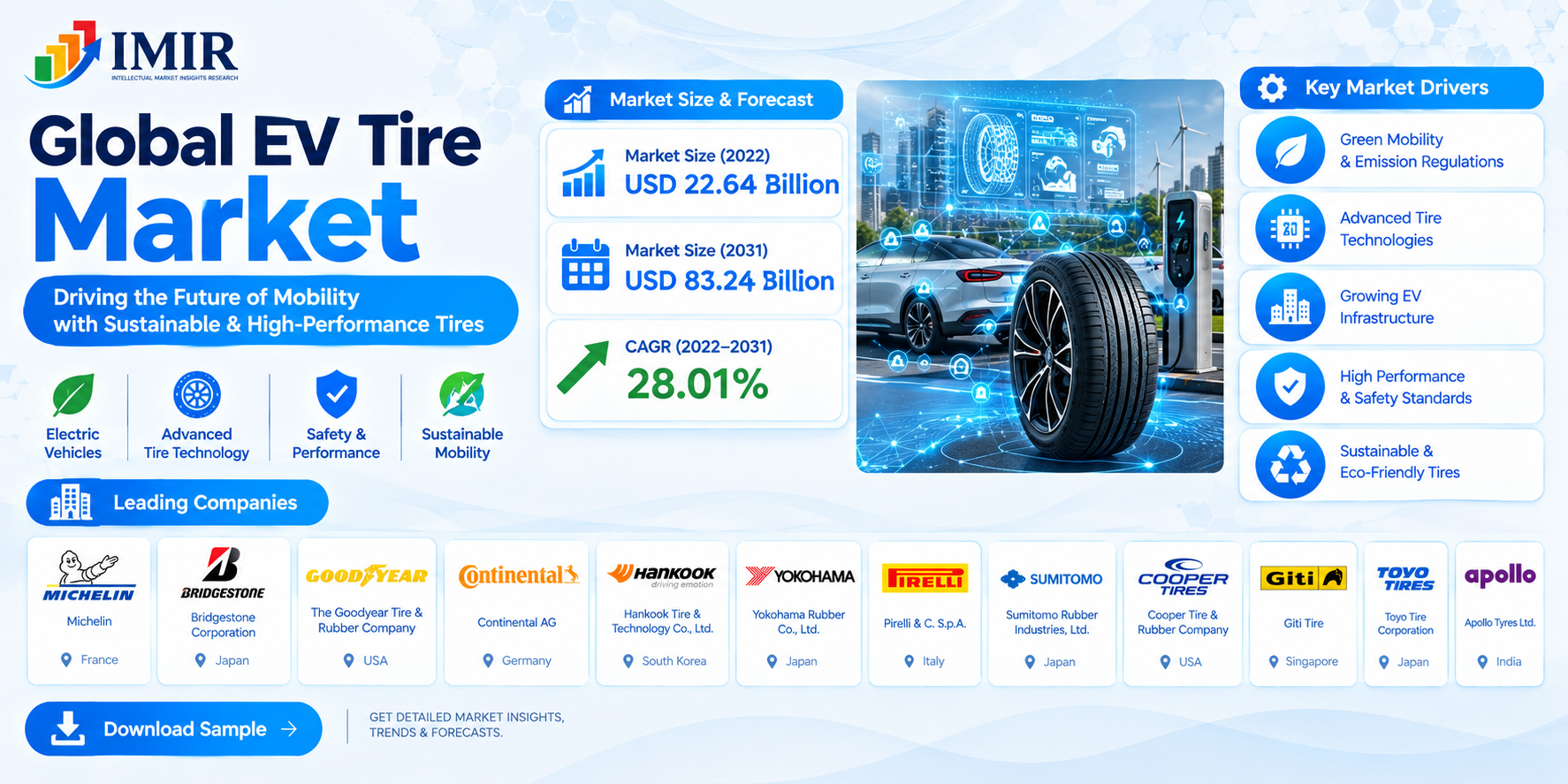
The global electric vehicle tires market is projected to grow from roughly USD 22.64 Billion in 2022 to USD 83.24 Billion by 2031, at a CAGR of about 28.01%, according to one widely cited estimate.
| Parameter | Details |
|---|---|
| Market Size (2025) | USD 22.64 Billion |
| Projected Market Size (2032) | USD 83.24 Billion |
| CAGR (2025–2032) | 8.01% (independent estimates range from about 9% to 22%) |
| Leading Region | Asia-Pacific (largest EV production base); Europe (fastest growth on emission rules); North America (premium EV demand) |
| Key Segments (by Vehicle Type) | Passenger Cars, Commercial Vehicles, Two-Wheelers |
| Key Segments (by Propulsion) | Battery Electric (BEV), Plug-in Hybrid (PHEV), Hybrid |
| Key Segments (by Sales Channel) | Original Equipment (OE), Replacement/Aftermarket |
Why the estimates differ: The spread comes almost entirely from scope, i.e., whether a study counts only tires marketed as EV-specific or every tire fitted to an electric vehicle. Every major forecaster agrees on the direction: double-digit-adjacent growth driven by EV adoption.
North America snapshot: the North America EV tire market was valued at about USD 5.9 billion in 2024 and is expected to grow at about 9.2% CAGR through 2034. The U.S. accounts for roughly 88% of regional revenue, BEVs hold about 70% of the regional segment, passenger cars about 65%, and the top seven manufacturers together hold about 62% of the market.
Why the EV Tire Market Is Growing
1. Rapid Growth in Global EV Adoption
Every electric vehicle sold needs EV-optimized tires, and rising BEV and PHEV sales across China, Europe, and North America expand both the OE and replacement-tire base year after year.
2. Faster Tire Wear on Heavier, Higher-Torque Vehicles
EVs are heavier and deliver instant torque, which wears tires faster than comparable combustion vehicles. Shorter replacement cycles raise aftermarket tire demand and give tire makers a recurring revenue stream.
3. Range Anxiety and the Rolling-Resistance Race
Since tires can influence range meaningfully, automakers specify ultra-low-rolling-resistance tires as a cheap way to add range, which pushes OE partnerships and premium-priced EV product lines.
4. Noise, Comfort, and Premium Positioning
With no engine to mask road noise, EV buyers are more sensitive to tire noise, driving adoption of noise-reducing constructions and supporting premium pricing.
5. Strict Emission and Efficiency Regulations
Regulations in Europe and other regions on tire efficiency labeling, emissions, and sustainability push manufacturers toward low-resistance, sustainable-material tires, and government EV incentives support the underlying vehicle demand.
6. Sustainable Materials and Smart Tire Technology
Growing use of bio-based and recycled materials, along with sensor-equipped and AI-designed tread patterns, is creating a new innovation tier that commands higher margins.
Market Opportunities & Restraints
A key opportunity lies in EV-specific premium lines and OE partnerships: tire makers that secure fitment on high-volume EV platforms, and pair it with strong replacement-channel sales as first-generation EVs age, capture both volume and margin. On the restraint side, weak near-term OE volumes, price competition, and a cost-heavy R&D race are the main headwinds: Michelin, for example, reported a 4.7% drop in tire volumes in 2025, with more than 80% of the decline in original-equipment markets, and noted that low-priced tires stocked by distributors penalized non-premium brands, showing how cyclical demand and low-cost competition can compress margins even in a structurally growing segment.
Leading Companies in the EV Tire Market: Cross-Analysis of Global Sources
To identify the genuinely leading EV tire players, we compared the company lists published by several global market research firms and the manufacturers' own competitor disclosures. Five companies appear in every source; the next tier appears in most.
| Company | Named as key player by | Global tire market share (2023, by sales) |
|---|---|---|
| Michelin | All major firms (MarketsandMarkets, Market Research Future, GMI, Grand View-type lists) | 14.4% |
| Bridgestone | All major firms | 13.3% |
| Goodyear | All major firms | 9.0% |
| Continental | All major firms | 6.5% |
| Pirelli | All major firms | 3.7% |
| Sumitomo Rubber Industries | MarketsandMarkets, GMI (North America), others | 3.7% |
| Hankook Tire & Technology | MarketsandMarkets, GMI, Market Research Future, others | 3.5% |
| Yokohama Rubber | Most firms | 3.2% |
| Toyo Tire | Several firms | 1.9% |
| Nokian Tyres / Kumho / Giti / Apollo | Selected firms (regional or niche coverage) | Below 2% each (varies) |
Together, the top five by sales hold roughly 47% of the global tire market, and the top twelve companies hold about 65% (total global tire sales were about USD 192 billion in 2023). Source for share data: Tire Business global company rankings, as reproduced in Bridgestone's 2025 data book.
Leading Companies Associated with the EV Tire Market
| Company | Headquarters | Founded | Employees | Revenue (latest available) | EV Tire Positioning |
|---|---|---|---|---|---|
| Michelin | Clermont-Ferrand, France | 1889 | Approx. 120,000+ | EUR 25.99 Billion (2025) | Global #1; premium Pilot Sport EV and Primacy ranges; 68% of passenger tire sales in 18"+ sizes. |
| Bridgestone | Tokyo, Japan | 1931 | Approx. 130,000+ | Approx. USD 28–30 Billion | Global #2; ultra-low-rolling-resistance tires for BMW EVs; Enliten technology platform. |
| Goodyear | Akron, Ohio, USA | 1898 | Approx. 63,000 | USD 18.88 Billion (2024) | Global #3; Range Max RSD for electric commercial vehicles; sold Dunlop rights to Sumitomo in May 2025. |
| Continental | Hanover, Germany | 1871 | Tens of thousands | Approx. EUR 13B+ (tires) | Global #4; every current tire line EV-compatible; strong European OE position; ContiSilent noise tech. |
| Pirelli | Milan, Italy | 1872 | Approx. 30,000+ | Approx. EUR 6.5–7 Billion | Premium/performance leader; ELECT series; AI-designed P Zero 5th generation for EVs (May 2025). |
| Sumitomo Rubber Industries | Kobe, Japan | 1909 | Approx. 38,000 | Approx. USD 7–8 Billion | Dunlop, Falken, Sumitomo brands; acquired Dunlop rights in Europe, N. America, Oceania (2025). |
| Hankook Tire & Technology | Seoul, South Korea | 1941 | Approx. 19,000–20,000 | Approx. USD 6–7 Billion | iON EV line; Formula E supplier; WRC supplier from 2025. |
| Yokohama Rubber | Tokyo, Japan | 1917 | Approx. 27,000 | Approx. USD 6–7 Billion | ADVAN and BluEarth lines; global top-ten by sales. |
| Toyo Tire | Itami, Japan | 1945 | Approx. 10,000+ | Approx. USD 3–4 Billion | Strong North American presence; EV-oriented lines. |
| Nokian Tyres | Nokia, Finland | 1898 | Approx. 4,000 | Approx. EUR 1.3–1.4 Billion | Nordic winter/all-weather specialist; eco-focused EV tires. |
Competitive Landscape
The EV tire market is concentrated at the top and contested in the middle. The big five, Michelin, Bridgestone, Goodyear, Continental, and Pirelli, hold about 47% of global tire sales and appear in every research firm's key-player list, competing on OE fitments, rolling-resistance leadership, and premium branding. In North America the top seven manufacturers (Michelin, Bridgestone, Goodyear, Continental, Pirelli, Sumitomo, and Cooper Tire) collectively hold around 62% of the EV tire market.
Challengers Hankook, Sumitomo, Yokohama, and Toyo compete through motorsport visibility (Hankook in Formula E and WRC), brand consolidation (Sumitomo's acquisition of Dunlop rights), and cost-competitive EV lines. Rankings have been remarkably stable: in the latest Global Tire Report, Michelin, Bridgestone, Goodyear, Continental, Pirelli, and Sumitomo all retained their positions, while Hankook, Yokohama, Zhongce (ZC Rubber), and Sailun grew sales but not enough to break into the established top set. Chinese and value players such as Zhongce, Sailun, Giti, and Linglong add price pressure, particularly in the replacement channel, which Michelin cited when noting that low-priced tires stocked by distributors penalized non-premium brands.
Regional Analysis
Asia-Pacific
Asia-Pacific is the largest EV production base, led by China, and is home to major tire makers including Bridgestone, Sumitomo, Yokohama, Toyo, Hankook, and fast-growing Chinese producers, making it the volume center of the EV tire market.
Europe
Europe is expected to see the fastest growth in EV tire demand because strict emission regulations and a mature automotive sector push demand for advanced, sustainable tire technologies, with Michelin, Continental, Pirelli, and Nokian headquartered in the region.
North America
North America was valued at about USD 5.9 billion in 2024, growing at roughly 9.2% CAGR through 2034, supported by expanding charging infrastructure, premium EV preference, and manufacturer investment in EV-specific tire lines. The U.S. accounts for about 88% of regional revenue.
Latin America & Middle East and Africa
Both regions are early-stage EV tire markets, with growth tied to gradual EV adoption, government incentives, and the extension of global OEM and replacement networks.
Emerging Trends in the EV Tire Market
1. AI-Designed Tread Patterns and Smart Tires: Pirelli's fifth-generation P Zero for EVs, launched in May 2025, uses AI-driven tread patterns and low rolling resistance to improve range, signaling the shift toward computationally designed and sensor-ready tires.
2. Brand Portfolio Consolidation: Goodyear's May 2025 sale of Dunlop brand rights to Sumitomo Rubber shows tire makers reshaping portfolios to concentrate capital on core, higher-margin lines.
3. Motorsport as an EV Proving Ground: Hankook's supply role in Formula E (replacing Michelin) and the World Rally Championship (replacing Pirelli from 2025) shows challengers using electric-racing visibility to build EV credibility.
4. Premiumization and Larger Fitments: Michelin reports that tires of 18 inches and larger now account for 68% of its Michelin-brand passenger tire sales, reflecting the EV-driven move to larger, higher-value sizes.
5. Sustainable and Recycled Materials: Manufacturers are investing in bio-based and recycled materials and lower-carbon production to meet regulatory expectations and OEM sustainability targets.
6. Volume Volatility and Price Pressure: Michelin's 2025 results (tire volumes down 4.7%, mostly OE) illustrate that cyclical OE demand and low-priced imports can offset structural EV-driven growth, making product mix and pricing discipline decisive.
Future Outlook (2025–2034)
The EV tire market is expected to keep growing at a low-to-high double-digit pace depending on scope, from about USD 11 billion in 2025 toward roughly USD 28 billion by 2032 on the base estimate used here. Growth will be underpinned by rising EV parc, shorter replacement cycles on heavier vehicles, and a mix shift toward larger, premium, EV-specific tires. Longer term, the replacement market should become the larger profit pool as the first mass-market EV generation ages.
Key themes to 2034 include: continued dominance of the top five with share gains in premium EV lines; challenger growth from Hankook, Sumitomo, and Yokohama; further portfolio consolidation and licensing deals; wider adoption of AI-assisted tire design and embedded sensors; and greater use of sustainable materials. Companies that combine OE partnerships, premium EV lines, and disciplined cost control will be best positioned to capture the growth.
Frequently Asked Questions (FAQ)
1. What is the size of the global EV tire market?
The global electric vehicle tires market is projected to grow from roughly USD 22.64 Billion in 2022 to USD 83.24 Billion by 2031, at a CAGR of about 28.01%, according to one widely cited estimate.
2. Who are the leading companies in the EV tire market?
Michelin, Bridgestone, Goodyear, Continental, and Pirelli appear on every major research firm's list, followed by Sumitomo Rubber Industries, Hankook, Yokohama, Toyo, and Nokian.
3. Who is the largest tire manufacturer?
Michelin has been the world's largest tire maker by tire sales for six consecutive years, with 2025 sales of EUR 25.99 billion, followed by Bridgestone and Goodyear.
4. How are EV tires different from regular tires?
They are engineered for higher vehicle weight and instant torque, with lower rolling resistance to extend range, reinforced construction, wear-resistant compounds, and noise-reducing features because there is no engine noise to mask tire noise.
5. Which region leads the EV tire market?
Asia-Pacific leads in volume because of China's EV production, Europe is expected to grow fastest due to emission regulations, and North America (about USD 5.9 billion in 2024) is driven by premium EV demand.
6. What recent deals have shaped the market?
In May 2025 Goodyear sold its Dunlop brand rights in Europe, North America, and Oceania to Sumitomo Rubber Industries, Pirelli launched a fifth-generation EV-oriented P Zero, and Hankook took over as supplier for Formula E and the World Rally Championship.
7. What are the main challenges?
Cyclical OE demand, price competition from low-cost tires, and the cost of continuous R&D. Michelin's 2025 tire volumes fell 4.7%, mostly in original-equipment markets.
Conclusion
The EV tire market combines structural growth from vehicle electrification with the volatility of a mature, capital-intensive industry. A concentrated group led by Michelin, Bridgestone, Goodyear, Continental, and Pirelli holds the strongest positions through OE fitments, premium EV lines, and R&D scale, while Hankook, Sumitomo, Yokohama, and Toyo are gaining visibility through motorsport, acquisitions, and cost-competitive offerings.
As AI-assisted design, sustainable materials, and larger premium fitments reshape the category, the winners through 2032 and beyond will be the companies that lock in EV platform partnerships, defend premium pricing against low-cost imports, and convert today's EV fleet growth into a durable replacement-tire business.