
Global Energy Management System Market Leading Companies
Author:
Intellectual Market Insights Research
Published Date:
10 Sep 2026
Energy Management System Market: Growth Trends, Key Players, and Outlook Through 2034
Introduction
Energy costs, sustainability targets, and tightening emissions regulations have pushed organizations across every sector to look more closely at how they generate, distribute, and consume power. Energy Management Systems (EMS) — the combined hardware, software, and services used to monitor and optimize energy use — have become one of the fastest-growing categories in the broader energy technology space. This article breaks down the current state of the EMS market, the forces driving its expansion, the companies shaping it, and where the industry is headed over the next decade.
Market Overview
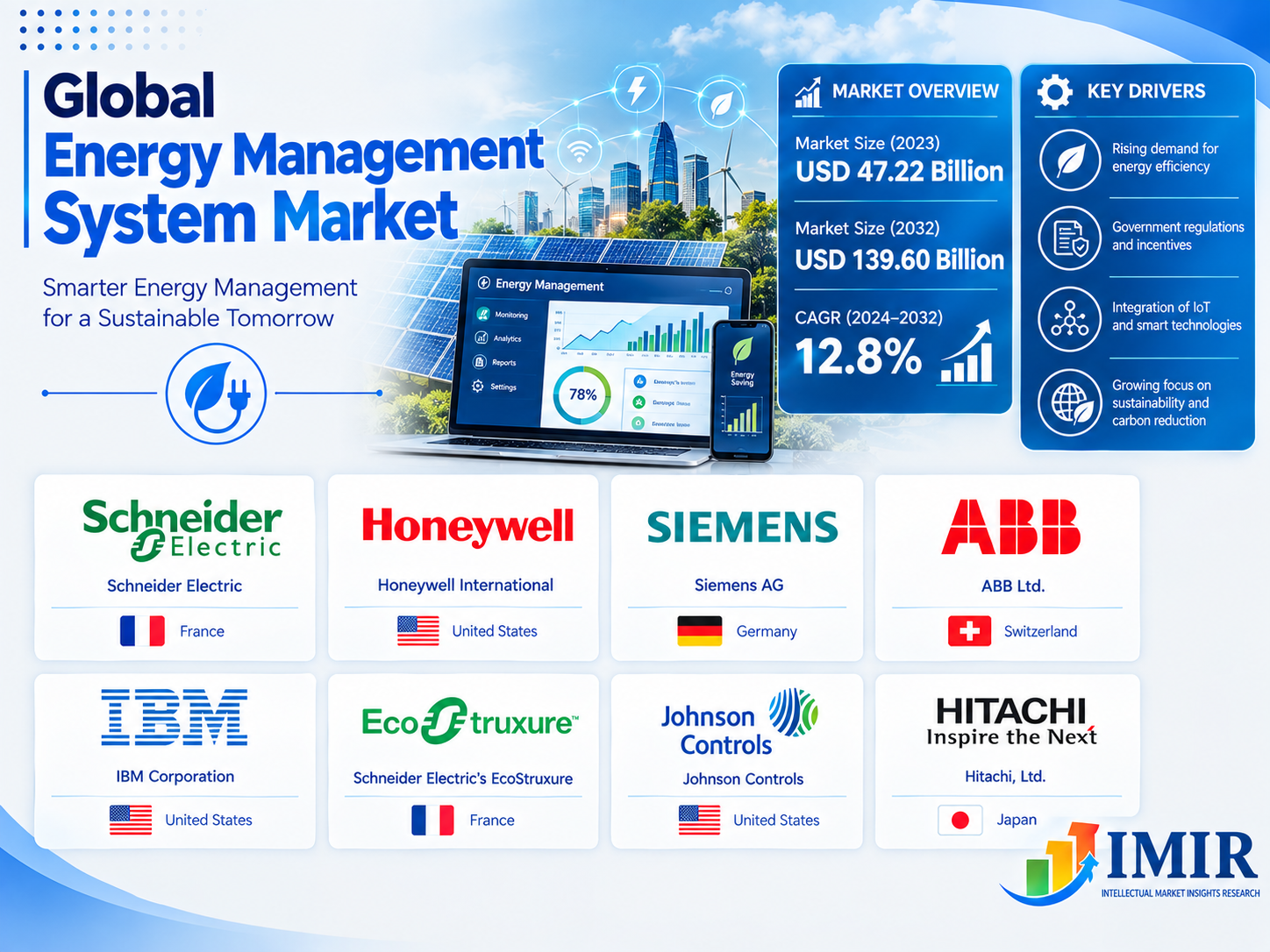
The global EMS market was valued at roughly $47.22 billion in 2023 and is projected to climb to around $139.60 billion by 2032, reflecting a compound annual growth rate (CAGR) of approximately 12.8% across the 2024–2032 forecast window.
EMS solutions cover a broad set of technologies used to track, control, and optimize energy consumption in residential, commercial, and industrial settings. Growth is being fueled by a mix of regulatory pressure, corporate sustainability commitments, and the maturing of digital tools — big data, artificial intelligence, and IoT — that make real-time energy monitoring and predictive optimization commercially viable at scale. Smart meters, demand-response platforms, and energy storage systems are giving building owners and industrial operators far more visibility into where energy is being wasted and where efficiency gains are possible.
The market is typically segmented by:
- System type: Industrial Energy Management Systems (IEMS), Building Energy Management Systems (BEMS), and Home Energy Management Systems (HEMS)
- Component: Hardware, Software, and Services
- Deployment: On-premises and Cloud
- Vertical: Residential, Energy & Power, Telecom & IT, Manufacturing, Retail, Healthcare, and others
- Region: North America, Europe, Asia-Pacific, Latin America, and the Middle East & Africa
Why the EMS Market Is Growing
Several converging trends explain the pace of expansion:
Regulatory and efficiency pressure. Governments worldwide are rolling out stricter energy-efficiency standards and carbon-reduction mandates. This is pushing both public and private organizations toward EMS adoption simply to stay compliant while controlling operating costs.
Digital technology maturity. IoT sensors now make real-time consumption data cheap and easy to collect; AI models turn that data into predictive maintenance schedules and load forecasts; and big-data platforms let large organizations spot inefficiencies across dozens or hundreds of sites at once. Together, these have turned EMS from a reporting tool into an active optimization system.
Renewable energy integration. As solar, wind, and other distributed generation sources join the grid, businesses need more sophisticated systems to balance intermittent supply with demand — a role EMS platforms are increasingly built to fill.
ESG and corporate sustainability commitments. Companies pursuing environmental, social, and governance (ESG) goals are treating energy visibility as a prerequisite for credible sustainability reporting, driving procurement of EMS software and services.
Smart grid and smart city investment. Utilities and municipalities modernizing grid infrastructure are creating downstream demand for EMS tools that can interface with distributed generation and smart metering networks.
Offsetting these tailwinds, high upfront implementation costs, data security concerns, and integration challenges with legacy infrastructure remain real constraints — particularly for smaller organizations and emerging markets, where the return on investment takes longer to materialize.
Companies Associated with the EMS Market
| Company | Headquarters / Region | Notable Area of Focus |
|---|---|---|
| ABB | Switzerland | Industrial automation and digital energy optimization (e.g., ABB Ability OPTIMAX) |
| Cisco Systems, Inc. | United States | Networking infrastructure supporting smart energy systems |
| GridPoint | United States | Commercial building energy management |
| General Electric | United States | Industrial and grid-scale energy solutions |
| Honeywell International Inc. | United States | Building automation and industrial EMS |
| IBM Corporation | United States | AI and analytics platforms for energy optimization |
| Johnson Controls, Inc. | United States/Ireland | Building energy management and HVAC integration |
| Schneider Electric SE | France | Industrial and building energy management, digital energy platforms |
| Siemens AG | Germany | Industrial automation and smart grid technology |
This list is illustrative rather than exhaustive — the competitive field also includes numerous regional integrators and software-focused entrants.
Competitive Landscape
The EMS space blends established industrial conglomerates with more specialized software and services providers, and the competitive dynamic is shifting in a few notable ways:
- Partnership-driven innovation: Large players are increasingly teaming up with IT and consulting firms rather than building every capability in-house. For example, Schneider Electric partnered with Capgemini in 2024 to launch an Energy Command Centre aimed at monitoring and optimizing energy-consuming assets — including data centers — using AI, machine learning, and IoT.
- Product platform upgrades: Incumbents are refreshing flagship platforms with AI-driven forecasting. ABB's mid-2024 release of an updated version of its OPTIMAX energy optimization system added predictive modeling for load demand, generation, and pricing, aimed at reducing costly grid-nomination errors.
- Large infrastructure contracts: Regional players are winning sizable public-sector deals. In late 2024, Larsen & Toubro's Digital Energy Solutions division secured a contract to deploy EMS infrastructure across multiple state and regional load-dispatch centers in southern India, spanning a dozen control rooms.
Overall, competition is concentrated around who can pair strong hardware/sensor portfolios with credible AI-driven software layers — a combination that favors firms with both industrial and digital capabilities.
Regional Analysis
North America leads current market share, driven by early smart-technology adoption, mature infrastructure, and supportive regulation such as carbon emission caps and efficiency requirements. Heavy investment in IoT, cloud platforms, and smart grids is central to the region's EMS uptake, with the U.S. and Canada as the primary markets.
Europe is expanding quickly, propelled by the EU's Green Deal and related national policies that impose stricter emissions and efficiency rules. Rising energy prices are also pushing businesses and households to seek better consumption management, alongside continued investment in smart grid infrastructure and renewable integration. Germany, the UK, and France are the region's largest markets.
Asia-Pacific is expected to post the fastest growth rates, driven by rapid industrialization, urbanization, and large-scale smart city programs in countries like China and India. Government incentives supporting energy efficiency, combined with rising sustainability concerns, are accelerating adoption across both the public and private sectors.
Latin America and the Middle East & Africa are earlier-stage but growing markets, with adoption driven by similar efficiency and sustainability pressures, and government initiatives aimed at reducing consumption and emissions — Brazil, Mexico, the UAE, and Saudi Arabia among the more active markets.
Emerging Trends in the EMS Market
- AI-native optimization: Rather than simply reporting consumption data, next-generation EMS platforms are using AI to autonomously adjust systems in near real time based on pricing signals, demand forecasts, and equipment health.
- Cloud-based and remote-monitoring platforms: Distributed portfolios of buildings or industrial sites are increasingly managed through centralized cloud dashboards rather than site-by-site, on-premises tools.
- Convergence with renewable energy management: EMS platforms are extending beyond consumption monitoring into managing the balance between on-site renewable generation, storage, and grid draw.
- IoT-enabled hardware proliferation: Smart meters, sensors, and connected controllers are becoming standard infrastructure rather than premium add-ons, especially in new construction and major retrofits.
- Sustainability reporting integration: As ESG disclosure requirements tighten, EMS software is increasingly expected to produce audit-ready carbon and energy-use reporting, not just operational dashboards.
Future Outlook (2025–2034)
Extrapolating from current momentum, the EMS market is likely to keep compounding at a double-digit rate through the mid-2030s, with growth increasingly weighted toward:
- Software and AI-driven services, as the hardware layer matures and differentiation shifts toward analytics, forecasting, and automation capabilities.
- Asia-Pacific as the primary growth engine, as industrialization, smart city buildouts, and government efficiency mandates continue to scale faster than in more mature regions.
- Deeper renewable and storage integration, as more grids incorporate distributed generation and businesses seek to manage that variability cost-effectively.
- Consolidation among vendors, as large industrial players continue to acquire or partner with specialized software and AI firms rather than building every capability internally.
- Falling implementation barriers, as hardware costs decline and cloud-based deployment models lower the upfront investment historically required, gradually opening the market to smaller organizations that have so far been priced out.
By the early-to-mid 2030s, EMS adoption is likely to shift from being a differentiator for sustainability-forward organizations to a baseline expectation across most commercial and industrial real estate and operations.
Frequently Asked Questions (FAQ)
How large is the global Energy Management System market? The market was valued at approximately $47.22 billion in 2023 and is projected to reach around $139.60 billion by 2032, growing at a CAGR of about 12.8%.
Which region currently holds the largest market share? North America led the market as of 2024, supported by early adoption of smart energy technologies, mature infrastructure, and supportive regulation.
What is driving EMS market growth? Key drivers include tightening energy-efficiency and emissions regulations, corporate ESG commitments, integration of renewable energy sources, and advances in IoT, AI, and big-data analytics that make real-time optimization practical.
Which segment leads the market by system type? Industrial Energy Management Systems (IEMS) held the largest share in 2024, generating more than 72.9% of global revenue, driven by industrial demand for cost reduction and emissions control.
Who are the major companies in the EMS market? Leading players include ABB, Cisco Systems, GridPoint, General Electric, Honeywell, IBM, Johnson Controls, Schneider Electric, and Siemens, among others.
Conclusion
The Energy Management System market sits at the intersection of two durable trends: the global push toward energy efficiency and decarbonization, and the rapid maturation of AI, IoT, and cloud technologies capable of acting on energy data in real time. With the market on track to nearly triple in value by the early 2030s, and growth increasingly concentrated in software, AI-driven optimization, and Asia-Pacific deployment, EMS is moving from a niche sustainability tool toward core infrastructure for how organizations manage energy — a shift likely to accelerate as implementation costs continue to fall and regulatory pressure continues to build.