
Leading Companies in the Global ENT Devices Market 2025
Author:
Intellectual Market Insights Research
Published Date:
26 Sep 2026
Global ENT (Ear, Nose, and Throat) Devices Market: Top Companies, Trends, and Future Outlook
Introduction
ENT (ear, nose, and throat) devices encompass the diagnostic, surgical, and therapeutic tools used by otolaryngologists and audiologists to treat conditions affecting hearing, balance, breathing, and voice. From hearing aids and cochlear implants to endoscopes, balloon sinuplasty systems, and voice prostheses, ENT devices address some of the most prevalent chronic conditions worldwide, with the World Health Organization estimating that around 5% of the global population requires rehabilitation to address hearing loss alone.
The global ENT (Ear, Nose, and Throat) Devices Market spans diagnostic ENT devices (including endoscopes and hearing screening devices), surgical ENT devices, hearing aids (analog and digital), hearing implants, nasal splints, and other specialty devices, deployed across hospitals, specialty clinics, and increasingly, home-use and tele-audiology settings. This article provides a research-based analysis of the global ENT (Ear, Nose, and Throat) Devices Market, the companies shaping it, and the regional and technological forces driving its growth toward 2034.
Market Overview
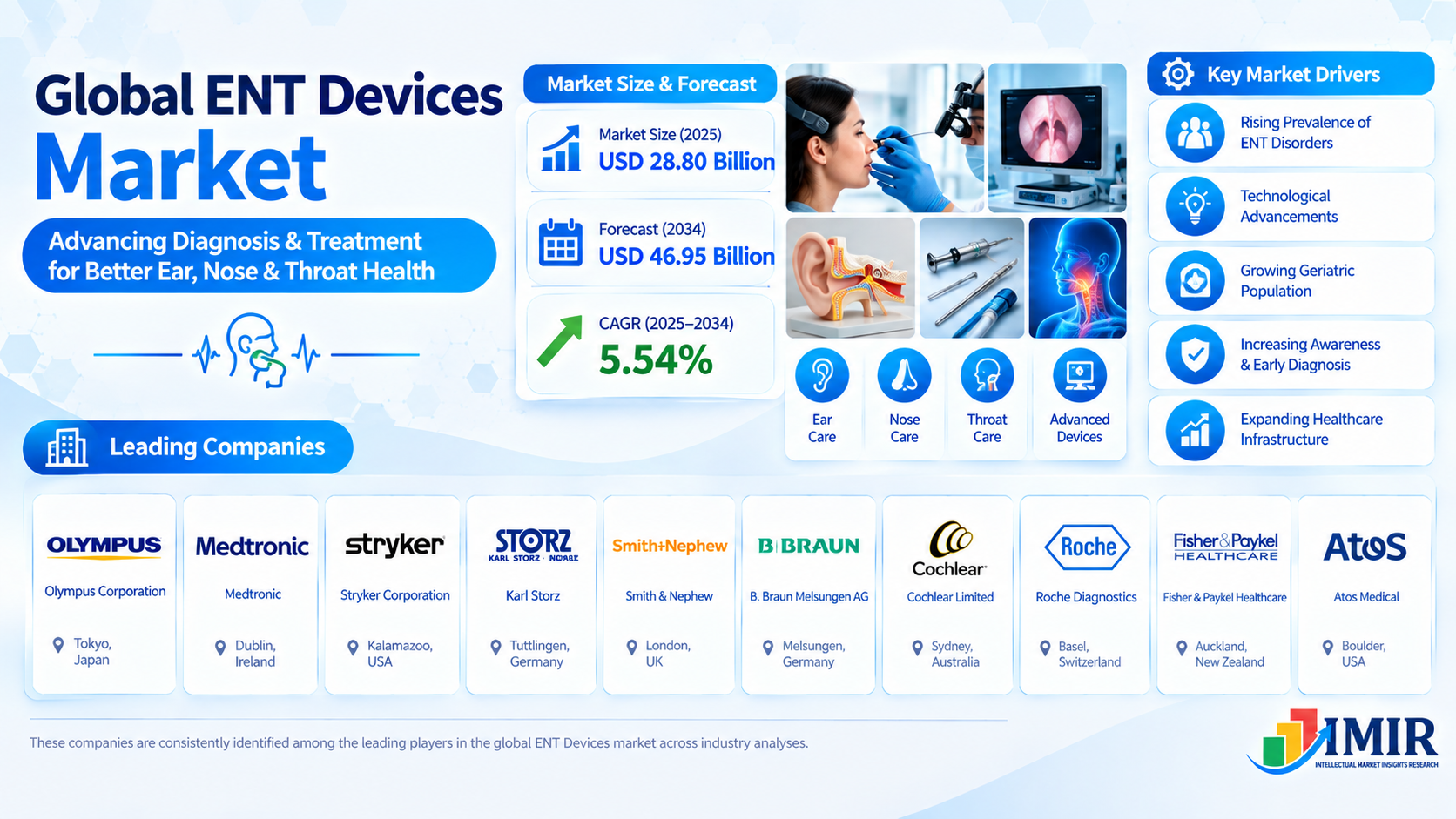
Global ENT (Ear, Nose, and Throat) Devices Market size was valued at USD 28.80 Billion in 2025 and is projected to reach USD 46.95 Billion by 2034, growing at a CAGR of 5.54% from 2025 to 2034, according to a new report by Intellectual Market Insights Research.
| Parameter | Details |
|---|---|
| Market Size (2025) | USD 28.80 Billion |
| Projected Market Size (2034) | USD 46.95 Billion |
| CAGR (2025–2034) | 5.54% |
| Forecast Period | 2025–2034 |
| Leading Region | North America (highest revenue share); Asia-Pacific (fastest growth) |
| Key Segments (by Product Type) | Diagnostic ENT Devices (Endoscopes, Hearing Screening Devices), Surgical ENT Devices, Hearing Aids (Analog, Digital), Hearing Implants, Nasal Splints, Others |
| Key Segments (by End-User) | Hospitals, Specialty Clinics, Others |
Why the ENT Devices Market Is Growing
1. Rising Prevalence of Hearing Loss and ENT Disorders
Hearing loss and impairment have become a significant public health concern, particularly in developed economies, with the WHO estimating that around 5% of the global population requires rehabilitation to address hearing loss, sustaining strong long-term demand for hearing aids, cochlear implants, and diagnostic ENT equipment.
2. Growing Geriatric Population
The aging global population continues to expand the pool of age-related auditory and sinonasal disorders, with projections showing all baby boomers will be older than 65 by 2030, significantly expanding the user base for hearing aids and cochlear implants.
3. Rising Demand for Minimally Invasive Procedures
Growing patient and physician preference for minimally invasive ENT procedures, such as balloon sinuplasty and functional endoscopic sinus surgery (FESS), is driving adoption of advanced surgical tools that enable faster recovery and reduced procedural complexity.
4. Technological Advancements and AI Integration
Deep integration of artificial intelligence for predictive and personalized ENT interventions, including AI-powered endoscopes and AI-driven sound processing in hearing aids, continues to enhance procedural accuracy and treatment personalization.
5. Expansion of the OTC Hearing Aid Market
The U.S. FDA's OTC hearing aid rule, which came into effect in 2022, is significantly expanding the addressable market by enabling direct consumer access to hearing aids for mild-to-moderate hearing loss without a prescription or audiologist visit.
6. Rising Tele-ENT Consultations and Home-Use Devices
Growing adoption of tele-audiology platforms and home-use ENT devices is expanding market reach beyond traditional hospital and clinic settings, improving access to care in both urban and rural areas.
Market Opportunities & Restraints
A key opportunity lies in AI-powered personalization and home-use device expansion: as regulatory changes such as the U.S. OTC hearing aid rule open direct consumer access, and as AI-enabled hearing aids increasingly adjust to real-world listening environments, manufacturers have significant opportunity to capture a broader, more price-diverse customer base spanning premium clinical devices to accessible consumer-grade solutions. On the restraint side, high procedure and device costs alongside persistent social stigma remain primary headwinds, as the cost of advanced surgical instruments and premium hearing devices can limit adoption, particularly in price-sensitive and emerging markets, while social stigma surrounding hearing aid use continues to suppress treatment-seeking behavior among eligible patients globally.
Companies Associated with the ENT Devices Market
| Company | Headquarters | Founded | Employees | Revenue | Overview |
|---|---|---|---|---|---|
| Medtronic plc | Galway, Ireland / Minneapolis, USA | 1949 | Approx. 95,000 | Approx. USD 33.54 Billion | Market leader with 12.5%+ share, offering ENT surgical navigation, powered instruments, and balloon sinus dilation systems. |
| Stryker Corporation | Portage, Michigan, USA | 1941 | Approx. 53,000 | Approx. USD 25.12 Billion | A global medical technology leader offering ENT surgical instruments and navigation systems. |
| Cochlear Limited | Sydney, Australia | 1981 | Approx. 4,500–4,800 | Approx. AUD 2.36 Billion | The global leader in implantable hearing solutions, including the Nucleus cochlear implant and Baha bone conduction implant. |
| Sonova Holding AG | Stäfa, Switzerland | 1947 | Approx. 17,990–18,100 | Approx. CHF 3.6–4.4 Billion | A leading hearing care company operating Phonak, Unitron, and Advanced Bionics brands with AI-driven sound processing. |
| Smith & Nephew plc | Watford, England, UK | 1856 | Approx. 18,000 | Approx. USD 6.16 Billion | A British medical equipment manufacturer offering ENT surgical devices among its broader portfolio. |
| Olympus Corporation | Tokyo, Japan | 1919 | Tens of thousands | Multi-billion dollar diversified company | A dominant ENT endoscopy and imaging player operating in 160+ countries with AI-powered endoscopes. |
| Johnson & Johnson Services, Inc. | New Brunswick, New Jersey, USA | 1886 | Approx. 138,000 (group) | Approx. USD 94.2 Billion (total company) | Offers balloon sinus dilation and minimally invasive ENT technologies through its Acclarent subsidiary. |
| KARL STORZ SE & Co. KG | Tuttlingen, Germany | 1945 | Approx. 9,700–9,900 | Approx. EUR 2.18 Billion (2023) | A family-owned global endoscopy leader with ENT-specific instruments, originally founded for ear, nose, and throat medicine. |
| Atos Medical (Coloplast) | Malmö, Sweden | 1986 | Approx. 500–1,000 | Acquired by Coloplast for ~EUR 2.16B (2022) | The global market leader in laryngectomy products including voice prostheses, now part of Coloplast. |
Competitive Landscape
The global ENT Devices Market is moderately concentrated, with a few global leaders such as Medtronic, Smith & Nephew, Stryker, and Cochlear Ltd. dominating due to their strong product portfolios, extensive distribution networks, and continuous R&D investments; the top 5 players collectively held a market share of 41.5% in 2024. Diversified medical technology majors Medtronic, Stryker, Smith & Nephew, and Johnson & Johnson leverage broad surgical equipment portfolios and global distribution scale to maintain leadership positions. Hearing-focused specialists Sonova and Cochlear compete through deep category focus in hearing aids, cochlear implants, and assistive listening devices, competing directly with Demant A/S and GN Store Nord in the hearing devices segment. Endoscopy and imaging leaders Olympus and KARL STORZ maintain strong positions in ENT diagnostic and surgical visualization technology. The market continues to see consolidation activity, exemplified by Coloplast's 2022 acquisition of Atos Medical, illustrating how larger medical device companies are acquiring specialized ENT technology providers to expand their portfolios.
Regional Analysis
North America
North America dominated the ENT Devices Market with a share of 34.99% in 2024, attributable to increased demand for hearing care devices, the presence of large hospital chains and highly equipped ambulatory facilities, and a significant target population, with the U.S. holding the largest share within the region.
Europe
Europe represents a significant ENT Devices Market, anchored by major manufacturers such as Sonova, KARL STORZ, and Atos Medical, alongside strong healthcare infrastructure and regulatory frameworks across Germany, Switzerland, and Sweden.
Asia-Pacific
Asia-Pacific is projected to maintain the fastest growth rate during the forecast period, driven by enhanced healthcare availability, rising healthcare spending, and increased patient awareness, alongside developing ENT healthcare infrastructure and rising demand for advanced hearing devices.
Latin America & Middle East and Africa
Latin America and the Middle East & Africa represent emerging growth markets for ENT devices, with adoption tied to expanding healthcare infrastructure investment and growing access to advanced diagnostic and surgical ENT technologies.
Emerging Trends in the ENT Devices Market
1. Deep Integration of AI for Predictive and Personalized ENT Interventions: The market is witnessing a shift toward AI-powered predictive and personalized ENT interventions, including hyperspectral endoscopes that reveal tissue microstructures and AI-enabled hearing aids that adjust to real-world listening environments.
2. Proliferation of 3D Bioprinting for Custom Regenerative ENT Constructs: Emerging 3D bioprinting technology is opening new possibilities for custom regenerative ENT constructs, representing a longer-term innovation frontier for the industry.
3. Expansion of OTC and Home-Use Hearing Solutions: The U.S. FDA's OTC hearing aid rule and growing tele-audiology adoption are expanding the addressable market beyond traditional clinical settings into direct consumer and home-use channels.
4. Consolidation Through Strategic Acquisitions: Coloplast's 2022 acquisition of Atos Medical and Cochlear's 2025 acquisition of Oticon Medical's cochlear implant business illustrate ongoing consolidation as larger medical device companies acquire specialized ENT technology providers.
5. Growth of Minimally Invasive and Micro-ENT Devices: The market is witnessing a major trend toward smaller, micro-ENT devices for better patient comfort, with modern hearing aids becoming lighter, less visible, and easier to use, alongside portable and clinic-based ENT solutions.
Future Outlook (2025–2034)
The global ENT Devices Market's trajectory toward USD 46.95 billion by 2034 reflects sustained demand growth driven by rising hearing loss prevalence, an aging global population, and continued innovation in minimally invasive and AI-enabled ENT technologies. The 5.54% CAGR forecast through 2034 assumes continued OTC hearing aid market expansion, growing tele-ENT and home-use device adoption, and sustained healthcare infrastructure investment across emerging markets in Asia-Pacific.
Key investment themes for 2025–2034 include continued AI and digital integration by global leaders such as Medtronic, Stryker, and Sonova, growing competition in the hearing devices segment among Cochlear, Sonova, Demant, and GN Store Nord, and sustained consolidation activity as larger medical device companies acquire specialized ENT technology providers, following the pattern set by Coloplast's acquisition of Atos Medical. As AI-powered personalization, OTC hearing aid expansion, and minimally invasive surgical technology continue to reshape the industry, the companies that combine deep clinical expertise with digital innovation will be best positioned to capture growth through 2034.
Frequently Asked Questions (FAQ)
1. What is the current size of the global ENT Devices Market?
Global ENT Devices Market size was valued at USD 28.80 billion in 2025 and is projected to reach USD 46.95 billion by 2034, growing at a CAGR of 5.54% from 2025 to 2034, according to a new report by Intellectual Market Insights Research.
2. Who are the top companies in the ENT Devices Market?
Leading companies include Medtronic plc, Stryker Corporation, Smith & Nephew plc, Cochlear Limited, Sonova Holding AG, Olympus Corporation, Johnson & Johnson Services, Inc., KARL STORZ SE & Co. KG, and Atos Medical (now part of Coloplast).
3. Which region dominates the ENT Devices Market?
North America dominated the ENT Devices Market with a share of 34.99% in 2024, while Asia-Pacific is projected to maintain the fastest growth rate during the forecast period.
4. What is the forecast CAGR for the ENT Devices Market?
The market is forecast to grow at a CAGR of 5.54% from 2025 to 2034.
5. What are the main growth drivers for this market?
Key drivers include the rising prevalence of hearing loss and ENT disorders, growing geriatric population, rising demand for minimally invasive procedures, technological advancements and AI integration, and expansion of the OTC hearing aid market.
6. What product types make up the ENT Devices Market?
The market is segmented by product type into diagnostic ENT devices (endoscopes, hearing screening devices), surgical ENT devices, hearing aids (analog and digital), hearing implants, nasal splints, and other specialty devices.
7. Who are the top 5 players in the ENT Devices Market by market share?
The top 5 players include Medtronic, Stryker, Smith & Nephew, Cochlear, and Sonova (Phonak, Unitron), which collectively held a market share of 41.5% in 2024, with Medtronic leading at over 12.5% share.
Conclusion
The global ENT (Ear, Nose, and Throat) Devices Market sits at the intersection of rising hearing loss prevalence and the ongoing shift toward AI-enabled, minimally invasive, and increasingly accessible ENT care. With a projected size of USD 46.95 billion by 2034 at a 5.54% CAGR, the market offers steady, technology-driven growth across diagnostic, surgical, and hearing device segments.
Medtronic, Stryker, and Smith & Nephew continue to lead on the strength of broad surgical equipment portfolios, while Sonova and Cochlear dominate the hearing devices segment through deep category focus, and Olympus and KARL STORZ maintain strong positions in endoscopy and imaging technology. As AI-powered personalization, OTC hearing aid expansion, and continued industry consolidation reshape the market, the companies that combine deep clinical expertise with digital innovation will define market leadership through 2034 and beyond.