
Leading Companies in the Global EV Charging Cable Market 2025
Author:
Intellectual Market Insights Research
Published Date:
13 Aug 2026
Introduction
The global shift toward electric mobility has turned a once-overlooked component the humble charging cable into a critical piece of automotive infrastructure. EV charging cables carry the electric power that moves from the grid or charging station into the vehicle's battery, and as EV adoption accelerates across China, the United States, and Europe, so does demand for cables that are durable, fast-charging capable, and compliant with an expanding patchwork of regional safety standards.
Download brochure link: https://www.intellectualmarketinsights.com/report/ev-charging-cable-market-size-and-share-analysis/imi-008394
The global EV charging cable market was valued at approximately USD 1.7 billion in 2025 and is projected to reach USD 6.3 billion by 2034, expanding at a compound annual growth rate (CAGR) of 16.4% over the forecast period, according to Intellectual Market Insights Research. This growth reflects surging EV sales, expanding public and private charging networks, and continuous innovation in cable materials, insulation, and thermal management.
Unlike many automotive components, charging cables sit at the intersection of the automotive and electrical/industrial equipment industries, cable and wiring harness manufacturers, connector specialists, and diversified electronics groups are all competing for share as charging standards mature and fast-charging (DC) infrastructure scales up globally.
Understanding which companies lead this fast-growing market is essential for automotive investors, charging infrastructure developers, and industry analysts. This article provides a research-based analysis of the top companies in the global EV charging cable market, their positioning, flagship offerings, and the regional and technological forces shaping the competitive landscape.
Market Overview
|
Parameter |
Details |
|---|---|
|
Market Size (2025) |
USD 1.7 Billion |
|
Projected Market Size (2034) |
USD 6.3 Billion |
|
CAGR (2025–2034) |
16.4% |
|
Base Year |
2024 |
|
Forecast Period |
2025–2034 |
|
Leading Region |
Asia-Pacific (China, Japan, South Korea) |
|
Fastest-Growing Region |
North America (United States) |
|
Key Growth Drivers |
Rising EV sales, expanding charging infrastructure, fast-charging (DC) adoption, cable material innovation |
|
Key Challenges |
High cost of advanced cables, lack of standardization across charging protocols, high upfront cost of EVs |
|
Key Opportunities |
Growth of PHEVs, bidirectional/smart-charging cables, ultra-fast charging cable development |
Why the EV Charging Cable Market Is Growing
1. Accelerating Global EV Adoption
Electric vehicle sales continue to climb across China, the US, and Europe, supported by government subsidies and tax incentives. As automakers expand electric passenger car lineups, the attached charging cable ecosystem, from onboard cables to public fast-charging cables, scales in tandem.
2. Expansion of Public and Private Charging Infrastructure
Growing investment in public charging networks, workplace charging, and home charging installations is directly expanding the addressable market for both AC and DC charging cables.
3. Fast-Charging and DC Infrastructure Growth
Highway corridors and urban charging hubs are increasingly deploying DC fast chargers, which require heavier-gauge, thermally managed cables capable of handling higher currents safely.
4. Advances in Cable Materials and Design
Manufacturers are investing in lightweight, heat-resistant, and waterproof cable technologies that improve durability and user convenience, a key differentiator as competition intensifies.
5. Growth of Plug-in Hybrid Electric Vehicles (PHEVs)
Rising PHEV sales, particularly in the US and China, are creating incremental demand for charging cables even outside the fully battery-electric segment.
6. Emergence of Smart and Bidirectional Charging
The integration of renewable energy into the grid is driving interest in smart charging and vehicle-to-grid (V2G) applications, opening a new, higher-value category of intelligent charging cables.
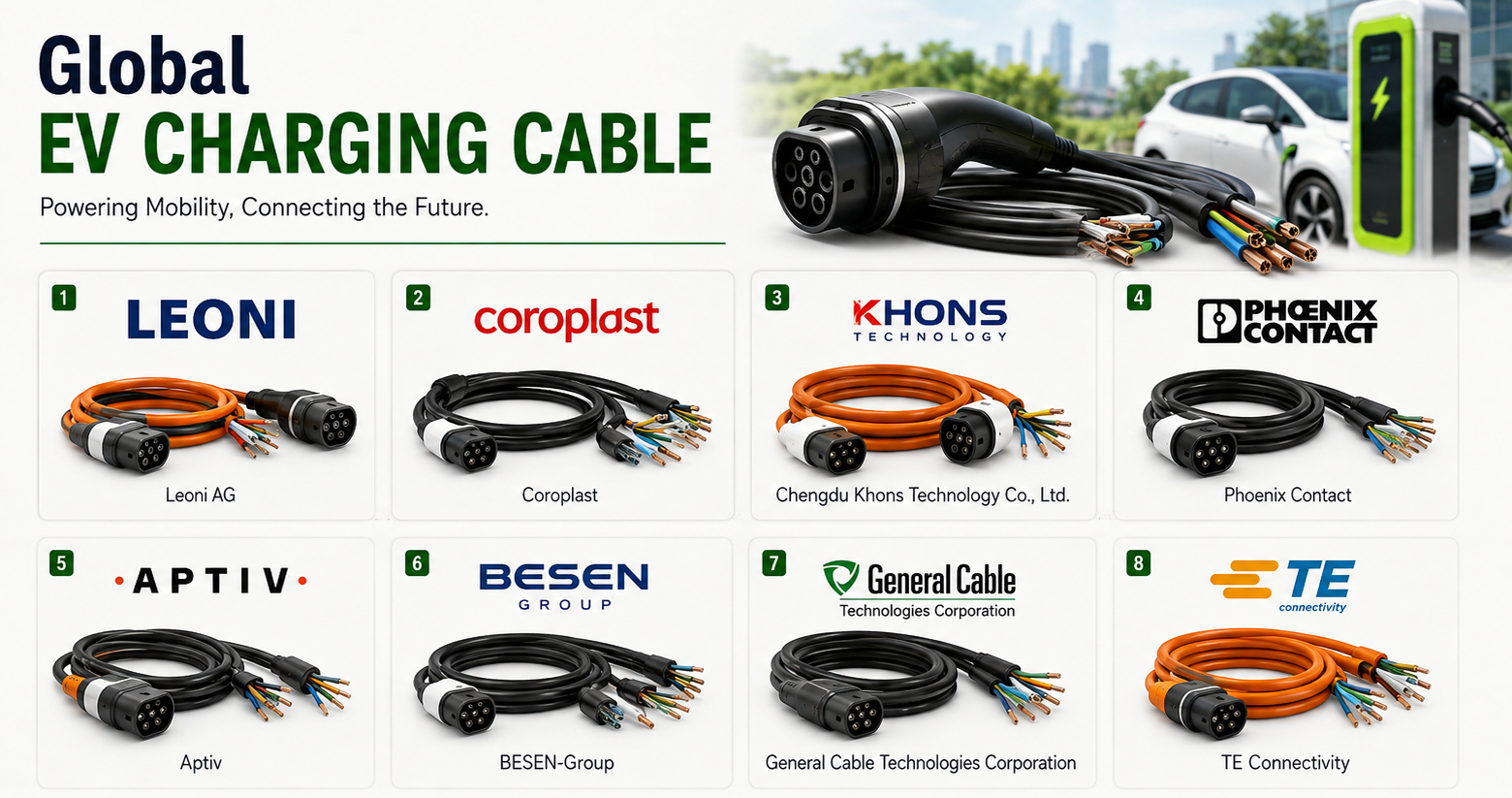
Top 9 Companies in the EV Charging Cable Market
- Leoni AG
- TE Connectivity
- Aptiv
- Phoenix Contact
- Coroplast
- Chengdu Khons Technology Co., Ltd.
- BESEN-Group
- General Cable Technologies Corporation
- Dyden Corporation
1. Leoni AG
|
Category |
Details |
|---|---|
|
Company Name |
Leoni AG |
|
Headquarters |
Nuremberg, Germany |
|
Founded |
1917 |
|
Employees |
Approx. 90,000+ |
|
Revenue |
Approx. USD 5 Billion |
|
Company Overview |
Leoni is a long-established German cable and wiring-systems manufacturer serving the automotive sector worldwide through its Wire & Cable Solutions and Wiring Systems divisions. In 2025, Leoni became a majority-owned subsidiary of China's Luxshare Precision. |
|
Key Products |
High-voltage cables, standardized and special cables, charging cable assemblies, and complete automotive wiring harnesses. |
|
Market Position |
One of the largest global cable and harness suppliers to the automotive industry, with a strong footprint in EV high-voltage and charging cable solutions. |
|
Recent Developments |
Majority stake acquisition by Luxshare Precision (2025) aimed at strengthening its position in EV-related cable and connectivity technology. |
|
Strategic Advantages |
Deep automotive OEM relationships, century-long manufacturing heritage, and an extensive global production footprint across more than 20 countries. |
|
Category |
Details |
|---|---|
|
Company Name |
TE Connectivity plc |
|
Headquarters |
Galway, Ireland |
|
Founded |
1941 (as AMP Incorporated; independent as TE Connectivity since 2007) |
|
Employees |
Approx. 90,000+ |
|
Revenue |
Approx. USD 17–18 Billion |
|
Company Overview |
TE Connectivity is a global industrial technology leader supplying connectivity and sensor solutions, including EV charging connectors, high-voltage cabling, and terminal systems for next-generation transportation. |
|
Key Products |
EV charging connectors and cable assemblies, high-voltage automotive cabling, terminals, and sensor systems. |
|
Market Position |
A top-tier global supplier of connectivity components to the transportation and EV charging infrastructure sectors. |
|
Recent Developments |
Continued investment in transportation solutions targeting electric vehicle production and charging infrastructure growth. |
|
Strategic Advantages |
Broad diversification across transportation, industrial, and communications segments, plus a large global engineering base supporting rapid product development. |
3. Aptiv
|
Category |
Details |
|---|---|
|
Company Name |
Aptiv PLC |
|
Headquarters |
Schaffhausen, Switzerland (Dublin, Ireland listed address) |
|
Founded |
1994 (spun off from Delphi Automotive in 2017) |
|
Employees |
Approx. 140,000 |
|
Revenue |
Approx. USD 20 Billion |
|
Company Overview |
Aptiv is a global vehicle architecture and mobility technology company, supplying electrical distribution systems, connectors, and cable management solutions used across EV platforms. |
|
Key Products |
High-voltage and low-voltage automotive cabling, connectors, wiring assemblies, and electrical distribution systems. |
|
Market Position |
A leading global vehicle technology supplier to the world's largest automakers, with strong exposure to EV electrical architecture. |
|
Recent Developments |
Ongoing expansion of its Signal and Power Solutions segment to support electrified and software-defined vehicle platforms. |
|
Strategic Advantages |
Deep OEM integration, large-scale global manufacturing footprint, and strong R&D investment in vehicle electrification technology. |
|
Category |
Details |
|---|---|
|
Company Name |
Phoenix Contact GmbH & Co. KG |
|
Headquarters |
Blomberg, Germany |
|
Founded |
1923 |
|
Employees |
Approx. 22,000 |
|
Revenue |
Approx. USD 3.5–4 Billion |
|
Company Overview |
Phoenix Contact is a family-owned German industrial electronics and automation group that has built a dedicated e-mobility business (including its E-CHARX and POWERCHARX brands) supplying charging connectors and cables. |
|
Key Products |
AC and DC EV charging connectors, charging cables, and e-mobility infrastructure components. |
|
Market Position |
A leading specialist supplier of EV charging hardware to charging-station manufacturers and infrastructure operators. |
|
Recent Developments |
Continued expansion of its dedicated e-mobility product line for public and private charging infrastructure. |
|
Strategic Advantages |
Century-long engineering heritage, family ownership enabling long-term investment, and a purpose-built e-mobility component portfolio. |
5. Coroplast
|
Category |
Details |
|---|---|
|
Company Name |
Coroplast Group |
|
Headquarters |
Wuppertal, Germany |
|
Founded |
1919 |
|
Employees |
Approx. 5,000+ |
|
Revenue |
Approx. USD 1 Billion (est.) |
|
Company Overview |
Coroplast is a German family-owned manufacturer of wires, cables, and adhesive tapes, with a growing automotive cable and e-mobility charging cable business. |
|
Key Products |
Automotive wiring, charging cables, insulation tapes, and specialty cable products. |
|
Market Position |
A mid-sized but well-established European cable manufacturer with growing relevance in the EV charging cable segment. |
|
Recent Developments |
Expansion of automotive and e-mobility cable production capacity to meet rising EV-related demand. |
|
Strategic Advantages |
Long manufacturing heritage, vertically integrated production, and strong ties to the European automotive supply chain. |
Competitive Landscape
The global EV charging cable market is moderately fragmented, spanning large diversified electronics and connectivity groups such as TE Connectivity and Aptiv, established automotive cable and wiring-harness specialists such as Leoni and Coroplast, industrial connector manufacturers such as Phoenix Contact, and a growing set of Asia-based specialists such as Chengdu Khons Technology, BESEN-Group, and Dyden Corporation.
Scale vs. Specialization: Large diversified suppliers compete on global manufacturing scale and OEM relationships, while specialist e-mobility component makers compete on charging-specific engineering, such as thermal management and fast-charging compatibility.
Standards-Driven Competition: As charging protocols and safety standards continue to evolve across regions, companies that can rapidly adapt cable designs to new regulatory and technical requirements gain a competitive edge.
Consolidation Activity: The 2025 acquisition of a majority stake in Leoni by China's Luxshare Precision illustrates ongoing consolidation as companies seek scale and access to EV-related cable and connectivity technology.
Material and Design Innovation: Competitive differentiation increasingly centers on lightweight, heat-resistant, and waterproof cable construction, alongside coiled and ultra-fast-charging cable formats.
Regional Analysis
Asia-Pacific
Asia-Pacific holds the largest share of the global EV charging cable market, led by China's dominant EV production and sales base, alongside strong government support for charging infrastructure in Japan and South Korea.
North America
North America is expected to be the fastest-growing region, driven by rising US government investment in charging infrastructure, EV tax credits, and expanding collaboration between automakers and charging-network developers.
Europe
Germany, France, and the UK anchor European demand, supported by strict emissions targets and an established automotive cable manufacturing base led by companies such as Leoni, Coroplast, and Phoenix Contact.
Latin America and MEA
These regions represent early-stage but emerging markets, with growth tied to gradual EV adoption and nascent public charging network development.
Emerging Trends in the EV Charging Cable Market
1. Ultra-Fast Charging Cable Development: Rising demand for reduced charging times is accelerating innovation in high-capacity, lightweight cable designs.
2. Smart and Bidirectional Charging Cables: Vehicle-to-grid (V2G) applications are creating a new category of cables integrated with energy-management and communication capabilities.
3. Enhanced Durability Features: Heat resistance, waterproofing, and extra insulation are becoming standard requirements as cables are deployed in more demanding public charging environments.
4. Coiled Cable Adoption: Coiled cable formats are gaining traction in public and commercial charging settings for space efficiency and durability.
5. Standardization Pressure: Ongoing fragmentation across charging protocols and connector types continues to push suppliers toward more universally compatible cable designs.
Future Outlook (2025–2034)
The global EV charging cable market's trajectory toward USD 6.3 billion by 2034 reflects the durable expansion of EV adoption and charging infrastructure worldwide. The 16.4% CAGR forecast through 2034 assumes continued growth in both AC home/workplace charging and DC fast-charging networks, alongside sustained investment in cable material and design innovation.
Key investment themes include the scaling of ultra-fast and smart charging cable technologies, continued infrastructure investment in North America and Asia-Pacific, and further consolidation among cable and connectivity manufacturers seeking EV-related scale. Leading companies including Leoni, TE Connectivity, Aptiv, and Phoenix Contact are likely to retain leadership, while specialist and regional players continue to compete for share in fast-growing charging infrastructure segments.
Frequently Asked Questions (FAQ)
1. What is the current size of the global EV charging cable market?
The global EV charging cable market was valued at approximately USD 1.7 billion in 2025 and is projected to reach USD 6.3 billion by 2034, growing at a CAGR of 16.4%.
2. Who are the top companies in the EV charging cable market?
Leading companies include Leoni AG, TE Connectivity, Aptiv, Phoenix Contact, Coroplast, Chengdu Khons Technology Co., Ltd., BESEN-Group, General Cable Technologies Corporation, and Dyden Corporation.
3. Which region dominates the EV charging cable market?
Asia-Pacific leads the market, driven by China's large EV production and sales base, while North America is expected to be the fastest-growing region.
4. What is the forecast CAGR for the EV charging cable market?
The market is forecast to grow at a CAGR of 16.4% from 2025 to 2034.
5. What are the main growth drivers for this market?
Key drivers include rising EV adoption, expanding public and private charging infrastructure, growth of DC fast-charging networks, and continuous innovation in cable materials and design.
6. What challenges does the EV charging cable industry face?
The industry faces high costs for advanced cable technology, a lack of standardization across charging protocols and connector types, and the broader challenge of high upfront EV costs affecting adoption rates.
7. Is AC or DC charging the larger segment for charging cables?
AC (Alternate Charging) currently holds the largest market share due to its lower installation cost and compatibility with existing home and workplace charging infrastructure, though DC fast-charging cables are growing quickly in public charging networks.
Conclusion
The global EV charging cable market sits at the intersection of the automotive electrification wave and rapidly scaling charging infrastructure investment. With a projected size of USD 6.3 billion by 2034 at a 16.4% CAGR, the sector offers substantial growth potential for cable, connector, and wiring-systems manufacturers alike.
Companies led by Leoni, TE Connectivity, Aptiv, and Phoenix Contact are not just supplying components, they are actively investing in fast-charging, smart-charging, and durability-focused cable technologies to capture share in an increasingly standards-driven and infrastructure-dependent market. The manufacturers that successfully balance manufacturing scale, technical innovation, and adaptability to evolving charging standards will define market leadership through 2034 and beyond.


