
Leading Companies of Global Fiber Optic Connector Market
Author:
Intellectual Market Insights Research
Published Date:
10 Sep 2026
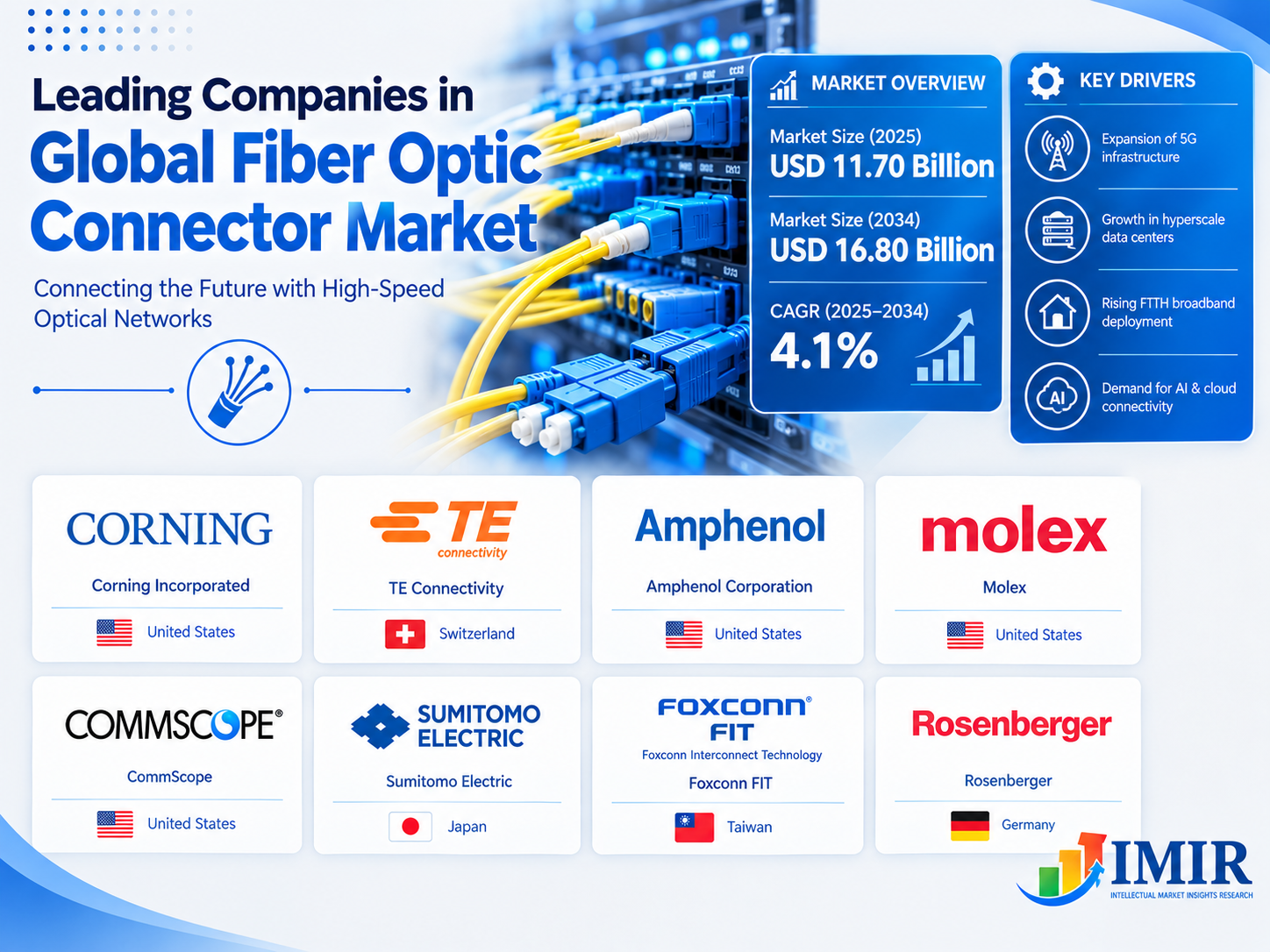
Introduction
Fiber optic connectors are the critical junction points that join optical fibers together or connect them to transmission equipment, enabling the high-speed, high-bandwidth data transmission that underpins modern telecommunications, data centers, and countless specialized industrial applications. As global data traffic continues to surge and network operators race to deploy faster, more reliable infrastructure, fiber optic connectors have become an essential enabling technology across telecom, defense, healthcare, financial services, and industrial sectors.
The global fiber optic connector market spans a range of connector types, including Lucent Connector (LC), Subscriber Connector (SC), Straight Tip (ST), Multi-Fiber Termination Push On/Pull Off (MTP), Master Unit (MU), Fiber Distributed Data Interface (FDDI), and Sub Multi Assembly (SMA) formats, deployed across telecom, oil and gas, military and aerospace, BFSI, medical, and railway applications. This article provides a research-based analysis of the global fiber optic connector market, the companies shaping it, and the regional and technological forces driving its growth toward 2033.
Market Overview
| Parameter | Details |
|---|---|
| Market Size (2024) | USD 4.91 Billion |
| Projected Market Size (2033) | USD 10.2 Billion |
| CAGR (2024–2033) | 9.71% |
| Base Year | 2023 |
| Historic Year | 2018–2022 |
| Forecast Period | 2024–2033 |
| Leading Region | North America (highest revenue share); Asia-Pacific (significant growth) |
| Key Segments (by Type) | LC, SC, ST, MTP, MU, FDDI, SMA, Other |
| Key Segments (by Application) | Telecom, Oil and Gas, Military & Aerospace, BFSI, Medical, Railway, Others |
Why the Fiber Optic Connector Market Is Growing
Explosive Growth in Global Data Traffic
The relentless rise of video streaming, cloud computing, and mobile data consumption is driving telecom operators and data center providers to expand fiber optic network infrastructure, directly increasing demand for high-performance connector solutions.
Data Center and Hyperscale Infrastructure Expansion
The rapid buildout of hyperscale data centers to support cloud computing and AI workloads is creating substantial demand for high-density fiber optic connectors such as MTP/MPO formats capable of supporting massive parallel data transmission.
5G Network Rollout and Fiber Backhaul Investment
Continued global rollout of 5G wireless networks requires extensive fiber backhaul infrastructure to connect cell towers and small cells to core networks, driving sustained demand for fiber optic connectors in telecom applications.
Rising Adoption in Military, Aerospace, and Industrial Applications
Fiber optic connectors are increasingly used in demanding military, aerospace, and industrial environments due to their immunity to electromagnetic interference, light weight, and high signal integrity, expanding the market beyond traditional telecom applications.
Growth in Healthcare and Financial Services Connectivity
Expanding use of fiber optic networks in medical imaging equipment, hospital data systems, and high-frequency financial trading infrastructure is broadening demand for specialized, high-reliability connector solutions.
Fiber-to-the-Home (FTTH) Deployment
Continued global expansion of fiber-to-the-home broadband deployment, particularly in emerging markets, is driving substantial demand for cost-effective, easy-to-install fiber optic connectors for last-mile connectivity.
Market Opportunities & Restraints
A key opportunity lies in high-density connector innovation for AI and hyperscale data centers: as AI workloads drive unprecedented demand for data center bandwidth and interconnect density, manufacturers have significant opportunity to develop next-generation high-fiber-count MTP/MPO connectors and low-loss polishing technologies that meet the stringent performance requirements of hyperscale and AI computing infrastructure, positioning early innovators to capture outsized share of this fast-growing segment. On the restraint side, installation complexity and skilled labor requirements remain a primary headwind, as fiber optic connector termination and splicing require specialized tools and trained technicians, increasing deployment costs and slowing adoption in cost-sensitive and rural markets compared to conventional copper-based connectivity solutions.
Companies Associated with the Fiber Optic Connector Market (Details in Table)
| Company | Headquarters | Founded | Employees | Revenue | Overview |
|---|---|---|---|---|---|
| Amphenol Corporation | Wallingford, Connecticut, USA | 1932 | Approx. 170,000 | Approx. USD 23.1 Billion (2025) | One of the largest global designers and manufacturers of electrical, electronic, and fiber optic connectors, serving data centers, IT, industrial, automotive, communications, defense, and aerospace markets. |
| TE Connectivity | Galway, Ireland / Berwyn, Pennsylvania, USA | 2007 | Approx. 93,000 | Approx. USD 17.26 Billion (2025) | Designs and manufactures electrical and electronic components, including fiber optic connectivity solutions, serving automotive, aerospace, defense, medical, and energy industries across ~140 countries. |
| Molex | Lisle, Illinois, USA | 1938 | Approx. 45,000 | Approx. USD 10.3 Billion | A Koch Industries subsidiary and leading manufacturer of electronic, electrical, and fiber optic connectivity systems, offering 100,000+ products across data communications, medical, industrial, and consumer electronics. |
| 3M Company | Saint Paul (Maplewood), Minnesota, USA | 1902 | Approx. 60,500 | Approx. USD 24.9 Billion (FY2025, total company) | Diversified global conglomerate whose Transportation and Electronics segment includes fiber optic and electronic interconnect solutions alongside its broader industrial and consumer portfolio. |
| Optical Cable Corporation (OCC) | Roanoke, Virginia, USA | 1983 | Approx. 348 | Approx. USD 73–78 Million (FY2025) | Specialized manufacturer of fiber optic and copper data communication cabling and connectivity solutions for enterprise, data center, harsh environment, and wireless carrier markets. |
| Aptiv | Dublin, Ireland | 2017 (spun off from Delphi) | Approx. 150,000+ | Approx. USD 20 Billion+ | Global technology company supplying advanced connectivity, electrical architecture, and software solutions to the automotive industry, including fiber optic and high-speed data connectors. |
| Broadcom | Palo Alto, California, USA | 1961 (predecessor); 2016 (current form) | Approx. 37,000+ | Approx. USD 60 Billion+ | Global semiconductor and infrastructure software leader whose networking and optical components portfolio supports high-speed data center and telecom fiber optic interconnects. |
| Extron | Anaheim, California, USA | 1983 | Approx. 2,000 | Privately held (revenue not disclosed) | Global manufacturer of professional AV and control systems that incorporates fiber optic connectivity solutions for signal distribution across enterprise and institutional environments. |
| Siemens AG | Munich, Germany | 1847 | Approx. 300,000+ | Approx. EUR 75 Billion+ (total company) | Global industrial conglomerate whose digital industries and infrastructure businesses incorporate fiber optic connectivity for industrial automation and smart infrastructure applications. |
Competitive Landscape
The global fiber optic connector market brings together a mix of large diversified electronics and connectivity conglomerates alongside specialized fiber optic manufacturers. Global interconnect majors Amphenol, TE Connectivity, and Molex hold particularly strong positions, built on massive manufacturing scale, broad product portfolios spanning multiple connector technologies, and deep customer relationships across data center, telecom, automotive, and industrial end-markets. Diversified industrial conglomerates such as 3M and Siemens AG bring broad technology platforms and global distribution reach to the fiber optic connector segment as part of larger electronics and industrial businesses. Specialized fiber optic manufacturers including Optical Cable Corporation (OCC) and Shenzhen ADTEK Technology compete through deep category focus, harsh-environment and specialty application expertise, and regional manufacturing agility, while Aptiv, Broadcom, and Extron round out the competitive field with complementary connectivity and networking technologies across the fragmented global market.
Regional Analysis
North America
North America holds the highest revenue share in the fiber optic connector market, supported by extensive data center and hyperscale infrastructure investment, ongoing 5G network deployment, and the presence of major manufacturers such as Amphenol, TE Connectivity, Molex, and OCC.
Europe
Europe represents a significant fiber optic connector market, driven by continued telecom infrastructure modernization, growing data center capacity, and strong industrial and automotive connector demand across Germany, France, and the UK.
Asia-Pacific
Asia-Pacific is expected to register significant growth, driven by the presence of key fiber optic connector companies in economies such as Japan and China, alongside rapid 5G rollout, expanding data center construction, and large-scale fiber-to-the-home broadband deployment across the region.
Latin America & Middle East and Africa
Latin America and the Middle East & Africa represent emerging growth markets for fiber optic connectors, with demand tied to expanding telecom infrastructure investment, growing data center development, and increasing broadband connectivity initiatives.
Emerging Trends in the Fiber Optic Connector Market
High-Density Connectors for AI and Hyperscale Data Centers:
Growing AI workload demands are driving adoption of high-fiber-count MTP/MPO connectors capable of supporting massive parallel data transmission within hyperscale data center environments.
Miniaturization of Connector Form Factors:
Continued development of smaller, higher-density connector designs is enabling greater port density within data center switches and patch panels, supporting the industry's shift toward higher-bandwidth network architectures.
Growth of Single-Mode Fiber Adoption:
Rising demand for longer-distance, higher-bandwidth transmission is driving increased adoption of single-mode fiber connectors over multimode alternatives in telecom and data center backbone applications.
Expansion into Harsh Environment and Specialty Applications:
Growing use of ruggedized fiber optic connectors in military, aerospace, oil and gas, and industrial environments is broadening the market beyond traditional telecom and data center applications.
Automation in Connector Termination and Polishing:
Manufacturers are increasingly investing in automated termination, polishing, and testing processes to reduce installation costs and improve consistency, addressing one of the market's key adoption barriers.
Future Outlook (2025–2033)
Building on the underlying report's original 2024–2033 forecast window (USD 4.91 billion in 2024 to USD 10.2 billion by 2033 at a 9.71% CAGR), the market's momentum is expected to continue well beyond 2033 as data center, AI infrastructure, and 5G-driven fiber deployment remain long-term structural growth drivers through 2034. Extending the trend, continued double-digit-adjacent growth would be supported by sustained hyperscale data center construction, expanding fiber-to-the-home penetration in emerging markets, and growing fiber optic adoption in military, aerospace, and industrial automation applications.
Key investment themes for 2025–2034 include continued high-density connector innovation by global interconnect majors such as Amphenol, TE Connectivity, and Molex, sustained specialty and harsh-environment market positioning by focused manufacturers like OCC, and growing automation investment across the industry to address installation cost and labor availability challenges. As data center, 5G, and fiber-to-the-home deployment continues to accelerate globally, the companies that combine manufacturing scale with high-density and automation innovation will be best positioned to capture growth through 2034.
Frequently Asked Questions (FAQ)
1. What is the current size of the global fiber optic connector market?
The global fiber optic connector market exceeded USD 4.91 billion in 2024 and is projected to reach USD 10.2 billion by 2033, growing at a CAGR of 9.71% from 2024 to 2033, according to the underlying market report.
2. Who are the top companies in the fiber optic connector market?
Leading companies include Amphenol Corporation, TE Connectivity, Molex, 3M Company, Optical Cable Corporation (OCC), Aptiv, Broadcom, Extron, Siemens AG, and Shenzhen ADTEK Technology Co., Ltd.
3. Which region dominates the fiber optic connector market?
North America holds the highest revenue share in the fiber optic connector market, while Asia-Pacific is expected to register significant growth due to the presence of key companies in economies such as Japan and China.
4. What is the forecast CAGR for the fiber optic connector market?
The underlying report forecasts a CAGR of 9.71% from 2024 to 2033; this growth trajectory is expected to broadly continue through 2034 given sustained data center, 5G, and fiber broadband investment.
5. What are the main growth drivers for this market?
Key drivers include explosive growth in global data traffic, data center and hyperscale infrastructure expansion, 5G network rollout, rising adoption in military and industrial applications, and continued fiber-to-the-home deployment.
6. What connector types are used in the fiber optic connector market?
The market is segmented by type into Lucent Connector (LC), Subscriber Connector (SC), Straight Tip (ST), Multi-Fiber Termination Push On/Pull Off (MTP), Master Unit (MU), Fiber Distributed Data Interface (FDDI), Sub Multi Assembly (SMA), and other connector formats.
7. What applications does the fiber optic connector market serve?
Fiber optic connectors serve telecom, oil and gas, military and aerospace, BFSI (banking, financial services and insurance), medical, railway, and other specialized connectivity applications across the global economy.
Conclusion
The global fiber optic connector market sits at the intersection of surging global data demand and the ongoing buildout of next-generation network and data center infrastructure. With a projected size of USD 10.2 billion by 2033 at a 9.71% CAGR — and structural growth drivers expected to persist through 2034 — the market offers strong, technology-driven growth across telecom, data center, and specialty application segments.
Amphenol, TE Connectivity, and Molex continue to lead on the strength of massive manufacturing scale and broad interconnect technology portfolios, while 3M and Siemens bring diversified industrial technology platforms, and specialty manufacturers like OCC compete through deep harsh-environment and enterprise connectivity expertise. As high-density data center connectors, 5G fiber backhaul, and automation continue to reshape the industry, the companies that combine manufacturing scale with high-performance connector innovation will define market leadership well into the next decade.