Leading Companies in the Global Green Technology & Sustainability Market
Author:
Intellectual Market Insights Research
Published Date:
07 Oct 2026
Global Green Technology & Sustainability Market: Top Companies, Trends, and Future Outlook
Introduction
Green technology and sustainability solutions encompass the software platforms, IoT sensors, AI analytics, and digital infrastructure that organizations use to monitor, manage, and reduce their environmental impact, spanning carbon footprint management, renewable energy integration, pollution monitoring, and sustainability reporting. As regulatory pressure, investor expectations, and consumer demand for corporate environmental accountability intensify worldwide, green technology has evolved from a niche compliance function into a core pillar of enterprise digital transformation strategy.
The global green technology and sustainability market spans technologies including the Internet of Things (IoT), cloud computing, artificial intelligence and analytics, digital twins, cybersecurity, and blockchain, deployed across applications such as green building management, carbon footprint management, weather monitoring and forecasting, air and water pollution monitoring, forest and crop monitoring, and water purification. This article provides a research-based analysis of the global green technology and sustainability market, the companies shaping it, and the technological forces driving its growth toward 2033.
Market Overview
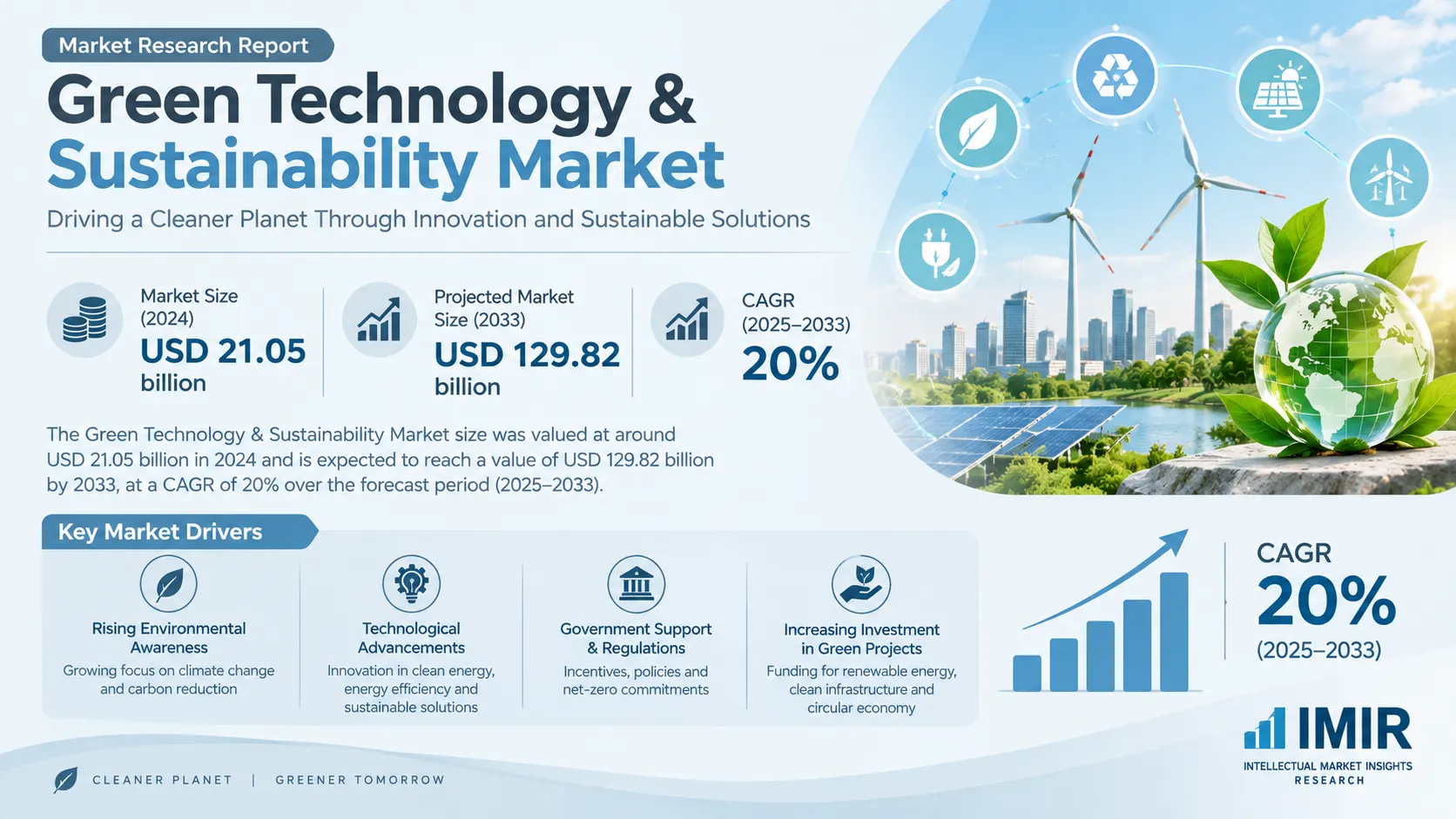
The Green Technology & Sustainability Market size was valued at around USD 21.05 Billion in 2024 and is expected to reach a value of USD 129.82 Billion by 2033, at a CAGR of 20% over the forecast period (2025–2033).
| Parameter | Details |
|---|---|
| Market Size (2024) | USD 21.05 Billion |
| Projected Market Size (2033) | USD 129.82 Billion |
| CAGR (2025–2033) | 20% |
| Forecast Period | 2025–2033 |
| Leading Region | North America (dominant, approx. 34% share); Asia-Pacific (fastest growth, led by India and China) |
| Key Segments (by Technology) | Internet of Things (IoT), Cloud Computing, Artificial Intelligence & Analytics, Digital Twin, Cybersecurity, Blockchain |
| Key Segments (by Application) | Green Building, Carbon Footprint Management, Weather Monitoring & Forecasting, Air & Water Pollution Monitoring, Forest Monitoring, Crop Monitoring, Soil Condition/Moisture Monitoring, Water Purification, Others |
Additional context worth noting: published estimates for this market vary considerably by research provider and scope, with base-year figures ranging from roughly USD 20 billion to USD 29 billion and CAGR estimates ranging from approximately 20% to nearly 32% depending on methodology. The figures used here fall within this broad consensus range, reflecting the exceptionally fast growth nearly every independent forecaster projects for this category.
Why the Green Technology & Sustainability Market Is Growing
1. Rising Need for Data-Driven, Scalable Environmental Solutions
The growing need for data-driven, scalable, and efficient environmental solutions is a primary driver fueling the green technology and sustainability market, as organizations increasingly require real-time environmental data to inform business decisions.
2. Government and Private Sector Pollution Monitoring Initiatives
The global green technology and sustainability market is booming, largely due to the rising need for effective pollution monitoring and control, alongside increasing initiatives by governments and private companies to promote environmental responsibility.
3. Expanding Corporate Sustainability Reporting Requirements
Growing regulatory and investor pressure for standardized, verifiable sustainability disclosures continues to drive adoption of carbon footprint management and ESG reporting software across enterprises of all sizes.
4. Integration of AI and IoT for Environmental Monitoring
Continued integration of artificial intelligence, IoT sensors, and advanced analytics into environmental monitoring platforms is improving the accuracy and real-time responsiveness of weather forecasting, pollution monitoring, and resource management systems.
5. Growth of Precision Agriculture and Natural Resource Monitoring
Rising investment in crop monitoring, soil condition monitoring, and forest monitoring technologies continues to expand the green technology market's reach into agriculture and natural resource management applications.
6. Strategic Partnerships and Continuous Platform Innovation
Companies operating in the market continue to prioritize strategic collaborations and partnerships to expand their business operations and client base, while simultaneously investing in emerging technologies to integrate and introduce new green technology and sustainability solutions.
Market Opportunities & Restraints
A key opportunity lies in integrated sustainability platforms spanning energy, building, and industrial automation: as demonstrated by Schneider Electric's 2023 introduction of its "EcoStruxure Microgrid Advisor" software, designed to help businesses optimize energy use and integrate renewable energy sources, companies that successfully combine energy management, carbon accounting, and industrial automation into unified digital platforms stand to capture outsized value as enterprises seek fewer, more comprehensive sustainability technology partners rather than point solutions. On the restraint side, high cost of production and a shortage of personalized solutions remain the primary headwinds, as the high cost of developing and deploying green technology solutions can be prohibitive for smaller organizations, while the shortage of personalized solutions capable of addressing unique, organization-specific environmental challenges continues to limit adoption among businesses whose needs don't fit standardized platform offerings.
Companies Associated with the Green Technology & Sustainability Market
| Company | Headquarters | Founded | Employees | Revenue (2025) | Overview |
|---|---|---|---|---|---|
| IBM Corporation | Armonk, New York, USA | 1911 | Approx. 280,000+ | Multi-billion dollar diversified company | AI-powered environmental monitoring, carbon management, and sustainability analytics platforms. |
| Microsoft Corporation | Redmond, Washington, USA | 1975 | Approx. 228,000+ | Approx. USD 281.7 Billion (total company) | Microsoft Sustainability Manager; leverages Azure cloud and AI for enterprise environmental tracking. |
| Schneider Electric SE | Rueil-Malmaison, France | 1836 | Approx. 160,000–177,000 | Approx. EUR 40.15 Billion | EcoStruxure Microgrid Advisor (2023) and EcoStruxure IT sustainability reporting (2024); 19% of FY25 revenue from Software & Services. |
| SAP SE | Walldorf, Germany | 1972 | Approx. 110,650 | Approx. EUR 36.8 Billion | Europe's largest software company; ERP and sustainability management software for enterprise ESG integration. |
| Siemens AG | Munich, Germany | 1847 | Approx. 320,000+ | Approx. EUR 78.91 Billion | Digital industries and smart infrastructure solutions incorporating sustainability analytics and energy management. |
| Oracle Corporation | Austin, Texas, USA | 1977 | Approx. 160,000+ | Multi-billion dollar diversified company | Cloud-based sustainability and ESG reporting tools within its broader enterprise applications portfolio. |
| Salesforce, Inc. | San Francisco, California, USA | 1999 | Approx. 76,000+ | Approx. USD 37.9 Billion | Net Zero Cloud and sustainability management tools for emissions tracking and climate action. |
| GE Vernova Inc. | Cambridge, Massachusetts, USA | 2024 (GE spin-off) | Approx. 70,000 | Approx. USD 38.07 Billion | Inherited GE's energy technology businesses (wind, grid, electrification) following GE's 2024 three-way breakup. |
| Xylem Inc. | Washington, D.C., USA | 2011 | Approx. 22,000 | Approx. USD 9.0 Billion | Smart water management, pollution monitoring, and resource efficiency via Xylem and Sensus. |
| Wolters Kluwer N.V. | Alphen aan den Rijn, Netherlands | 1836 | Approx. 21,500+ | Approx. EUR 5.9+ Billion | Environmental, health, and safety (EHS) compliance and sustainability management software. |
Competitive Landscape
The global green technology and sustainability market brings together large diversified technology conglomerates, industrial automation leaders, and specialized compliance software providers, with 19 companies identified in the formal company evaluation matrix of one leading research provider's competitive analysis. Global technology and cloud platform giants IBM, Microsoft, Oracle, and Salesforce leverage massive existing enterprise software footprints and cloud infrastructure to embed sustainability management capabilities, including dedicated products such as Microsoft Sustainability Manager and Salesforce Net Zero Cloud, directly into customers' existing technology stacks. Industrial automation and energy technology leaders Schneider Electric, Siemens, and GE Vernova (the energy-focused successor following General Electric's 2024 corporate breakup) compete through deep integration of sustainability analytics with physical infrastructure, electrification, and automation technology, exemplified by Schneider Electric's EcoStruxure platform. Specialized environmental technology providers SAP, Xylem, and Wolters Kluwer round out the competitive field, with SAP embedding sustainability into enterprise resource planning, Xylem focused on water technology and monitoring, and Wolters Kluwer specializing in environmental compliance software. A broader ecosystem of smaller players and startups, including Watershed, Clarity AI, Normative, Persefoni, CropX, Taranis, and IsoMetrix, compete in specialized niches such as carbon accounting, precision agriculture monitoring, and ESG data management.
Regional Analysis
North America
North America dominated the global green technology and sustainability market with a share of approximately 34.4% in 2025, supported by several dominant technology corporations, including major players such as Apple, Microsoft, and Google, utilizing their technologies for green technology and sustainable practices.
Europe
Europe represents a significant green technology and sustainability market, anchored by major European players including Schneider Electric, SAP, Siemens, and Wolters Kluwer, alongside strong regulatory frameworks driving corporate sustainability reporting requirements.
Asia-Pacific
The Asia Pacific green technology and sustainability industry is credited with a growing number of investments made for developing green technologies in countries such as India and China, positioning the region for continued rapid growth over the projected timeframe.
Latin America & Middle East and Africa
Latin America and the Middle East & Africa represent emerging growth markets for green technology and sustainability solutions, with adoption tied to expanding environmental monitoring infrastructure investment and growing regulatory emphasis on sustainability reporting.
Emerging Trends in the Green Technology & Sustainability Market
1. Integration of Energy Management with Digital Sustainability Reporting: Schneider Electric's 2023 EcoStruxure Microgrid Advisor and 2024 EcoStruxure IT sustainability reporting additions illustrate the industry's shift toward unified platforms combining physical energy infrastructure management with digital sustainability reporting.
2. Growth of Dedicated Enterprise Sustainability Software Products: The emergence of dedicated products such as Microsoft Sustainability Manager and Salesforce Net Zero Cloud reflects how major cloud platform providers are embedding purpose-built sustainability management tools directly into their core enterprise software offerings.
3. Corporate Restructuring Reshaping Market Participants: General Electric's 2024 breakup into GE Aerospace, GE HealthCare, and GE Vernova illustrates how corporate restructuring among historically dominant green technology players can reshape the competitive landscape, with GE Vernova now carrying forward the energy technology business most relevant to this market.
4. Rise of Specialized Carbon Accounting and ESG Startups: A growing ecosystem of specialized startups, including Watershed, Clarity AI, Normative, and Persefoni, continues to secure funding to launch better carbon accounting and ESG data management solutions, expanding their global reach alongside established technology giants.
5. Expansion into Precision Agriculture and Natural Resource Monitoring: Growing investment from companies such as CropX and Taranis in crop monitoring, soil condition monitoring, and forest monitoring technologies continues to expand the green technology market beyond traditional energy and carbon management applications.
Future Outlook (2025–2033)
The global green technology and sustainability market's trajectory toward USD 129.82 billion by 2033 reflects exceptionally strong growth driven by intensifying regulatory pressure, growing enterprise demand for data-driven environmental solutions, and continued AI and IoT integration into sustainability platforms. The 20% CAGR forecast through 2033 assumes continued expansion of corporate sustainability reporting requirements, growing integration of sustainability management into core enterprise software platforms, and sustained investment in precision agriculture and natural resource monitoring technology.
Key investment themes for 2025–2033 include continued platform integration by cloud giants IBM, Microsoft, Oracle, and Salesforce, deepening convergence of physical energy infrastructure with digital sustainability reporting led by Schneider Electric and Siemens, and continued emergence of specialized carbon accounting and ESG startups complementing established technology players. As corporate restructuring, AI-powered environmental analytics, and expanding precision agriculture applications continue to reshape the industry, the companies that combine enterprise software scale with deep sustainability domain expertise will be best positioned to capture growth through 2033.
Frequently Asked Questions (FAQ)
1. What is the current size of the global green technology and sustainability market?
The Green Technology & Sustainability Market size was valued at around USD 21.05 billion in 2024 and is expected to reach a value of USD 129.82 billion by 2033, at a CAGR of 20% over the forecast period (2025–2033).
2. Who are the top companies in the green technology and sustainability market?
Leading companies include International Business Machines Corporation (IBM), Microsoft Corporation, Schneider Electric SE, SAP SE, Siemens AG, Oracle Corporation, Salesforce, Inc., GE Vernova Inc. (formerly part of General Electric), Xylem Inc., and Wolters Kluwer N.V.
3. Which region dominates the green technology and sustainability market?
North America dominated the global green technology and sustainability market with a share of approximately 34.4% in 2025, supported by major technology corporations including Apple, Microsoft, and Google, while Asia-Pacific is expected to see strong growth driven by investments in India and China.
4. What is the forecast CAGR for the green technology and sustainability market?
The market is forecast to grow at a CAGR of 20% from 2025 to 2033, according to the primary estimate used in this analysis; independent sources show CAGR estimates ranging from approximately 20% to nearly 32% depending on methodology and scope.
5. What are the main growth drivers for this market?
Key drivers include rising need for data-driven, scalable environmental solutions, government and private sector pollution monitoring initiatives, expanding corporate sustainability reporting requirements, integration of AI and IoT for environmental monitoring, and growth of precision agriculture and natural resource monitoring.
6. What technologies make up the green technology and sustainability market?
The market spans Internet of Things (IoT), cloud computing, artificial intelligence and analytics, digital twin, cybersecurity, and blockchain technologies, applied across green building, carbon footprint management, pollution monitoring, and resource management applications.
7. How did General Electric's 2024 breakup affect this market?
General Electric, historically cited as a top market player, split into three independent companies in 2024: GE Aerospace, GE HealthCare, and GE Vernova. GE Vernova inherited GE's energy technology businesses, including wind power and grid solutions, which are most directly relevant to the green technology and sustainability market.
Conclusion
The global green technology and sustainability market sits at the intersection of intensifying regulatory pressure and the broader enterprise shift toward data-driven, AI-enabled environmental management. With a projected size of USD 129.82 billion by 2033 at a 20% CAGR, the market offers exceptionally strong, technology-driven growth across carbon management, pollution monitoring, and resource efficiency applications.
IBM, Microsoft, Oracle, and Salesforce continue to lead through deep cloud platform integration of sustainability management tools, while Schneider Electric, Siemens, and GE Vernova compete through physical energy infrastructure and automation expertise, and SAP, Xylem, and Wolters Kluwer round out the field with specialized enterprise, water, and compliance technology. As corporate restructuring, AI-powered analytics, and precision agriculture expansion continue to reshape the industry, the companies that combine enterprise software scale with deep sustainability domain expertise will define market leadership through 2033 and beyond.