
Leading Companies in the Global IoT Roaming Market
Author:
Intellectual Market Insights Research
Published Date:
31 Aug 2026
Introduction
As industrial equipment, connected vehicles, and enterprise devices increasingly cross borders, keeping them reliably and affordably connected has become a distinct technology challenge in its own right. IoT roaming solves this by letting a cellular-connected device a fleet tracker, a smart meter, a connected car switch seamlessly between mobile networks in different countries without losing service or requiring a local SIM, using multi-network SIMs, eSIM profiles, and connectivity management platforms that sit between mobile operators and enterprise customers.
The global IoT roaming market was valued at approximately USD 8.1 billion in 2025 and is projected to reach USD 16.4 billion by 2034, expanding at a compound annual growth rate (CAGR) of 10.8% over the forecast period, according to IMIR Market Research. This growth reflects the rapid proliferation of connected devices across manufacturing, healthcare, utilities, and logistics, along with rising enterprise demand for connectivity that works reliably across borders without manual SIM swaps.
The competitive landscape spans connectivity management platform (CMP) providers, mobile virtual network enablers, and telecom analytics vendors that specialize in roaming, security, and risk management for mobile network operators. Because IoT roaming depends on dense webs of bilateral roaming agreements, regulatory compliance across jurisdictions, and real-time network orchestration, the market rewards providers that can combine deep carrier relationships with resilient, secure connectivity platforms.
Understanding which companies lead this fast-growing but technically intricate market is essential for enterprises deploying connected devices at scale and for mobile operators looking to expand their IoT roaming revenue. This article provides a research-based analysis of the top companies in the global IoT roaming market, their positioning, flagship offerings, and the regional and technological forces shaping the competitive landscape.
Market Overview
|
Parameter |
Details |
|---|---|
|
Market Size (2025) |
USD 8.1 Billion |
|
Projected Market Size (2034) |
USD 16.4 Billion |
|
CAGR (2025–2034) |
10.8% |
|
Base Year |
2024 |
|
Historic Period |
2018–2023 |
|
Forecast Period |
2025–2034 |
|
Leading Region |
North America |
|
Fastest-Growing Region |
Asia-Pacific, led by China and Japan |
|
Key Growth Drivers |
Rapid growth in connected devices, enterprise demand for seamless cross-border connectivity, expansion of eSIM adoption |
|
Key Challenges |
Complexity of bilateral roaming agreements, data security and regulatory compliance across jurisdictions |
|
Key Opportunities |
Connectivity management platform (CMP) growth, expansion in manufacturing and healthcare IoT, 5G and satellite roaming integration |
Why the IoT Roaming Market Is Growing
1. Explosive Growth in Connected Devices
The rising number of cellular-connected sensors, trackers, and industrial devices deployed across global supply chains is directly increasing demand for connectivity that works reliably as devices and the goods or vehicles they're attached to move between countries.
2. Enterprise Demand for Seamless Global Connectivity
Manufacturers, logistics providers, and connected-vehicle OEMs increasingly need a single SIM or eSIM profile that keeps devices online worldwide without local SIM swaps or fragmented multi-carrier billing relationships.
3. eSIM and Multi-IMSI Technology Adoption
Embedded SIM and multi-IMSI (International Mobile Subscriber Identity) technologies are making it easier for connectivity providers to offer flexible, remotely provisioned roaming plans, reducing the logistical burden of managing physical SIMs across borders.
4. Expansion of IoT into Regulated, Data-Intensive Sectors
Healthcare, utilities, and IT & ITES industries are deploying growing numbers of connected devices that require dependable roaming connectivity alongside strong data security and regulatory compliance, particularly for devices carrying sensitive data across borders.
5. 5G Network Rollout and Standalone Roaming
As mobile operators roll out 5G standalone networks, new roaming interoperability standards are emerging to support IoT use cases such as connected vehicles and industrial automation, creating fresh demand for platforms that can manage this transition.
6. Growth in Connected Vehicle and Fleet Applications
Automotive OEMs and fleet operators are major consumers of IoT roaming services, as connected cars and logistics fleets increasingly cross national borders and require always-on connectivity for telematics, infotainment, and safety features.
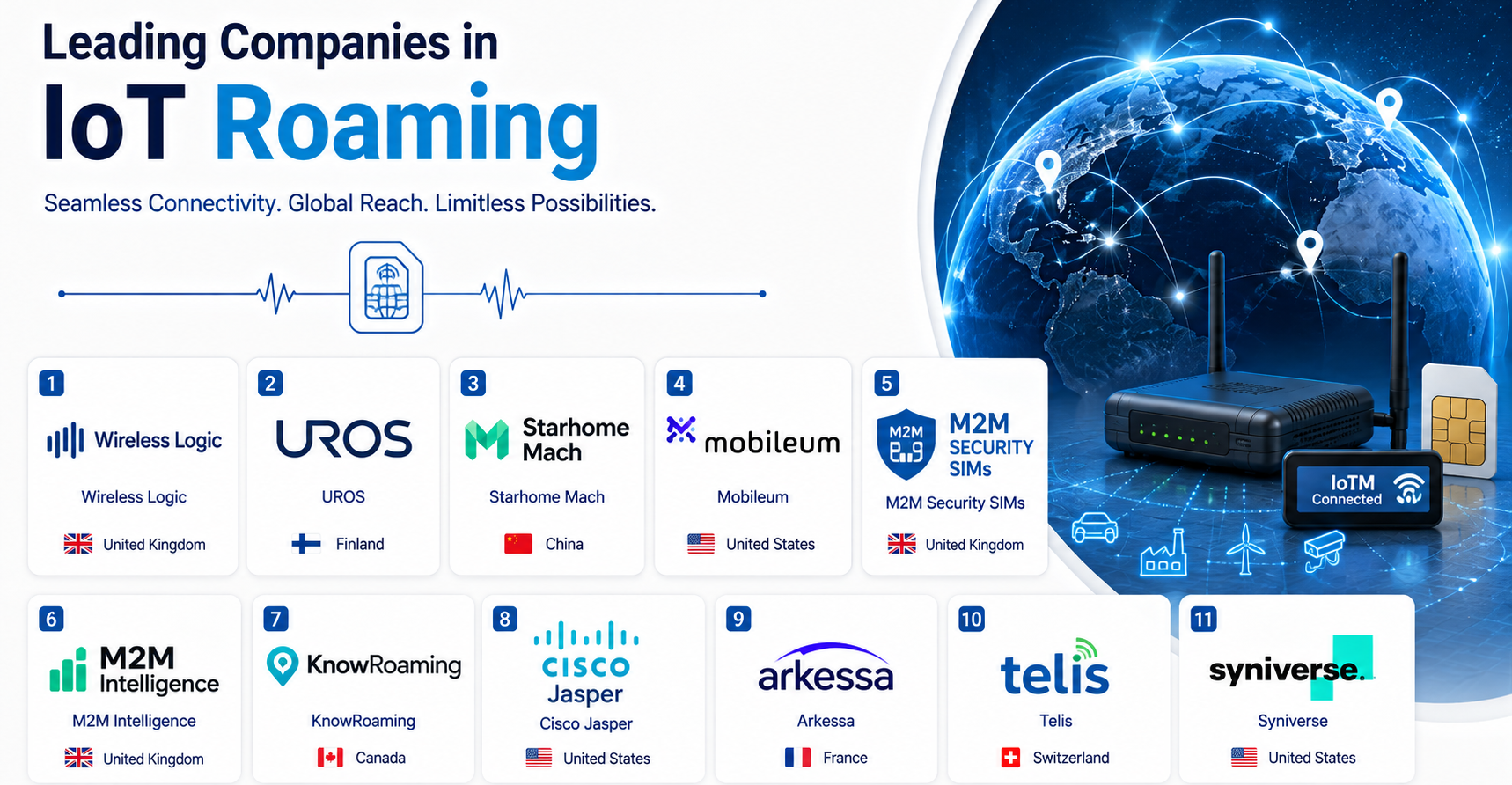
Top Companies in the Global IoT Roaming Market
- Wireless Logic
- UROS
- Starhome Mach
- Mobileum
- M2M Security SIMs
- M2M Intelligence
- KnowRoaming
- Cisco (IoT Control Center, formerly Jasper)
- Arkessa
- Syniverse
1. Wireless Logic
|
Category |
Details |
|---|---|
|
Company Name |
Wireless Logic Group |
|
Headquarters |
Hurley, England, United Kingdom |
|
Founded |
1999/2000 |
|
Employees |
Approx. 1,000–1,500 across multiple continents |
|
Revenue |
Approx. USD 300–370 Million |
|
Company Overview |
Wireless Logic is a leading independent global IoT connectivity provider, offering multi-network SIM and eSIM solutions through its Conexa network and SIMPro management platform to industrial, healthcare, energy, and transport and logistics customers. |
|
Key Products |
Multi-carrier IoT SIMs and eSIMs, the SIMPro connectivity management platform, and managed IoT services spanning device connectivity, security, and billing. |
|
Market Position |
A leading independent (non-carrier-owned) IoT connectivity provider, recognized as a Leader in Gartner's Magic Quadrant for Managed IoT Connectivity Services for two consecutive years, with more than 18 million active IoT subscriptions across 165 countries. |
|
Recent Developments |
Completed a string of acquisitions, including Zipit Wireless, SIMETRY, and Comms365, while bringing on General Atlantic as a minority investor alongside existing backer Montagu Private Equity to fund continued global expansion. |
|
Strategic Advantages |
Broad multi-network reach spanning more than 750 mobile networks, an actively expanding acquisition strategy, and strong private-equity backing supporting continued scale. |
2. Mobileum
|
Category |
Details |
|---|---|
|
Company Name |
Mobileum Inc. |
|
Headquarters |
Cupertino, California (Silicon Valley), United States |
|
Founded |
2000 |
|
Employees |
Approx. 1,800–2,000 |
|
Revenue |
Approx. USD 378 Million |
|
Company Overview |
Mobileum is a telecom analytics company whose Active Intelligence platform serves more than 900 mobile operators worldwide, providing roaming management, IoT security, fraud prevention, and network testing and monitoring solutions. |
|
Key Products |
Roaming management and revenue assurance software, the Roaming Exposure Function (REF) for real-time roaming intelligence, IoT security and lifecycle management tools, and 5G and eSIM testing solutions. |
|
Market Position |
A leading analytics and risk-management vendor to mobile network operators globally, with particular strength in roaming intelligence, fraud detection, and IoT ecosystem security. |
|
Recent Developments |
Launched its Roaming Exposure Function to provide standardized, API-driven access to roaming data for use cases including IoT lifecycle management, and expanded AI-powered offerings such as a white-labeled AI assistant for telecom customers. |
|
Strategic Advantages |
Deep, decades-long relationships with mobile network operators, a broad analytics platform spanning roaming, security, and fraud, and continued investment in AI-driven telecom solutions. |
3. Syniverse
|
Category |
Details |
|---|---|
|
Company Name |
Syniverse Technologies, LLC |
|
Headquarters |
Tampa, Florida, United States |
|
Founded |
1987 (as a division of GTE); independent since 1989 |
|
Employees |
Approx. 1,400–2,000 |
|
Revenue |
Approx. USD 580 Million |
|
Company Overview |
Syniverse is a long-established communications technology company describing itself as "the world's most connected company," providing 5G roaming, messaging (A2P/P2P/RCS), IPX, fraud prevention, and IoT connectivity services to mobile operators and enterprises across nearly 200 countries. |
|
Key Products |
Mobile roaming enablement and clearing/settlement services, IoT connectivity solutions, satellite and 5G standalone roaming support, and mobile identity and authentication services. |
|
Market Position |
A top-ranked global roaming vendor, recognized by Kaleido Intelligence as a leading mobile roaming provider for multiple consecutive years, with a professional services arm that performs more than 15,000 roaming tests per month across 50-plus mobile network operators. |
|
Recent Developments |
Partnered with BICS to accelerate global 5G standalone roaming and continued expanding its roaming and IoT testing capabilities to support satellite-based connectivity and non-terrestrial network interoperability. |
|
Strategic Advantages |
Decades of roaming clearing-house expertise, an extensive global operator network, and a growing focus on 5G, satellite, and IoT roaming interoperability. |
4. Cisco (IoT Control Center)
|
Category |
Details |
|---|---|
|
Company Name |
Cisco Systems, Inc. (IoT Control Center platform, formerly Jasper Control Center) |
|
Headquarters |
San Jose, California, United States |
|
Founded |
1984 (Cisco); Jasper platform acquired 2016 |
|
Employees |
Approx. 90,000+ (Cisco group-wide) |
|
Revenue |
Approx. USD 56.7 Billion (Cisco group-wide, fiscal year 2025) |
|
Company Overview |
Cisco's IoT Control Center, built on the Jasper platform it acquired in 2016, is a leading SaaS connectivity management platform (CMP) that lets service providers and enterprises launch, scale, and manage global cellular IoT connectivity, including multi-operator roaming. |
|
Key Products |
IoT Control Center connectivity management platform, dynamic policy and charging tools, and use-case solutions for connected vehicles and IoT asset management, all integrated within Cisco's broader Mobility Services Platform. |
|
Market Position |
One of the most widely deployed connectivity management platforms globally, supporting more than 160 million connected cellular devices, including over 60 million connected cars, through service-provider partners worldwide. |
|
Recent Developments |
Continued expanding IoT Control Center's 5G and connected-vehicle capabilities, including automated service provisioning for automotive OEMs managing SIM lifecycles across manufacturing, shipping, and in-market use. |
|
Strategic Advantages |
Deep integration with Cisco's broader networking, security, and cloud portfolio, an extensive base of service-provider partners, and a long track record as the connectivity layer behind many operators' IoT offerings. |
5. UROS
|
Category |
Details |
|---|---|
|
Company Name |
UROS Ltd |
|
Headquarters |
Freienbach, Switzerland (founded in Oulu, Finland) |
|
Founded |
2011 |
|
Employees |
Approx. 80–150 |
|
Revenue |
Not publicly disclosed (privately held) |
|
Company Overview |
UROS is a global IoT connectivity technology company that builds turnkey, eSIM-enabled connectivity solutions for consumer and industrial IoT deployments, allowing devices to connect across multiple carrier networks worldwide through a single platform. |
|
Key Products |
UROS Connect eSIM connectivity solutions, the UROS M2M platform for global roaming management, and turnkey IoT connectivity for verticals including smart cities, industrial automation, and connected devices. |
|
Market Position |
A specialist eSIM and IoT roaming technology provider recognized for rapid growth, partnering with device manufacturers and mobile operators to embed global connectivity directly into IoT hardware. |
|
Recent Developments |
Expanded its eSIM connectivity partnerships with industrial computer and device manufacturers, and continued developing its innovation center work with mobile operators on private 5G and next-generation IoT connectivity. |
|
Strategic Advantages |
Deep specialization in eSIM-based multi-network roaming, agility as a smaller independent player, and hands-on partnerships with device OEMs embedding connectivity at the hardware level. |
Competitive Landscape
The global IoT roaming market is fragmented, spanning independent connectivity management platform providers such as Wireless Logic and UROS, telecom analytics and roaming intelligence vendors such as Mobileum and Syniverse, and large diversified technology companies such as Cisco that offer IoT connectivity management as part of a broader networking and cloud portfolio.
Carrier Relationships as a Barrier to Entry: IoT roaming depends on dense webs of bilateral roaming agreements between mobile network operators, favoring established providers with long-standing carrier relationships and global network reach.
Specialization vs. Platform Breadth: Specialists like UROS and Wireless Logic compete on deep, singular focus on IoT connectivity and eSIM technology, while diversified players like Cisco and Syniverse compete on the ability to bundle roaming connectivity within broader networking, security, or communications platforms.
Analytics and Security as a Differentiator: Vendors like Mobileum are increasingly competing on the depth of their roaming analytics, fraud detection, and risk-management capabilities rather than connectivity alone, as operators seek to protect and monetize roaming revenue.
Connected Vehicles as an Anchor End Market: Given the automotive industry's growing reliance on always-on connectivity for telematics and infotainment, companies with strong automotive OEM relationships, such as Cisco's IoT Control Center, hold a structural advantage in capturing large-scale, long-duration IoT roaming contracts.
Regional Analysis
North America
North America leads the market, supported by early enterprise IoT adoption, a mature telecom infrastructure, and strong demand from manufacturing, healthcare, and connected-vehicle sectors for reliable cross-border connectivity.
Asia-Pacific
Asia-Pacific is expected to register significant growth, driven by the presence of major IoT device manufacturers and mobile operators in economies such as China and Japan, alongside rapidly expanding industrial and utility IoT deployments.
Europe
Europe represents a mature market shaped by extensive cross-border trade and travel within the region, along with regulatory emphasis on data protection that influences how IoT roaming providers manage device data across jurisdictions.
Latin America and MEA
These regions represent smaller but developing markets, with growth tied to expanding industrial IoT deployments and gradual modernization of mobile network infrastructure supporting more reliable roaming agreements.
Emerging Trends in the IoT Roaming Market
1. eSIM and Multi-IMSI Adoption: Embedded SIM technology is increasingly replacing physical SIM logistics, letting connectivity providers remotely provision and switch network profiles for devices deployed anywhere in the world.
2. 5G Standalone Roaming Interoperability: As operators roll out 5G standalone networks, new roaming interoperability standards are emerging to support latency-sensitive and high-bandwidth IoT use cases such as connected vehicles and industrial automation.
3. AI-Powered Roaming Analytics: Providers are embedding AI into roaming intelligence platforms to detect fraud, predict network issues, and optimize traffic steering in real time across global roaming partnerships.
4. Satellite and Non-Terrestrial Network Integration: IoT roaming platforms are beginning to integrate satellite connectivity to extend coverage to remote areas beyond traditional cellular network reach, particularly for logistics and asset-tracking use cases.
5. Consolidation Among Independent Connectivity Providers: Independent IoT connectivity providers are pursuing acquisitions to expand network reach and platform capabilities, reflecting the scale advantages of broader multi-network coverage.
Future Outlook (2025–2034)
The global IoT roaming market's trajectory toward USD 16.4 billion by 2034 reflects the structural, long-term nature of enterprise IoT expansion across manufacturing, healthcare, utilities, and logistics. The 10.8% CAGR forecast through 2034 assumes continued growth in connected-device deployments, ongoing eSIM and multi-IMSI adoption, and steady progress in 5G standalone roaming interoperability across global mobile networks.
Key investment themes include continued expansion of connectivity management platforms, growth in AI-powered roaming analytics and security, and the gradual integration of satellite connectivity into IoT roaming offerings. Leading companies including Wireless Logic, Mobileum, Syniverse, and Cisco's IoT Control Center are likely to retain strong market positions, while specialist and regional players continue to compete for share as enterprises worldwide scale their connected-device deployments.
Frequently Asked Questions (FAQ)
1. What is the current size of the global IoT roaming market?
The global IoT roaming market was valued at approximately USD 8.1 billion in 2025 and is projected to reach USD 16.4 billion by 2034, growing at a CAGR of 10.8%.
2. Who are the top companies in the IoT roaming market?
Leading companies include Wireless Logic, UROS, Starhome Mach, Mobileum, M2M Security SIMs, M2M Intelligence, KnowRoaming, Cisco (IoT Control Center), Arkessa, and Syniverse.
3. Which region dominates the IoT roaming market?
North America currently leads the market, while Asia-Pacific is expected to register the strongest growth, driven by IoT companies and manufacturers based in economies such as China and Japan.
4. What is the forecast CAGR for the IoT roaming market?
The market is forecast to grow at a CAGR of 10.8% from 2025 to 2034.
5. What are the main growth drivers for this market?
Key drivers include the rapid growth of connected devices, enterprise demand for seamless cross-border connectivity, and expanding eSIM and multi-IMSI adoption.
6. What challenges does the IoT roaming industry face?
The industry's primary challenges are the complexity of managing bilateral roaming agreements across many mobile operators and ensuring data security and regulatory compliance as devices move between jurisdictions.
7. Which application segment drives the most IoT roaming demand?
Manufacturing and IT & ITES are significant contributors to demand, alongside growing adoption in healthcare and utilities, both of which depend on dependable, secure cross-border connectivity for regulated or safety-critical devices.
Conclusion
The global IoT roaming market sits at the intersection of two durable trends: the explosive growth of connected devices worldwide and enterprises' need for connectivity that works seamlessly regardless of where those devices travel. With a projected size of USD 16.4 billion by 2034 at a 10.8% CAGR, the sector offers strong growth potential for companies that can combine broad carrier relationships with secure, scalable connectivity management platforms.
Companies led by Wireless Logic, Mobileum, and Syniverse are leveraging deep roaming and analytics expertise, while platform players like Cisco's IoT Control Center benefit from integration with broader networking ecosystems, and specialists like UROS compete on agility and eSIM innovation. The companies that successfully extend their platforms into 5G standalone roaming, AI-driven analytics, and satellite connectivity will define market leadership through 2034 and beyond.


