
Leading Companies in the Global Matcha Market Overview
Author:
Intellectual Market Insights Research
Published Date:
01 Oct 2026
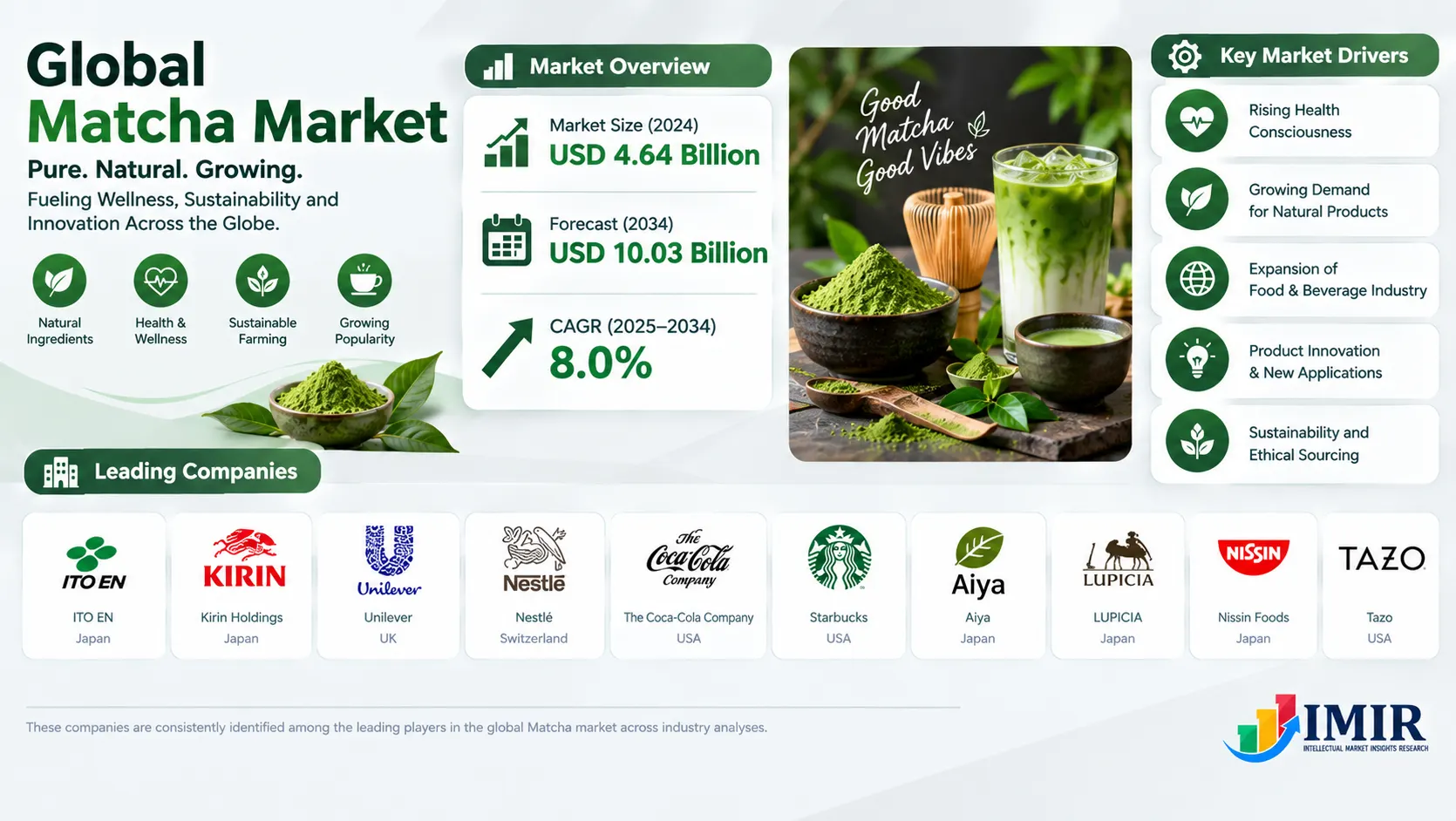
Global Matcha Market: Top Companies, Trends, and Future Outlook
Introduction
Matcha, a finely milled powder made from shade-grown green tea leaves known as tencha, has evolved from a centuries-old component of Japanese tea ceremonies into a mainstream global ingredient found in beverages, desserts, skincare products, and health supplements. Prized for its concentrated chlorophyll, amino acids, and antioxidant catechins, matcha's vivid color and distinctive flavor profile have made it a favorite among health-conscious consumers and specialty beverage brands worldwide.
The global matcha market spans ceremonial, classic, and culinary grades, used across personal care, regular tea, matcha beverages, food, matcha ice cream, matcha cake, and other specialty applications, distributed through hypermarkets, supermarkets, specialty stores, and online channels. This article provides a research-based analysis of the global matcha market, the companies shaping it, and the regional and consumer trends driving its growth toward 2034 and beyond.
Market Overview
According to IMIR Research Analyst, the Global Matcha Market size is expected to reach USD 6.42 Billion by 2034, exhibiting a CAGR of 7.91% during the forecast period (2024–2034). The market size stood at USD 4.21 Billion in 2024.
| Parameter | Details |
|---|---|
| Market Size (2024) | USD 4.64 Billion |
| Projected Market Size (2034) | USD 10.03 Billion |
| CAGR (2024–2034) | 8.0% |
| Base Year | 2024 |
| Historic Year | 2020-2023 |
| Forecast Period | 2025 to 2034 |
| Unit | USD Million/Billion |
| Leading Region | Asia-Pacific (largest, rooted tea culture); North America (second-largest, health-conscious consumers) |
| Key Segments (by Grade) | Ceremonial, Classic, Culinary |
| Key Segments (by Application) | Personal Care, Regular Tea, Matcha Beverages, Food, Matcha Ice-Cream, Matcha Cake, Cha-Soba Sushi Roll, Others |
| Key Segments (by Distribution Channel) | Hypermarket, Supermarket, Online Store, Others |
Why the Matcha Market Is Growing
1. Surging Popularity of Ready-to-Drink Beverages and Pre-Packaged Products
The rising popularity of ready-to-drink matcha beverages and pre-packaged matcha products worldwide continues to be a primary driver of market growth, as convenience-focused consumers increasingly seek matcha in formats beyond traditional powder preparation.
2. Growing Demand for Natural and Nutritious Beverages
Consumer demand for natural, nutrient-dense beverages continues to rise globally, with matcha's reputation as a concentrated source of antioxidants and amino acids positioning it as a preferred alternative to sugary drinks and artificial supplements.
3. Emerging Fitness Trends and Health-Conscious Consumption
The surging preference for nutritional health drinks, driven by emerging fitness trends, continues to expand matcha's consumer base, particularly in North America where health and wellness consumption patterns are accelerating.
4. Expansion into Diverse Product Categories
Matcha's growing presence across diverse product categories, including matcha ice cream, matcha cake, cha-soba, and personal care products, is broadening its addressable market well beyond traditional tea consumption.
5. Deep-Rooted Tea Culture Driving Asia-Pacific Demand
Asia-Pacific's deeply rooted tea culture continues to anchor strong baseline demand for matcha, with the region holding a leading market position across both ceremonial and classic grade segments.
6. Growth in Matcha-Infused Foods and Desserts
Rising consumer interest in matcha-infused foods and desserts, such as ice cream, cakes, and confectionery, continues to open new revenue streams for matcha producers beyond the beverage category.
Market Opportunities & Restraints
A key opportunity lies in expansion into ready-to-drink beverages and flavored formulations: as consumer demand shifts toward convenient, on-the-go consumption formats, matcha producers have significant opportunity to develop ready-to-drink beverages and flavored matcha formulations that appeal to a broader, more casual consumer base beyond traditional tea enthusiasts, while continued growth in matcha-infused foods and desserts offers additional avenues for premium product development. On the restraint side, supply chain constraints and quality consistency challenges remain a notable headwind, as high-quality matcha production is concentrated in specific shade-grown tea regions, primarily in Japan, creating potential supply bottlenecks and price volatility as global demand continues to outpace the availability of premium-grade tencha leaves.
Companies Associated with the Matcha Market
| Company | Headquarters | Founded | Employees | Revenue (2024 est.) | Overview |
|---|---|---|---|---|---|
| Aiya Matcha | Nishio, Japan | 1888 | 500+ | USD 100M+ | One of Japan's oldest and most established matcha producers, specializing in premium ceremonial and culinary-grade matcha with deep roots in Nishio's renowned tea-growing region. |
| Tata Global Beverages | Mumbai, India | 1962 | 2,500+ | USD 1.6 Billion (all products) | A major Indian beverage conglomerate with a growing matcha and specialty tea portfolio, leveraging its extensive distribution network across emerging and developed markets. |
| ITO EN Ltd. | Tokyo, Japan | 1966 | 5,000+ | USD 3.2 Billion (tea & beverages) | A leading Japanese tea and beverage company with a significant matcha product lineup spanning ready-to-drink beverages, powders, and traditional tea products. |
| Unilever Group | London, UK / Rotterdam, Netherlands | 1930 | 128,000+ | USD 60 Billion (all divisions) | A global consumer goods giant incorporating matcha into select beverage, food, and personal care product lines across its vast international portfolio. |
| Matcha Maiden | Melbourne, Australia | 2014 | 50+ | USD 2–5 Million | An Australian matcha brand focused on premium, ceremonial-grade matcha products targeting health-conscious consumers in the wellness and fitness space. |
| Mizuba Tea Co. | Portland, USA | 2013 | 20+ | USD 1 Million+ | A U.S.-based specialty matcha importer and retailer focused on sourcing high-quality, single-origin Japanese matcha for discerning tea enthusiasts. |
| Encha Life LLC | Palo Alto, USA | 2014 | 20+ | USD 2 Million+ | A direct-from-farm matcha company sourcing organic matcha directly from Japanese tea farmers, emphasizing transparency and premium quality for U.S. consumers. |
| The AOI Tea Company | Nishio, Japan | 1910 | 250+ | USD 80 Million+ | A century-old Japanese tea company specializing in high-grade matcha production, serving both domestic Japanese and international export markets. |
| Green Foods Corporation | California, USA | 1979 | 100+ | USD 10 Million+ | A U.S. natural foods company offering matcha and green tea-based nutritional products as part of its broader health food portfolio. |
| Tenzo Tea | Los Angeles, USA | 2016 | 100+ | USD 8 Million+ | A fast-growing U.S. direct-to-consumer matcha brand targeting younger, wellness-oriented consumers through strong digital and social media marketing. |
Competitive Landscape
The global matcha market brings together a mix of century-old Japanese tea producers, diversified global beverage conglomerates, and fast-growing direct-to-consumer specialty brands. Established Japanese matcha producers Aiya Matcha and The AOI Tea Company, both based in Nishio, a historic center of Japanese tea cultivation, hold particularly strong positions built on generations of cultivation expertise and premium-grade product reputation. Diversified beverage and consumer goods giants ITO EN, Tata Global Beverages, and Unilever Group leverage extensive distribution networks and broad product portfolios to incorporate matcha into ready-to-drink beverages and packaged goods at global scale. Direct-to-consumer and specialty brands Encha, Mizuba Tea Co., Matcha Maiden, Tenzo Tea, and Green Foods Corporation compete through premium positioning, farm-direct sourcing transparency, and strong digital marketing, particularly targeting younger, wellness-focused consumers in North America and Australia.
Regional Analysis
Asia-Pacific
Asia-Pacific represents the largest matcha market, anchored by deeply rooted tea culture and the presence of major historic producers such as Aiya Matcha and The AOI Tea Company in Japan's Nishio region, alongside strong consumer demand across both ceremonial and classic grade segments.
North America
North America is the second-largest matcha market, driven by health-conscious consumers and the rising popularity of premium beverages, with the U.S. market forecast to grow significantly, led by matcha beverages and supplements, and supported by specialty brands such as Encha, Mizuba Tea Co., Green Foods Corporation, and Tenzo Tea.
Europe
Europe represents a growing matcha market, supported by rising health and wellness consumption trends and the presence of global consumer goods companies such as Unilever incorporating matcha into their broader beverage and personal care portfolios.
Latin America & Middle East and Africa
Latin America and the Middle East & Africa represent emerging growth markets for matcha, with adoption tied to rising global wellness trends and expanding specialty retail and online distribution channels.
Emerging Trends in the Matcha Market
1. Expansion into Ready-to-Drink Beverages: Growing demand for convenient, on-the-go consumption continues to drive the development of ready-to-drink matcha beverages and pre-packaged products across both established and emerging brands.
2. Growth of Matcha-Infused Foods and Desserts: Rising consumer interest in matcha-infused ice cream, cakes, and confectionery is expanding matcha's reach well beyond traditional tea and beverage applications.
3. Direct-to-Farm Sourcing and Transparency: Brands such as Encha are increasingly emphasizing direct-from-farm sourcing relationships with Japanese tea growers, appealing to consumers who value transparency and authenticity in premium food and beverage products.
4. Digital-First, Wellness-Focused Branding: Fast-growing brands such as Tenzo Tea are leveraging strong digital and social media marketing strategies to reach younger, wellness-oriented consumers, a departure from matcha's traditional positioning.
5. Premiumization Through Ceremonial-Grade Positioning: Brands including Matcha Maiden and Mizuba Tea Co. continue to emphasize premium, ceremonial-grade matcha sourcing to differentiate themselves in an increasingly crowded specialty beverage market.
Future Outlook (2025–2034)
Building on the underlying report's original 2025-2034 forecast window (USD 4.64 billion in 2024 to USD 10.03 billion by 2034 at a 8.0% CAGR), the market's growth momentum is expected to continue beyond 2034 as ready-to-drink beverage expansion, matcha-infused food innovation, and sustained health and wellness consumption trends remain long-term structural growth drivers. Extending the trend, continued mid-single-digit-to-high-single-digit growth would be supported by expanding North American and European demand, continued premiumization, and growing direct-to-consumer brand penetration.
Key investment themes for 2025 and beyond include continued expansion into ready-to-drink and flavored matcha formulations, growing investment in matcha-infused food and dessert innovation, and sustained premiumization through ceremonial-grade product positioning. As direct-to-farm sourcing transparency, digital-first branding, and diversification into new product categories continue to reshape the industry, the companies that combine authentic sourcing credentials with strong consumer engagement will be best positioned to capture growth in the years ahead.
Frequently Asked Questions (FAQ)
1. What is the current size of the global matcha market?
According to IMIR Research Analyst, the Global Matcha Market size is expected to reach USD 10.03 billion by 2034, exhibiting a CAGR of 8.0% during the forecast period 2025–2034, with the market size standing at USD 4.64 billion in 2024.
2. Who are the top companies in the matcha market?
Leading companies include Aiya Matcha, Tata Global Beverages, ITO EN Ltd., Unilever Group, Matcha Maiden, Mizuba Tea Co., Encha Life LLC, The AOI Tea Company, Green Foods Corporation, and Tenzo Tea.
3. Which region dominates the matcha market?
Asia-Pacific represents the largest matcha market due to its deeply rooted tea culture, while North America is the second-largest market, driven by health-conscious consumers and the rise of premium beverages.
4. What is the forecast CAGR for the matcha market?
The market is forecast to grow at a CAGR of 8.0% during the forecast period from 2025 to 2034.
5. What are the main growth drivers for this market?
Key drivers include the surging popularity of ready-to-drink beverages and pre-packaged products, growing demand for natural and nutritious beverages, emerging fitness trends, expansion into diverse product categories, and deep-rooted tea culture in Asia-Pacific.
6. What grades of matcha are available in the market?
The market is segmented by grade into ceremonial, classic, and culinary matcha, each suited to different quality tiers and use cases ranging from traditional tea ceremonies to everyday cooking and beverage preparation.
7. What applications does matcha serve beyond traditional tea?
Matcha is used across personal care products, regular tea, matcha beverages, food, matcha ice cream, matcha cake, and even specialty dishes such as cha-soba sushi rolls, reflecting its expanding presence across the food and beverage industry.
Conclusion
The global matcha market sits at the intersection of centuries-old Japanese tea tradition and modern health and wellness consumer trends. With a projected size of USD 6.42 billion by 2034 at a CAGR of 7.91%, the market offers steady, diversification-driven growth across beverages, food, and personal care applications.
Aiya Matcha and The AOI Tea Company continue to lead on the strength of generations of cultivation expertise in Japan's historic Nishio tea region, while ITO EN, Tata Global Beverages, and Unilever bring global distribution scale, and direct-to-consumer specialty brands such as Encha, Mizuba Tea Co., and Tenzo Tea compete through premium positioning and digital-first marketing. As ready-to-drink expansion, matcha-infused food innovation, and direct-to-farm sourcing transparency continue to reshape the industry, the companies that combine authentic Japanese heritage with modern consumer engagement will define market leadership in the years ahead.