
Leading Companies in the Global Microfluidics Market
Author:
Intellectual Market Insights Research
Published Date:
03 Sep 2026
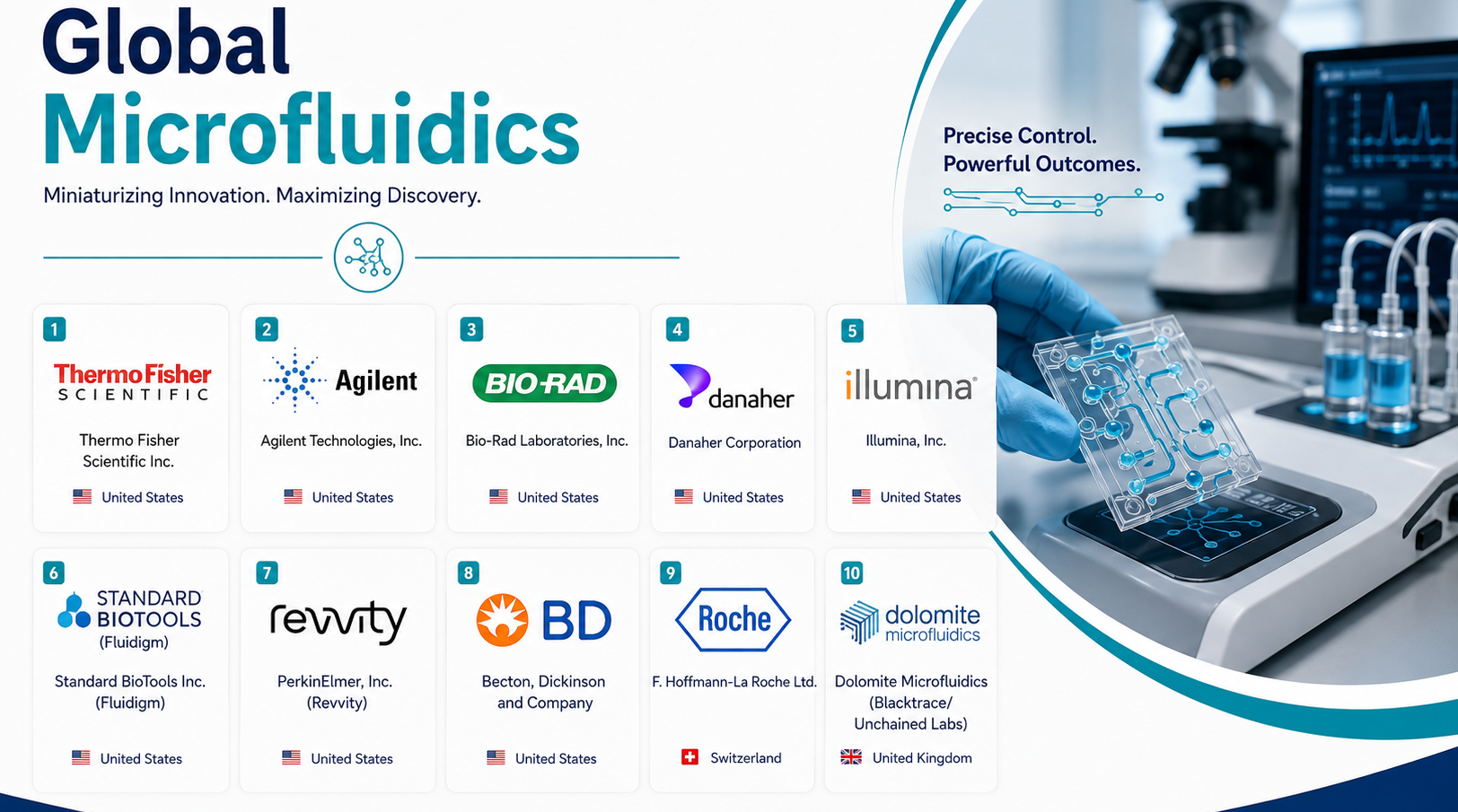
Top Companies in the World Offering Microfluidics Solutions
Microfluidics is the science and engineering of precisely manipulating fluids at the microliter-to-picoliter scale through channels measuring tens to hundreds of micrometers. By miniaturizing chemical and biological processes onto chip-based platforms, microfluidic systems dramatically reduce reagent consumption, shorten reaction and analysis times, and enable automation and portability. These properties have made microfluidics a foundational technology across in-vitro diagnostics, genomics and sequencing, drug discovery, point-of-care testing, and organ-on-chip research.
The Global Microfluidics Market was valued at approximately USD 35.9 billion in 2025 and is projected to reach USD 124.2 billion by 2034, growing at a compound annual growth rate (CAGR) of 14.8% from 2025 to 2034. Growth is being driven by surging demand for point-of-care and molecular diagnostics, expanding use of lab-on-chip platforms in genomics and proteomics research, rising pharmaceutical and biotech R&D spending on miniaturized drug-discovery and screening tools, and growing adoption of organ-on-chip and single-cell analysis technologies in personalized medicine.
The competitive landscape is anchored by global life-sciences and diagnostics leaders including Thermo Fisher Scientific, Agilent Technologies, Bio-Rad Laboratories, Danaher Corporation, and Illumina, alongside specialized microfluidics innovators such as Standard BioTools (Fluidigm), Dolomite Microfluidics, and Micronit. This article provides a research-based analysis of the top companies shaping the global microfluidics market, their positioning, flagship offerings, and the regional and technological forces driving the industry forward.
Market Overview
|
Parameter |
Details |
|---|---|
|
Market Size (2025) |
USD 35.9 Billion |
|
Projected Market Size (2034) |
USD 124.2 Billion |
|
CAGR (2025–2034) |
14.8% |
|
Base Year |
2024 |
|
Historic Year |
2019–2023 |
|
Forecast Period |
2025–2034 |
|
Leading & Fastest-Growing Region |
Asia-Pacific |
|
Key Segments (by Application) |
Point-of-Care Diagnostics, Genomics & Proteomics, Pharmaceutical & Biotech Research, Organ-on-Chip, Others |
|
Key Segments (by Material) |
Silicon, Glass, Polymer, Others |
|
Fastest-Growing Application |
Pharmaceutical & Biotechnology Research (~19–20% CAGR) |
Why the Microfluidics Market Is Growing
1. Rising Demand for Point-of-Care and Molecular Diagnostics
Growing prevalence of chronic and infectious diseases, combined with the need for rapid, portable, and accurate testing, is driving adoption of microfluidic cartridges and lab-on-chip devices across hospitals, clinics, and decentralized care settings.
2. Expansion of Genomics and Proteomics Applications
Microfluidic platforms enable high-throughput, low-volume sample preparation for next-generation sequencing, single-cell analysis, and PCR-based diagnostics, supporting adoption by genomics and proteomics leaders across research and clinical labs.
3. Growth in Pharmaceutical and Biotechnology R&D
Drug discovery and development teams are turning to microfluidic screening and organ-on-chip systems to miniaturize assays, cut reagent costs, and generate more physiologically relevant preclinical data, accelerating adoption across the pharmaceutical value chain.
4. Advances in Chip Materials and Fabrication Technology
Ongoing innovation in polymer-based fabrication (PDMS, PMMA, polycarbonate) and 3D-printed microfluidics is lowering production costs and enabling more complex, application-specific chip designs, broadening the addressable market.
5. Rising Healthcare Investment in Asia-Pacific
Expanding healthcare infrastructure, growing diagnostic testing volumes, and increasing government support for biotechnology manufacturing are driving rapid microfluidics adoption across China, Japan, South Korea, and India.
6. Rapid Growth in Pharmaceutical & Biotechnology Research
This segment is projected to grow at close to 20% CAGR, as drug-discovery groups prioritize reagent savings, assay miniaturization, and higher-throughput screening enabled by microfluidic platforms.
Market Opportunities & Restraints
A key opportunity lies in organ-on-chip and single-cell analysis platforms: advances in chip integration, sensor miniaturization, and automation are extending microfluidics into personalized medicine, toxicology testing, and preclinical drug evaluation, while growing collaboration between microfluidics specialists and pharmaceutical R&D organizations is broadening commercial adoption. On the restraint side, high development and fabrication costs, along with the technical complexity of scaling chip manufacturing and integrating microfluidic systems with existing laboratory workflows, remain key headwinds, particularly for smaller diagnostic laboratories and research institutions with constrained capital budgets.
Top 10 Companies in the Microfluidics Market
- Thermo Fisher Scientific Inc.
- Agilent Technologies, Inc.
- Bio-Rad Laboratories, Inc.
- Danaher Corporation
- Illumina, Inc.
- Standard BioTools Inc. (Fluidigm)
- PerkinElmer, Inc. (Revvity)
- Becton, Dickinson and Company
- F. Hoffmann-La Roche Ltd.
- Dolomite Microfluidics (Blacktrace/Unchained Labs)
1. Thermo Fisher Scientific Inc.
|
Category |
Details |
|---|---|
|
Company Name |
Thermo Fisher Scientific Inc. |
|
Headquarters |
Waltham, Massachusetts, USA |
|
Founded |
1956 |
|
Employees |
Approx. 125,000 |
|
Revenue |
Approx. USD 44.56 Billion (2025) |
|
Company Overview |
Thermo Fisher is the world's largest life-sciences and laboratory-products company, offering microfluidic-based consumables, instruments, and clinical/genomic workflow solutions under brands including Applied Biosystems and Invitrogen. |
|
Key Products |
Microfluidic sample-prep and PCR/qPCR systems, lab-on-chip consumables, and integrated genomic-analysis platforms serving research and clinical diagnostics. |
|
Market Position |
One of the leading global suppliers of microfluidic-enabled diagnostics and genomics tools, with an extensive worldwide distribution and service network. |
|
Recent Developments |
Continues expanding microfluidic and automated sample-to-answer platforms across its Life Sciences Solutions and Diagnostics segments to support molecular diagnostics demand. |
|
Strategic Advantages |
Massive scale and global reach, deep integration across reagents-instruments-services, and sustained R&D investment across genomics, proteomics, and diagnostics. |
2. Agilent Technologies, Inc.
|
Category |
Details |
|---|---|
|
Company Name |
Agilent Technologies, Inc. |
|
Headquarters |
Santa Clara, California, USA |
|
Founded |
1999 (spun off from Hewlett-Packard) |
|
Employees |
Approx. 18,000 |
|
Revenue |
Approx. USD 6.5 Billion+ |
|
Company Overview |
Agilent provides analytical instrumentation, lab-on-chip, and microfluidic-based systems supporting genomics, diagnostics, and pharmaceutical quality-control applications. |
|
Key Products |
Bioanalyzer and TapeStation microfluidic electrophoresis systems, along with clinical and research diagnostic platforms. |
|
Market Position |
A leading global provider of microfluidic analytical instruments for nucleic acid and protein analysis in research and clinical laboratories. |
|
Recent Developments |
Continues to invest in next-generation automated, miniaturized analytical workflows spanning genomics, diagnostics, and pharma quality-control applications. |
|
Strategic Advantages |
Strong analytical-instrumentation heritage, tight integration between microfluidic chip technology and downstream software analytics, and global life-sciences customer base. |
3. Bio-Rad Laboratories, Inc.
|
Category |
Details |
|---|---|
|
Company Name |
Bio-Rad Laboratories, Inc. |
|
Headquarters |
Hercules, California, USA |
|
Founded |
1952 |
|
Employees |
Approx. 8,000 |
|
Revenue |
Approx. USD 2.6 Billion |
|
Company Overview |
Bio-Rad develops life-science research and clinical diagnostics products, including droplet-based digital PCR microfluidic systems used for high-precision nucleic acid detection. |
|
Key Products |
Droplet Digital PCR (ddPCR) systems, microfluidic droplet-generation cartridges, and clinical diagnostics instrumentation. |
|
Market Position |
A leading provider of microfluidics-based digital PCR technology, widely used in genomics, oncology research, and infectious-disease detection. |
|
Recent Developments |
Continues expanding its droplet-microfluidics digital PCR portfolio to support precision-medicine and biopharma research applications. |
|
Strategic Advantages |
Proprietary droplet-microfluidics technology, strong installed base in research and clinical labs, and deep expertise in nucleic-acid quantification. |
4. Danaher Corporation
|
Category |
Details |
|---|---|
|
Company Name |
Danaher Corporation |
|
Headquarters |
Washington, D.C., USA |
|
Founded |
1969 |
|
Employees |
Approx. 62,000 |
|
Revenue |
Approx. USD 23 Billion+ |
|
Company Overview |
Danaher's Life Sciences and Diagnostics segments, including its Cepheid subsidiary, deliver microfluidic cartridge-based molecular diagnostics for infectious-disease and point-of-care testing. |
|
Key Products |
Cepheid GeneXpert cartridge-based microfluidic PCR testing systems and broader life-sciences instrumentation across its portfolio companies. |
|
Market Position |
A major global player in cartridge-based microfluidic molecular diagnostics, with an especially strong position in point-of-care infectious-disease testing. |
|
Recent Developments |
Continues to expand Cepheid's cartridge-based testing menu and manufacturing capacity to meet global point-of-care diagnostics demand. |
|
Strategic Advantages |
Deep operational excellence across a diversified life-sciences and diagnostics portfolio, and a leading position in rapid, decentralized molecular testing. |
5. Illumina, Inc.
|
Category |
Details |
|---|---|
|
Company Name |
Illumina, Inc. |
|
Headquarters |
San Diego, California, USA |
|
Founded |
1998 |
|
Employees |
Approx. 8,500 |
|
Revenue |
Approx. USD 4.4 Billion+ |
|
Company Overview |
Illumina is a global leader in DNA sequencing and array-based technologies, using microfluidic flow-cell architecture at the core of its next-generation sequencing platforms. |
|
Key Products |
NovaSeq and MiSeq sequencing systems built on proprietary microfluidic flow-cell technology for genomic analysis. |
|
Market Position |
The dominant global supplier of next-generation sequencing platforms, with microfluidics central to its flow-cell chemistry and instrument design. |
|
Recent Developments |
Continues advancing flow-cell miniaturization and throughput to lower per-sample sequencing costs and expand clinical genomics adoption. |
|
Strategic Advantages |
Market-leading sequencing installed base, proprietary flow-cell microfluidics chemistry, and deep integration with genomics research and clinical ecosystems. |
Competitive Landscape
The global microfluidics market brings together a broad and diverse set of competitors. Diversified life-sciences and diagnostics majors Thermo Fisher Scientific, Agilent Technologies, Bio-Rad Laboratories, Danaher Corporation, Illumina, PerkinElmer (Revvity), Becton Dickinson, and F. Hoffmann-La Roche hold particularly strong positions, built on integrated microfluidic platforms embedded within broader genomics, diagnostics, and instrumentation portfolios. Specialized microfluidics innovators, including Standard BioTools (Fluidigm), Dolomite Microfluidics, Micronit, Fluigent, Elveflow, Sphere Fluidics, Emulate, and uFluidix, compete on chip customization, organ-on-chip technology, and application-specific fluid-control engineering. A broad base of regional and niche manufacturers rounds out the fragmented global supply base, competing on cost, turnaround time, and specialized chip fabrication capabilities.
Regional Analysis
Asia-Pacific
Asia-Pacific is expected to be the fastest-growing region in the microfluidics market, supported by rising healthcare investments, expanding diagnostic testing infrastructure, and advancements in lab-on-chip technologies across China, Japan, South Korea, and India. Growing government support for domestic biotechnology and diagnostics manufacturing is further accelerating regional adoption.
North America
North America represents the largest microfluidics market, underpinned by a dense concentration of life-sciences and diagnostics companies, strong biopharmaceutical R&D spending, and rapid adoption of point-of-care and molecular diagnostic technologies.
Europe
Europe features a well-established life-sciences research base and strong regulatory support for diagnostics innovation, supporting steady microfluidics adoption across pharmaceutical, academic, and clinical research settings.
Latin America & Middle East and Africa
Latin America and the Middle East & Africa remain emerging microfluidics markets, expected to grow as healthcare infrastructure investment and diagnostic testing capacity expand across these regions.
Emerging Trends in the Microfluidics Market
1. Organ-on-Chip and 3D Cell Culture Systems: Growing use of microfluidic organ-on-chip platforms is enabling more physiologically relevant drug-toxicity and efficacy testing, reducing reliance on animal models in preclinical research.
2. Point-of-Care and Decentralized Diagnostics: Cartridge-based microfluidic testing systems are expanding rapid, near-patient diagnostic capabilities for infectious disease, cardiac markers, and chronic-disease monitoring.
3. Growth in Pharmaceutical & Biotechnology Research Applications: This segment is projected to grow at nearly 20% CAGR, outpacing the broader market as drug-discovery teams adopt microfluidics for assay miniaturization and reagent savings.
4. 3D-Printed and Polymer-Based Microfluidics: Advances in additive manufacturing and low-cost polymer fabrication (PDMS, PMMA, polycarbonate) are lowering chip-production costs and accelerating design iteration.
5. Single-Cell Analysis and Precision Medicine: Expanding use of microfluidics in single-cell genomics and proteomics is supporting more granular disease characterization and personalized-treatment development.
Future Outlook (2025–2034)
The global microfluidics market's trajectory toward USD 124.2 billion by 2034 reflects sustained demand growth across diagnostics, genomics, and pharmaceutical research applications. The 14.8% CAGR forecast through 2034 assumes continued expansion of point-of-care testing infrastructure, rising biopharma R&D investment in miniaturized screening tools, and growing adoption of organ-on-chip and single-cell analysis platforms in precision medicine.
Key investment themes include continued innovation in cartridge-based diagnostic platforms, development of organ-on-chip systems for preclinical drug testing, and growing polymer- and 3D-printing-based fabrication that lowers production costs. Diversified life-sciences leaders Thermo Fisher Scientific, Agilent Technologies, and Bio-Rad Laboratories are likely to retain strong positions built on integrated instrument-consumable-service ecosystems, while specialized microfluidics innovators such as Standard BioTools and Dolomite Microfluidics continue to compete on application-specific chip engineering across the fragmented global market.
Frequently Asked Questions (FAQ)
1. What is the current size of the global microfluidics market?
The global microfluidics market was valued at approximately USD 35.9 billion in 2025 and is projected to reach USD 124.2 billion by 2034, growing at a CAGR of 14.8%.
2. Who are the top companies in the microfluidics market?
Leading companies include Thermo Fisher Scientific Inc., Agilent Technologies, Inc., Bio-Rad Laboratories, Inc., Danaher Corporation, Illumina, Inc., Standard BioTools Inc. (Fluidigm), PerkinElmer, Inc. (Revvity), Becton, Dickinson and Company, F. Hoffmann-La Roche Ltd., and Dolomite Microfluidics.
3. Which region dominates the microfluidics market?
North America currently holds the largest market share, while Asia-Pacific is expected to be the fastest-growing region, driven by rising healthcare investments and advancements in lab-on-chip technologies.
4. What is the forecast CAGR for the microfluidics market?
The market is forecast to grow at a CAGR of approximately 14.8% from 2025 to 2034, though estimates across research firms range from roughly 12% to 24% depending on scope and methodology.
5. What are the main growth drivers for this market?
Key drivers include rising demand for point-of-care and molecular diagnostics, expansion of genomics and proteomics applications, growth in pharmaceutical and biotechnology R&D, and advances in chip materials and fabrication technology.
6. Which application segment is growing fastest?
The Pharmaceutical & Biotechnology Research segment is projected to grow at close to 20% CAGR, outpacing the overall market due to rising demand for assay miniaturization and reagent-saving screening tools.
7. What materials are used to produce microfluidic chips?
Microfluidic chips are fabricated from silicon, glass (borosilicate, fused silica, soda-lime), and polymers (PDMS, PMMA, polycarbonate), with polymer-based chips dominating due to their cost-effectiveness and compatibility with mass production.
Conclusion
The global microfluidics market sits at the intersection of rising diagnostic demand and rapid innovation in miniaturized fluid-handling technology. With a projected size of USD 124.2 billion by 2034 at a 14.8% CAGR, the market offers strong, innovation-driven growth across diagnostics, genomics, and pharmaceutical research applications.
Thermo Fisher Scientific, Agilent Technologies, and Bio-Rad Laboratories continue to lead on the strength of integrated instrument-consumable-service ecosystems, while Danaher and Illumina bring category-defining platforms in cartridge-based diagnostics and sequencing, and a broad base of specialized microfluidics innovators compete on chip customization and organ-on-chip technology. As point-of-care diagnostics, organ-on-chip systems, and polymer-based fabrication reshape the industry, the companies that combine deep fluidics engineering with integrated clinical and research ecosystems will define market leadership through 2034 and beyond.


