
Global Nanomedicine Market: Leading Companies, Trends, and Future Outlook
Author:
Intellectual Market Insights Research
Published Date:
26 Sep 2026
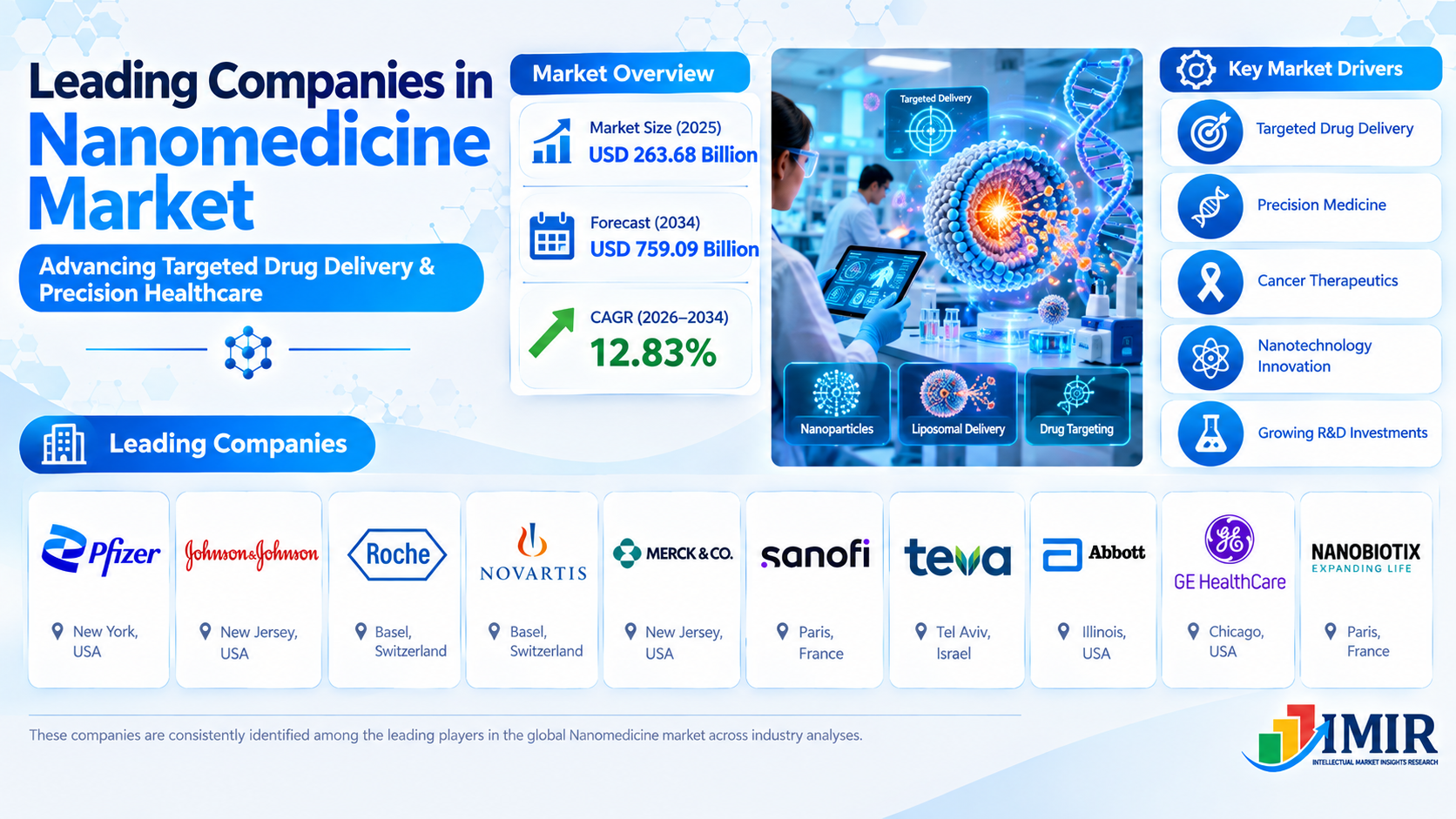
Global Nanomedicine Market: Leading Companies, Trends, and Future Outlook
Introduction
Nanomedicine applies nanotechnology, the science of manipulating matter at the scale of roughly 1 to 100 nanometers, to the prevention, diagnosis, and treatment of disease. By engineering drug delivery vehicles such as lipid nanoparticles, liposomes, and polymeric nanoparticles, nanomedicine enables more precise, targeted therapeutic delivery, improved bioavailability, and reduced off-target toxicity compared to conventional drug formulations, transforming treatment approaches across oncology, infectious disease, cardiovascular disease, and beyond.
The global nanomedicine market spans nanoparticle-based drug delivery systems, nanodiagnostics, and nanotechnology-enabled medical devices, deployed across oncology, cardiovascular disease, infectious disease, neurology, and other therapeutic applications. This article provides a research-based analysis of the global nanomedicine market, the companies shaping it, and the regional and technological forces driving its growth toward 2032.
Market Overview
Global Nanomedicine Market size was valued at USD 198.18 Billion in 2023 and is poised to grow from USD 223.75 Billion in 2024 to USD 590.63 Billion by 2032, growing at a CAGR of 12.9% in the forecast period (2024–2032).
| Parameter | Details |
|---|---|
| Market Size (2023) | USD 198.18 Billion |
| Market Size (2024) | USD 223.75 Billion |
| Projected Market Size (2032) | USD 590.63 Billion |
| CAGR (2024–2032) | 12.9% |
| Forecast Period | 2024–2032 |
| Leading Region | North America (largest revenue share); Asia-Pacific (fastest growth) |
| Key Segments (by Therapeutic Area) | Oncology, Cardiovascular Disease, Infectious Disease, Neurology, Others |
| Key Segments (by Technology) | Nanoparticle Drug Delivery, Nanodiagnostics, Nanomedical Devices |
Why the Nanomedicine Market Is Growing
1. Rising Demand for Targeted and More Effective Therapies
The nanomedicine market is being primarily driven by the growing need for targeted and more effective therapies, particularly in the treatment of cancer, cardiovascular diseases, and chronic disorders, where conventional drugs often face limitations in precision and side-effect profiles.
2. Success of Lipid Nanoparticle Vaccine Technology
The breakthrough success of lipid nanoparticle (LNP) technology in mRNA-based COVID-19 vaccines demonstrated the power and commercial viability of nanomedicine platforms, accelerating investment and interest in nanoparticle-based drug and vaccine delivery across the pharmaceutical industry.
3. Rising Global Burden of Cancer and Chronic Disease
The rising global burden of cancer, infectious diseases, and neurological conditions, combined with an expanding elderly population, continues to drive demand for nanomedicine-based diagnostic and therapeutic solutions capable of addressing complex, hard-to-treat conditions.
4. Strong R&D Investment in Nanotechnology
Sustained pharmaceutical industry R&D investment in nanotechnology-based drug formulations, diagnostics, and nanomaterial innovation continues to expand the range of clinically viable nanomedicine products reaching patients.
5. Advances in Nanoscale Diagnostic Technologies
Numerous technological developments in nanoscale technologies are improving diagnostic techniques, enabling earlier disease detection and more precise monitoring across oncology and other therapeutic areas.
6. Growing Government Support and Funding
Increasing government support and funding for nanotechnology research, combined with rising demand for advanced therapies, continues to drive sustained market growth across major and emerging healthcare markets.
Market Opportunities & Restraints
A key opportunity lies in manufacturing scale-up for nanoparticle production: as demonstrated by innovations such as MEPSGEN's April 2025 launch of NanoCalibur, a scalable nanoparticle production system designed for precise, controllable synthesis of lipid nanoparticles and liposomes, addressing manufacturing scalability, a key bottleneck constraining broader nanomedicine commercialization, presents significant opportunity for companies that can solve production challenges at commercial scale. On the restraint side, market fragmentation and regulatory complexity remain primary headwinds, as the nanomedicine market remains highly fragmented, with the top 10 players accounting for only a small percentage of total market revenue, reflecting moderate-to-high technological and regulatory entry barriers driven by stringent formulation standards, clinical and safety compliance requirements, and the need for precision and reliability in therapeutic development.
Companies Associated with the Nanomedicine Market
| Company | Headquarters | Founded | Employees | Revenue (2025) | Overview |
|---|---|---|---|---|---|
| Abbott Laboratories | Abbott Park, Illinois, USA | 1888 | Approx. 115,000 | Approx. USD 44.3 Billion | A global healthcare giant advancing nanomedicine-based drug delivery, diagnostics, and medical devices across 160+ countries. |
| Pfizer, Inc. | New York City, New York, USA | 1849 | Approx. 75,000–81,000 | Approx. USD 62.6 Billion | A pharmaceutical giant whose BioNTech mRNA vaccine partnership showcased the commercial power of lipid nanoparticle technology. |
| Merck & Co., Inc. | Rahway, New Jersey, USA | 1891 | Approx. 75,000 | Approx. USD 58.1–65.0 Billion | A biopharmaceutical leader with a strong nanoparticle-based drug formulation pipeline for oncology and diagnostics. |
| Johnson & Johnson Services, Inc. | New Brunswick, New Jersey, USA | 1886 | Approx. 138,000 (group) | Approx. USD 94.2 Billion (total company) | A healthcare conglomerate leveraging nanotechnology across pharmaceutical and medical device businesses. |
| Sanofi S.A. | Paris, France | 1973 | Approx. 82,000–91,570 | Approx. EUR 41.1 Billion | A global biopharmaceutical company applying nanomedicine across immunology, oncology, and vaccine platforms in 100+ countries. |
| Gilead Sciences, Inc. | Foster City, California, USA | 1987 | Approx. 17,000 | Approx. USD 29.44 Billion | A biopharmaceutical innovator using nanotechnology to enhance bioavailability and targeted therapy in HIV, hepatitis, and cancer treatment. |
Competitive Landscape
The global nanomedicine market brings together the world's largest diversified pharmaceutical and healthcare companies, each applying nanotechnology across different therapeutic and diagnostic applications. Global pharmaceutical majors Pfizer, Merck & Co., Johnson & Johnson, and Sanofi hold particularly strong positions, built on broad R&D pipelines, deep regulatory expertise, and global commercialization capabilities, particularly for nanoparticle-based oncology drugs and mRNA vaccine platforms. Diversified healthcare technology leaders Abbott Laboratories bring nanotechnology applications across both pharmaceuticals and medical devices, spanning diagnostics and drug delivery. Specialized infectious disease innovators such as Gilead Sciences compete through deep category focus in HIV, hepatitis, and oncology therapeutics, leveraging nanotechnology to enhance long-acting drug formulations. The broader market remains highly fragmented, with the top 10 players accounting for only a small share of total market revenue, reflecting the significant presence of specialized nanomedicine innovators such as Nanospectra Biosciences, BIND Biosciences, Nanobiotix, and Starpharma Holdings competing alongside these established pharmaceutical giants.
Regional Analysis
North America
North America dominates the global nanomedicine market, supported by increasing application of nanomedicine in early disease diagnosis, preventive intervention, and prophylaxis of chronic and acute disorders, alongside a well-defined regulatory framework for the approval and commercialization of nanomedicine products.
Europe
Europe represents a significant nanomedicine market, anchored by major players such as Sanofi, alongside strong pharmaceutical R&D infrastructure and regulatory frameworks supporting nanotechnology-based drug development.
Asia-Pacific
Asia-Pacific is expected to register significant growth, driven by the presence of key nanomedicine companies, high prevalence of cancer, significant investments in nanotechnology-based research, and growing R&D funding for cancer drug discovery and personalized medicine opportunities.
Latin America & Middle East and Africa
Latin America and the Middle East & Africa represent emerging growth markets for nanomedicine, with adoption tied to improving healthcare access, expanding oncology and infectious disease treatment infrastructure, and increasing participation in global clinical trials.
Emerging Trends in the Nanomedicine Market
1. Growth of Lipid Nanoparticle and mRNA Platforms: Building on the breakthrough success of lipid nanoparticle-based mRNA COVID-19 vaccines, pharmaceutical companies continue to expand LNP technology applications across oncology, infectious disease, and rare disease treatment.
2. Advances in Nanoparticle Manufacturing Scalability: Innovations such as MEPSGEN's NanoCalibur scalable nanoparticle production system, launched in April 2025, are addressing manufacturing scalability challenges that have historically constrained broader nanomedicine commercialization.
3. Expansion into Diagnostics and Imaging: Growing application of nanotechnology in diagnostics and imaging, alongside therapeutics, is broadening the nanomedicine market beyond drug delivery into earlier disease detection and monitoring applications.
4. Rising Competition from Specialized Nanomedicine Innovators: Companies such as Nanospectra Biosciences, BIND Biosciences, CytImmune Sciences, Starpharma Holdings, Precision NanoSystem, and Nanobiotix continue to advance next-generation nanomedicine platforms, contributing to the market's high fragmentation alongside established pharmaceutical majors.
5. Growing Focus on Oncology Applications: The oncological diseases segment is projected to dominate the global nanomedicine market, as most nanomedicine research continues to focus on developing more precise, targeted cancer treatment products.
Future Outlook (2024–2032)
The global nanomedicine market's trajectory toward USD 590.63 billion by 2032 reflects sustained demand growth driven by rising cancer and chronic disease prevalence, continued success of nanoparticle-based drug delivery platforms, and expanding applications in diagnostics and personalized medicine. The 12.9% CAGR forecast through 2032 assumes continued R&D investment in nanotechnology, ongoing manufacturing scale-up innovation, and sustained regulatory support for nanomedicine product approvals across major markets.
Key investment themes include continued nanoparticle-based drug delivery innovation by global majors such as Pfizer, Merck & Co., and Johnson & Johnson, growing competition from specialized nanomedicine innovators addressing niche therapeutic and diagnostic applications, and increasing investment in solving manufacturing scalability challenges that have historically limited broader commercialization. As lipid nanoparticle technology, diagnostic applications, and oncology-focused innovation continue to reshape the industry, the companies that combine deep pharmaceutical R&D capability with nanotechnology manufacturing expertise will define market leadership through 2032 and beyond.
Frequently Asked Questions (FAQ)
1. What is the current size of the global nanomedicine market?
Global Nanomedicine Market size was valued at USD 198.18 billion in 2023 and is poised to grow from USD 223.75 billion in 2024 to USD 590.63 billion by 2032, growing at a CAGR of 12.9% in the forecast period (2024–2032).
2. Who are the top companies in the nanomedicine market?
Leading companies include Abbott Laboratories, Pfizer, Inc., Merck & Co., Inc., Johnson & Johnson Services, Inc., Sanofi S.A., and Gilead Sciences, Inc., alongside specialized innovators such as Nanospectra Biosciences, BIND Biosciences, and Nanobiotix.
3. Which region dominates the nanomedicine market?
North America dominates the global nanomedicine market, supported by a well-defined regulatory framework and increasing application of nanomedicine in early disease diagnosis and preventive intervention, while Asia-Pacific is expected to register significant growth.
4. What is the forecast CAGR for the nanomedicine market?
The market is forecast to grow at a CAGR of 12.9% from 2024 to 2032.
5. What are the main growth drivers for this market?
Key drivers include rising demand for targeted and more effective therapies, the success of lipid nanoparticle vaccine technology, the rising global burden of cancer and chronic disease, strong R&D investment in nanotechnology, and advances in nanoscale diagnostic technologies.
6. What therapeutic areas does the nanomedicine market serve?
Nanomedicine serves oncology, cardiovascular disease, infectious disease, neurology, and other therapeutic applications, with oncology representing the largest and fastest-growing application segment.
7. Why is the nanomedicine market considered fragmented?
The nanomedicine market remains highly fragmented, with the top 10 players accounting for only a small share of total market revenue, reflecting moderate-to-high technological and regulatory entry barriers alongside the significant presence of specialized nanomedicine innovators competing alongside major pharmaceutical companies.
Conclusion
The global nanomedicine market sits at the intersection of rising chronic disease burden and the transformative potential of nanotechnology-based targeted drug delivery. With a projected size of USD 590.63 billion by 2032 at a 12.9% CAGR, the market offers strong, innovation-driven growth across oncology, infectious disease, and diagnostic applications.
Pfizer, Merck & Co., Johnson & Johnson, and Sanofi continue to lead on the strength of broad R&D pipelines and global commercialization capabilities, while Abbott Laboratories brings diversified nanotechnology applications across pharmaceuticals and devices, and Gilead Sciences leads in infectious disease-focused nanomedicine innovation. As lipid nanoparticle technology, manufacturing scalability solutions, and specialized innovator competition continue to reshape the industry, the companies that combine deep R&D expertise with nanotechnology manufacturing capability will define market leadership through 2032 and beyond.