
Leading Companies in the Global Next-Generation Batteries Market 2025
Author:
Intellectual Market Insights Research
Published Date:
02 Oct 2026
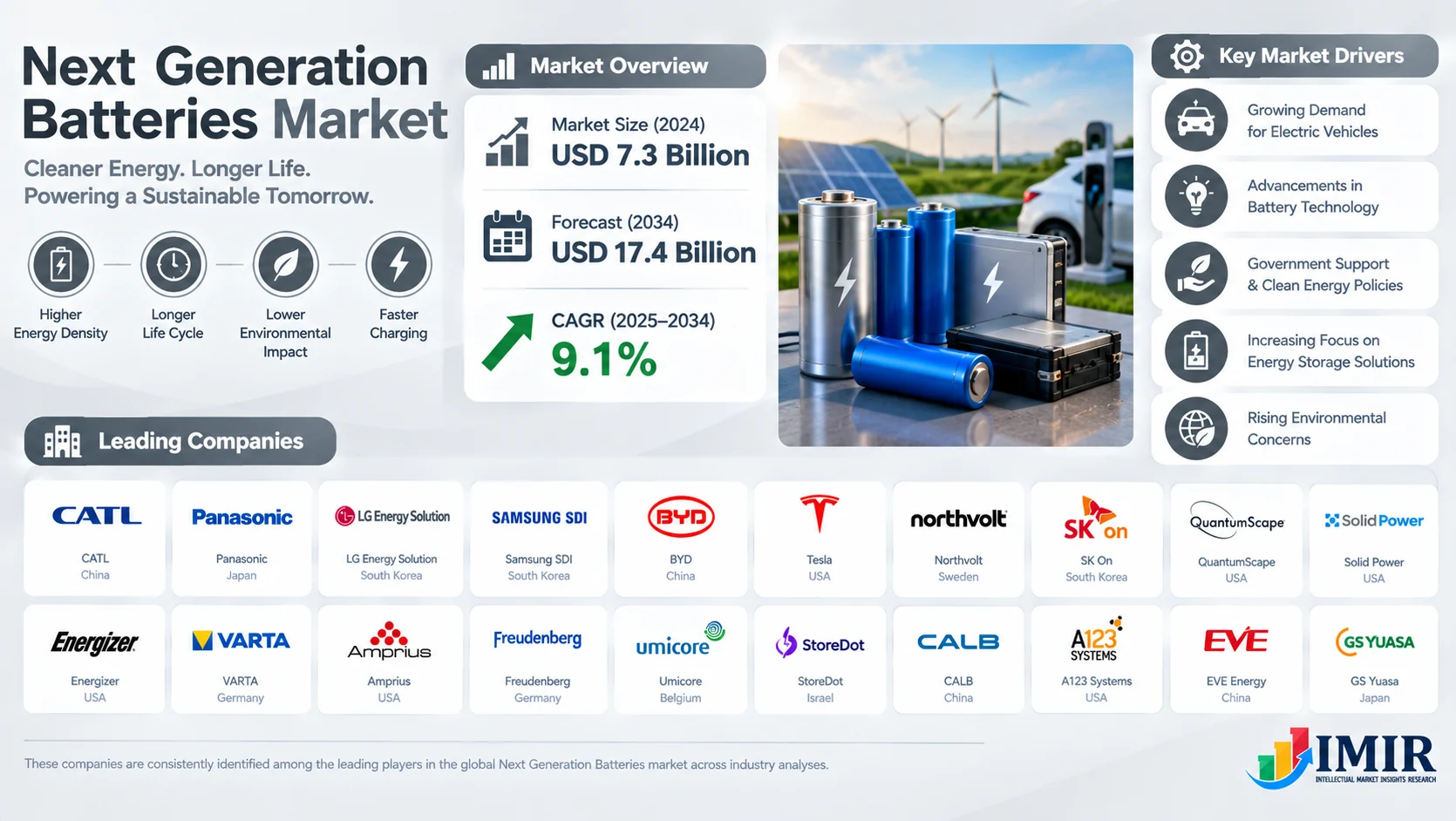
Global Next Generation Batteries Market: Top Companies, Trends, and Future Outlook
Introduction
Next-generation batteries represent the emerging class of energy storage technologies designed to overcome the fundamental limitations of conventional lithium-ion batteries, including energy density ceilings, charging speed, safety risks from flammable liquid electrolytes, and reliance on scarce raw materials. Spanning solid-state batteries, lithium-metal batteries, sodium-ion batteries, lithium-sulfur batteries, and other advanced chemistries, these technologies promise longer range, faster charging, improved safety, and lower long-term costs, positioning them as the likely successors to today's dominant battery technology across electric vehicles, consumer electronics, aerospace, and grid-scale energy storage.
The global next generation batteries market spans advanced lithium-ion, solid-state, sodium-ion, lithium-sulfur, metal-air, and other emerging battery chemistries, deployed across electric vehicles, consumer electronics, aerospace and defense, and industrial and utility energy storage applications. This article provides a research-based analysis of the global next generation batteries market, the companies shaping it, and the technological forces driving its growth toward 2034.
Market Overview
The Next Generation Batteries Market size was valued at around USD 7.3 Billion in 2024 and is expected to reach a value of USD 17.4 Billion by 2034, at a CAGR of 9.1% over the forecast period (2025–2034).
| Parameter | Details |
|---|---|
| Market Size (2024) | USD 7.3 Billion |
| Projected Market Size (2034) | USD 17.4 Billion |
| CAGR (2025–2034) | 9.1% |
| Base Year | 2024 |
| Forecast Period | 2025–2034 |
| Leading Region | Asia-Pacific (largest, led by China); North America (fast-growing, EV and defense demand) |
| Key Segments (by Technology) | Solid-State Batteries, Lithium-Metal Batteries, Sodium-Ion Batteries, Lithium-Sulfur Batteries, Metal-Air Batteries, Flow Batteries |
| Key Segments (by Application) | Electric Vehicles, Consumer Electronics, Aerospace & Defense, Industrial & Utility Energy Storage |
Why the Next Generation Batteries Market Is Growing
1. Rapid Expansion of the Electric Vehicle Sector
The next-generation batteries market is flourishing, particularly due to the rapid expansion of the electric vehicle sector, as automakers race to improve driving range, reduce charging times, and lower battery costs through advanced chemistries that outperform conventional lithium-ion cells.
2. Growing Investments in Renewable Energy Storage Systems
Rising investment in grid-scale renewable energy storage continues to drive demand for next-generation battery chemistries capable of delivering longer duration, higher safety, and lower lifecycle costs than legacy battery technology.
3. Intensifying Automaker Investment in Solid-State and Lithium-Metal Technology
Major automotive companies, including Toyota, Volkswagen, Ford, and BMW, are actively working on developing next-generation batteries, including solid-state and lithium-metal options, to enhance EV performance and secure competitive advantage in the electrification race.
4. Government-Backed Innovation Platforms and Industrial Policy
Government-led initiatives, such as China's All-Solid-State Battery Collaborative Innovation Platform launched in 2024, bring together government, academia, and industry to develop and manufacture solid-state batteries capable of competing globally, accelerating the pace of commercialization.
5. Demand for Higher Energy Density in Aerospace and Defense Applications
Next-generation battery chemistries offering significantly higher energy density than conventional lithium-ion batteries are increasingly sought after for aerospace and defense applications, where weight and performance margins are critical.
6. Diversification Away from Scarce and Geopolitically Sensitive Raw Materials
Growing interest in sodium-ion and other alternative chemistries reflects the industry's broader push to reduce dependence on scarce, geographically concentrated materials such as cobalt and lithium, improving supply chain resilience.
Market Opportunities & Restraints
A key opportunity lies in solid-state battery commercialization for premium EV and aerospace applications: with Toyota targeting commercial-grade solid-state cell production in 2027–2028 in partnership with Idemitsu Kosan, and companies such as QuantumScape and Solid Power advancing automotive qualification programs with partners including Volkswagen's PowerCo, Ford, and BMW, the first wave of commercial solid-state batteries is poised to capture premium pricing in next-generation EVs offering 500+ mile range and 15-minute charging, creating a significant first-mover opportunity for companies that successfully scale production. On the restraint side, manufacturing scalability and commercialization timelines remain the primary headwind, as the ability of companies to scale intricate manufacturing processes for solid-state and other next-generation chemistries directly influences whether projected market values are realized, with several leading developers, including QuantumScape, still largely pre-revenue despite more than a decade of research and hundreds of millions of dollars in R&D investment.
Companies Associated with the Next Generation Batteries Market
| Company | Headquarters | Founded | Employees | Revenue | Technology Focus |
|---|---|---|---|---|---|
| CATL | Ningde, Fujian Province, China | 2011 | Approx. 100,000+ | Approx. USD 61.4 Billion | Dominant Li-ion producer expanding into sodium-ion and condensed-matter next-gen chemistries. |
| Toyota Motor Corporation | Toyota City, Aichi, Japan | 1937 | Approx. 380,000+ | Multi-billion dollar diversified company | World's largest solid-state battery patent holder; targeting commercial production with Idemitsu Kosan in 2027-28. |
| LG Energy Solution | Seoul, South Korea | 2020 | Approx. 20,000–22,000 | Approx. USD 16 Billion | Investing in solid-state and next-gen chemistries alongside core lithium-ion EV/ESS business. |
| Samsung SDI | Yongin, South Korea | 1970 | Approx. 12,000–14,000 | Approx. USD 9.3 Billion | Solid-state battery development alongside core lithium-ion manufacturing. |
| QuantumScape Corporation | San Jose, California, USA | 2010 | Approx. 700–800 | Largely pre-revenue (~$7.6B market cap) | Solid-state lithium-metal pioneer; backed by VW's PowerCo; QSE-5 cells target 500+ mile range. |
| Solid Power, Inc. | Louisville, Colorado, USA | 2011 | Several hundred | Modest, growing | All-solid-state, sulfide-electrolyte batteries; partners with Ford and BMW. |
| GS Yuasa Corporation | Kyoto, Japan | 2004 | Approx. 12,500–15,800 | Approx. USD 3.9 Billion | Industrial/motorcycle Li-ion specialist exploring lithium-sulfur technology. |
| ProLogium Technology | Taoyuan, Taiwan | 2006 | Several hundred–low thousands | Not publicly disclosed | Taiwanese solid-state battery pioneer for EV and consumer electronics. |
| Ilika plc | Romsey, Hampshire, UK | 2004 | Approx. 100+ | Modest (small-cap public) | Solid-state and solid-state sodium-ion batteries for medical devices, wearables, and IoT. |
| Panasonic Holdings Corporation | Kadoma, Osaka, Japan | 1918 | Approx. 230,000+ | Multi-billion dollar diversified company | Long-time Tesla Li-ion supplier; partnered with Toyota on solid-state development. |
Competitive Landscape
The next-generation batteries market is a battleground of innovation, with established giants and nimble startups vying for dominance; currently, the top 5 players are estimated to hold a vital share of around 50% of the market. Established battery giants CATL, LG Energy Solution, Samsung SDI, and Panasonic leverage massive existing lithium-ion manufacturing scale and deep automotive OEM relationships to fund and de-risk their parallel investments in solid-state and other next-generation chemistries. Automaker-led innovation is a defining feature of this market, with Toyota holding the largest solid-state battery patent portfolio globally and targeting 2027–2028 for commercial-grade production, while Volkswagen, Ford, and BMW back pure-play solid-state specialists QuantumScape and Solid Power, respectively, through strategic partnerships and automotive qualification programs. Pure-play solid-state specialists QuantumScape, Solid Power, and ProLogium represent the innovation hubs of the industry, having raised hundreds of millions of dollars in funding while working to solve the manufacturing scalability challenges that stand between laboratory breakthroughs and commercial production. Niche and regional innovators such as Ilika and GS Yuasa round out the competitive field, targeting specialized applications in medical devices, wearables, and industrial equipment rather than competing directly in the large-format EV battery segment.
Regional Analysis
Asia-Pacific
China remains the global leader in the next-generation batteries market, accounting for the largest share of production and consumption, anchored by CATL's dominant position and reinforced by the 2024 launch of the China All-Solid-State Battery Collaborative Innovation Platform; Japan and South Korea also play central roles through Toyota, Panasonic, LG Energy Solution, and Samsung SDI.
North America
North America is a fast-growing next-generation batteries market, led by pure-play innovators QuantumScape and Solid Power, alongside major automakers Tesla, Ford, and General Motors actively developing next-gen batteries including solid-state and lithium-metal options to enhance EV performance; government incentives such as the Inflation Reduction Act continue to encourage domestic battery manufacturing investment.
Europe
Europe represents a significant next-generation batteries market, anchored by Volkswagen's strategic investment in QuantumScape through its PowerCo subsidiary and BMW's partnership with Solid Power, alongside UK-based solid-state innovator Ilika plc.
Latin America & Middle East and Africa
Latin America and the Middle East & Africa represent emerging markets for next-generation batteries, with growth tied to expanding electric vehicle adoption and growing interest in grid-scale energy storage infrastructure investment.
Emerging Trends in the Next Generation Batteries Market
1. Race to Commercialize Solid-State Batteries by the Late 2020s: Toyota's target of 2027–2028 for commercial-grade solid-state cell production, alongside QuantumScape and Solid Power's ongoing automotive qualification programs, signals that the industry's long-promised solid-state transition may finally be approaching commercial reality.
2. Automaker-Backed Strategic Investment in Pure-Play Innovators: Volkswagen's backing of QuantumScape through its PowerCo subsidiary and Ford and BMW's partnerships with Solid Power illustrate how major automakers are hedging their battery technology bets by directly investing in and partnering with specialized next-generation battery developers.
3. Government-Led Innovation Platforms: China's 2024 launch of the All-Solid-State Battery Collaborative Innovation Platform, bringing together government, academia, and industry, reflects a broader global trend of coordinated public-private investment to accelerate next-generation battery commercialization.
4. Diversification into Sodium-Ion and Alternative Chemistries: Companies including CATL and Ilika continue to invest in sodium-ion battery technology as a lower-cost, more supply-chain-resilient alternative to lithium-based chemistries for certain applications.
5. Expansion into Niche, High-Value Applications: Companies such as Ilika are targeting specialized, high-margin applications including medical devices, wearables, and industrial IoT sensors, where solid-state battery safety and miniaturization advantages command premium value outside the large-format EV market.
Future Outlook (2025–2034)
The global next generation batteries market's trajectory toward USD 17.4 billion by 2034 reflects sustained demand growth driven by electric vehicle expansion, renewable energy storage investment, and the approaching commercialization of solid-state battery technology. The 9.1% CAGR forecast through 2034 assumes successful manufacturing scale-up by leading solid-state developers, continued automaker investment and strategic partnerships, and sustained government support for next-generation battery innovation platforms in major markets including China, Japan, the United States, and Europe.
Key investment themes for 2025–2034 include the commercialization trajectory of pure-play solid-state specialists QuantumScape and Solid Power as they advance through automotive qualification with Volkswagen, Ford, and BMW, Toyota's parallel bet on both solid-state and high-performance lithium-ion technology, and continued diversification into sodium-ion and other alternative chemistries by established giants such as CATL. As manufacturing scalability challenges are gradually resolved and the first commercial solid-state batteries reach the market later this decade, the companies that successfully bridge laboratory innovation with mass-production manufacturing will be best positioned to capture growth through 2034.
Frequently Asked Questions (FAQ)
1. What is the current size of the global next generation batteries market?
The Next Generation Batteries Market size was valued at around USD 7.3 billion in 2024 and is expected to reach a value of USD 17.4 billion by 2034, at a CAGR of 9.1% over the forecast period (2025–2034).
2. Who are the top companies in the next generation batteries market?
Leading companies include Contemporary Amperex Technology Co., Limited (CATL), Toyota Motor Corporation, LG Energy Solution, Samsung SDI, QuantumScape Corporation, Solid Power, Inc., GS Yuasa Corporation, ProLogium Technology, Ilika plc, and Panasonic Holdings Corporation.
3. Which region dominates the next generation batteries market?
China remains the global leader in the next-generation batteries market, accounting for the largest share of production and consumption, while North America is a fast-growing market led by pure-play innovators such as QuantumScape and Solid Power.
4. What is the forecast CAGR for the next generation batteries market?
The market is forecast to grow at a CAGR of 9.1% from 2025 to 2034.
5. What are the main growth drivers for this market?
Key drivers include rapid expansion of the electric vehicle sector, growing investments in renewable energy storage systems, intensifying automaker investment in solid-state and lithium-metal technology, government-backed innovation platforms, and demand for higher energy density in aerospace and defense applications.
6. What battery technologies are covered in the next generation batteries market?
The market spans solid-state batteries, lithium-metal batteries, sodium-ion batteries, lithium-sulfur batteries, metal-air batteries, and flow batteries, each offering distinct advantages over conventional lithium-ion technology.
7. When are solid-state batteries expected to reach commercial production?
Toyota has targeted 2027–2028 for commercial-grade solid-state cell production in partnership with Idemitsu Kosan, while pure-play developers QuantumScape and Solid Power continue to advance automotive qualification programs with partners including Volkswagen, Ford, and BMW.
Conclusion
The global next generation batteries market sits at the intersection of accelerating electric vehicle adoption and the long-awaited commercialization of transformative battery chemistries. With a projected size of USD 17.4 billion by 2034 at a 9.1% CAGR, the market offers strong, innovation-driven growth across solid-state, lithium-metal, sodium-ion, and other emerging battery technologies.
CATL, Toyota, LG Energy Solution, Samsung SDI, and Panasonic continue to lead through massive manufacturing scale and deep automotive relationships, while pure-play innovators QuantumScape and Solid Power, backed by Volkswagen, Ford, and BMW respectively, represent the industry's most closely watched bets on solid-state commercialization. As manufacturing scalability challenges are resolved and the first commercial solid-state batteries approach market readiness later this decade, the companies that successfully bridge breakthrough science with mass-production manufacturing will define market leadership through 2034 and beyond.