Leading Companies in the Global Nitrogenous Fertilizer Market: An Industry Analysis
Author:
Intellectual Market Insights Research
Published Date:
27 Sep 2026
Leading Companies in the Global Nitrogenous Fertilizer Market: An Industry Analysis
Introduction
Nitrogenous fertilizers, including urea, ammonium nitrate, and ammonium sulfate, supply the nitrogen that crops need for healthy growth, chlorophyll production, and yield optimization, making them the single most widely used category of chemical fertilizer worldwide. Manufactured primarily from ammonia derived through the energy-intensive Haber-Bosch process, nitrogenous fertilizers underpin global food production at a scale matched by no other agricultural input.
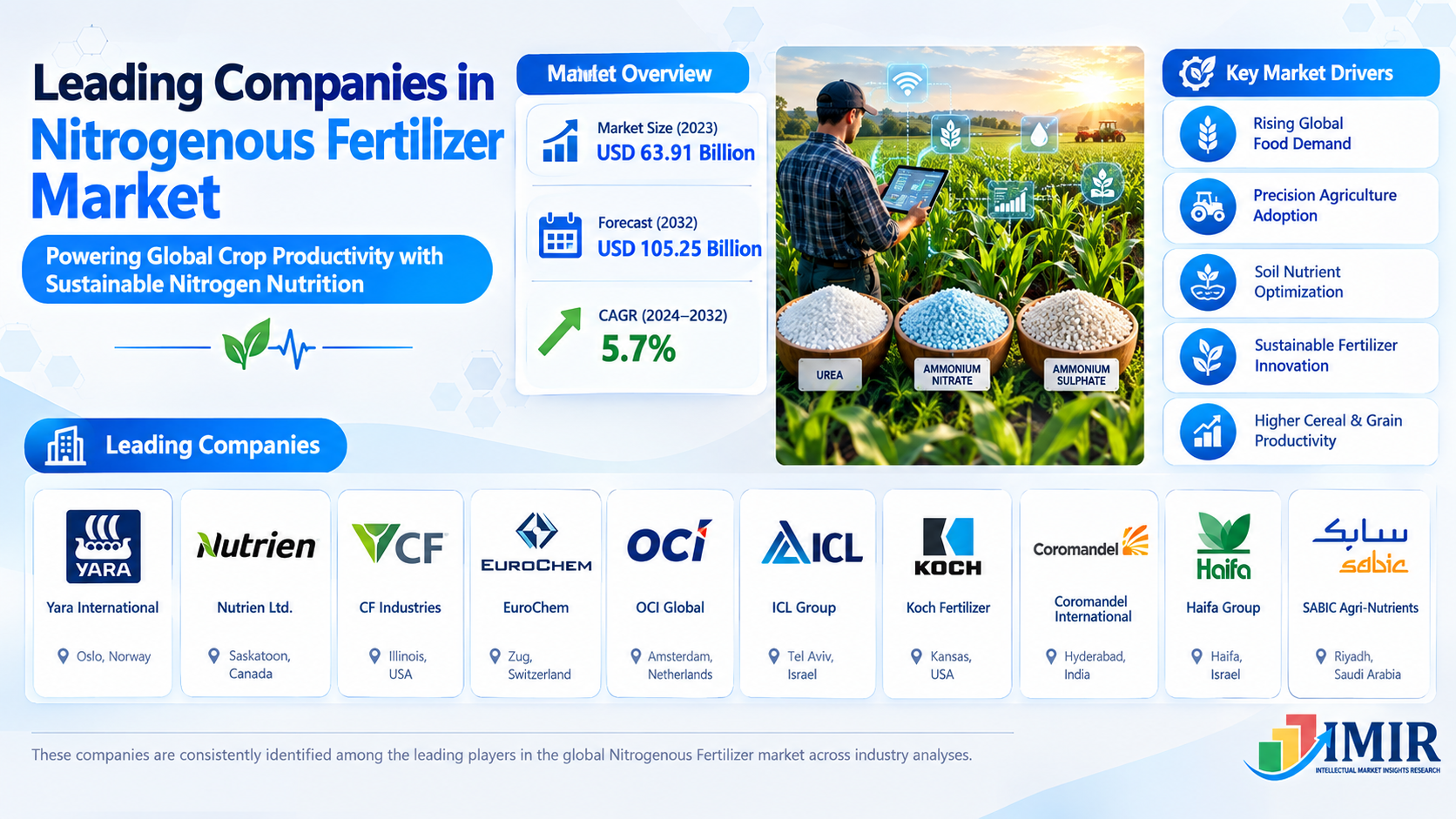
The global nitrogenous fertilizer market was valued at approximately USD 63.91 billion in 2023 and has been projected by various independent research firms to reach USD 105.25 billion by 2032, growing at a CAGR of 5.7% over the forecast period (2024–2032). Growth is being driven by rising global population and food demand, increasing awareness of soil nutrient management among farmers, and continued expansion of agricultural output across major grain- and oilseed-producing economies.
Market Overview
| Parameter | Details |
|---|---|
| Market Size (2023) | USD 63.91 billion |
| Projected Market Size (2032) | USD 105.25 billion |
| CAGR | 5.7% (estimates vary by source and forecast window) |
| Leading Region | Asia-Pacific (largest volume, led by India and China); Latin America (fast growth) |
| Key Segments (by Product) | Urea, Ammonium Nitrate, Ammonium Sulfate, Methylene Urea |
| Key Segments (by Application) | Cereals & Grains, Oil Seeds & Pulses, Fruits & Vegetables, Others |
Urea remains the dominant product segment, contributing roughly 47% of revenue share due to its comparatively affordable cost relative to other nitrogenous fertilizer types, while ammonium sulfate represents the second-largest segment, favored for its high solubility and broad agricultural applicability.
Why the Nitrogenous Fertilizer Market Is Growing
1. Rising Global Population and Food Demand
Continued global population growth is driving higher annual crop yield requirements, directly boosting demand for nitrogenous fertilizers across the agriculture sector worldwide.
2. Growing Awareness of Soil Nutrient Management
Rising awareness among farmers about maintaining proper nutritional balance in soil is encouraging more systematic and consistent nitrogenous fertilizer application to sustain long-term soil productivity.
3. Expansion of Agrarian Economies in Asia-Pacific
The presence of large agrarian economies such as India, China, and Indonesia continues to drive significant regional demand growth, with India and China expected to lead the market over the forecast period.
4. Continued R&D Investment and Product Portfolio Expansion
Key manufacturers are investing heavily in R&D activities to launch new fertilizer products and broaden their portfolios, helping capture a wider range of crop-specific and regional customer needs.
5. Expanding Retail Distribution Networks
Multinational fertilizer companies are expanding their product reach by establishing retail outlets at strategic locations across various countries, improving farmer access to nitrogenous fertilizer products in underserved localities.
6. Growth in Latin American Agricultural Output
Latin America is expected to grow rapidly over the forecast period, driven by expanding commercial farming operations and rising fertilizer adoption across major agricultural economies in the region.
Market Opportunities & Restraints
A key opportunity lies in retail network expansion and product diversification in emerging agrarian economies: as large agrarian economies in Asia-Pacific and Latin America continue to modernize their farming practices, fertilizer producers have significant opportunity to expand distribution networks and introduce new, crop-specific nitrogenous fertilizer formulations tailored to regional soil and crop needs. On the restraint side, feedstock price volatility and geopolitical supply disruption remain a primary headwind, as nitrogenous fertilizer production is heavily dependent on natural gas as an ammonia feedstock, exposing producers to significant cost volatility tied to global energy markets, while geopolitical instability affecting major producing regions such as Russia and Eastern Europe continues to create supply chain uncertainty across the global market.
Leading Companies in the Nitrogenous Fertilizer Market
Below are the top 10 leading nitrogenous fertilizer companies
| Company | Headquarters | Founded | Employees | Revenue | Overview |
|---|---|---|---|---|---|
| Yara International ASA | Oslo, Norway | 1905 | Approx. 15,700 | Approx. USD 14–15 Billion | A global crop nutrition leader and one of the world's largest nitrogen fertilizer producers, selling to roughly 150 countries under brands like YaraMila and YaraLiva. |
| Nutrien Ltd. | Saskatoon, Saskatchewan, Canada | 2018 (merger of PotashCorp and Agrium) | Approx. 23,400–25,100 | Approx. USD 26–29 Billion | The world's largest fertilizer producer by capacity and the third-largest nitrogen fertilizer manufacturer, with the largest agricultural retail network in North America and Australia. |
| CF Industries Holdings, Inc. | Northbrook, Illinois, USA | 1946 | Approx. 3,000+ | Approx. USD 7.08 Billion (2025) | Holds the largest ammonia production capacity in the U.S. and among the largest worldwide, making it a leading dedicated nitrogen fertilizer producer. |
| EuroChem Group AG | Zug, Switzerland | 2001 | Approx. 10,000–27,000 | Approx. USD 6.2–10.2 Billion | A vertically integrated top-5 global producer of nitrogen, phosphate, potash, and NPK fertilizers with production concentrated in Russia. |
| Koch Fertilizer, LLC | Wichita, Kansas, USA | Part of Koch Industries (1940) | Several hundred–low thousands (Koch Fertilizer); ~120,000 (Koch group) | Part of Koch Industries' USD 125 Billion+ group revenue | A global nitrogen fertilizer provider under Koch Ag & Energy Solutions, with expanding UAN production and ENERGY STAR-certified plants. |
| OCI N.V. | Amsterdam, Netherlands | 2010 (OCI Nitrogen) | Approx. 540 (OCI Nitrogen); thousands group-wide | Approx. USD 1.09–4.08 Billion | A top global nitrogen fertilizer producer with ~8.4 million metric tons of capacity across the Netherlands, U.S., Egypt, and Algeria; also the world's largest melamine producer. |
| SABIC (Agri-Nutrients Division) | Riyadh, Saudi Arabia | 1976 (SABIC); 1965 (Agri-Nutrients/SAFCO) | Approx. 32,700+ (group-wide) | Approx. USD 52.9 Billion (group-wide) | A Saudi petrochemical giant whose Agri-Nutrients division produces urea and ammonia with 4.9+ million tons of annual fertilizer capacity. |
| UralChem Group | Moscow, Russia | 2007 | Approx. 5,000–10,000 | Approx. RUB 110.2 Billion | A major Russian producer of nitrogen, phosphate, and ammonium-based fertilizers, a key supplier to Africa and partner on new Indian-financed urea capacity. |
| Sinofert Holdings Limited | Beijing, China | 1994 | Several thousand (Sinochem Group: ~382,894) | Reported under parent Sinochem Group (~USD 143.2 Billion) | China's largest all-rounded fertilizer enterprise, majority-owned by state-owned Sinochem Group, spanning production to retail distribution. |
| IFFCO | New Delhi, India | 1967 | Approx. 1,000–5,000 (direct) | Approx. INR 42,662–45,468 Crore (~USD 4.5 Billion) | India's largest fertilizer cooperative and the world's third-largest, operating five mega plants and expanding into nano fertilizer exports. |
Competitive Landscape
The global nitrogenous fertilizer market brings together a mix of large diversified crop nutrition majors, dedicated nitrogen producers, and vertically integrated industrial conglomerates. Global crop nutrition leaders Yara and Nutrien hold particularly strong positions, built on decades of agronomic expertise, integrated production and distribution networks, and broad fertilizer portfolios spanning nitrogen, phosphate, and potash. Dedicated nitrogen specialists CF Industries and EuroChem compete through concentrated production scale and, in CF Industries' case, the largest ammonia production capacity in North America. Diversified industrial and petrochemical players including Koch Fertilizer, OCI N.V., and SABIC leverage vertically integrated natural gas and petrochemical operations to support cost-competitive nitrogen fertilizer production, while regional players such as UralChem, Sinofert, PhosAgro, and IFFCO maintain strong positions within their respective domestic markets in Russia, China, and India.
Regional Analysis
North America
North America hosts several of the world's largest nitrogen fertilizer producers, including CF Industries and Koch Fertilizer, supported by access to low-cost domestic natural gas feedstock and extensive grain and oilseed farming operations across the United States and Canada.
Europe
Europe represents a significant nitrogenous fertilizer market, anchored by major players such as Yara and EuroChem (headquartered in Switzerland), alongside strong regulatory frameworks governing fertilizer quality and environmental impact.
Asia-Pacific
Asia-Pacific is expected to register significant growth, driven by the presence of large agrarian economies such as India, China, and Indonesia, with India and China expected to lead the market over the forecast period, supported by major domestic players such as IFFCO and Sinofert.
Latin America
Latin America is expected to grow rapidly over the forecast period, driven by expanding commercial farming operations and rising fertilizer adoption across major agricultural economies including Brazil and Argentina.
Middle East & Africa
The Middle East continues to expand its nitrogen fertilizer production capacity, leveraging abundant natural gas resources, with producers such as SABIC playing a significant role in both regional supply and global exports.
Emerging Trends in the Nitrogenous Fertilizer Market
1. Vertical Integration Across the Fertilizer Value Chain: Companies such as EuroChem and Nutrien continue to pursue vertical integration strategies spanning mining, production, and distribution to maintain cost control and supply chain resilience.
2. Expansion of Retail and Direct-to-Farmer Distribution: Nutrien's extensive agricultural retail network across North America and Australia illustrates a broader industry trend of fertilizer producers expanding direct-to-farmer distribution channels alongside traditional wholesale supply.
3. Growing Focus on Energy Efficiency in Ammonia Production: Koch Fertilizer's achievement of ENERGY STAR certification across multiple nitrogen plants reflects growing industry emphasis on improving the energy efficiency of ammonia production, which remains highly energy-intensive.
4. Continued Geopolitical Realignment of Supply Chains: EuroChem's 2015 relocation of its headquarters from Russia to Switzerland illustrates the ongoing geopolitical pressures reshaping global fertilizer supply chains and corporate structures.
5. International Supply Agreements and Trade Partnerships: Agreements such as Koch Fertilizer's urea supply deal with QatarEnergy reflect a growing trend of long-term international supply partnerships helping secure stable feedstock and product flows across borders.
Future Outlook (2025–2034)
Building on the underlying market's historical trajectory (USD 66.1 billion in 2020 growing toward USD 82–89 billion by 2027–2028 at a CAGR of approximately 4.4%–5.3%), the market's steady growth is expected to continue through 2034 as rising global food demand, expanding agrarian economies in Asia-Pacific and Latin America, and continued soil nutrient management awareness remain long-term structural growth drivers. Extending the trend, continued low-to-mid single-digit growth would be supported by sustained population growth, expanding retail distribution networks in emerging markets, and continued R&D investment in more efficient and specialized nitrogenous fertilizer formulations.
Key investment themes for 2025–2034 include continued vertical integration and retail network expansion by global leaders such as Yara and Nutrien, sustained production efficiency investment by dedicated nitrogen specialists such as CF Industries and Koch Fertilizer, and continued geopolitical realignment of supply chains affecting major producers such as EuroChem. As soil nutrient management awareness, retail distribution expansion, and energy efficiency investment continue to shape the industry, the companies that combine production scale with distribution reach and feedstock cost advantages will be best positioned to capture growth through 2034.
Frequently Asked Questions (FAQ)
1. What is the current size of the global nitrogenous fertilizer market?
Independent market research estimates place the global nitrogenous fertilizer market was valued at approximately USD 63.91 billion in 2023 and has been projected by various independent research firms to reach USD 105.25 billion by 2032, growing at a CAGR of 5.7% over the forecast period (2024–2032), though estimates vary by source and forecast window.
2. Who are the top companies in the nitrogenous fertilizer market?
Leading companies include Yara International ASA, Nutrien Ltd., CF Industries Holdings, Inc., EuroChem Group AG, Koch Fertilizer (Koch Ag & Energy Solutions), OCI N.V., SABIC, UralChem Group, Sinofert Holdings Limited, PhosAgro Group, and IFFCO.
3. Which region dominates the nitrogenous fertilizer market?
Asia-Pacific is expected to register significant growth due to the presence of large agrarian economies such as India, China, and Indonesia, with India and China expected to lead the market over the forecast period, while Latin America is expected to grow rapidly as well.
4. What is the forecast CAGR for the nitrogenous fertilizer market?
Independent research estimates range from approximately 5% to 6% CAGR depending on the source and forecast window used.
5. What are the main growth drivers for this market?
Key drivers include rising global population and food demand, growing awareness of soil nutrient management, expansion of agrarian economies in Asia-Pacific, continued R&D investment and product portfolio expansion, and expanding retail distribution networks.
6. What product types make up the nitrogenous fertilizer market?
The market is segmented by product into urea, ammonium nitrate, ammonium sulfate, and methylene urea, with urea holding the largest revenue share at approximately 47% due to its comparatively affordable cost.
7. What crop applications does the nitrogenous fertilizer market serve?
Nitrogenous fertilizers are primarily used across cereals and grains, oil seeds and pulses, fruits and vegetables, and other agricultural applications, with the cereals and grains segment historically dominating market demand.
Conclusion
The global nitrogenous fertilizer market sits at the intersection of rising global food demand and the ongoing modernization of agricultural practices across major and emerging farming economies. With projections pointing toward USD 82–89 billion by 2027–2028 at a CAGR of approximately 4.4%–5.3%, the market offers steady, population-driven growth across urea, ammonium nitrate, and ammonium sulfate product segments.
Yara and Nutrien continue to lead on the strength of integrated crop nutrition portfolios and extensive global distribution networks, while CF Industries and EuroChem compete through concentrated nitrogen production scale, and Koch Fertilizer, OCI N.V., and SABIC leverage vertically integrated natural gas operations to maintain cost-competitive positions. As vertical integration, retail expansion, and energy efficiency investment continue to shape the industry, the companies that combine production scale with distribution reach will define market leadership through 2034 and beyond.